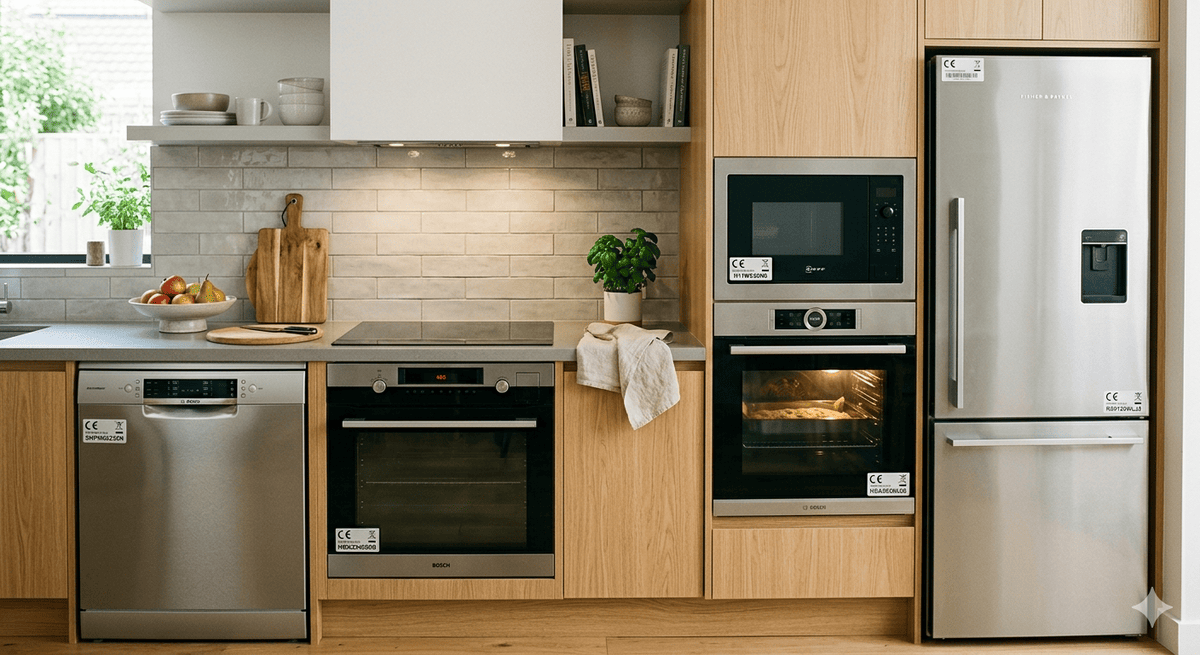
Digital Product Passport for Home Appliances
Key Takeaways
- Home appliances are a priority ESPR category; the European Commission chose them because infrastructure of regulation already exists and appliances represent one of the largest WEEE streams in Europe.
- The average washing machine lasts 10–14 years — the QR code printed on a 2027 unit may still be scanned in 2040, making it a permanent customer touchpoint across the product's entire life.
- The DPP does not replace the EU energy label; it extends it — the energy label remains the physical marking, while the DPP is the full data record accessible via QR.
- One serialised QR code serves compliance (regulatory audit), commerce (warranty registration, spare parts), and support (AI troubleshooting) — no separate infrastructure required.
Your products already carry energy labels, CE markings, and WEEE symbols. You already comply with the Ecodesign Directive, report to energy databases, and — for certain categories — publish repairability scores and commit to spare parts availability under the Right to Repair regulations. You are, by any measure, the most regulated sector of consumer goods manufacturing.
And yet the EU's Digital Product Passport (DPP) is coming for appliances first.
That is not a coincidence. The European Commission chose home appliances as a priority category under the Ecodesign for Sustainable Products Regulation (ESPR) precisely because the infrastructure of regulation already exists — and because appliances represent one of the largest streams of waste, energy consumption, and untapped repairability in the European economy. The DPP does not start from scratch. It extends, connects, and makes machine-readable everything you are already required to know about your products.
For product managers and compliance leads at appliance brands — whether you sit inside a global group like BSH or Electrolux, or lead compliance at a mid-market manufacturer — this is your practical guide to what the DPP means, what it requires, and how to turn a regulatory deadline into a genuine competitive advantage.
Why Appliances Are a Priority Category
Home appliances were chosen as a priority ESPR category because the regulatory groundwork already exists. Appliances are subject to the Energy Labelling Regulation, the Ecodesign Directive, WEEE, RoHS, and — for washing machines, dishwashers, and refrigerators — the Right to Repair package. The DPP does not demand entirely new data collection; it requires existing data to be structured, digitised, and made accessible via a standardised digital link. The scale of impact reinforces the choice: European households operate roughly 1.5 billion major appliances, and the European Commission's ESPR impact assessment estimates that extending appliance lifetimes by just two years could cut associated carbon emissions by up to 30 million tonnes annually. Product longevity is central to the logic — the average washing machine lasts 10 to 14 years, making repair economically compelling over replacement. The DPP is designed to keep technical documentation, spare parts identifiers, and disassembly instructions accessible across that entire lifespan.
What Data the DPP Requires for Appliances
The appliance DPP consolidates data that currently sits across separate regulatory silos. Understanding what each category requires — and where your gaps are — is the first step toward a practical compliance plan.
Product Identity and Technical Specifications
Every appliance DPP requires a unique product identifier — at minimum at model level, potentially at serial level for certain categories — together with basic technical specifications and manufacturing information including country of origin and production date. This data already exists in most ERP and PLM systems. The challenge is not availability but structure: it is rarely formatted in a way that supports automated DPP generation without integration work.
Energy Performance Data
For regulated categories — washing machines, dishwashers, refrigerators, air conditioners, and televisions — energy class data and underlying performance metrics such as rated capacity, annual energy consumption, noise levels, and programme durations are already published to the EU Product Database for Energy Labelling (EPREL). The DPP extends this, it does not replace it. Expect the DPP to reference EPREL data while adding dynamic elements — actual performance data from connected products, for instance — that the static energy label cannot accommodate.
Materials Composition and Substances of Concern
The DPP requires disclosure of materials composition, including the presence of any Substances of Very High Concern (SVHCs) listed under REACH. For most appliance manufacturers this data exists within supply chain compliance systems and product safety files, but it is rarely consolidated at product level in a format suitable for digital disclosure. This is one of the more operationally demanding requirements, particularly for manufacturers with large and geographically distributed supply chains.
Repairability Score and Spare Parts Availability
Several appliance categories — washing machines, washer-dryers, dishwashers, and refrigerating appliances — already carry mandatory repairability commitments under the 2021 Right to Repair regulations, including minimum spare parts availability periods of typically seven to ten years from market withdrawal and restrictions on fasteners that impede repair. The DPP embeds this information — repairability scores, spare parts identifiers, availability status, and sourcing details — in a machine-readable format that consumers, independent repairers, and regulators can all access via a single scan.
Environmental Impact and End-of-Life Information
The DPP includes lifecycle environmental impact data — carbon footprint, resource use, recyclability — alongside end-of-life handling instructions aligned with WEEE obligations. Disassembly information for professional recyclers is required, along with materials details for key components that affect recyclability. For manufacturers already publishing Environmental Product Declarations (EPDs), much of this data exists in structured form. For those who have not yet conducted lifecycle assessments, building this capability will require investment in data collection before the relevant delegated act comes into force.
The Overlap with Energy Labelling
The DPP does not replace the EU energy label. The rescaled A-G energy label remains a mandatory physical marking on the product and its packaging. The DPP extends the information accessible via a digital link printed alongside — or incorporated into — the energy label. Think of the energy label as the headline and the DPP as the full article: everything in the headline is also in the article, but the article contains considerably more detail on materials, repairability, and end-of-life.
The Appliance-Specific Opportunity
Unlike consumer electronics replaced every two to three years, home appliances stay in the home for a decade or more. The QR code printed on a washing machine in 2027 may still be scanned in 2040 — thirteen years of interaction with a customer who, without it, is lost to you after the point of sale. The DPP creates a permanent, product-attached digital touchpoint at every stage of the product's life. At installation the fitter accesses commissioning data; at first use the homeowner registers warranty in three taps, where the ikea effect drives lasting brand loyalty through active setup engagement. When a fault appears, the model-specific troubleshooting guide resolves it without a service call. When maintenance is due, the correct spare part is ordered directly from you. When the house is sold, the new owner completes ownership transfer in seconds. None of this requires an app or a connected product — only a serialised QR code already on your rating label.
Current Challenges for Appliance Manufacturers
Building an appliance DPP means confronting how product data is currently managed. Specifications live in PLM, energy data in EPREL, materials data in supply chain compliance tools, and service documentation in separate technical repositories. No single system holds a complete picture, so consolidation is the core integration challenge. Existing energy labels compound the problem: printed at manufacture, they cannot be updated to reflect software improvements or changed material classifications, whereas the DPP is a living record — part of the broader shift from paper manuals to digital instructions. The installer channel adds complexity: trade professionals commissioning built-in ovens or heat pumps need technical specifications from the same QR code a homeowner uses for warranty registration. And because authorised service networks are typically third-party operators, spare parts transactions and repair records must flow back into the DPP through external integrations to keep availability data accurate and avoid regulatory exposure.
How BrandedMark Solves This
BrandedMark addresses the data and workflow challenges appliance manufacturers face. The platform generates a unique, serialised QR code per unit — not per model — following the GS1 Digital Link standard for full EU DPP carrier compliance. From your product data it auto-generates the five core DPP pages: product identity, energy and performance, materials and substances, repairability and spare parts, and end-of-life guidance. At commissioning, a trade professional scanning the code sees an installer view with technical specifications, commissioning checklist, and installation logging against the unit's serial record. The homeowner scanning the same code sees warranty registration, setup guide, and support resources. Spare parts pages link to live stock so homeowners can identify the correct part and order directly, recapturing revenue from third-party distributors. When a fault develops, the AI assistant draws on model-specific documentation to resolve it without a service call. Compliance data is structured at entry, not assembled retroactively.
A Practical Example: One Oven, Thirteen Years of Value
A built-in oven manufactured in 2027 shows what a single serialised QR code delivers over a product lifetime. At installation the fitter accesses electrical specifications and logs the commissioning event against the unit's serial record. That evening the homeowner registers warranty in under a minute — no separate website, no card to post. Fourteen months later an error code appears; the AI assistant identifies a door seal fault, links to the correct spare part, and resolves the issue without a service call. Five years in, the house is sold; the new owners review the service history and complete ownership transfer in seconds. Eight years in, a fan motor fails; the spare parts commitment in the DPP ensures the part is available for an independent repairer. At twelve years, the owner scans for WEEE take-back options and the oven is correctly recycled. One QR code. Twelve years of compliance, spare parts revenue, and customer relationships — from the label already on the product.
Getting Started: Four Steps
Step 1: Audit Your Product Data Landscape
Map every system that holds product data: PLM, ERP, EPREL, supply chain compliance tools, and service documentation repositories. For each DPP data element, identify whether it exists, whether it is structured for digital output, and where the gaps are. This audit surfaces the organisational and technical dependencies that will determine your realistic implementation timeline and prevents surprises when integration work begins.
Step 2: Define Your Category Scope and Timeline
The DPP mandate rolls out category by category under ESPR delegated acts. Washing machines, dishwashers, refrigerating appliances, ovens, and heat pumps are all expected in early waves. Check the current regulatory calendar for your specific categories, then sequence your implementation by proximity to deadline and production volume. Categories with both near deadlines and high volumes should be resourced first.
Step 3: Integrate Your Rating Label Print Process
The rating label already applied to every unit at manufacture is the most practical entry point for DPP deployment. Adding a serialised, DPP-linked QR code to the existing label print process is operationally simpler than introducing a separate label or carrier. Work with your label printing supplier and DPP platform provider to ensure unique codes are generated per unit, linked to the correct product data record, and verified before application at the line.
Step 4: Build the Post-Purchase Experience in Parallel
Compliance data — materials, energy class, repairability score — is the minimum the regulation requires. The commercial opportunity lies in building the installer workflow, warranty registration flow, troubleshooting content, and spare parts catalogue at the same time, so the DPP launches as a customer relationship platform rather than a regulatory data store. The incremental cost of building both in parallel is far lower than retrofitting commercial features after the compliance deadline has passed.
Start Building Your Appliance DPP
Appliance manufacturers are better positioned for DPP compliance than most sectors — the regulatory data already exists, the timelines are known, and the long product lifetimes create commercial potential that no other category can match. The decision is not whether to build a DPP but whether to build one that satisfies regulators or one that transforms your relationship with every customer whose appliance carries your QR code. BrandedMark gives appliance manufacturers a single platform for serial-tracked DPP generation, installer workflow management, warranty registration, AI-powered troubleshooting, and spare parts commerce — all from the QR code already on your rating label. Learn more about what a Digital Product Passport is and how the DPP applies to consumer electronics — a category with instructive parallels. For broader context on data management and DPP readiness, see our guide to product lifecycle management, and for the commercial case, read about the trillion-dollar post-purchase problem.
Frequently Asked Questions
Do appliances already need a Digital Product Passport?
Not yet — but they will. The European Commission is expected to publish delegated acts under ESPR specifying DPP requirements for priority appliance categories including washing machines, dishwashers, refrigerating appliances, and heating and cooling equipment. The exact mandatory dates will be set in those delegated acts, but manufacturers in these categories should plan for compliance within the next two to four years. Starting now — particularly on the data infrastructure and label integration — is significantly less disruptive than a last-minute sprint.
How does the DPP relate to the EU energy label?
They are complementary, not competing, requirements. The EU energy label — the A-G rated sticker on the front of the product — remains mandatory. It is a physical marking that provides a quick, comparable energy performance indicator at the point of sale. The DPP is a digital record, accessible via a QR code, that contains a much richer data set: materials composition, repairability information, spare parts details, environmental impact, and end-of-life guidance. Manufacturers will need to maintain both. In practice, the DPP is best thought of as the digital extension of the energy label — accessible via a QR code that can sit on or adjacent to the rating label already applied to every unit.
Where should I put the QR code on an appliance?
The EU's DPP implementing regulations will specify carrier requirements, but current guidance indicates that the QR code should be physically attached to the product and must remain legible throughout the product's useful life. For white goods, the most practical location is the rating label — already applied to the inside of the door, the rear panel, or a visible interior surface. For built-in appliances, the inside of the door frame or the door edge is common. For HVAC and heating equipment, the rating label position is typically specified by the category regulation. The key requirement is durability: the code must be scannable after years of use, cleaning, and handling.
Do I need a separate DPP system from my energy label database?
Not necessarily, but EPREL alone is not sufficient for DPP compliance. EPREL holds energy performance data for the purpose of the energy labelling regulation — it was not designed to hold materials data, repairability scores, service history, or end-of-life instructions. A DPP platform needs to either integrate with EPREL to pull energy data or allow that data to be entered directly, whilst also handling the broader DPP data set. Manufacturers with mature PLM and supply chain compliance systems will benefit from a DPP platform that can integrate with those systems via API, rather than requiring data to be re-entered manually.
What about appliances already installed in customers' homes?
The DPP obligation applies to products placed on the EU market after the mandatory date for each category — it is not retrospective. Products installed before the relevant mandatory date do not need a DPP under ESPR. However, manufacturers who are building DPP infrastructure for new production should consider whether the same platform can serve legacy products as well. Many of the commercial benefits — warranty registration, spare parts ordering, troubleshooting — apply equally to products already in the field. Issuing voluntary DPP-style product pages for existing model lines, accessible via a QR code, is an option some manufacturers are exploring as a way to get ahead of the compliance curve whilst also activating the post-purchase opportunity across their installed base.