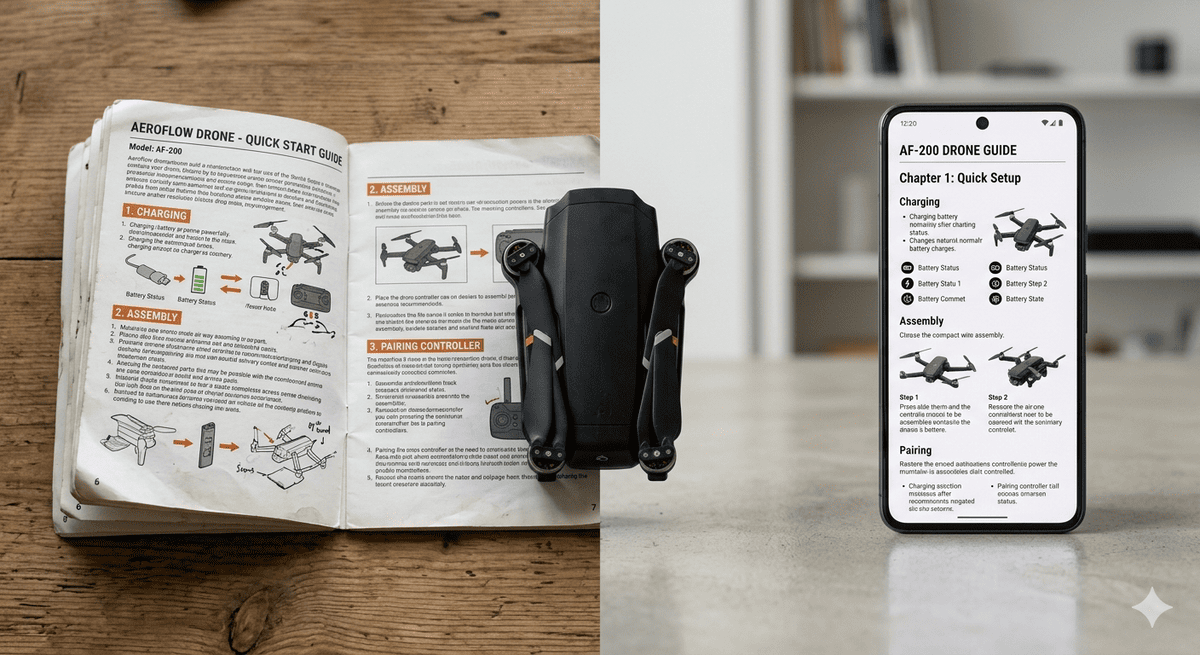
Why Digital Manuals Beat Paper: The Complete Guide
Key Takeaways
- Most paper manuals are never read beyond the first few pages — customers search online instead, often encountering incorrect third-party advice that damages brand perception.
- Digital manuals with search, video, AR, and AI assistance reduce support contact rates, accelerate feature discovery, and increase overall customer satisfaction scores.
- Leading brands (Apple, Dyson, IKEA) treat documentation as a living product updated continuously from usage data — not a static artefact frozen at the moment of printing.
- Connected packaging bridges the physical-to-digital gap: a QR code scan opens model-specific, language-matched documentation without any app download or URL memorisation.
Your customer opens the box, finds a thick manual in a dozen languages, and immediately closes it. The economics alone make this unsustainable — as we explore in detail in why printing multilingual paper manuals is a waste of everyone's time. Instead, they Google "[your product] how to" and end up watching a random YouTube video from someone who may or may not know what they're talking about.
Sound familiar?
Meanwhile, the manual you spent thousands to write, translate, and print sits in a drawer, never to be opened again. This is not a niche problem — industry research suggests the vast majority of paper manuals are never read beyond the first few pages.
There's a better way. Forward-thinking brands are replacing static paper booklets with digital manuals that guide, teach, and delight customers through every interaction with their product. The question is not whether to go digital — it is how quickly you can make the transition.
Why Paper Manuals Fail in 2025
Customer Behaviour Has Fundamentally Shifted
Modern consumers expect immediate, visual, interactive guidance. Trained by Netflix, TikTok, and YouTube, they find a 48-page booklet of diagrams and fine print as outdated as a fax machine. Studies consistently show that most customers search online before consulting a printed manual, and the majority abandon paper instructions after encountering a single confusing diagram. That behaviour gap is costly: a significant share of inbound support calls trace directly back to unclear printed instructions. The problem is not that customers lack patience — it is that paper cannot adapt to how people actually learn in 2025. Attention spans have not shortened; expectations have risen. Customers expect the product experience to guide them, not hand them a document and step back. Digital manuals meet customers where they already are: on their phones, expecting instant answers and frictionless guidance at every step.
The Hidden Costs of Paper Documentation
Printing manuals is not just expensive — it is actively counterproductive:
- Per-unit printing costs for complex, full-colour, multi-language manuals can run anywhere from several dollars to tens of dollars each
- Translation costs become obsolete every time the product is updated
- Errors cannot be corrected until the next print run ships
- Storage, shipping weight, and disposal add ongoing operational burden
- Environmental impact from billions of manuals printed annually, most of which go unread
Beyond the direct costs, every customer who abandons your paper manual and turns to a third-party YouTube video is a missed brand-building opportunity. Worse, incorrect third-party advice can cause product damage, safety incidents, or negative reviews — all outcomes that trace directly back to documentation that failed at the moment it mattered most. The financial and reputational costs of a paper-first documentation strategy are compounding, not static.
The Digital Advantage: Beyond Just "Better"
Instant Search and Discovery
Search is the single most important feature a digital manual can offer. Instead of flipping through a table of contents, customers type a natural language question and land directly on the answer in seconds. Cross-referenced results surface every relevant mention of a component across setup, maintenance, and troubleshooting sections simultaneously — something no paper index can replicate at scale. Voice search lets customers keep their hands on the product while they ask for help, removing friction at critical assembly moments. Contextual suggestions surface related content that users would not have thought to look for, reducing follow-up contacts over time. This shift from passive browsing to active retrieval closes the critical gap between what customers need to know and what they actually find, which is precisely where most paper-manual failures occur and where avoidable support costs accumulate fastest.
Multimedia That Actually Helps
Different people learn differently, and well-designed digital manuals accommodate every learning style without compromise or added complexity. Visual learners navigate high-resolution photos, 3D animations, and step-by-step video walkthroughs. Auditory learners follow voice narration with speed control and language selection. Kinesthetic learners track progress through interactive checklists and confirmation steps. Text-oriented learners can expand detailed descriptions on demand without cluttering the default view. Research into cognitive load shows that visual processing is dramatically faster than text comprehension, and video-based instructions significantly reduce learning time versus text-only guides. A study in Computers in Human Behavior found multimedia learners completed tasks 25–40% faster with fewer errors — with the largest gains on procedural, step-by-step tasks. Interactive elements further boost task completion rates by keeping users actively engaged throughout the process rather than skimming ahead and missing critical steps.
Always-Current Information
A digital manual is never out of date. Real-time updates push corrections and improvements to every customer the moment they are published — no waiting for the next print run to correct an error that may have shipped with millions of units already. Product recalls and safety notices reach customers immediately, without requiring a separate communication campaign or hoping customers check the right channel. Firmware updates get documented and surfaced automatically for affected users. Seasonal content, such as winterisation guides or holiday setup tips, appears when it is contextually relevant and disappears when it is not. This is a structural advantage paper can never replicate: the manual a customer reads today accurately reflects everything the brand knows right now, not what was accurate at the moment a print file was submitted many months ago before launch.
How Leading Brands Do It
Apple: Digital-First Documentation Pioneer
Apple eliminated printed manuals in 2010, replacing them with a layered digital approach built around the moments customers actually need help — not the moments the product team assumed they would. Quick Start Guides cover essential setup in a visual, minimal-text format included in the box. Built-in Help delivers contextual assistance from directly within device settings and apps — no browser required. A comprehensive, searchable online support database integrates video walkthroughs alongside step-by-step text. Community forums provide user-generated answers with expert moderation to ensure accuracy. The defining principle is integration: Apple's documentation feels like a natural extension of the product, not a separate resource bolted on afterwards. Help appears at the precise moment it is needed, in the context where the customer is already working. That seamlessness is what separates best-in-class digital documentation from a PDF simply uploaded to a website.
Dyson: Problem-First Troubleshooting
Dyson organises its digital documentation entirely around the moments customers actually need help, not around product feature lists or engineering categories that mean nothing to someone with a broken vacuum. A customer searching "my vacuum won't start" lands directly on targeted troubleshooting steps rather than a generic homepage. "Suction is weak" opens video demonstrations of the relevant maintenance procedure. "Strange noise" surfaces audio examples alongside corresponding solutions. Dyson has extended this further with sound recognition — customers upload audio of unusual noises for automatic diagnosis — and photo-based visual troubleshooting that identifies problems from submitted images. Direct parts ordering from within the troubleshooting flow eliminates the friction of a separate purchase journey entirely. The combined result is a support experience that resolves issues significantly faster and has measurably reduced inbound support contact volume over time.
IKEA: Assembly Instructions Reimagined
IKEA built its manual philosophy on a single insight: visual communication transcends language. Their instruction sheets use no text at all — a universal visual language that works across every market without translation costs or localisation delays. Progressive complexity orders steps so that simple connections come first and complex joints last, reducing early-stage errors that cause downstream frustration. Visual warnings appear before common mistakes rather than after them. 3D animation shows exactly how pieces fit together with motion context that static diagrams cannot convey. Digital enhancements — AR room placement, time-lapse assembly videos, and community photo sharing — have driven measurably higher assembly success rates and faster completion times. The lesson for any brand: remove language as a barrier, sequence steps around how humans actually learn, and digital tools amplify that advantage at scale.
What These Brands Have in Common
Apple, Dyson, and IKEA share three structural principles worth studying closely before building your own digital documentation strategy. They organise documentation around customer tasks and real problems, not around product feature hierarchies designed for engineers. They treat their manuals as living products that improve continuously from usage data rather than static artefacts finalised at launch and never revisited. And they embed help into the natural flow of product use, so customers encounter guidance exactly when they need it rather than having to seek it out separately from a different system. None of these principles require an enterprise budget or a dedicated documentation team to implement. They require a deliberate decision to treat post-purchase experience as a core product discipline — one that compounds in value every time a customer finds an answer without needing to call support.
Augmented Reality: The Next Frontier
AR transforms assembly and maintenance from following instructions to a guided, spatial experience. Component overlay highlights exactly where each part goes in real physical space, eliminating the mental translation from diagram to object. Assembly animation shows the motion paths required for correct part installation — information a static image cannot convey. Size verification confirms the correct part is selected before assembly begins. Quality checking visually confirms proper connections and alignments at each step. According to PTC's 2023 Augmented Reality State of the Market report, manufacturers deploying AR-assisted instructions observed a 32% reduction in assembly errors and a 45% reduction in time-to-first-successful-use versus paper equivalents. AR is most effective for complex assemblies where spatial understanding is the primary challenge. Modern smartphones already have the required hardware, and platforms like ARKit and ARCore provide the development foundation — making AR increasingly accessible beyond enterprise budgets.
AI-Powered Assistance
Intelligent guidance that adapts to each individual customer represents the next evolution of digital manuals. The best implementations go beyond static text to become conversational — much like the AI-powered customer support agents that leading brands are now deploying to handle product questions at scale. Natural language processing enables customers to describe problems in plain speech: "My dishwasher is making a grinding sound" returns a contextual, intelligent response. Intent recognition understands what customers want to accomplish, not just the literal words they use. Machine learning analyses usage patterns to identify which content resolves issues fastest and surfaces predictive content before customers search for it. Computer vision allows part identification from customer-submitted photos, progress verification at each assembly step, and error detection before damage occurs. Together, these capabilities shift documentation from a static reference to an adaptive system that gets more useful with every interaction.
Community Integration
The best digital manuals treat customer knowledge as a first-class content source, not an afterthought. Experienced users contribute tips and tricks that surface context a professional writer would never think to include. Photo sharing provides real-world examples of setups, installations, and creative solutions that resonate more authentically with new owners than polished studio shots ever could. Q&A forums enable peer support with manufacturer expert oversight to ensure accuracy and safety. Customer-created video tutorials — reviewed and curated by the brand — extend the library of practical guidance at near-zero marginal cost. This community layer, when paired with professional content verification, creates a self-improving knowledge base that grows more valuable with every new product owner added to the ecosystem. It also builds genuine belonging: isolated product owners become part of an engaged community, strengthening brand loyalty in ways no official document can replicate alone.
From Frustration to Empowerment: The Customer Journey
The contrast between paper and digital documentation is not incremental — it is a complete experience reversal. With a paper manual, the customer opens the box, finds a dense booklet, struggles with unclear diagrams and tiny text, makes an error, gets frustrated, and eventually calls support or searches online for third-party help. With a digital manual, they scan a QR code, see a welcome video tailored to their exact product variant, follow step-by-step visual guidance at their own pace, and receive confirmation at each completed step. They finish feeling confident and genuinely knowledgeable. Digital instructions do not just guide assembly or troubleshooting — they build lasting product expertise. Customers who understand what each component does and how to maintain their product generate fewer future support contacts, leave better reviews, and are significantly more likely to buy again.
The Economics of Going Digital
Cost Savings
The financial case for digital manuals is direct and measurable from the first quarter of deployment. Eliminating per-unit print costs generates immediate savings that compound at scale — complex multi-language manuals can cost several dollars to tens of dollars each to produce, and that cost recurs with every unit shipped. Automated and streamlined localisation dramatically reduces translation spend, especially for products that update frequently. Distribution of corrections and improvements carries zero marginal cost: update once, reach every customer instantly with no reprinting cycle required. Support deflection compounds these savings further — fewer inbound contacts for issues that better documentation resolves before customers reach for the phone. Brands that have made the switch consistently report that first-year savings on print, translation, and support offset the initial digital investment, with ongoing costs a fraction of recurring print expenditure.
Revenue Upside
The economic case extends well beyond cost reduction — digital documentation actively drives revenue growth across the entire customer lifecycle when approached strategically. Better documentation drives higher utilisation of product capabilities, which directly increases satisfaction scores and reduces return rates — one of the highest-cost outcomes a product company can face. An exceptional post-purchase support experience strengthens premium positioning and helps justify pricing in competitive categories where alternatives are close in specification. Customers who deeply understand their product are measurably more likely to purchase compatible accessories and add-ons. The positive post-purchase experience that excellent digital documentation creates also drives referral behaviour: satisfied customers recommend products to peers, generating acquisition at zero incremental marketing spend. Documentation quality, when treated as a revenue driver rather than a cost centre, compounds in value across every unit sold and every customer retained.
Measuring Success
Track these metrics to quantify your digital manual ROI and identify where to focus improvement efforts:
- Search query patterns: What customers look for most frequently
- Content completion rates: Which sections are read thoroughly vs. skimmed
- Video engagement: Watch time and replay rates
- Problem resolution success: Percentage of issues resolved without escalation to support
- Support deflection rates: Reduction in calls and emails for manual-covered topics
- Customer satisfaction correlation: Impact of manual quality on overall product ratings and reviews
Monitoring these indicators together reveals a compound picture: which content is working, which gaps are generating support costs, and where to allocate documentation effort next. Brands that treat these metrics with the same rigour as product telemetry tend to iterate on documentation quarterly, closing gaps before they accumulate into significant support costs or negative reviews. The data also builds the internal business case for continued investment in documentation quality.
Connected Packaging: The Bridge to Digital
The most common barrier to digital manuals is not technology — it is the physical-to-digital handoff. QR codes on connected packaging solve this elegantly, without requiring customers to remember a URL or download an app. A single scan opens documentation specific to the exact product variant purchased, served in the customer's preferred language, with no additional steps. Different QR codes can link to distinct sections — setup, maintenance, troubleshooting — placing the right content in front of customers at the right moment. Progress synchronisation lets customers continue a setup session across multiple devices without losing their place. Unlike printed instructions frozen at the moment of manufacture, connected packaging links to living documentation that improves continuously. This approach also pairs naturally with better error code troubleshooting resources — when a customer encounters a problem, the same QR code that delivered setup instructions can surface the exact fix they need.
Make the Switch with BrandedMark
Your manual is often the first detailed interaction customers have with your brand after purchase. Make it excellent, and they will trust you with their most complex questions — and their future purchase decisions. Make it poor, and that impression is difficult to reverse regardless of product quality.
BrandedMark's experience designer makes the transition from paper to digital seamless, letting teams build no-code interactive product experiences without requiring engineering resources or long implementation cycles. With a single QR code scan, your customers get instant access to searchable, multimedia documentation tailored to their exact product variant — no app downloads, no friction, no URL to remember. Every scan becomes an opportunity to educate, support, and build a lasting relationship that extends well beyond the initial purchase.
Get started with BrandedMark and see how connected packaging turns static manuals into dynamic, always-improving customer experiences.
Frequently Asked Questions
Do digital manuals work for customers who are not tech-savvy?
Yes. The beauty of QR-code-based digital manuals is that they require no app installation or technical knowledge — customers simply point their phone camera at the code and the content loads in their browser. The best implementations also offer adjustable text sizes, voice narration, and simple navigation designed for all comfort levels with technology.
What about customers who do not have internet access during setup?
Modern digital manual platforms support offline functionality. After the initial load, content can be cached on the device for use without connectivity. For products commonly assembled in areas with poor signal (like garden furniture or garage equipment), this offline-first approach is essential.
How much does it cost to switch from paper to digital manuals?
Costs vary depending on complexity, but most brands find that the savings on printing, translation, and distribution cover the initial investment within the first year. The ongoing costs of hosting and updating digital content are a fraction of recurring print costs, and the support deflection savings alone often justify the switch.
Can digital manuals fully replace paper, or should we offer both?
For most consumer products, a minimal printed quick-start card paired with comprehensive digital documentation is the ideal approach. The quick-start card provides the QR code entry point and covers absolute basics (safety warnings, power on), while the digital manual handles everything else. This approach satisfies regulatory requirements while delivering a superior customer experience.
How do digital manuals handle regulatory and compliance requirements?
Many industries require certain safety information and warnings to be included with the product. Digital manuals can meet these requirements while improving upon them — safety warnings can include video demonstrations, interactive checklists, and acknowledgement steps that verify the customer has reviewed critical information. For jurisdictions that still require printed safety documentation, a slim printed safety card combined with comprehensive digital content is the standard approach. Always consult your regulatory requirements, but most frameworks are adapting to accept digital delivery.