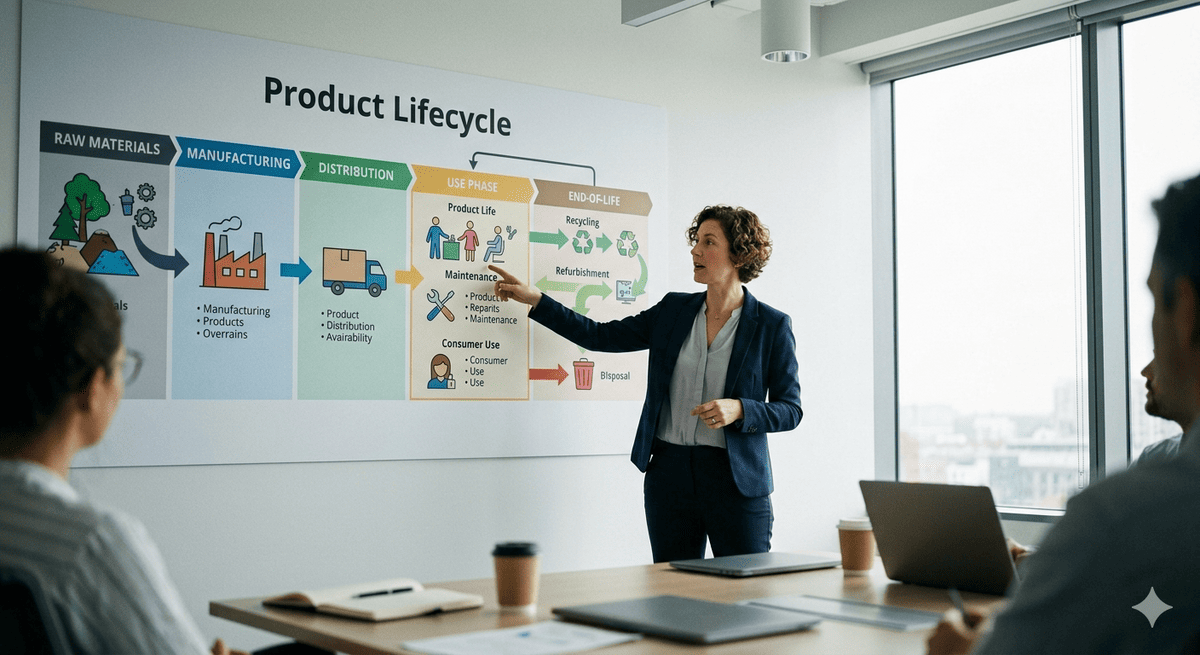
What Is Product Lifecycle Management? The Modern Definition
Key Takeaways
- Traditional PLM software (Siemens Teamcenter, PTC Windchill, Arena) covers design through manufacture but goes dark at shipment — leaving 90% of a product's actual life untracked
- ERP, CRM, and field service systems fill parts of the post-sale gap but none connects a specific physical product to its current owner, state, and full service history
- A Product Operating System extends PLM with persistent digital identity per unit, enabling ownership registration, warranty tracking, aftermarket commerce, and EU DPP compliance across the full lifecycle
- The EU Digital Product Passport mandate (ESPR, from 2027) requires lifecycle data — ownership, service events, disposal — that traditional PLM systems do not capture
92% of manufacturers don't know who owns their products.
A company can spend three years and £40 million bringing a new appliance to market — precision-engineered, rigorously tested, beautifully packaged — and the moment it ships to a distributor, that company loses track of it entirely. No owner. No location. No service history. No idea whether it's still working, sitting in a warehouse, or being used in a country they never intended to sell into.
That number — 92% — comes from industry research on durable goods manufacturers published by the Manufacturing Leadership Council. It's not a niche problem. It's the default state of manufacturing.
Product Lifecycle Management software was supposed to solve this. It hasn't. And understanding why requires taking a hard look at what PLM actually covers, and what it has always ignored.
The Problem: PLM Stops at the Factory Gate
Ask any product manager or engineer what PLM means, and you'll get a broadly consistent answer: the system that manages a product from concept through design, engineering, prototyping, manufacturing, and launch. That answer is correct — and it is also only half the story.
The major PLM platforms — Siemens Teamcenter, PTC Windchill, Arena Solutions, Aras — are extraordinarily capable within their domain. They manage CAD data, bills of materials, change orders, compliance documentation, supplier collaboration, and manufacturing handoffs. For the product development phase, they are the definitive record of truth.
But every one of those systems goes dark at the moment of shipment. Once a finished product leaves the factory, PLM has nothing more to say about it. No concept of an owner. No field for installation location. No mechanism to track a service event, record a repair, log a firmware update, or note that a product changed hands when a building was sold. From a PLM perspective, a product shipped in 2019 and one shipped yesterday are indistinguishable. Both are simply "released."
What Product Lifecycle Actually Means
The word "lifecycle" implies the full arc of a product's existence. In practice, a physical product moves through something like this:
Design → Engineering → Prototyping → Compliance → Manufacturing → Quality → Distribution → Retail → Purchase → Unboxing → Setup → Registration → Use → Maintenance → Service → Repair → Resale → End of Life → Recycling
Traditional PLM covers roughly the first seven stages. Everything from "Purchase" onwards — the stages representing the product's actual life in the real world — receives no systematic attention from PLM at all.
Consider the timescales. A product might take 18 months to design and manufacture. It may then remain in active use for 10 to 15 years. The post-purchase phase is not a footnote: it represents 90% of a product's total lifespan, yet receives approximately 0% of PLM's attention. Manufacturers are, in effect, building sophisticated systems to manage the shortest and least commercially consequential part of a product's existence — then abandoning the record entirely at the moment customers start using it.
Where the other systems are supposed to fill the gap
Manufacturers know this gap exists. They've tried to paper over it with adjacent software categories:
- ERP tracks inventory and transactions at a product-type level. It knows you have 400 units of SKU-7842 in a warehouse. It doesn't know that serial number 7842-00391 was sold to a residential customer in Manchester and has been running continuously for three years.
- CRM tracks customers, not products. It knows a customer bought an appliance in March. It doesn't know which specific unit, what firmware version it runs, or whether it was among last autumn's recall batch.
- Field Service Management software tracks service tickets and engineer dispatch. But it only activates when something goes wrong and depends on customers calling in — leaving 95% of products that never raise a support ticket completely invisible.
None of these systems connects the specific physical product to its current owner, its current state, and its full history. That connection does not exist anywhere in the standard manufacturing technology stack.
Why This Matters More Than It Used To
The gap between traditional PLM and real-world product life has always existed. For most of manufacturing history it was accepted as an inconvenient fact: you built and sold a product, and what happened next was someone else's problem. Three converging forces have now made that position untenable.
First, the EU Digital Product Passport. Under the European Sustainability Products Regulation (ESPR) — adopted by the European Parliament in 2024 — manufacturers selling into the EU must maintain and share detailed product data across the entire lifecycle, including materials, repairability, carbon footprint, and end-of-life handling. That data must follow the physical product through its whole life, not just to the factory gate. ESPR applies from 2027. See our full breakdown of what the Digital Product Passport means for manufacturers.
Second, the direct relationship imperative. Selling through retail means the retailer owns the customer relationship. Amazon, Argos, and Currys know far more about your end customers than you do — and as aftermarket revenue becomes a larger share of product economics, that information gap is a structural liability.
Third, rising customer expectations. Consumers expect physical products to behave like software: knowing who owns them, surfacing contextual help, remembering service history, and making consumable reorders frictionless. Products that cannot do this increasingly feel outdated.
The Modern Model: A Product Operating System
The answer to all three pressures is the same: give every product a persistent digital identity — not a generic product-type identity, but a specific individual identity tied to that serial number, that unit, that owner.
When a product has a persistent digital identity, the identity becomes a thread connecting every stage of its life, from manufacture through recycling. Every event — registration, service, firmware update, ownership transfer, end-of-life disposal — attaches to that identity and becomes part of a permanent, accessible record. This is what a Product Operating System does: the infrastructure layer PLM has always been missing.
A product with a digital identity can register its owner at unboxing, surface its manual in the correct language via a single scan — the same shift from paper to digital instructions transforming post-purchase support — track its warranty against the actual purchase date, sell compatible spare parts directly, and publish environmental data for DPP compliance.
None of this requires IoT connectivity or an embedded processor. It needs one thing: a durable, unique identifier — a QR code or NFC tag — linking the physical object to its digital record. For the fundamentals, see why every product needs a digital identity.
What This Looks Like in Practice
Abstract frameworks are easy to agree with. Here is what a Product Operating System looks like when applied to real product categories. Each example below illustrates a different dimension of lifecycle value: installer accountability, fleet asset management, ownership transfer, and aftermarket commerce. In every case, the enabling mechanism is the same — a unique digital identity per unit that accumulates a record across every scan, service event, and ownership change. The product becomes more valuable to each successive owner, and the manufacturer gains visibility and revenue they previously surrendered to intermediaries.
A thermostat that knows its installer
A heating engineer fits a new thermostat at a residential property. Before leaving the job, they scan the QR code on the unit. The scan registers the product at that address, logs the installer's certification details, captures the installation date, and activates the manufacturer's two-year warranty. When the homeowner subsequently scans the same code, they're presented with their user manual, a guided setup walkthrough, and a direct channel to manufacturer support — all pre-populated with the correct product details. No form-filling. No digging out the serial number from the back of the unit.
A pressure washer whose rental history follows it
A tool hire company runs a fleet of commercial pressure washers across 12 depot locations. Each unit carries a unique digital identity. When a machine is rented out, the scan logs the customer, start date, and depot. When it's returned, the system records run-time hours. When it goes in for service, the technician logs the work against that specific unit. When the machine is eventually sold into the second-hand market, the buyer can scan the code and see the full service history — every rental cycle, every maintenance event, every part replaced. The second owner inherits the same trust and transparency the first owner had.
An oven whose service record transfers with the house
A family sells their home. The kitchen includes an integrated oven purchased four years ago. Under a Product OS model, the seller transfers the product registration to the buyer as part of the conveyancing process — a 30-second QR scan. The new homeowner inherits the remaining warranty, the full service history, the original manual, and direct access to manufacturer support. The manufacturer, meanwhile, has updated the ownership record and now has a relationship with a new customer — without spending a penny on acquisition.
An air purifier that orders its own filter
A premium air purifier tracks filter usage through a combination of runtime hours and air quality data. As the filter approaches the end of its service life, the product identity system surfaces a replacement prompt the next time the owner scans the unit's code. One tap orders the correct filter for that specific model — sourced directly from the manufacturer, not via Amazon. The manufacturer captures the aftermarket revenue. The customer gets the right part, first time, without having to identify the model number themselves.
The Business Case
Connecting a product to its owner across the full lifecycle is not just philosophically correct. The financial return is substantial across five distinct vectors.
Direct customer relationships. Capturing first-party data at registration breaks the retailer's monopoly on customer knowledge. Manufacturers can communicate directly, personalise service, and build relationships that drive repeat purchase without paying a channel margin on every interaction.
Aftermarket revenue. Spare parts, consumables, accessories, extended warranties, and service contracts are significantly more profitable than the original product sale. Manufacturers with direct customer connections capture a far larger share of this revenue than those who sell blind through retail.
Reduced support costs. Self-service product experiences — manuals, troubleshooting guides, setup videos surfaced by a scan — deflect a substantial share of inbound support contacts before they reach an agent.
Regulatory compliance. Manufacturers who have built product identity infrastructure will satisfy EU Digital Product Passport requirements as a byproduct of normal operations. Those who haven't face a significant retrofit project before 2027.
Sustainability differentiation. A product with a traceable, transferable service history is demonstrably more repairable and resaleable — a genuine circular economy credential, not a CSR footnote.
How to Start
The PLM gap is real, but closing it does not require a multi-year transformation programme. The architecture is modular and each layer delivers independent value.
Start with product identity. Assign a unique QR code or NFC tag to every product at manufacture — printed on the label, embossed on the chassis, or embedded in the packaging. This is the foundation. Everything else builds on top of it.
Add registration. Build a simple post-purchase registration flow triggered by scanning the code. Capturing owner name, contact details, and purchase date alone transforms customer visibility.
Layer on support and self-service. Attach the manual, setup guide, and FAQ to the product identity. Every subsequent scan becomes a self-service interaction — resolving error codes and fault diagnosis before they reach an agent.
Connect commerce. Link spare parts, accessories, and consumables to the product identity so customers see compatible items when they scan. Direct aftermarket revenue starts here.
Extend through the lifecycle. Add ownership transfer, service history logging, warranty management, and DPP compliance as successive capabilities. For a practical starting point, the connected packaging checklist walks through launching a product with digital identity from day one.
BrandedMark is the operating system for physical products. Every product gets a digital identity, a lifecycle, and an ongoing relationship with its owner. Join the waitlist →
Frequently Asked Questions
What is Product Lifecycle Management (PLM)?
Product Lifecycle Management is the discipline of managing a product's information, processes, and systems from initial concept through design, engineering, manufacturing, and launch. PLM software platforms centralise product data — CAD files, bills of materials, compliance documents, change histories — and enable collaboration across product development teams and supply chain partners.
What's the difference between PLM, ERP, and CRM?
PLM manages product development data. ERP manages business operations — finance, inventory, procurement, and logistics — at the product-type level. CRM manages customer relationships and sales pipelines. None of these systems tracks the relationship between a specific physical product and its current owner after the point of sale. That gap is what a Product Operating System is designed to fill.
What is a Product Operating System?
A Product Operating System is the infrastructure layer that gives every individual physical product a persistent digital identity, and connects that identity to its owner, its service history, its documentation, and its commercial lifecycle. It extends the traditional PLM view — which ends at manufacture — through ownership, use, maintenance, resale, and recycling.
What is the EU Digital Product Passport and how does PLM relate to it?
The EU Digital Product Passport (DPP), introduced under the European Sustainability Products Regulation (ESPR), requires manufacturers selling into the EU to maintain and share standardised product data across the full lifecycle — including materials, repairability, carbon footprint, and end-of-life instructions. Traditional PLM captures much of the manufacturing-phase data required, but DPP compliance also demands lifecycle data — ownership, service events, and disposal — that PLM systems don't track. Manufacturers will need product identity infrastructure to bridge that gap.
How do QR codes enable modern product lifecycle management?
A serialised QR code — unique to an individual unit, not just a product type — acts as the physical link between a product and its digital record. When scanned at any point in the product's life, it can surface the correct documentation, register an ownership change, log a service event, or connect the owner to direct support. Because QR codes require no special hardware on the product itself, they're cost-effective to deploy across large product volumes and long supply chains. Combined with a Product OS platform, each scan becomes an event in the product's permanent lifecycle record.