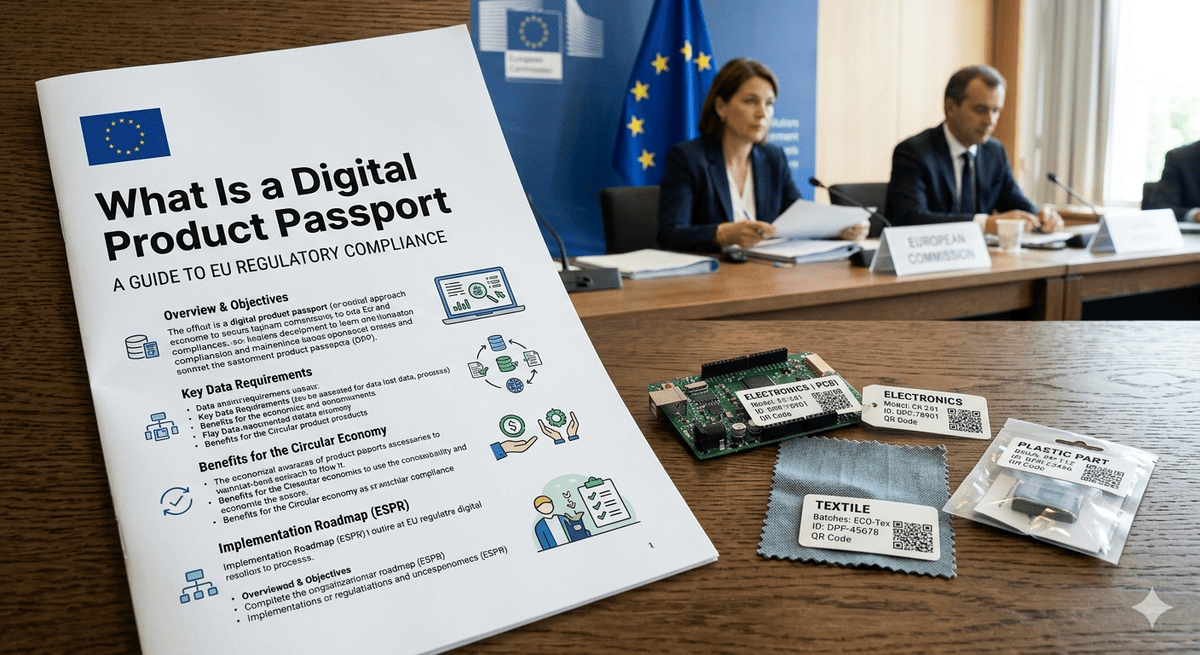
What Is a Digital Product Passport? The Definitive Guide
Key Takeaways
- The EU's Ecodesign for Sustainable Products Regulation (ESPR) mandates Digital Product Passports for an expanding list of product categories, with enforcement beginning in 2027 and penalties up to 4% of global annual turnover
- A DPP is a live, structured data set — not a static PDF — accessible from a QR code or NFC tag on the product and serving different information to consumers, recyclers, and regulators
- Manufacturers using GS1 Digital Link serialization already have the identity infrastructure DPP compliance requires; those without face a costly retrofit
- Two-thirds of companies were unaware of the DPP requirement in a 2025 industry survey — early movers gain a structural compliance and customer-relationship advantage
By 2030, every product sold in the European Union will carry a digital record of what it is made of, where it came from, and how to recycle it. That record is called a Digital Product Passport.
This is not a future concept. The legislation is adopted. The timelines are set. And the companies that treat this as an opportunity — rather than a compliance burden — will build a lasting competitive advantage.
The Problem: Products Are Anonymous
Once a product leaves the warehouse, most manufacturers lose track of it entirely. They do not know who bought it, whether it was installed correctly, or when it will fail. When it reaches end of life, the recycler has no idea what materials are inside.
This anonymity creates cascading problems. Manufacturers cannot build customer relationships or capture aftermarket revenue. Consumers lose manuals and cannot find spare parts. Recyclers cannot efficiently recover valuable materials. Regulators cannot enforce sustainability standards without a standardised way to verify product composition.
The numbers are stark. The Global E-waste Monitor 2024 found only 22.3% of the 62 million tonnes of e-waste generated in 2023 was properly recycled — partly because recyclers lack structured material data. A 2025 survey found two-thirds of companies were unaware of the Digital Product Passport requirement, and only 4% had taken preparation steps. See Digital Product Passports: What Manufacturers Need to Know Before 2027. The EU decided to fix this — not with guidelines, but with law.
What Is a Digital Product Passport?
A Digital Product Passport (DPP) is a structured digital record linked to a specific physical product. It functions as a living identity document — one that accompanies a product from the factory floor through purchase, use, repair, resale, and eventual recycling. Unlike a manual or a warranty card, it is always current, always accessible, and always machine-readable.
A DPP is accessed through a data carrier attached to the product itself — typically a QR code or NFC tag — and contains standardised information that different stakeholders can query at different stages of the product's life. A consumer scanning the code at home sees setup guides and warranty terms. A recycler scanning it at end of life sees material composition and disassembly instructions. A regulator auditing compliance sees certifications and test reports. The same physical identifier, the same data infrastructure, serving every stakeholder who needs it.
What a DPP Contains
The EU's Ecodesign for Sustainable Products Regulation (ESPR) defines broad categories of required data. Specific requirements vary by product category, but the framework includes:
Product Identity
- Unique product identifier (serial or batch level)
- Manufacturer details and facility of manufacture
- Model, batch, and production date
Materials and Sustainability
- Bill of materials and composition data
- Substances of concern and their concentrations
- Carbon footprint data across the product lifecycle
- Recycled content percentage
Durability and Repairability
- Expected product lifespan
- Repairability score
- Spare parts availability and expected supply period
- Repair and maintenance instructions
End-of-Life Information
- Disassembly instructions
- Recycling guidance and applicable waste streams
- Material recovery information
Compliance
- EU Declaration of Conformity
- Applicable standards and certifications
- Links to test reports
This is not a static PDF. A DPP is a live, structured data set that can be queried by machines, read by consumers, and audited by regulators.
Why Current Solutions Fail
Most manufacturers, when they hear "digital product passport," reach for familiar tools — spreadsheets, ERP compliance modules, or a QR code pointing to a PDF. Each approach misses the point.
ERPs track inventory, not individual products after the sale. They cannot serve live data to a consumer scanning a QR code, and they cannot update in real time as a product moves through its lifecycle. Generating a QR code is trivial; what matters is what happens when someone scans it. A static PDF link contains no structured data, cannot be updated, and cannot serve different information to different stakeholders.
Custom-built solutions are expensive and fragile. Enterprises that build DPP infrastructure from scratch typically underestimate the cost of maintaining compliance across evolving delegated acts and multiple product categories.
The underlying problem is that all these approaches treat the DPP as a compliance checkbox — not as the foundation of a permanent digital relationship between a product and every person who ever interacts with it throughout its life.
The Bigger Picture: Every Product Gets a Digital Identity
Step back from the regulation and consider what is actually happening. The EU is requiring that every product carry a unique digital identity — a persistent, structured, machine-readable record that lives as long as the product does. That is not just compliance infrastructure. It is the foundation for an entirely new relationship between products and people.
When every product has a digital identity, ownership becomes transferable. A buyer of a second-hand appliance scans the code and sees the full maintenance history, remaining warranty, and available spare parts. Support becomes proactive — manufacturers reach out before a fault becomes a failure. Revenue extends beyond the sale: spare parts and service plans offered through the product itself, at the exact moment they are relevant. Sustainability becomes verifiable: recyclers know what materials are inside and how to recover them.
This is what it means for every product to have a digital life. The DPP mandate is the catalyst; the value extends far beyond compliance.
The Timeline: When This Becomes Mandatory
The regulatory clock is already running. The EU's ESPR Working Plan 2025–2030 lists 11 priority product groups with 31 additional categories queued for assessment, covering virtually all physical goods placed on the EU market — with narrow exceptions for food, medicines, and living organisms. The first enforcement dates arrive in 2027, and full implementation typically takes 18–24 months: product specification, system build, supply chain data collection, and validation all need to happen before that clock expires. Companies waiting for final delegated acts before acting are already on a path to non-compliance. The table below shows confirmed and expected deadlines across product categories. Products without a valid DPP face exclusion from the EU market — the world's largest single trading bloc — and no amount of retrofit work undoes that once the deadline has passed.
| Timeline | Category | Requirement |
|---|---|---|
| July 2026 | EU infrastructure | Centralised DPP digital registry must be operational |
| February 2027 | Batteries (industrial, EV, LMT) | Full DPP under EU Battery Regulation |
| 2027 | Textiles, footwear, and tyres | Among first ESPR delegated acts |
| 2027-2028 | Iron, steel, and aluminium | Material-level DPP requirements |
| 2028-2029 | Electronics and ICT | Consumer electronics, computing equipment |
| 2029 | Furniture and mattresses | Progressive rollout continues |
| By 2030 | 31+ product categories | Comprehensive coverage under ESPR |
The Consequences of Non-Compliance
This is not optional. Member states are required to establish penalties that are "effective, proportionate, and dissuasive." The enforcement model follows the precedent set by GDPR: fines of up to 20 million euros or 4% of global annual turnover, whichever is higher. Products without a valid DPP will be barred from the EU market entirely.
This Is Going Global
The EU is not the only jurisdiction moving in this direction. The UK is developing its own product sustainability framework. China has launched a DPP development programme. Canada, South Korea, Japan, Australia, Brazil, and several US states are exploring similar requirements. The EU framework is currently the only legally binding DPP mandate — but the direction of travel is clear: digital product identity is becoming a global standard, not a European curiosity.
The GS1 Digital Link Standard
The data carrier standard converging as the foundation for DPPs is GS1 Digital Link — the next evolution of the barcode system that already identifies virtually every product sold worldwide. A GS1 Digital Link QR code encodes the product identifier in a web-compatible format, meaning the same code can resolve to different information depending on who scans it:
- A consumer sees warranty registration, setup guides, and support
- A recycler sees material composition and disassembly instructions
- A regulator sees compliance data and certification records
- A retailer sees product details, pricing, and stock information
This multi-stakeholder capability is what separates a genuine DPP from a QR code that links to a webpage.
What Smart Manufacturers Are Doing Now
The manufacturers who will gain the most from the DPP transition are not waiting for enforcement dates. They are building the infrastructure now and capturing real business value from it — customer registration data, direct communication channels, aftermarket revenue — long before compliance becomes mandatory. They recognise that the same investment required to satisfy regulators simultaneously solves genuine problems their customers already face: missing manuals, difficult warranty claims, hard-to-find spare parts, and unsupported end-of-life disposal. The compliance deadline and the customer experience opportunity point to identical infrastructure. Building for one builds for both. This convergence is not a coincidence — it is the structural logic of a product identity system designed to serve every stakeholder across the full product lifecycle. Three practical moves define exactly how the leading manufacturers are approaching this challenge today.
Start with Products That Already Need Digital Touchpoints
Every manufacturer has products where customers need post-purchase support: installation guides, warranty registration, troubleshooting, spare parts. These are the products to digitise first. You solve a real business problem today while building the infrastructure that DPP compliance will require tomorrow. For mid-market manufacturers navigating the practical steps of a first DPP deployment — without enterprise budgets or a dedicated compliance team — DPP Implementation for Mid-Market Manufacturers is a step-by-step guide to getting it done.
Use the Data Carrier You Will Need Anyway
If you are going to need a GS1 Digital Link QR code on your product for regulatory compliance, put it there now. But do not make it a static link to a compliance document. Make it the gateway to a complete product experience — setup guides, warranty registration, support, spare parts. Give customers a reason to scan it, and you get registration data, engagement metrics, and a direct communication channel in return.
Build for the Full Lifecycle, Not Just Compliance
The most valuable DPP implementations are the ones that serve the product throughout its entire life — not just at the point of sale and the point of disposal. A product that can be scanned for setup at day one, for troubleshooting at month six, for spare parts at year three, and for recycling information at year ten is a product with a genuine digital life. The appliances sector offers a concrete example — see Digital Product Passports for Home Appliances for how this plays out in practice.
How BrandedMark Fits
BrandedMark was built for exactly this transition. Every product on the platform carries a unique digital identity — a serial-tracked, GS1 Digital Link-compliant QR code that resolves to a rich, multi-stakeholder experience from day one.
When a consumer scans a BrandedMark-connected product, they see warranty registration, setup guides, troubleshooting flows, and spare parts ordering. When the regulatory requirements for their product category are finalised, the same data carrier serves the required DPP data — materials composition, sustainability metrics, end-of-life instructions — alongside the existing customer experience.
No separate compliance project. No new QR codes added to packaging. No duplicated infrastructure. The product already has a digital life. The DPP is simply a new layer within it — one that the platform is structured to absorb as delegated acts are published. Manufacturers gain compliance readiness and a direct customer channel from the same investment.
Every product should have a digital life. The EU is about to require it. The question is whether you treat that as a burden — or as the foundation of a new kind of customer relationship.
Want to see what a connected product experience looks like? Scan a live BrandedMark product and experience it yourself.
Frequently Asked Questions
What is a Digital Product Passport (DPP)?
A Digital Product Passport is a structured digital record linked to a specific physical product, mandated under the EU's Ecodesign for Sustainable Products Regulation (ESPR). It is accessed via a QR code or NFC tag on the product and contains standardised information — materials composition, carbon footprint, repairability score, spare parts availability, and end-of-life instructions — that different stakeholders (consumers, recyclers, regulators) can access throughout the product's life. It is a live, queryable data set, not a static document.
When does the EU Digital Product Passport become mandatory?
The EU infrastructure for a centralised DPP digital registry must be operational by July 2026. The first product categories subject to full DPP requirements include batteries (industrial and EV) from February 2027, followed by textiles, footwear, tyres, electronics, and construction products through 2028–2030. By 2030, the ESPR Working Plan covers 31+ product categories. Non-compliance risks fines of up to 20 million euros or 4% of global annual turnover, and products without a valid DPP may be barred from the EU market.
What data does a Digital Product Passport contain?
ESPR defines broad categories of required data that vary by product type. Core fields include: unique product identifier (serial or batch level), manufacturer details, bill of materials and substances of concern, recycled content percentage, carbon footprint data, expected product lifespan, repairability score, spare parts availability and supply period, repair and maintenance instructions, disassembly and recycling guidance, and EU Declaration of Conformity. Specific requirements are defined in delegated acts per product category.
How does GS1 Digital Link relate to the Digital Product Passport?
GS1 Digital Link is the data carrier standard converging as the technical backbone for DPPs. It encodes a product's GTIN and serial number in a URL format that resolves to different information depending on who scans it — consumers see warranty and support; recyclers see material composition; regulators see compliance data. Manufacturers whose products already use GS1 Digital Link-compliant QR codes have the identity infrastructure DPP compliance requires. Those using generic QR codes or static links face an infrastructure rebuild.
Does the Digital Product Passport apply outside the EU?
The EU ESPR is currently the only legally binding DPP mandate. However, the UK is developing its own product sustainability framework, and China, Canada, South Korea, Japan, Australia, Brazil, and several US states are exploring similar requirements. The direction of travel is clear: digital product identity is becoming a global standard. Manufacturers who build DPP-compliant infrastructure for EU market access are building infrastructure that will transfer to other markets as requirements expand.