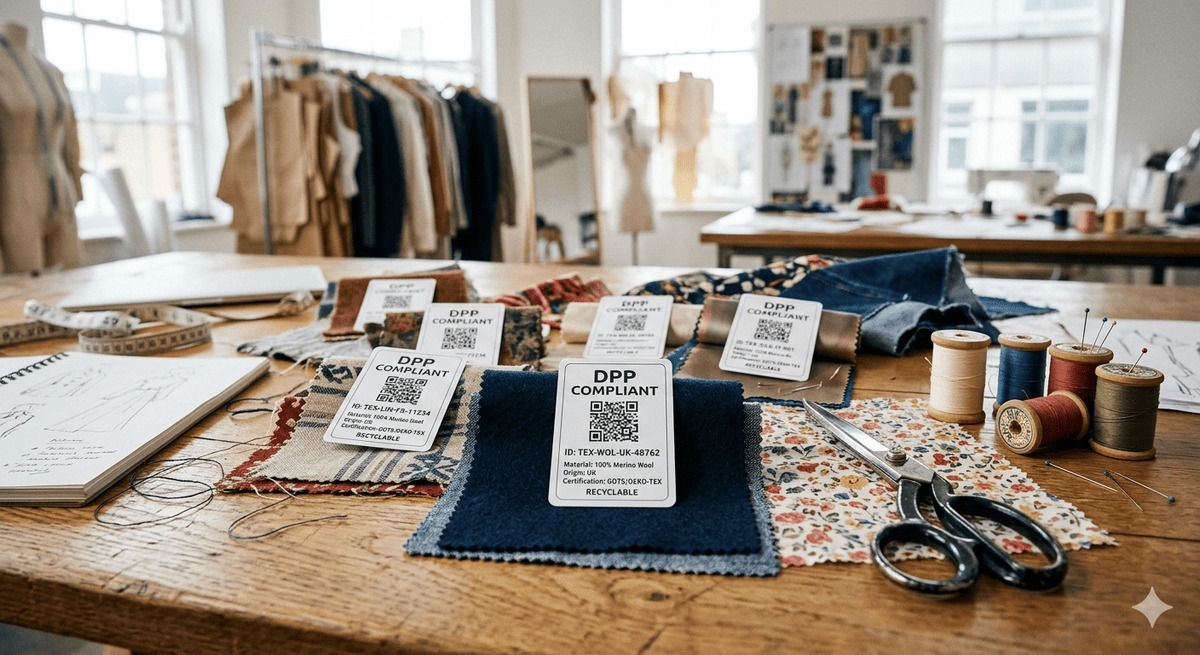
Digital Product Passport for Textiles and Fashion
Key Takeaways
- Textiles are among the first ESPR categories — the delegated act is expected to be finalised in 2025 or 2026, with compliance required approximately 18–24 months after adoption.
- The textile DPP must cover fibre composition, substances of concern (including PFAS and azo dyes), environmental impact (carbon footprint, water usage, microfibre shedding), care/repair guidance, and end-of-life instructions.
- France's Loi AGEC already requires environmental labelling for textiles — brands with AGEC compliance have a head start, but EU DPP requirements go considerably further.
- A QR code on the care label or hang tag can simultaneously satisfy regulatory compliance, enable product authentication in the resale market, and build a direct brand relationship with the end consumer.
The fashion industry has spent the last decade making sustainability pledges. The EU has now decided that pledges are not enough — and it has chosen textiles as one of the first product categories where it will enforce that view. The EU's Ecodesign for Sustainable Products Regulation (ESPR) mandates Digital Product Passports for textiles, and the infrastructure behind them must be built before the regulation takes effect, not scrambled together in the months before a deadline.
If you manufacture clothing, footwear, accessories, or home textiles sold into the EU, a Digital Product Passport will soon be a legal requirement. This guide explains why textiles were singled out, what data your DPP must contain, where the real challenges lie, and — critically — how to turn a compliance obligation into a genuine competitive differentiator. For a broader introduction to how DPPs work, see our guide on what a Digital Product Passport is.
Why Textiles Are a Priority
The EU chose textiles as an early ESPR priority because the industry's environmental record is poor — and decades of voluntary commitments have not changed it. The fashion sector generates around 92 million tonnes of textile waste every year, with less than 1% of textile fibre recycled back into new fibre. Most discarded garments go to landfill or incineration. The industry contributes roughly 10% of global carbon emissions and is a major source of water pollution through dyeing processes and microplastic contamination from synthetic fibre washing. The European Commission published its EU Strategy for Sustainable and Circular Textiles in March 2022, explicitly naming Digital Product Passports as the data infrastructure needed to make circularity practical. Without reliable, accessible product data, recyclers cannot sort effectively, consumers cannot make informed choices, and greenwashing claims go unchallenged. The Commission's own 2021 study found that 53% of EU green claims were vague, misleading, or unsubstantiated — a finding that directly drove the shift from voluntary disclosure to mandatory, verifiable DPP data.
France Is Already Ahead
It is worth noting that France moved before the EU. The Loi AGEC (Loi Anti-Gaspillage pour une Économie Circulaire), adopted in 2020, already requires environmental labelling for textiles sold in France — including information on fibres, traceability, and environmental impact. French manufacturers and brands selling into France have therefore already begun building some of the underlying data infrastructure. The EU DPP will extend and formalise these requirements across all 27 member states. If you have already navigated AGEC compliance, you have a head start — but the DPP requirements are considerably more comprehensive.
What a Textile Digital Product Passport Must Contain
The precise data requirements will be finalised in a delegated act — the per-category technical regulation that ESPR empowers the European Commission to adopt. The textiles delegated act is expected in 2025 or 2026, with a compliance window of 18 to 24 months from adoption. While the final text is pending, the data fields are already well understood from the ESPR framework, Commission working documents, and preparatory industry consultations. Textile DPPs must cover product identity, materials composition, substances of concern, environmental impact, durability, care and repair guidance, and end-of-life instructions. Critically, this data must be machine-readable and structured — not simply a web page a human can read — so that market surveillance authorities can run automated verification. Brands that treat the DPP as a static PDF or a marketing page will not satisfy the regulation. Structured, schema-compliant data linked to a GS1 Digital Link QR code is the required approach.
Here is what the textile DPP is expected to cover.
Product Identity
The DPP must unambiguously identify the product — and, for serialised items, the individual unit. Required fields will include:
- Brand name and legal manufacturer entity
- Product model name and product reference number
- GTIN (Global Trade Item Number)
- Country of manufacture and, where applicable, country of origin for key materials
- Production facility identifier
For fashion and textiles, the question of serialisation is more nuanced than for electronics or appliances. A luxury jacket or a pair of premium trainers is a natural candidate for per-unit tracking. A fast-fashion t-shirt produced in runs of 50,000 units presents different economics. The regulation is expected to allow batch-level identification for products where individual serialisation is disproportionate — but premium and mid-market brands should expect per-unit to become the standard, particularly where authentication and resale are relevant.
Materials Composition
Fibre content labelling is already required under EU Regulation 1007/2011 — every garment sold in the EU must declare its fibre composition on a label. The DPP extends this significantly:
- Full fibre content by percentage (carrying forward existing label requirements in a machine-readable format)
- Origin of materials where known — country and, for key raw materials, supply chain provenance
- Whether fibres are virgin or recycled, and the recycled content percentage
- Distinction between primary material, lining, and trim where compositions differ
For brands sourcing from complex, multi-tier supply chains, this will require a step change in supplier data collection. Knowing that a fabric is 70% cotton and 30% polyester is not sufficient if you cannot say where the cotton was grown, whether it is conventionally or organically certified, and whether the polyester is virgin or recycled. Full product component transparency — documenting what a product is made from at a granular level — is the underlying capability the DPP demands.
Substances of Concern
This is an area where the textile DPP will create significant compliance work for many manufacturers:
- REACH compliance — substances of very high concern (SVHCs) above the 0.1% threshold, which applies to finished textile articles
- Restricted substances — azo dyes that release carcinogenic amines, PFAS (per- and polyfluoroalkyl substances used in water-repellent finishes), formaldehyde residues in crease-resistant finishes, heavy metals in dyes and pigments
- Certification data — where products hold OEKO-TEX Standard 100, GOTS (Global Organic Textile Standard), bluesign, or equivalent certifications, this data should be included and verifiable
Many brands currently rely on supplier declarations and test reports buried in quality management systems. The DPP requirement means this data must be structured, accessible, and linked to the product — not archived in a compliance folder that a regulator would need to request and then manually review.
Environmental Impact
- Carbon footprint — expressed as kg CO₂e, covering at minimum the production phase, with cradle-to-grave methodology expected for higher-impact categories
- Water usage — a particular concern for cotton, dyeing, and finishing processes
- Microfibre shedding potential — the EU has identified this as a specific concern for synthetic textiles; the DPP is expected to include information on microfibre release under washing conditions
This is where many fashion brands will face their most significant data gaps. Carbon footprinting across a multi-tier textile supply chain is methodologically complex and data-intensive. Brands that have invested in Scope 3 emissions measurement will be better positioned; those that have not will need to build or buy that capability.
Durability and Quality
The EU's sustainable textiles strategy explicitly targets premature product obsolescence — the design of garments that wear out faster than necessary, driving replacement purchases. The DPP is expected to include:
- Expected product lifespan under normal use conditions
- Colour fastness (resistance to washing, rubbing, and light)
- Pilling resistance
- Dimensional stability after washing (shrinkage)
- Seam strength
For brands that compete on quality and durability — workwear, outdoor clothing, premium fashion — this is an opportunity to substantiate claims that are currently made on the basis of brand reputation alone. For fast-fashion operators, it will expose product quality in a way that marketing language currently obscures.
Care and Repair
Care instructions are already required on garments under EU rules, and existing care label symbols (ISO 3758) are familiar to most manufacturers. The DPP extends this:
- Full washing, drying, ironing, bleaching, and dry-cleaning instructions in machine-readable format
- Repair guidance — how to address common wear issues (loose seams, broken zips, worn elbows)
- Alteration guidance — can the garment be taken in, let out, hemmed?
- Links to authorised repair services or brand repair programmes where available
The care label is currently a physical object sewn into the garment that fades, detaches, and becomes illegible. The DPP makes care information permanently accessible via the product — a practical benefit that outlasts the label.
End-of-Life
This is where the circular economy ambition of the regulation is most visible:
- Recyclability assessment — can the garment be recycled, and by what process?
- Fibre separation guidance — for blended fabrics, information on whether fibre separation is feasible
- Take-back programme information — brand or retailer take-back schemes, deposit programmes
- Biodegradability information where applicable
- Nearest deposit and collection points (expected to be integrated via geolocation in more advanced implementations)
Supply Chain and Certifications
- Key tier-1 and tier-2 suppliers (at minimum: fabric mill, cut-make-trim facility)
- Certification chain — Fair Trade, organic cotton certification (GOTS, OCS), recycled content verification (GRS), responsible down (RDS), and similar
- Country of processing for key stages (spinning, weaving/knitting, dyeing and finishing, garment assembly)
Supply chain transparency at this level is a significant undertaking for most fashion brands. Even brands with strong sustainability programmes often have limited visibility beyond their direct suppliers. The DPP will require either building that visibility or being transparent about where it does not yet exist.
The Real Challenges for Textile Brands
The data requirements for a textile DPP are easy to list; getting that data in place is genuinely hard. A typical garment's data trail spans a raw material farm, a spinning mill, a weaving or knitting facility, a dye house, a trim supplier, and a cut-make-trim factory across multiple countries. Each party holds a fragment of the required data; none currently transmit it in a standardised format. Fashion also lacks the industry-wide data exchange standards that automotive (IMDS) and electronics (IPC) have long relied on. Physical care labels have no digital equivalent — adding a QR code requires production workflow changes with lead times measured in months. Once sold, the brand has no ongoing relationship with the garment: the owner may wash it incorrectly, discard rather than repair it, and resell it with no provenance data. Fast fashion faces the steepest challenge — its competitive model depends on rapid sourcing from a rotating supplier base, which is structurally incompatible with the traceability the DPP requires.
The Opportunity: A Garment That Talks Back
A QR code on the care label or hang tag turns a garment into a connected product — and that connection creates value well beyond compliance. Care instructions become permanently accessible even after the physical label has faded; a jacket owned for fifteen years can still be washed correctly. In the second-hand market, growing faster than new fashion on platforms like Vinted, Depop, and Vestiaire Collective, a scannable DPP provides authentication at resale — the buyer confirms model, materials, and provenance without contacting the brand. Sustainability claims become verifiable rather than decorative: "50% recycled fibres" shifts from a hang-tag assertion to a confirmed data point with a certification reference. When a seam splits, a scan surfaces repair and alteration services. When the garment reaches end of life, a scan directs the owner to take-back programmes or local recycling facilities. None of these interactions require a dedicated app — they resolve from any smartphone camera, creating a brand touchpoint that persists through resale and the full product lifespan.
How BrandedMark Solves This for Textile and Fashion Brands
BrandedMark is built around giving every product a digital identity — and the textile DPP is a direct application of that principle. The platform handles QR code generation, structured DPP data, public-facing product pages, and GS1 Digital Link compliance in a single no-code interface designed for brand and operations teams, not software engineers. There is no custom development required and no integration project to manage: brands enter product data once, and BrandedMark generates the compliant DPP pages, structured schema output, and serialised QR codes ready for label printing. Updates — a revised fibre composition, a new certification, an updated take-back programme — are made centrally and flow through to every DPP page automatically. The platform also layers in capabilities that turn the compliance infrastructure into ongoing brand value: product registration, consumer engagement, authentication for resale, and post-purchase care guidance. Compliance and customer relationship building share the same QR code.
QR Code on the Care Label or Hang Tag
BrandedMark generates unique QR codes per product (and per unit where serialisation is appropriate), following GS1 Digital Link standards. That code can be printed on the care label, woven into a label, or applied to the hang tag. It requires no app — any smartphone camera resolves it. It is publicly accessible without authentication, as ESPR requires. And it serves multiple audiences from the same scan: the regulator, the consumer, the recycler, and the brand's own customer engagement layer.
Auto-Generated DPP Pages
For textile and fashion brands, BrandedMark auto-generates structured DPP pages covering product identity, materials composition, substances and certifications, environmental data, care and repair guidance, and end-of-life information. The data is entered once and managed centrally — updating a fibre composition or adding a new certification flows through to every DPP page automatically.
The pages are machine-readable and structured (not just a human-readable web page), which satisfies the regulatory requirement for automated verification by market surveillance authorities.
Product Registration Builds Direct Customer Relationships
For brands selling through retailers — which is most fashion brands — the DPP scan is also the first touchpoint for a direct customer relationship. BrandedMark's warranty and product registration capability means the same scan that delivers compliance data to a regulator can invite the consumer to register the product, opt in to brand communications, and access exclusive content. For brands that have historically had no direct relationship with the end consumer because all sales flow through wholesale or retail channels, this is a significant capability shift.
Authentication Supports the Resale Market
For premium and luxury fashion brands, BrandedMark's serial tracking provides the authentication infrastructure for second-hand markets. When a jacket appears on Vinted or Depop, the buyer can scan the QR code to verify the model, materials, and production provenance. The brand benefits from being present in a resale transaction that would otherwise be entirely outside its influence.
A Practical Example
A premium outerwear brand adds a BrandedMark QR code to the care label of a new range of merino wool jackets. That single code now serves seven distinct purposes:
- EU market access — the DPP satisfies ESPR compliance, accessible to market surveillance authorities without authentication
- French AGEC compliance — the materials and environmental data satisfies France's existing environmental labelling requirement
- Consumer transparency — the materials origin, GOTS certification, and carbon footprint are verifiable by any consumer who scans
- Care instructions — always accessible, even after the physical label has faded or detached
- Authentication — when the jacket appears on a resale platform three years later, the buyer can scan to verify provenance
- Repair booking — when the down baffle stitching fails, the owner can scan and book a repair through the brand's repair programme
- End-of-life recycling — when the jacket reaches end of life, the owner is directed to the brand's take-back programme or the nearest textile recycling facility
This is the difference between a compliance project and a connected product strategy. The DPP obligation creates the infrastructure; BrandedMark makes it earn its keep across the full product lifecycle.
Getting Started: Four Practical Steps
Brands that start building DPP data infrastructure before the regulatory deadline will find compliance manageable. Those that wait will face supplier engagement, label redesign, and data structuring running in parallel against a fixed deadline.
Step 1: Audit your product data. Map what you hold and where it lives — fibre composition at material level, supplier facility identifiers, carbon footprint data, REACH documentation. Gaps are almost always larger than expected.
Step 2: Engage your supply chain. The DPP is only as accurate as the data your suppliers provide. Identify who can supply structured, verifiable data and who cannot — the latter are compliance risks.
Step 3: Choose your data carrier. A printed QR on the care label is the lowest-cost, most wash-resilient option. Woven labels and NFC chips suit premium products. Label redesign lead times run months — start early.
Step 4: Pilot one range first. Validate the full workflow — data entry, QR generation, label production, public access — before rolling out across the collection.
BrandedMark: Compliance Becomes a Feature
ESPR requires textile brands to build DPP infrastructure. BrandedMark makes that infrastructure earn its keep across the full product lifecycle — not just at the point of regulatory audit. The same QR code that satisfies a market surveillance authority also registers the customer, surfaces repair guidance when a seam fails, authenticates the garment on a resale platform, and directs the owner to a take-back programme at end of life. Product registration, post-purchase engagement, and authentication are built into the same platform as the DPP data structure and GS1 Digital Link output — there is no separate system to integrate or maintain. For fashion brands that have historically had no direct relationship with the end consumer because sales flow through wholesale or retail channels, the DPP scan is the first opportunity to establish that relationship. Compliance creates the infrastructure; BrandedMark ensures it generates commercial return from day one.
Join the waitlist to see how BrandedMark handles DPP for textile and fashion manufacturers.
Frequently Asked Questions
When do textiles need a Digital Product Passport?
The ESPR delegated act for textiles is expected to be adopted in 2025 or 2026. Compliance windows typically run 18 to 24 months from the date a delegated act enters into force. On current projections, most textile and fashion brands should plan to be DPP-ready by 2027 or 2028. However, brands selling into France are already subject to existing environmental labelling requirements under the Loi AGEC, and early preparation for DPP also supports AGEC compliance. Monitor the European Commission's ESPR working plan and the Official Journal of the EU for the adoption date of the textiles delegated act. Building infrastructure now — rather than in the final months before a deadline — significantly reduces compliance risk and cost.
Does the DPP replace the care label?
No. The physical care label sewn into the garment remains a legal requirement under EU Textile Labelling Regulation 1007/2011 and the relevant care labelling standards. The DPP is an additional, digital data record that must be accessible via a data carrier (such as a QR code) on the product. In practice, a QR code on the care label can serve both functions: the physical label meets existing textile labelling requirements, while the QR code links to the DPP and extends the care information into a permanent digital format. The DPP does not substitute for the physical label — it supplements and extends it.
What about garments already manufactured?
DPP requirements will apply to products placed on the EU market after the relevant delegated act comes into force. Garments manufactured and placed on the market before that date are generally not required to be retrofitted. Products manufactured after the compliance date — including continuations of existing styles or carry-over lines — will require a DPP. Brands should plan their transition around seasonal collection cycles, ensuring new production runs after the compliance date are DPP-ready. Collections planned for launch after the compliance window should be designed with DPP in mind from the product development stage, not retrofitted at the production stage.
How does the French AGEC law relate to the EU Digital Product Passport?
France's Loi AGEC (Anti-Gaspillage pour une Économie Circulaire) introduced mandatory environmental labelling for textiles sold in France from 2023. The labelling requirements include information on fibre composition, country of origin, environmental impact, and end-of-life guidance — overlapping significantly with the data that a DPP will require. Brands that have already built AGEC-compliant data infrastructure will find the transition to EU DPP compliance considerably easier, as much of the underlying data is the same. However, the DPP goes further in several areas — particularly on supply chain traceability, substances of concern, and machine-readable structured data — so AGEC compliance alone does not constitute DPP readiness. It does, however, provide a strong foundation.
Can I use the DPP for brand storytelling?
Yes — and this is one of the most underappreciated opportunities in the regulation. The DPP is a publicly accessible, scannable data record linked to the product. While the compliance data (materials, substances, environmental impact, end-of-life guidance) must be present and accurate, there is no reason the DPP page cannot also carry brand narrative: the story of the fabric mill, the provenance of the wool, the certifications your suppliers hold, the brand's repair programme, or the carbon offset projects linked to the product's footprint. For premium and purpose-driven brands, the DPP QR code is a direct channel to the consumer at the moment they are holding the product — not an advertising impression, but a genuine product interaction. BrandedMark's no-code Experience Designer makes it straightforward to build DPP pages that satisfy the regulatory requirement and serve as compelling brand experiences.