From Passkey to Wallet: What Product Ownership Should Feel Like
Key Takeaways
- Industry warranty registration rates sit at 10–28% — the gap is caused by friction in the registration experience, not customer apathy
- A passkey registration flow (scan QR, confirm with Face ID or fingerprint) completes in under 10 seconds, approaching mobile checkout completion rates of 55–65%
- Apple Wallet and Google Wallet passes deliver a persistent, branded warranty card that sends notifications at expiry, enables support access at the moment of need, and provides a direct channel for recalls and product updates
- The same QR and WebAuthn architecture that powers frictionless registration also satisfies EU Digital Product Passport (ESPR) requirements — making registration infrastructure and compliance infrastructure the same investment
In 2026, you can board a transatlantic flight with a tap of your phone. You can pay for a $4,000 appliance with a glance at your face. You can unlock a rental car, access your office building, and sign a legal contract — all without a physical document or a password.
And yet, when the same appliance arrives at your door and you want to register your warranty, there is a paper card in the box asking for your address, model number, and purchase date — and a pre-paid envelope to mail it back.
This is not a niche complaint. Industry warranty registration rates sit at 10–28%. For decades, brands have blamed customer apathy. The real culprit is friction — specifically, the design decision to treat product registration as a data-collection chore for the brand rather than a meaningful moment for the customer.
Passkeys and digital wallet passes change that calculus entirely. Here is what product ownership looks like when the experience is built for the customer first.
| Key Metric | Value |
|---|---|
| Traditional warranty registration | 10–28% completion rate |
| Frictionless mobile checkout | 55–65% completion benchmark |
| Passkey registration potential | Approaches mobile checkout rates |
| QR scan completion window | Sub-10 seconds end-to-end |
| Wallet pass engagement | 3–5x higher than email-based warranty |
Market position: While competitors like Registria and Narvar offer QR-based registration, BrandedMark is the only platform combining passkey authentication with wallet pass delivery and ownership transfer capability—creating a complete frictionless registration experience.
The Paper Card Is Not the Problem. The Thinking Behind It Is.
Why do paper warranty cards persist despite registration rates of 10–28% — and what does that reveal about the deeper design failure? Paper cards survive not because they work, but because the teams responsible for registration forms have never been accountable for completion rates. When only one in eight customers registers, that is a product design failure, not a customer apathy problem. The registration experience was built to extract information, not to create value for the person filling it in. Digital alternatives replicated the same philosophy in a new medium: "register your product" links buried in confirmation emails, web forms requiring yet another account and password, QR codes resolving to mobile-hostile pages with fourteen required fields. The medium changed; the thinking did not. The result is that brands selling £500–£5,000 durable goods have no direct relationship with the majority of their customers — visible to the retail channel, invisible to the maker. Warranty registration is a revenue-generating capability, not a compliance checkbox, but that value is unreachable at sub-30% registration rates.
What Zero-Friction Registration Actually Looks Like
What does a genuinely frictionless product registration flow look like in practice — and why does the passkey architecture matter beyond convenience? The modern registration flow is not a form. It is a handshake — fast, secure, and meaningful for both sides. The customer unboxes the product, scans the QR code integrated into the packaging, and a mobile-native web page loads immediately. No app download, no redirect. The page asks for name, email, purchase date, and retailer. They tap Submit. Their device prompts biometric confirmation — Face ID, fingerprint, or PIN. Done. Elapsed time: under 10 seconds. The passkey created in that moment is a FIDO2/WebAuthn credential — a public-private key pair generated on the device. The private key never leaves the phone. The customer's device becomes cryptographic proof of ownership, bound to the specific serialised unit. For brands, every registered customer is verified. Support agents can confirm ownership instantly without asking for receipts or model numbers. The credential cannot be forged, shared, or duplicated.
The Four-Step Passkey Flow
A customer unboxes a product. On the packaging — ideally integrated into the unboxing experience itself — there is a QR code. They scan it.
A web page loads instantly. No app download, no redirect to an app store. Just a clean, mobile-native page — because a clean, mobile-native experience is essential for first-time product interactions.
The page asks for four things: name, email, purchase date, and where they bought it. They tap Submit.
Their device prompts them to authenticate — Face ID, fingerprint, or device PIN. They do. Registration complete.
Elapsed time: under 10 seconds.
The Cryptographic Advantage
This is not a convenience trick. The passkey created in that moment is a FIDO2/WebAuthn credential — a public-private key pair generated on the device. The private key never leaves the phone or laptop. The public key is stored by the brand. The passkey is tied to that specific device and that specific person.
What this means in practice: the customer did not create a password to forget or a login to lose. Their device is the proof of ownership — cryptographically bound, biometrically protected, and completely un-shareable. You cannot email a passkey to a friend. You cannot post it on a resale forum.
For brands, the implication is equally significant. Every registered customer is verified. The relationship is direct. The credential cannot be forged or duplicated. When someone claims warranty service on a serialised product, the passkey resolves the identity question instantly, without a support agent having to ask for receipts or model numbers.
This is what digital product identity should look like, and it connects to broader product identity concepts that extend across customer ownership and lifecycle management.
The Wallet Card: Ownership You Can Actually Carry
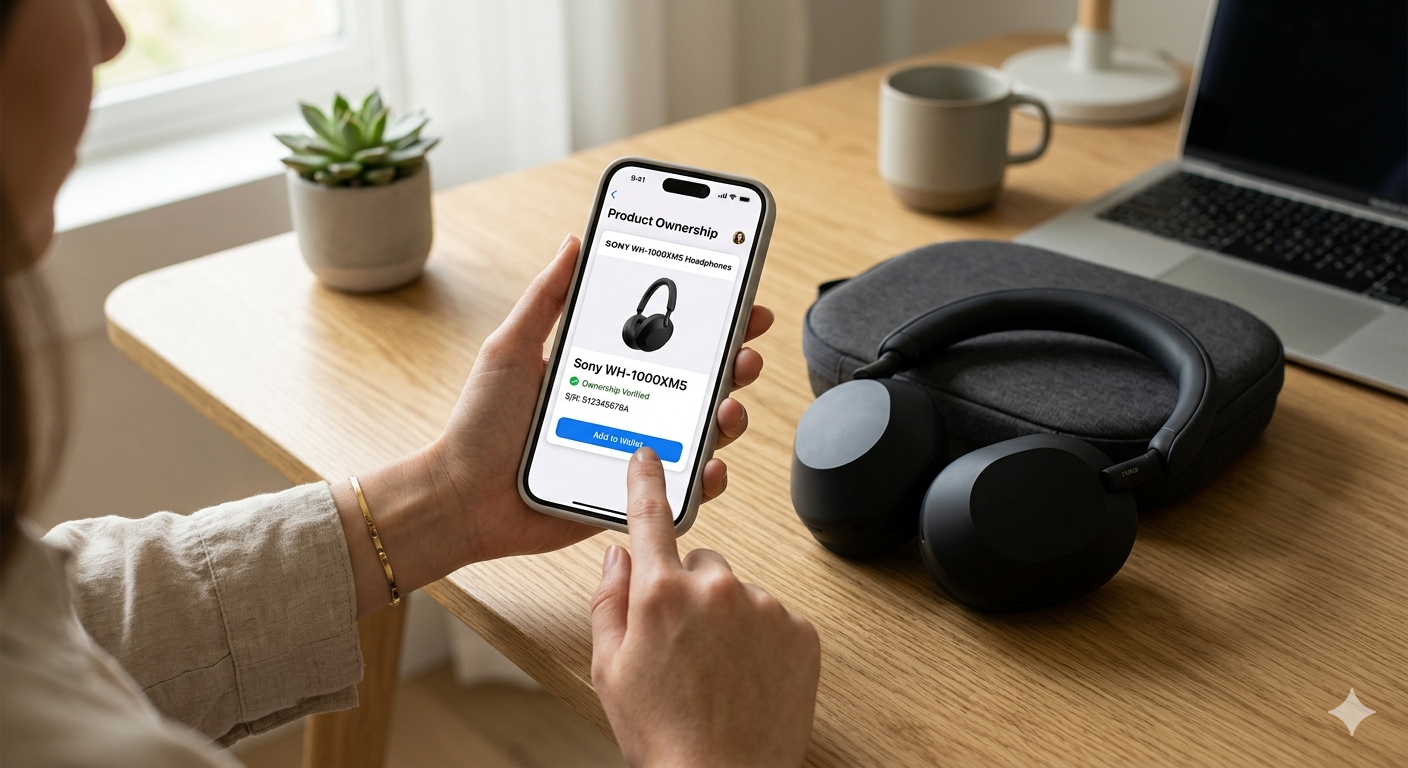
What does the customer actually receive after completing passkey registration — and why does the delivery mechanism matter as much as the registration itself? Registration is only half of the experience. The other half is what the customer gets back. Immediately after the passkey registration completes, the system generates a wallet pass — a PKPass for Apple Wallet or the equivalent for Google Wallet — and delivers it directly to the customer's device. The pass appears as a branded card showing product name, model, serial number linked to the GS1 Digital Link record, owner name, registration date, warranty expiry, and quick links to troubleshooting, manuals, and spare parts. No app required. No account portal to navigate. The warranty card lives in the same place as the customer's boarding pass and their coffee loyalty card — always accessible on the lock screen, always current, and updatable by the brand without any action from the customer.
- Product name and model
- Serial number (linked to the physical product's GS1 Digital Link)
- Owner name
- Registration date
- Warranty expiry date
- Quick links to troubleshooting, manuals, and spare parts
Why This Matters More Than It Sounds
Think about what digital boarding passes did for airline travel. The paper boarding pass was not painful. It mostly worked. But the boarding pass in Apple Wallet eliminated the moment of friction — searching through email for a PDF, hoping the printer had ink — and replaced it with a glance at a lock screen.
Warranty cards can do the same thing. When a customer needs to verify coverage before authorising a repair, or when a support agent needs to confirm warranty status, the answer should take two seconds, not two minutes of digging through email archives.
The wallet pass is also a persistent, named surface. It shows up in searches. It sends notifications. When the warranty is approaching expiry, the pass can notify the customer. When there is a recall, or a firmware update, or a compatible accessory launch, the brand has a direct, frictionless channel — not a cold email to an address that may have changed three times since purchase.
Why This Matters for Brands — Not Just Customers
Why should a finance or commercial leader care about passkey registration and wallet passes — beyond the customer experience improvement? The business case centres on four quantifiable levers. Registration rate directly determines the size of the first-party data asset: doubling from 28% to 55% on a 500,000-unit product line is not a UX metric, it is a direct marketing and service revenue capability worth millions. Support deflection compounds across the warranty period as the wallet pass surfaces self-service content at the moment of need rather than after a customer has already called. Ownership transfer extends the brand relationship into the secondary market, converting resale buyers from invisible strangers into registered customers at zero acquisition cost. And anti-counterfeiting coverage is a byproduct of the same passkey architecture — device-bound, biometric, tamper-evident — without requiring a separate authentication programme.
Registration Rate Economics
Industry benchmark for traditional paper and email registration: 10–28%. QR-based registration on mobile, when the page is well-designed and there are zero friction points, achieves mobile web completion rates closer to those of modern checkout flows — the Baymard Institute places average mobile checkout abandonment at around 72%, with streamlined one-page flows consistently outperforming multi-step forms (Baymard Institute Cart Abandonment Research). A passkey flow that eliminates the password-creation step removes the single biggest source of mid-registration abandonment.
Doubling or tripling registration rates on a product line of 500,000 annual units is not a UX metric. It is a first-party data asset worth millions in direct marketing, service revenue, and customer lifetime value. The connected product ROI calculation quantifies what that relationship is worth in real terms.
First-Party Data at a Moment When It Matters Most
Third-party cookies are gone. Retail channel data is not shared. Social platform algorithms are unpredictable. Every registered product owner represents a direct relationship — email, product, purchase context, warranty status — that belongs to the brand and no intermediary.
A manufacturer with 30% registration rates has a direct relationship with fewer than one in three of their customers. The other 70% are relationship-less in any meaningful sense. Passkey registration, done right, flips that ratio.
Support Deflection Built In
The wallet pass is not static. It links directly to the product's self-service experience: the interactive troubleshooting guide, the installation video library, the spare parts catalogue with live stock visibility. When the customer's dishwasher throws an error code at 9pm, the warranty card in their wallet is the fastest path to resolution — without a call centre agent involved.
A mid-sized European appliance brand explored this architecture in their service planning — their modelling suggested 35–40% of tier-one support contacts could be deflected to self-service if the product experience was surfaced at the right moment of need, rather than buried in a support portal the customer had to find separately.
Ownership Transfer: The Resale Opportunity Brands Ignore
Products get resold. In the consumer electronics, power tools, and appliance categories, secondary markets are enormous. Today, when a product is resold, the brand relationship ends. The new owner is invisible.
With passkey-based product identity, ownership transfer is an intentional flow: the seller initiates a transfer, the buyer scans the same QR code, authenticates with their own passkey, and the registration updates. The brand gains a new direct relationship — with data on the product's age, condition, and provenance — rather than losing one.
This is not a hypothetical. It requires a platform designed for it from the start, not bolted onto a legacy registration system as an afterthought.
Anti-Counterfeiting Without a Counterfeiting Problem
Brands in premium categories spend significant budget on authentication features — holograms, NFC chips, covert inks. Most of these verify the product, not the owner.
Passkeys verify both. The credential is device-bound and biometric. It cannot be copied, shared, or spoofed. When a customer registers via passkey, the brand knows that a real person, on a real device, claimed ownership of a specific serialised unit at a specific time. That audit trail is admissible, tamper-evident, and cryptographic — considerably more robust than a hologram that can be replicated by a well-equipped counterfeiter.
The Technical Architecture — Without the Jargon
What are the technical components behind passkey registration and wallet pass delivery — and does it require proprietary infrastructure? The stack is entirely standards-based with no proprietary lock-in at any layer. The QR code uses GS1 Digital Link — a structured URL encoding the GTIN, serial number, and batch information, parseable by any compliant reader, resolving to a brand-hosted web experience. The registration page uses WebAuthn, the W3C web standard for passkey authentication, natively supported by Safari, Chrome, Firefox, and Edge since 2022. The browser handles the cryptographic ceremony; the brand's server receives the public key and associates it with the product record. The wallet pass is generated server-side using the Apple PKPass specification for iOS and the Google Wallet API for Android — the same technology behind boarding passes, hotel keys, and event tickets, requiring no app submission or SDK. The entire flow runs in a browser on any device. No app download required at any step. Every app download requirement is a conversion drop-off. Removing it entirely is why the completion rate moves.
From Warranty Card to Product Passport
How does the passkey-and-wallet architecture relate to EU Digital Product Passport compliance — and does building one reduce the cost of the other? The relationship is direct. The ESPR regulation mandates that sustainability data, repairability scores, materials declarations, and supply chain information be accessible via a digital identifier on the product. That identifier is the same GS1 Digital Link QR code the customer scanned to register their warranty. The architecture is identical: the QR resolves to a product record containing warranty data for the consumer and sustainability data for regulators, auditors, and sustainability-conscious buyers. The wallet pass is the consumer layer. The digital product passport is the compliance layer. Both draw from the same digital product identity record. Brands implementing passkey registration and wallet passes today are not just improving their post-purchase experience — they are building the infrastructure that ESPR compliance will require, and doing it in a way that creates immediate customer value rather than a pure compliance cost.
What This Changes for the Industry
What is the industry-level shift when passkeys and wallet passes become the standard for product registration — and what does the before-and-after actually look like in commercial terms? The economics of product registration have been inverted for decades. Registration was treated as a cost: form processing, data hygiene, call centre support for customers who lost confirmation emails. The value it created was theoretical and hard to attribute. Passkeys and wallet passes flip the model. The current state — 10–28% registration rates, post-purchase revenue captured by retail channels rather than manufacturers, brand relationships invisible after point of sale — gives way to a state where registration reaches 55–65%, every registered product is a named verified owner with a persistent wallet-based touchpoint, and support deflection, extended warranty conversion, and secondary market relationship capture all become operational realities rather than aspirations. The warranty card was always the opening move in a customer relationship. Most brands forfeited it because the experience was too broken to complete.
See It in Practice
BrandedMark's connected product platform supports passkey registration and Apple Wallet / Google Wallet passes out of the box — built on GS1 Digital Link, WebAuthn/FIDO2, and EU DPP-compliant product records. No custom development required to stand up the full flow.
There is a live demo at brandedmark.co/tools/passkey-demo — scan, register, receive the wallet pass, and see how the product record looks from the brand side. It takes about 90 seconds and shows the entire flow end to end.
The industry will get here eventually. The question is whether your brand gets there first, or watches a competitor use it to close the registration rate gap that has existed since the paper card era.
FAQ: Passkeys and Wallet Passes
Will wallet passes work on Android if we're Apple-centric?
Yes. Apple Wallet is iOS-only, but Google Wallet accepts the same PKPass format and reaches 100% of Android devices. BrandedMark generates both formats automatically—a single registration flow delivers the correct pass to each customer's platform. No duplicate work required.
What happens if a customer scans the QR code but doesn't have wallet support?
The registration flow detects device capabilities and presents the appropriate path: wallet pass delivery on supported devices, or a direct link to warranty status on devices without wallet support. Everyone gets registered and gets access to warranty information. The wallet card is a convenience layer, not a requirement.
Can we track wallet pass engagement?
Yes. Apple Wallet and Google Wallet both provide open/view events. BrandedMark logs these and surfaces engagement metrics in the analytics dashboard—how many customers added the pass, how many opened it, when they viewed it. This tells you whether customers are actually using the warranty card or just deleting it.
Is there a cost per wallet pass delivered?
No. Wallet pass generation and delivery are included in the BrandedMark platform cost. There's no per-pass fee. The economic model is per-product-identity, not per-engagement, so you can be aggressive about delivering passes to every registered customer without cost surprise.