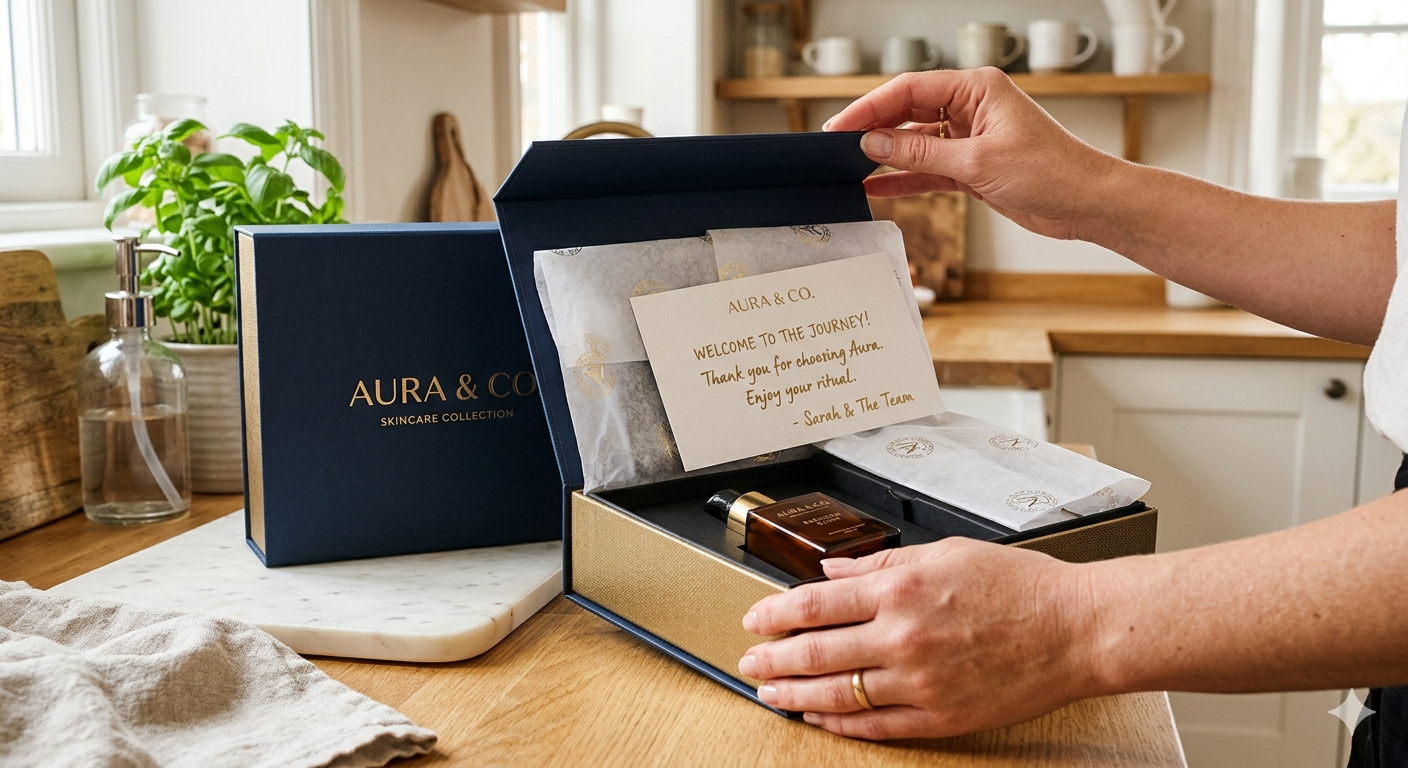
The Connected Product Unboxing Experience: First Scan, First Impression
Key Takeaways
- Brands that surface warranty registration at the unboxing moment via QR-triggered experience capture 3–4x more customer registrations than those relying on email follow-up or paper inserts.
- Roughly 80% of paper inserts are discarded within 24 hours of unboxing — the traditional warranty card and manual approach leaves the highest-intent customer moment completely wasted.
- A QR-scan registration at unboxing achieves 35–50% conversion; the same registration form sent via email 48 hours post-purchase averages 8–12%.
- Each registered customer is a direct brand relationship — not mediated by a retailer or algorithm — that enables proactive service, direct re-engagement, and measurable LTV uplift.
You have three minutes. Maybe less.
That's the window — from the moment a customer lifts the lid, slits the tape, or tears the perforation — when their attention is fully on your product and your brand. Curiosity is at its peak. Anticipation is high. They're primed to engage. And then, almost as quickly as it arrives, that window closes. The product gets set on the counter. The box goes in the bin. The paper inserts — manual, warranty card, quick-start guide — get stuffed in a drawer or tossed entirely.
| Key Metric | Paper Insert | Email Follow-up | QR at Unboxing |
|---|---|---|---|
| Registration rate | 10–15% | 8–12% | 35–50% |
| Days to registration (median) | 21+ (if at all) | 14–21 | 2–4 |
| Engagement rate (30 days post-registration) | 8–12% | 15–20% | 35–45% |
| Paper insert discard rate | ~80% within 24 hours | N/A | 0% (no paper) |
| Cost per registered customer | $2–5 | $0.50–1.50 | $0.20–0.50 |
Connected Unboxing vs. Competitors
BrandedMark is purpose-built around unboxing as the highest-intent moment in the customer lifecycle. Competing post-purchase platforms each serve a different problem: Narvar, parcelLab, and Loop Returns optimise shipping logistics — tracking updates, carrier communications, and returns processing — but do not treat unboxing as a registration conversion event. Registria manages warranty compliance and product registration programmes but does not specifically target the unboxing trigger as the primary activation moment. AfterShip focuses on reducing post-delivery tracking anxiety rather than driving product registration. BrandedMark serialises QR codes for inner packaging, builds mobile-first setup and registration experiences optimised for that specific three-minute window, and measures registration conversion rate as a primary KPI across product lines. The result is 3–4x higher registration rates than industry averages. The platform is designed specifically for the moment when customer motivation peaks — immediately after the box opens — not for logistics management or return flows.
What Most Brands Do: The Paper Insert Problem
Most manufacturers fail to capture warranty registrations at unboxing because their packaging design was built for a pre-smartphone era. A typical product box contains a shrink-wrapped booklet: a quick-start guide in eight languages, a warranty card with a URL no one types manually, and legal disclaimers no customer reads. Roughly 80% of paper inserts are discarded within 24 hours of unboxing, based on packaging engagement research across consumer electronics post-purchase studies. The warranty card ends up in a drawer or recycling bin. QR codes on the outer carton typically point to a generic product page. The customer must remember to register later — and most never do. Industry averages for warranty registration via paper or email rarely exceed 15–20%. This is not a customer engagement failure; it is a design failure. Paper inserts assume customers will engage on the brand's timeline. The connected product era requires meeting customers at their moment of peak motivation — immediately after the box opens.
What a Connected Unboxing Actually Looks Like
A well-designed connected unboxing experience begins the moment the customer opens the box. A single QR code on the inner lid carries one clear instruction: "Scan to set up your product." Scanning opens a branded mobile experience instantly — no app download, no login, no form before anything useful appears. The flow runs through five stages in under five minutes: a personalised welcome screen tied to that specific serialised unit; guided setup content formatted for mobile; frictionless warranty registration pre-populated from the QR code data; support links surfaced before any problem arises; and a light preview of spare parts and accessories. Each stage delivers value before asking for anything in return. This sequencing is why post-scan registration conversion rates of 35–50% are achievable, compared to 8–12% for email follow-up. The form is identical — the context is entirely different. The entire flow runs in a mobile browser with no friction and no dead ends.
Here's what the experience can flow through in under five minutes:
1. The Branded Welcome
A clean, full-screen welcome with the product name, a short congratulations message, and the brand's visual identity. Not a generic webpage — a serialised experience tied to this specific unit, identified by the QR code on the box. It feels personal because it is.
2. Guided Setup
Step-by-step installation or setup content — video, illustrated guides, or interactive checklists — formatted for a mobile screen. No scrolling through a 40-page PDF. No hunting for page 12 in a multilingual booklet. The customer follows along as they unpack and configure.
3. Warranty Registration
With the product already identified via the QR code, registration is frictionless. Name, email, and optional proof of purchase — that's it. No model number to locate, no serial number to squint at. The product knows what it is. The customer just confirms who they are.
4. Support Access
Before they've even encountered a problem, the customer sees where to get help. A link to troubleshooting guides, a video FAQ, or a chat channel — available from the same experience they just registered through. This is how you deflect support calls before they happen.
5. Spare Parts and Accessories Preview
A light touch. Not a hard sell. A section that says: "Here's what goes with your product" — consumables, compatible accessories, replacement filters, or extension kits. Shown at the moment of highest engagement, not in a marketing email six weeks later.
The entire experience lives in a mobile browser. No friction, no downloads, no dead ends.
The Data: Why the Unboxing Moment Is Non-Negotiable
Brands that surface warranty registration via a QR-triggered unboxing experience capture 3–4x more customer registrations than those relying on email or paper inserts, based on BrandedMark's analysis of registration conversion data across connected product deployments. The mechanism is behavioural: unboxing is the highest point of product-related motivation a customer will ever reach. They have spent money, they are holding the product, and attention is fully engaged. Motivation decays every day after that moment. A follow-up email sent 48 hours post-purchase reaches the customer after they have mentally moved on; registration rates average 8–12%. The identical registration form surfaced in-moment via QR achieves 35–50% conversion — same fields, radically different context. For a manufacturer shipping 200,000 units per year, the difference between 12% and 40% registration is 56,000 additional owned customer relationships annually. For more, see QR code product registration and optimising registration conversion.
Designing the Scan Trigger: Getting the QR Right
Three variables determine whether customers actually scan a product QR code at unboxing: placement, size, and call-to-action copy. Most brands underinvest in all three. Placement on the outer carton is the most common error — that box is handled by logistics and retail staff before the customer engages with it. The inner packaging, specifically the inner lid or flap visible the moment the box opens, is the correct location. Size must meet a minimum of 2.5 cm × 2.5 cm for reliable scanning at arm's length in varied lighting; 3–4 cm with a clear white quiet zone is the practical standard. Call-to-action copy is the most consistently overlooked variable. A QR code with no instruction converts far below one with a direct value proposition. The copy must communicate what happens after the scan — not simply prompt the action. Getting all three variables right is straightforward and each has a measurable, direct impact on scan rate.
Placement
The QR code belongs on the inner packaging, not the outer carton. The outer carton is handled by retailers, warehouses, and delivery drivers. By the time the customer sees the inner box, they're already in purchase mode. Place the code on:
- The inner lid or flap — the first thing visible when the box is opened
- The base insert or foam tray — immediately beneath the product
- A dedicated card insert positioned on top of everything else
Avoid placing it on the quick-start guide (likely to be ignored), the outer carton (wrong audience), or the product itself unless the product's form factor makes it natural and durable.
Size
The minimum scannable size for a QR code at arm's length is approximately 2.5 cm x 2.5 cm. In practice, a 3-4 cm code with a clear white quiet zone around it scans reliably across a wide range of phones and lighting conditions. Bigger is not always better — a QR code that dominates the insert can feel like a compliance label. Sized right, with breathing room, it reads as intentional and premium.
Call-to-Action Copy
This is where brands consistently underinvest. A naked QR code with no instruction converts far below one with a clear value proposition. The copy should communicate what happens after the scan, not just prompt the action.
Strong examples:
- "Scan to set up your product" — task-oriented, immediately useful
- "Scan to register and unlock your warranty" — benefit-led, action-clear
- "Scan to get started" — simple, low-friction
Avoid: "Scan me," "Learn more," or anything that sounds like a marketing prompt. The customer isn't looking for advertising at this moment — they're looking for help. Speak to that.
For deeper thinking on packaging as a communication channel, see our article on powerful unboxing design.
Designing the Post-Scan Experience
The QR code brings the customer to the door; the post-scan experience determines whether they complete registration. Four sequential stages define a high-converting flow. First, the welcome screen must confirm the product, establish that the experience is personalised, and state what happens next — all within five seconds. Serialised QR codes load correct product details automatically so customers never enter a model number. Second, guided setup addresses the most common cause of 48-hour returns: not product defects, but confidence failures. Video outperforms text for physical tasks; conditional logic routes customers to the right path for their specific model. Third, registration must feel invisible — three fields maximum, with the product already identified by the QR code. The customer confirms who they are; the system already knows what they have. Fourth, the final screen previews spare parts and accessories as a service, not a sales pitch — positioned when engagement is highest. For a detailed breakdown, see the business case for warranty registration.
Welcome: Earn Attention in the First Five Seconds
The opening screen is not the place for a brand story or a product brochure. It should confirm three things immediately: what product this is, that the experience is designed for them, and what happens next. A headline like "Welcome to your [Product Name]. Let's get you set up." does exactly that. Clean, purposeful, personal.
Serialised QR codes — where each code is tied to a unique unit — allow the experience to load the correct product details automatically. The customer doesn't enter a model number or navigate a product catalogue. The system already knows what they have.
Setup: Reduce Friction, Increase Confidence
The most common reason customers abandon a product in the first 48 hours is failed setup. Not a product defect — a confidence failure. They couldn't get it working, they didn't know where to look for help, and they gave up.
A guided setup experience embedded in the post-scan flow addresses this directly. Video performs better than text for physical assembly tasks. Numbered steps with visual confirmation ("Does your screen look like this?") outperform linear instructions. Where the product has variants or configurations, conditional logic in the experience can route customers through the right path for their specific model.
Registration: Make It Feel Invisible
By the time the customer reaches the registration step, they've already got value from the experience. They've set up the product. They're in a positive frame of mind. Registration at this stage should feel like a formality, not an obstacle.
Keep the form to three fields maximum: name, email, and optionally a purchase date or retailer. The product is already identified. The serial number is already logged. Everything else can be enriched later. Confirmation should be instant and warm — a brief acknowledgement that their warranty is active, with a summary of what comes next.
For a detailed breakdown of the registration journey, see the business case for warranty registration.
Value Preview: Plant the Seed for Future Engagement
The last screen of the unboxing flow is the highest-value screen most brands never use. The customer is registered, set up, and satisfied. This is the moment to show them what else is possible — spare parts for their product, an accessory that extends its use, a maintenance reminder they can opt into.
This is not a sales pitch. It's a service preview. The framing matters: "Here's everything available for your product" lands differently than "Buy these accessories now." One builds trust. One erodes it.
The Business Case in Summary
Replacing paper inserts with a connected unboxing experience produces four measurable financial outcomes. Warranty registration rates rise from the 12–18% typical of paper-based programmes to 35–50% with a QR-triggered mobile experience; each additional registered customer is an owned direct relationship with trackable lifetime value. Support call volume drops 20–30% when guided setup is embedded in the post-scan flow, because customers who self-serve successfully never reach the call centre. Accessory attach rates of 8–15% are achievable when a relevant offer appears at peak engagement, versus near-zero from cold email campaigns weeks later. Customer data — purchase date, product model, contact information — is captured consistently across the registered base rather than sporadically through paper returns. At scale, that registered base is the most defensible asset a product company can build: owned data, direct access, no algorithmic intermediary, and a customer relationship that began at the moment of highest motivation.
| Metric | Paper Insert | Connected Unboxing |
|---|---|---|
| Warranty registration rate | 12-18% | 35-50% |
| Support call volume | Baseline | 20-30% reduction |
| Accessory attach rate | Near zero | 8-15% |
| Customer data captured | Rarely | Consistently |
Each registered customer is a direct relationship the brand owns — not mediated by a retailer, not dependent on an algorithm. At scale, that is the most defensible asset a product company can build.
The three-minute window is real. The only question is whether you design for it.
FAQ: Connected Product Unboxing Experience
Should the unboxing QR code live on the outer box or the inner packaging?
Inner packaging—specifically on the inner lid or the first thing visible when the box opens. The outer box is handled by logistics, retailers, and delivery drivers before the customer sees it. The inner box is what the customer engages with at the moment of peak attention. Placing the code on the outer carton and requiring customers to hunt for it on the inner packaging wastes your three-minute window. A 3–4 cm QR code on the inner lid or a dedicated card insert positioned on top of the product itself converts best.
Can I retrofit an existing unboxing experience without changing my packaging?
Yes. Add a dedicated insert card positioned on top of the product, clearly visible the moment the box opens. This card carries a single QR code and a simple call-to-action: "Scan to set up your product." No packaging changes required. The insert costs pennies. The registration rate improvement is immediate. Most manufacturers test the connected unboxing with a retrofit insert first, then optimise packaging on the next production run.
What if my product doesn't naturally have an "unboxing moment"?
Some products (industrial equipment, B2B goods) don't have emotional unboxing moments. For these, the registration trigger moves to: (1) first use or installation, (2) when the customer first accesses support or manuals, or (3) when they register for a warranty claim. The same QR-scan-to-experience logic applies, just at a different moment. The key is identifying the moment of highest motivation and positioning the registration trigger there.
How do I measure whether my unboxing experience is working?
Track these KPIs: (1) scans per unit shipped, (2) registration rate among those who scan, (3) time from scan to registration completion. If you're seeing >40% of scans converting to registrations within 48 hours, your unboxing experience is working. If conversion is under 20%, test a different QR placement, call-to-action copy, or post-scan experience. Iteration is rapid; most brands find their optimal unboxing formula within 3–4 product runs.
Start With One Product
The entry point to a connected unboxing programme is a single product — one QR code, tied to one product line, pointing to one well-designed mobile experience. No platform overhaul, no packaging redesign from scratch. BrandedMark's Experience Designer allows the full post-scan flow — welcome screen, setup guide, registration form, support links, spare parts catalogue — to be configured visually and deployed to a serialised QR in minutes, without writing a line of code. When units ship, every product carries a code that launches the correct experience for that specific model, in the right language, with the right content, automatically identified by the serial number embedded in the QR. Most manufacturers pilot with a single SKU, measure the registration rate improvement within the first production run, and then roll out across their product range. The investment is minimal; the measurement is immediate. Explore how BrandedMark handles connected product registration — and what the post-scan experience looks like when it's designed to convert.