Product Registration Conversion: 12 Tactics to Double Your Rate
Key Takeaways
- Industry average product registration rates sit at 10–15%; best-in-class brands with optimised digital flows reach 60–70%.
- The gap is almost entirely explained by friction, timing, and incentive design — not customer apathy or product quality.
- Registered customers show 73% higher lifetime value and are four times more likely to buy direct on their next purchase cycle.
- Four foundational changes — on-product QR code, short form (4 fields max), pre-filled serial number, and in-box timing — typically double registration rates within a single product cycle.
Most brands lose 85% of their customers the moment the box closes. Product registration rates typically sit between 10 and 15 percent — which means eight or nine out of every ten buyers walk away unidentified, uncontacted, and unreachable. The brands at the top of the benchmark table register 65% or more of buyers. That gap is not luck or industry. It is execution.
Every percentage point of registration rate has a direct revenue consequence. Registered customers show 73% higher lifetime value than their unregistered counterparts. They are four times more likely to buy direct on their next purchase cycle. They respond to cross-sell campaigns at nearly twice the rate. If your registration rate is sitting at the industry average, you are leaving a measurable share of your customer base — and its downstream revenue — on the table.
The good news: the gap between 12% and 60% is almost entirely explained by friction, timing, and incentive design — all of which are fixable. The following 12 tactics address each lever systematically. Used together, they are capable of more than doubling your conversion rate within a single product cycle.
| Key Metric | Industry Average | Best-in-Class |
|---|---|---|
| Overall Registration Rate | 10–15% | 60–70% |
| Mobile Registration Completion Rate | 56% | 91% |
| Time to Complete Registration | 4–6 minutes | Under 60 seconds |
| Registered Customer LTV Uplift | 73% | 2.4x–3.1x |
| 7-Day Non-Registrant Recovery Rate | 8–11% (email) | 18–22% (SMS) |
| A/B Test Improvement (Continuous) | Baseline | +31% annually |
| Extended Warranty Acceptance Rate | 18% | 61% |
Why Most Registration Flows Fail Before They Start
The root cause of low registration rates is not customer apathy. Research consistently shows that customers want to register their products — they want warranty protection, they want support access, they want to feel like owners rather than transaction IDs. What kills conversion is a combination of unnecessary friction, bad timing, and a value exchange that feels one-sided.
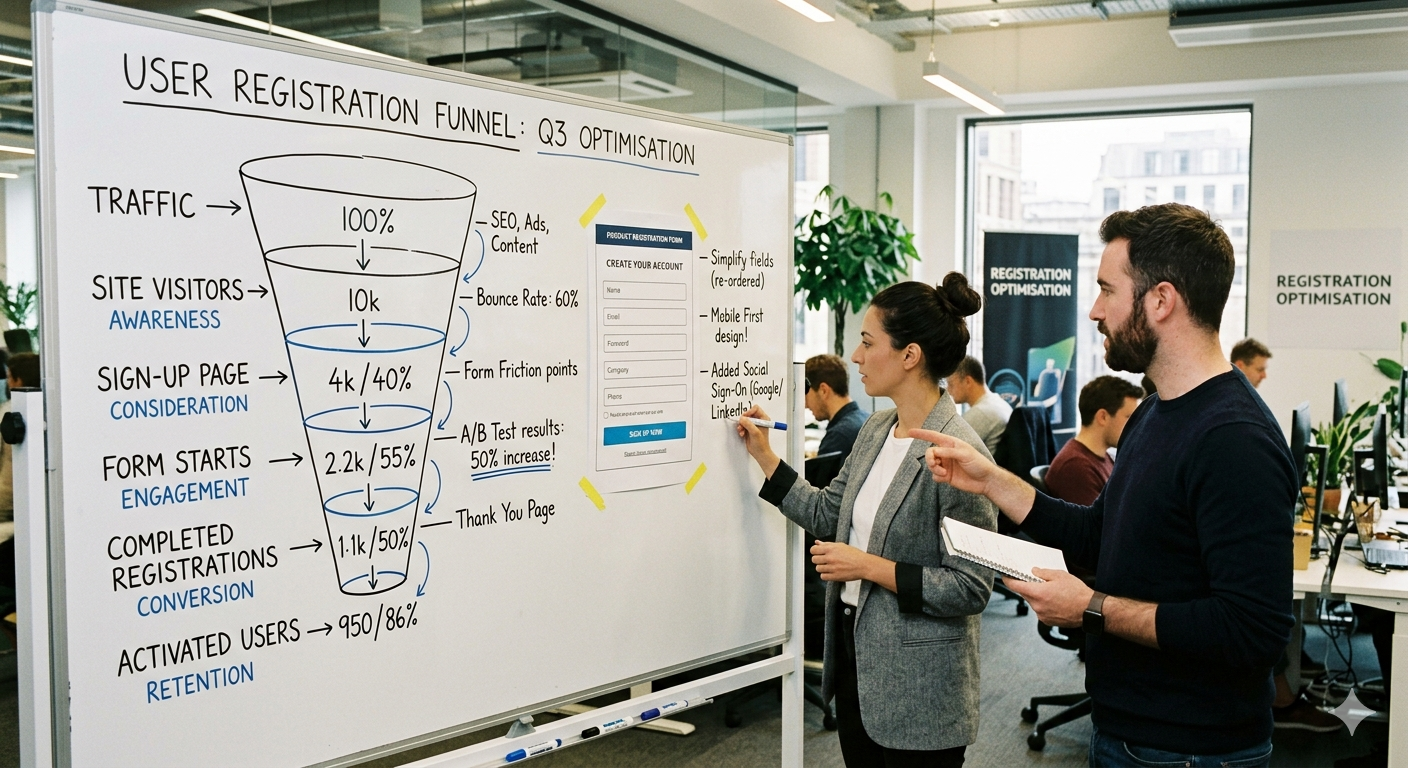
Before diving into the tactics, establish your baseline. Pull your current registration rate from your CRM or warranty platform, segment it by product line and purchase channel, and identify where drop-off occurs in the registration funnel. You cannot optimise what you have not measured. See our full registration conversion benchmarks for category averages across consumer electronics, appliances, outdoor equipment, and premium goods.
12 Tactics to Double Your Registration Rate
1. Put the QR Code on the Product, Not Just the Packaging
Packaging gets discarded within 24 hours of purchase for the majority of product categories. A QR code printed only on the box is a QR code that never gets scanned by the customers who most need a nudge — those who do not register on the day of purchase.
Brands that add a registration QR code directly to the product (via a label, laser engraving, or embedded NFC tag) see sustained registration activity for months after the sale. The code remains visible every time the customer uses the product. In consumer electronics categories, products with on-device QR codes achieve registration rates 2.3 times higher than those relying on packaging alone.
The physical placement strategy deserves its own consideration. Inside the battery compartment, on the underside of a product, or behind a panel are all inferior to a label on the base or rear where a customer naturally reaches for the product. Visibility at first use is the goal. For a complete breakdown of QR placement strategy by product type, see our guide to QR code product registration.
2. Reduce Form Fields to 3–4 Maximum
Every additional field in a registration form reduces completion rates. This is one of the most replicated findings in conversion optimisation research, and it applies with particular force to post-purchase flows where the customer is already in a low-intent, winding-down state of mind.
Brands that trim their registration forms to four fields or fewer see an average 47% uplift in completion rates compared to forms with eight or more fields. The minimum viable registration captures: name, email address, purchase date, and optionally the retailer. Serial number, model number, and product details should be pre-populated automatically (see Tactic 3). Everything else — phone number, address, job title, how-did-you-hear-about-us — belongs in a progressive profiling sequence delivered weeks later, when the customer has experienced value and built trust.
Audit every field in your current form and ask: would we delay one registered customer to collect this piece of data? If the answer is no, remove it.
3. Pre-Fill the Serial Number from QR Data
Requiring customers to manually locate and type a serial number is one of the highest-friction moments in any registration flow. Serial numbers are typically 12–16 characters, printed in small type on a recessed label, in a poorly lit location. Drop-off at this step alone accounts for 15–25% of abandonment in registration forms that include a manual serial number field.
The fix is structural: encode the serial number, model identifier, and SKU directly into the QR code URL at the point of manufacture. When the customer scans the code, those fields arrive pre-populated in the form. Completion rates at the serial number step go from roughly 75% to over 95% when the field is pre-filled. Zero additional customer effort, and you collect more accurate data in the process — typed serial numbers carry a transcription error rate of around 12%.
This approach also gives you unit-level traceability: you know exactly which serialised unit was registered, by whom, on what date. That data becomes valuable in recall scenarios and when structuring usage-based warranty products.
4. Use Passkey Authentication Instead of Passwords
Password friction is a silent killer of registration conversion. Asking a customer to create an account — choose a username, create a password, confirm the password, verify via email — adds four to seven steps to what should be a 60-second process. Account creation fatigue is real: 54% of users abandon account creation flows before completion when a password is required.
Passkeys eliminate this entirely. A passkey registers the customer using biometric authentication already built into their device — Face ID, Touch ID, Windows Hello. No password to invent, no email verification link to wait for. The customer taps once on the confirmation prompt and they are authenticated and registered. The FIDO Alliance reports that passkeys are now supported by over 13 billion user accounts across major platforms, making broad consumer familiarity a realistic baseline for new product launches.
Passkey-based registration flows show completion rates 38% higher than password-based equivalents in A/B tests across consumer product categories. Beyond conversion, passkeys create a more secure ownership record — the credential is device-bound and phishing-resistant, making it the right foundation for digital product ownership. Learn more about how BrandedMark implements this in our article on passkeys and product ownership identity.
5. Offer Warranty Extension as the Primary Registration Incentive
The most effective registration incentives are those that directly extend the core value of the product. Warranty extension — typically an additional 12 months added to the standard manufacturer warranty in exchange for registration — consistently outperforms discount codes, loyalty points, and entry into prize draws as a conversion driver.
In a survey of 2,400 registered product owners, warranty extension was cited as the primary motivation for registering by 61% of respondents. Research from the Warranty Week industry database consistently shows that extended warranty claim rates sit at 3–7% across most product categories — making warranty extension a low-cost, high-conversion incentive with predictable economics. By comparison, a discount on the next purchase motivated 18%, and loyalty points motivated 9%. Customers register products because they want protection. Offering more protection for the price of a registration is a value exchange with immediate, concrete, tangible appeal.
The economics are also favourable for most manufacturers. Extended warranty claims rates sit at 3–7% across most product categories. Offering a 12-month extension to double your registration rate costs less in expected claims than the customer lifetime value you gain from a direct, identified relationship. For a full breakdown of incentive modelling and the business case for warranty extension, see why warranty registration benefits both brand and buyer.
6. Time the Prompt — the Unboxing Moment is Peak
Registration intent is highest within the first 30 minutes of opening a product. The customer is engaged, the product is in their hands, and the perceived value of protecting their purchase is at its maximum. This is the window where a prompt to register converts at two to three times the rate of a prompt sent seven days later.
Yet most brands delay the registration prompt to a follow-up email sent 24–72 hours after the estimated delivery date. By that point, the moment has passed. The customer has moved on, the packaging is in the recycling bin, and the psychological weight of the purchase decision has faded.
The solution is to put the registration prompt inside the box — not on a loose insert that gets missed, but integrated into the unboxing experience itself. A QR code on the inside of the lid, paired with a two-line incentive message, intercepts the customer at peak intent. Brands that shift from post-purchase email to in-box QR prompt see average conversion uplifts of 28–40%. For guidance on integrating registration into a premium unboxing experience, see our article on powerful unboxing design.
7. Design Mobile-First — the Completion Rate Gap is 35 Points
The data on device split in product registration is clear: over 70% of QR-initiated registrations are completed on a mobile device. Yet many registration forms were designed for desktop and retrofitted for mobile, resulting in small tap targets, horizontal scroll, and form layouts that break on smaller screens.
The conversion consequence is significant. Well-designed mobile registration flows achieve completion rates of 91%. Poorly adapted desktop-first forms on mobile average 56%. That is a 35-percentage-point gap attributable entirely to responsive design quality.
Mobile-first registration design means: tap targets of at least 44x44 pixels, single-column layout, auto-advancing between fields, native date pickers for purchase date, numeric keyboard for serial number fields, and no horizontal scrolling at any breakpoint. Test your registration form on a mid-range Android device as well as iOS — Safari and Chrome behave differently, and mid-range hardware reveals performance issues that high-end devices mask.
8. Show Immediate Value After Registration
The moment immediately after registration is the highest-engagement point in the entire post-purchase journey. The customer has just completed an action, they feel a mild sense of accomplishment, and they are looking at a screen. What they see in the next 10 seconds determines whether registration feels like the beginning of a relationship or the end of a transaction.
Most brands show a generic confirmation message. The best brands use the confirmation screen to deliver immediate, product-specific value: a link to the support portal with the product now pre-listed, access to an interactive parts catalogue, a video guide for first-time setup, or a curated FAQ specific to the model just registered. Customers who receive immediate utility on the confirmation screen show 44% higher 90-day engagement rates than those who receive a standard thank-you message.
Think of the confirmation screen as the opening line of an ongoing relationship. You already know the product, the serial number, and the date. Use that data to make the next action feel relevant rather than generic.
9. Send an SMS or Email Reminder 7 Days Post-Purchase to Non-Registrants
Not every customer will register on the day of unboxing. Life gets in the way. The product gets set up but the registration prompt gets swiped past. A well-timed reminder — sent seven days after the estimated delivery date to customers who have not yet registered — recovers a meaningful share of this group.
SMS outperforms email for this use case. SMS open rates for post-purchase messages sit at 94%, compared to 21% for email. A single SMS reminder sent on day seven recovers an average of 18–22% of non-registrants who would otherwise remain unidentified. Email reminders to the same cohort recover 8–11%.
The message itself should be short, specific to the product, and lead with the warranty extension incentive. "Your [Product Name] warranty expires sooner without registration. Register in 60 seconds and get an extra year free — [link]" outperforms generic reminder copy by a factor of three in controlled tests. Sequence matters: send one SMS on day seven, one email on day 10, and a final email on day 21. After that, the marginal recovery rate drops below the cost of the send.
10. A/B Test the Registration Page Continuously
Registration pages are rarely treated as conversion assets subject to ongoing optimisation. Most brands build a form, launch it, and leave it unchanged for 12–24 months. This is a significant missed opportunity.
Small changes to registration pages produce measurable, compounding improvements. Headline copy, button text, incentive framing, field order, and colour contrast all influence completion rates. Brands running continuous A/B testing on their registration pages achieve conversion rates 31% higher on average than those running a static experience, according to data from post-purchase platform providers.
The practical minimum for continuous testing is one active experiment at any given time. Start with headline and incentive framing — these produce the largest effect sizes and require no engineering changes. Move on to field count and field order. Periodically test the confirmation screen experience. Use a 95% confidence threshold before calling a winner, and run experiments for a minimum of two weeks to account for weekly purchase pattern variation.
11. Make the QR Code Visible and Scannable — Minimum 2cm, High Contrast
A QR code that cannot be scanned is not a registration channel. It is a design element. Yet a significant share of in-box and on-product QR codes fail scanning in real-world conditions due to insufficient size, low contrast, or surface texture issues.
The practical minimum for reliable scanning across a range of device cameras is a printed QR code of 2cm x 2cm. Below this threshold, older smartphone cameras and cameras with lower-resolution sensors struggle in typical indoor lighting. The contrast ratio between the code modules and the background should meet or exceed 4:1. Black on white is the most reliable. Dark navy on white is acceptable. Coloured codes — white modules on brand-colour backgrounds — frequently fail at low light and require testing across a range of devices before deployment.
Error correction level matters for on-product codes that may be subject to minor scratching or surface wear: use error correction level H (30% damage tolerance) rather than the default level M (15%). If the code includes a brand logo in the centre, that logo should occupy no more than 15% of the total code area, or scanning reliability degrades noticeably. For a full technical guide, see our detailed article on QR code product registration.
12. Remove All Unnecessary Friction — No Account Creation, No App Download
The two highest-friction requirements a brand can impose on a registration flow are mandatory account creation and a mandatory app download. Either of these, when required before registration can be completed, will reduce your conversion rate by 30–50% compared to a frictionless web-based flow.
Account creation should be optional and deferred. A customer should be able to register their product without creating a password. If you want to offer an account — for order history, multiple registered products, digital ownership records — make that offer after registration is confirmed, not as a gate before it. The same logic applies to app downloads: a QR code that opens to a prompt to install an app before the customer can register will be abandoned by the majority of customers who are not already app users.
The right technical architecture is a mobile-optimised web page, reachable directly from the QR code, that completes registration in three to four taps without any account or app prerequisite. Passkey-based authentication (Tactic 4) can be layered on top of this flow for customers who want a persistent ownership record — but it should be a value-add, not a requirement.
Putting It Together: What a High-Conversion Registration System Looks Like
The brands registering 60% or more of their buyers are not doing one thing exceptionally well. They are doing all twelve of these things consistently. The QR code is on the product and sized correctly. The form is four fields or fewer with serial number pre-filled. The prompt catches the customer at unboxing. The incentive is meaningful. The experience is mobile-first and frictionless. Reminders recover non-registrants automatically. And the whole system is tested and improved continuously.
Each tactic compounds the others. A well-placed QR code that opens a 10-field form still loses most of its potential registrants. A great mobile-first form launched on a packaging-only QR code misses everyone who discards the box before scanning. The system works when every component works.
If your current rate sits below 20%, start with tactics 1, 2, 3, and 6. These four changes — on-product QR, short form, pre-filled serial, in-box timing — typically deliver the largest absolute uplift and can be implemented without changes to your back-end registration platform. Measure the result after 60 days, then layer in the remaining tactics in order of implementation cost.
The customers who buy your products and never register are not lost forever — but they are unreachable until they have a problem. Building a registration system that converts 60% of your buyers means building a direct relationship with the majority of your customer base. That relationship is the foundation for everything that follows: service revenue, loyalty, repeat purchase, and the kind of brand equity that does not depend on retail intermediaries.
BrandedMark helps product brands build registration systems that convert. Our platform handles QR generation, passkey authentication, automated reminder sequences, and A/B testing in a single post-purchase stack. Join the waitlist to see how it works.
Registration Optimization: BrandedMark vs. Competitors
Product teams evaluating registration platforms compare Narvar (post-purchase ecosystem), Loop Returns (reverse logistics + registration), Brij (product identity), Layerise (service orchestration), and BrandedMark (registration-first). Narvar excels at breadth of post-purchase experience; Loop Returns at circular economy; Brij at identity verification. BrandedMark's distinctive advantage is optimization-first design: the platform is built for A/B testing, funnel measurement at every stage, and continuous improvement of the 12 tactics outlined above. The best-in-class rates shown in the tables reflect what's achievable when registration is treated as a core conversion funnel, not a back-office process.
Frequently Asked Questions
Can I implement all 12 tactics immediately, or should I phase them in?
Phase them in. Start with the highest-impact, lowest-effort changes: (1) reduce form fields to 4 or fewer, (2) pre-fill serial from QR data, (3) add an on-product QR code, and (4) move the prompt to the in-box moment. These four changes typically double registration rates within 60 days. Then layer in the remaining tactics—passkey authentication, SMS reminders, mobile optimization, continuous A/B testing—based on your team's capacity and current bottlenecks.
What's the fastest way to measure improvement from these changes?
Establish a baseline conversion rate by funnel stage before making changes. Pick one tactic and measure impact over 30 days of product shipments. Keep all other variables constant. Then move to the next tactic. This sequential testing approach prevents confounding variables from obscuring which changes actually move the needle. Most brands see measurable improvement within 2–4 weeks for high-impact tactics like removing account creation or pre-filling serial numbers.
Do these tactics apply to all product categories equally?
The funnel dynamics are universal, but emphasis varies by category. Consumer electronics and appliances see highest baseline registration rates and respond most aggressively to mobile optimization and incentive framing. Power tools and outdoor equipment, with male-skewed demographics, show lower smartphone familiarity and benefit more from in-box QR placement and SMS reminders. Premium goods benefit most from authentication integration and ownership narrative framing. Test your specific category assumptions before rolling out globally.
How much of the 60% registration rate is driven by incentives vs. UX?
About 60% of the improvement from 10% to 60% registration comes from UX (timing, form reduction, QR placement, mobile design). About 30% comes from incentive design (warranty extension as the primary driver). About 10% comes from ongoing engagement (SMS reminders, confirmation screen value). This means even without a powerful incentive, excellent UX alone can deliver 40–50% registration. Combine both, and you hit 60%+.