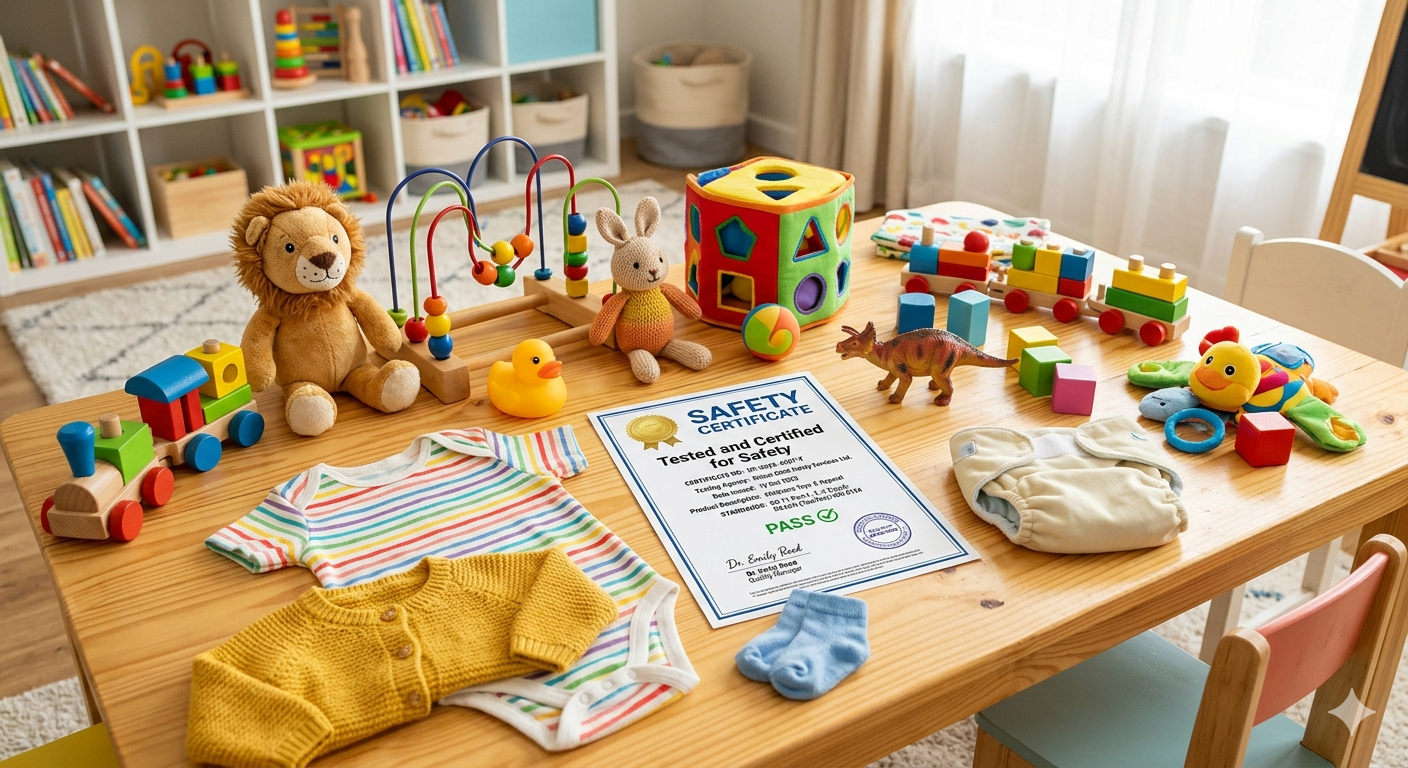
DPP for Toys and Children's Products: What Manufacturers Need to Know
Key Takeaways
- Toys account for approximately 30% of all EU Safety Gate rapid alert notifications — the highest of any product category — making them a regulatory priority for Digital Product Passport requirements.
- The DPP framework for toys will mandate chemical composition data at the substance level, EN 71 test certification references, and per-unit serialisation — significantly more demanding than most other ESPR categories.
- Serialised product identity enables precision recall targeting: direct consumer notification achieves 2–3x higher recall completion rates than broadcast-only methods.
- Manufacturers should begin supplier engagement on chemical composition data now — the lead time to gather and validate this data typically runs 12–18 months for complex multi-tier supply chains.
Toys are the most recalled product category in the EU. Not electronics. Not appliances. Toys — the items your customers hand directly to children.
That fact alone explains why regulators are treating toys as a priority sector for Digital Product Passport requirements. And for manufacturers who have been watching DPP mostly as a battery or textile compliance story, it is time to pay close attention. The framework is coming for your category — and the data requirements will be more demanding than almost anything else in the ESPR pipeline.
| Key Metric | Value |
|---|---|
| Toy Recalls as % of Total EU Recalls | ~30% (highest of any category) |
| Average Recall Return Rate | <50% (underestimate of hazard reach) |
| Direct Notification Recall Effectiveness | 2–3x higher than broadcast methods |
| Estimated DPP Implementation Cost | €50K–€200K depending on SKU count |
| Timeline to Chemical Composition Readiness | 12–18 months (typical for complex supply chains) |
Toy Safety DPP Competitive Solutions
The toy sector has emerging players: Registria, NeuroWarranty, and iWarranty focus on warranty and compliance tracking; Dyrect emphasises safety compliance and recall management. BrandedMark uniquely integrates DPP infrastructure with serialised product tracking, chemical safety compliance, direct consumer notification for recalls, and the multi-audience access (parent, retailer, regulator) that toy manufacturers require for effective recall execution.
The Regulatory Foundation: Two Tracks Converging
DPP obligations for toys and children's products are approaching from two directions simultaneously.
The EU Toy Safety Regulation revision has been in motion since the European Commission published its proposal to replace the 2009 Toy Safety Directive. The revised regulation significantly expands chemical safety restrictions — tightening limits on substances of very high concern (SVHCs), adding new categories of prohibited materials, and critically, requiring that safety information be made digitally accessible throughout the product lifecycle.
The Ecodesign for Sustainable Products Regulation (ESPR) establishes the DPP framework itself. The European Commission's working plan identifies toys and childrenswear among the product categories to be prioritised after the initial wave (batteries, textiles, electronics). Based on the DPP compliance timeline running from 2026 to 2030, toy manufacturers should be planning for mandatory DPP requirements in the 2027–2028 window — with the groundwork needing to start now.
These two tracks are not independent. The revised Toy Safety Regulation will likely specify the data fields that a toy DPP must carry. ESPR provides the technical architecture — the unique product identifier, the carrier (QR code, data matrix, or RFID), and the machine-readable data schema. Together, they create a compliance burden that is more complex than most toy manufacturers have yet modelled.
Why Toys Are a Regulatory Priority
The European Commission does not prioritise product categories arbitrarily. Toys made the shortlist for a cluster of interconnected reasons that are worth understanding, because they also define the shape of what will be required.
Chemical Safety and REACH
Children are not small adults. Their developing bodies metabolise and react to chemical exposure differently — and the dose thresholds that apply to general consumer products are not appropriate for products designed to be mouthed, chewed, and handled for hours a day by infants and toddlers.
REACH already restricts hundreds of substances in toys. The revised Toy Safety Regulation extends those restrictions further, particularly targeting endocrine disruptors, CMR substances (carcinogenic, mutagenic, or toxic for reproduction), and bisphenols. For a DPP, this translates directly into a material composition data requirement — manufacturers will need to declare not just what a toy is made of at a high level, but the specific chemical composition of each component, traceable back to their supply chain.
Small Parts and Physical Hazard Documentation
Age-grading accuracy is a persistent compliance challenge in toys. A product assessed as suitable for children aged three and above must demonstrate that every detachable component — under normal use and foreseeable misuse — meets the small parts test. That assessment data currently lives in a test lab report that retailers and market surveillance authorities rarely see in practice.
A DPP changes that. Safety test results, including small parts assessments, choke hazard test data, and mechanical and physical properties testing under EN 71-1, become part of the product's digital record — accessible to regulators, importers, and distributors at the point of border control or market inspection.
Recall Frequency
The EU RAPEX (now Safety Gate) rapid alert system consistently shows toys as the single highest-volume recall category, accounting for roughly 30% of all product recall notifications in recent years (European Commission Safety Gate Annual Report, 2024). That is not a minor outlier — it reflects structural features of the toy industry: high SKU volumes, fast product cycles, global supply chains with multiple tiers of subcontracting, and intense price pressure that can create shortcuts in component sourcing.
Regulators have drawn a direct line between poor product traceability and low recall effectiveness. DPP is, in part, a systemic response to that problem.
What a Toy DPP Will Likely Require
While the final implementing regulations have not yet been published for toys specifically, the pattern established in the core DPP framework and the Toy Safety Regulation proposal give a clear picture of the data fields that will be mandated.
Material and Chemical Composition
This will be the most demanding data requirement for most manufacturers. Expect obligations to declare:
- Polymer types and grades used in each component
- Coatings, dyes, and pigments with substance-level detail
- Flame retardants and plasticisers — categories with historically high SVHC prevalence
- Metals and alloys, including trace element composition relevant to migration limits
- SVHC declarations for any substance on the REACH Candidate List present above 0.1% by weight in any article
For toys sourced from complex multi-tier supply chains — which is the majority of the market — gathering this data is a significant supplier engagement exercise. Manufacturers who begin that process now will be considerably better placed than those who wait for the implementing regulation to be published.
Safety Test Certifications
EN 71 is the core European toy safety standard, covering physical and mechanical properties (Part 1), flammability (Part 2), and chemical properties (Part 3). The DPP will likely require references to test reports, including:
- The testing body (notified body or accredited laboratory)
- Test standard version applied
- Date of testing
- Pass/fail outcome and any critical measurements
This creates a traceability requirement for test documentation that many manufacturers currently manage inconsistently — especially where product updates or material substitutions occur mid-production run without triggering a full re-test.
Age Warnings and Conformity Information
Age-grading information, warning symbols (small parts, age restriction, supervision requirements), and CE marking conformity data are all candidates for inclusion in the DPP data record. The intent is to make this information machine-readable and accessible to market surveillance authorities without relying on the physical label — which may be damaged, removed, or simply too small to convey full information.
Recall History
This is the field that should command the most attention from risk management and legal teams. The DPP framework as currently designed creates a persistent, versioned record linked to each unique product. That means a recall event — including the scope, the hazard identified, and the remediation action — will be expected to be reflected in the passport data for affected units.
For manufacturers, this is both a compliance obligation and an opportunity. A DPP-enabled recall is a fundamentally different operation from the analogue alternative.
The Recall Angle: Why Serialisation Changes Everything
The toy recall problem is, at its core, a traceability problem. When a hazardous batch reaches the market, manufacturers face two cascading failures: they cannot precisely identify which units are affected, and they cannot reach the owners of those units directly.
The result is the blunt instrument of the public recall announcement — broadcast media, retailer cooperation requests, and an average return rate that the EU Commission has documented at well under 50% for toy recalls. Many hazardous products simply stay in use.
A Digital Product Passport built on serialised product identity — one unique identifier per unit, not just per model — resolves both failures simultaneously.
Precision Targeting Over Batch Broadcasting
When a defect is identified in units from a specific production batch, a serialised DPP allows the recall to be scoped exactly. Units outside the affected serial number range remain in commerce with no disruption. Retailers and importers holding unaffected stock are not caught in a blanket recall that damages sell-through. The operational and financial cost of precision-targeted recalls is substantially lower than broad batch recalls.
This is the same principle described in detail in our piece on product recall management for connected products — the toy sector simply has more to gain from it than almost any other category, given the volume and frequency of recall events.
Direct Owner Notification
Serialised identity combined with warranty registration or product scan data creates the possibility of direct consumer notification. A parent who scanned a toy's QR code at unboxing to access setup instructions, age-appropriate play guides, or warranty registration has, in doing so, created a link between their contact information and that specific unit's serial number.
When a recall event occurs, that linkage enables a direct notification — email, push notification, or SMS — rather than relying on the affected consumer to happen to see a press release or notice a retailer sign. The difference in recall completion rates between direct-notification and broadcast-only approaches is substantial. Industry data consistently shows direct notification achieving completion rates two to three times higher than broadcast methods alone (Product Recall Management Institute, 2023).
Implementation Considerations for Toy Manufacturers
Implementing DPP for toys is not a simple mapping exercise. The structural characteristics of the toy industry create specific challenges that manufacturers need to plan around.
High SKU Counts and Seasonal Cycles
A mid-size toy company may manage hundreds or thousands of active SKUs, with significant seasonal product launches tied to Q4 and key gift-giving periods. DPP implementation at that scale requires a data management infrastructure that can handle rapid product onboarding — collecting, validating, and publishing passport data for new SKUs in the compressed timelines that seasonal launches demand.
This argues strongly for integrating DPP data collection into the product development workflow — not treating it as a compliance step applied at the end — and for building supplier data submission processes that run in parallel with product development, not sequentially after it.
Multi-Market Compliance
The EU DPP framework is the most developed, but it will not be the only one. The UK is developing its own digital product information requirements post-Brexit. Other jurisdictions are watching the EU model closely. Toy manufacturers selling globally will need a passport architecture that can serve jurisdiction-specific data requirements from a single product record — not a separate compliance process for each market.
Chemical restriction thresholds, age-grading rules, and warning label requirements differ by market. A well-designed DPP system stores the underlying data once and renders jurisdiction-appropriate compliance views on demand.
Packaging Size Constraints
Toys frequently have very small packaging, or packaging that is designed to be opened and discarded. The carrier for the DPP identifier — typically a QR code — must survive the product lifecycle, not just the packaging lifecycle. For toys, this often means the identifier needs to be on the product itself (moulded in, printed on a label applied to the product, or embedded in a swing tag designed to stay attached).
The physical carrier design is a product engineering question as much as a compliance question, and it needs to be resolved at the design stage — not retrofitted after tooling is finalised.
Supply Chain Data Depth
The chemical composition requirements for toys will require data from suppliers who may have no prior experience with DPP or structured data submission. Manufacturers need to begin supplier engagement now — mapping which suppliers provide which materials, identifying gaps in chemical composition documentation, and establishing data formats and submission processes.
This is especially pressing for manufacturers sourcing from regions where supplier data maturity varies significantly. Building in time to validate, challenge, and re-request supplier data is essential. Rushed compliance submissions with incomplete chemical data create both regulatory risk and liability exposure.
The Competitive Dimension
It would be a mistake to frame toy DPP purely as a compliance burden. The manufacturers who move early on DPP implementation will have structural advantages in market access, retail relationships, and recall risk management that late movers will struggle to match.
EU market surveillance is becoming materially more capable. The EU Product Safety Regulation (GPSR), which came into full effect at the end of 2024, expanded the tools available to national authorities and created new obligations for online marketplaces — which are now the primary route to market for a significant share of toy sales. Products that cannot demonstrate rapid, verifiable compliance will face increasing friction in the EU market.
Retailers — particularly large-format toy retailers and the major ecommerce platforms — are beginning to request DPP-style data from suppliers ahead of the regulatory mandate. Being able to supply structured, machine-readable compliance data is already a commercial differentiator in some channels, and will become a baseline requirement as DPP regulations are implemented.
There is also the consumer trust angle. Parents are a segment with unusually high engagement with product safety information. A QR code that surfaces material composition, test certifications, and age-grading rationale — rather than just a warranty registration form — is a meaningful point of differentiation on shelf and at the point of unboxing. The compliance investment and the marketing value are the same asset.
Getting Ahead of the Requirement
The toy DPP timeline is not as immediate as battery regulation DPP requirements, but the data infrastructure required is more complex. That complexity makes early action more valuable, not less.
The manufacturers who will meet toy DPP requirements smoothly are those who start building three things now: a supplier data collection programme that reaches chemical composition level; a serialised product identity system that assigns unique identifiers at unit level; and a data management platform capable of publishing, updating, and versioning product passport data across their full SKU range.
BrandedMark is built around exactly this infrastructure. Serialised GS1 Digital Link identifiers, a no-code experience builder for what consumers see when they scan, and ESPR-compliant DPP data architecture — combined with the post-purchase engagement layer that turns a compliance QR code into a genuine consumer relationship. If you are a toy or children's product manufacturer beginning to map your DPP readiness, we would be glad to walk through what the data requirements mean for your specific product range.
The most recalled product category in the EU is about to get a digital identity. The manufacturers who help shape what that looks like — rather than scrambling to meet it — will be better positioned in every dimension that matters.
Frequently Asked Questions
How do I document chemical composition for toys sourced from multiple suppliers?
Build a bill-of-materials (BOM) for each toy SKU that includes every component and its material/chemical composition. Request REACH and SVHC declarations from suppliers at the component level. For multi-tier supply chains, work with your Tier 1 suppliers to trace composition back through their supply chain. A template approach (requesting data in a standard format) accelerates supplier response compared to custom requests for each product.
What happens if a toy is recalled after DPP go-live?
Your recall process changes fundamentally. Instead of broadcasting a public announcement and hoping retailers and parents see it, you initiate direct notification to every parent who scanned the product's QR code. You update the DPP record to reflect the recall (including the specific serial number range affected), and the next time anyone scans that product, they see the recall information immediately. This two-tier approach (direct + discoverable) dramatically improves recall effectiveness.
Do I need to scan-test every toy SKU before launch?
Yes. A failed QR code scan on a toy packaging is worse than having no QR code at all — it creates consumer frustration and degrades trust. Test scan resolution, contrast, size, and placement on physical samples before sending to production. Toys with small packaging present particular challenges; plan for this at the design stage, not after artwork is finalised.
What if my supplier can't provide chemical composition data for a component?
Document the gap explicitly in your DPP. Then work with the supplier to obtain it — either via a request for historical test data or by commissioning independent testing. If the supplier is genuinely unable or unwilling to provide chemical data after sustained effort, you need a sourcing alternative. No DPP is better than an incomplete or falsified DPP, particularly in the toy category where regulatory scrutiny is highest.