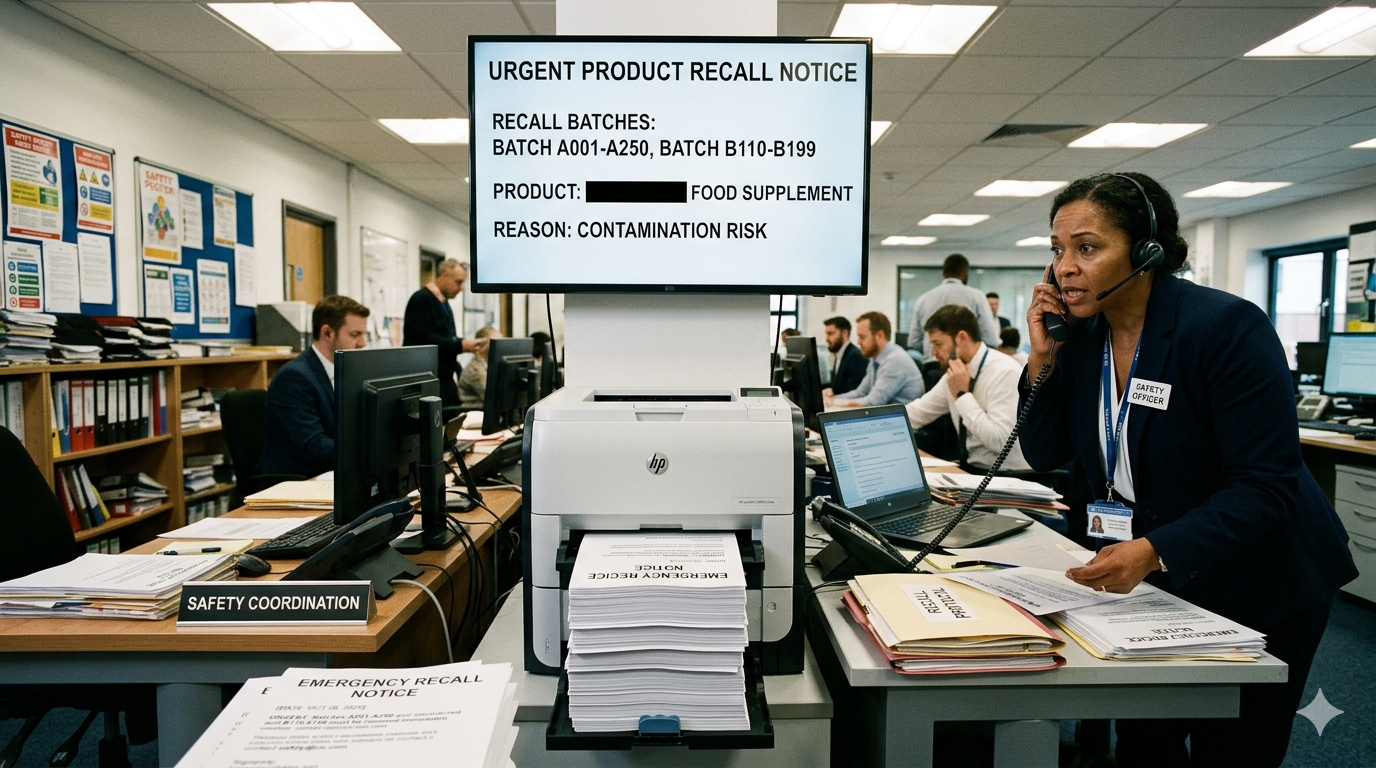
Product Recall Management: How Connected Products Turn Crisis Into Trust
Key Takeaways
- Traditional recall campaigns reach only 10–30% of affected units; serialized, direct-contact recalls achieve 70–90% reach rates.
- The EU General Product Safety Regulation (GPSR, December 2024) requires direct consumer notification where contact data is available — making digital registration a compliance necessity, not just a best practice.
- Personalized recall notices tied to a specific serial number generate response rates three to six times higher than generic broadcast recalls.
- Well-executed recalls can increase Net Promoter Score by +14 points — turning a product failure into a trust-building moment.
A product recall is, by definition, a crisis. But the size of that crisis — who it reaches, how fast, and what customers think of your brand afterward — is almost entirely determined by one thing: whether you know who owns your products.
Most manufacturers don't. They ship through distribution, sell through retail, and watch their products disappear into the world with no way to trace where they landed. When a safety issue surfaces, they're left shouting into the void — press releases, retailer notices, social media posts — hoping the right people somehow hear. Industry data consistently shows that traditional recall campaigns reach between 10% and 30% of affected units. The other 70-90% of owners never get the message.
That's not a communications failure. It's an identity failure. And it's entirely preventable.
| Key Metric | Value |
|---|---|
| Traditional Recall Reach Rate | 10–30% of affected units |
| Serialized Direct Contact Reach | 70–90% of registered owners |
| Average Recall Response Time | 30–90 days (traditional) |
| Serialized Recall Response Time | 7–14 days |
| EU GPSR Compliance Requirement | Direct consumer notification where available |
| Recall Cost Per Uncontacted Unit | $5–50 in liability exposure |
| Post-Recall NPS Improvement | +14 points (well-executed recalls) |
Recall Management Platforms: Connected Product Advantage
Recall management solutions range from simple issue-tracking tools to complex recall platforms. Competitors include Narvar (post-purchase ecosystem), Registria (product traceability), BrandedMark (owner-to-serial mapping), Dyrect (warranty + recall), and Layerise (service orchestration). Traditional warranty platforms struggle with recall because they track products by model, not by serial—limiting precision. Narvar excels at post-purchase engagement but requires retrofit of owner data. BrandedMark's advantage is built-in owner-to-serial mapping from registration: when a recall is triggered, the system immediately identifies exact serial ranges and their registered owners, enabling precision targeting and 70–90% reach rates versus the 10–30% industry norm.
The Anatomy of a Failed Recall
Before examining what works, it's worth being honest about what doesn't — and why the current industry standard is so broken.
The Mass-Media Recall Model
The traditional recall playbook looks something like this: your quality team identifies an issue affecting a production batch. Legal gets involved. You notify the relevant regulator — the CPSC in the US, the relevant market surveillance authority under EU GPSR — and issue a public announcement. Retailers are asked to pull stock from shelves. A press release goes out. Maybe there's a social post.
And then you wait.
The problem is structural. If you sold through a retailer, you have no direct line to the end customer. The retailer might have a loyalty account on file — or might not. The consumer who bought cash-in-hand at a hardware chain is completely unreachable. Even customers who did register a warranty with a third-party service may have provided outdated email addresses or opted out of communications.
The result: the average product recall achieves a 10-30% response rate. For high-volume consumer goods, that means tens of thousands of affected units remain in use — creating ongoing liability, regulatory exposure, and the kind of slow-burn brand damage that's harder to recover from than the original incident.
The Batch Problem
Compounding this is the imprecision of batch-level recall management. Without serialization, manufacturers often have to cast the net wider than necessary. If a defect affects units manufactured in a specific week, but you can only identify a production month, you end up recalling a much larger population than necessary — wasting money, creating unnecessary alarm, and straining customer service resources.
Serial-level precision changes this equation entirely.
How Serialized Identity Changes Recall Economics
When every product carries a unique digital identity — not just a model number, but a serialized ID tied to a specific unit — recall management transforms from a broadcast exercise into a precision operation.
Know Which Units Are Affected
With serialized production data, you can define the exact recall population: serial numbers 00042500 through 00047800 manufactured at facility X between dates Y and Z. Not an estimate. Not a batch approximation. The exact list.
This precision has three immediate effects. First, you don't over-recall — customers with unaffected units don't receive unnecessary alarm. Second, you don't under-recall — no affected unit falls outside the scope because of imprecise batch boundaries. Third, your regulatory filing is clean and defensible, which matters significantly under both US CPSC requirements and the EU General Product Safety Regulation.
Know Who Owns Them
Serialized identity only achieves its full potential when paired with ownership data. This is where warranty registration — specifically, scan-to-register at the point of unboxing — becomes a strategic asset rather than an administrative nicety.
When a customer scans the QR code on their product and completes registration, two things happen simultaneously: the brand gains a direct contact record tied to that specific serial number, and the customer begins a direct relationship with the manufacturer rather than the retailer.
At recall time, the query is simple: which registered owners hold a serial number in the affected range? The result is a precise contact list — not a mailing list scraped from a loyalty database, but a verified owner-to-serial mapping.
Make Direct, Specific Contact
The difference between "we are recalling model XYZ" and "your specific unit, serial number 00045312, is affected" is enormous — both in response rate and customer perception.
Generic recall notices get ignored. They feel like they might apply to someone else. Personalized notices, addressed to the specific owner of a specific unit, with confirmation that their unit is in the affected range, command attention. Response rates for serialized, direct-contact recalls consistently land in the 70-90% range — three to six times the industry average for broadcast recalls.
This isn't just about logistics. It's about trust. The customer who receives a personalized message from a brand they bought from experiences that brand as competent and accountable. The customer who hears about a recall from a news headline and has to figure out whether their unit is affected experiences something very different.
The Operational Recall Flow
A connected product platform turns recall management from an ad-hoc crisis response into a repeatable, auditable process. Here's what that flow looks like in practice.
Step 1: Define the Affected Serial Range
Quality or product engineering identifies the defect and the production parameters that correlate with it. The recall scope is defined as a serial range, a date range, a production batch identifier, or any combination. This definition feeds directly into the product database query.
Step 2: Query the Ownership Database
The platform queries registered owners against the defined scope. The output is a contact list: name, email, phone, and confirmed serial number for every registered owner of an affected unit. Unregistered units — those never scanned and registered — appear as a gap in the data, allowing the brand to estimate the uncontacted population and calibrate supplementary outreach accordingly.
Step 3: Trigger Personalized Notifications
Automated notifications go out across every available channel — email, SMS, push notification if a branded app exists — each personalized with the customer's name and their specific serial number. The message is unambiguous: your unit is affected, here is what to do, here is the link.
The action provided can be a prepaid return label, a self-service firmware fix, a field service booking, a replacement order, or a voucher — whatever the resolution pathway requires. The notification is the door; the action is the room.
Step 4: Track Resolution in Real Time
As customers complete the recall action, resolution status updates against their serial number. The dashboard shows, at any moment: total affected units, contacted owners, unregistered gap, notifications opened, actions initiated, actions completed. Compliance reporting to regulatory bodies is generated from live data, not reconstructed after the fact.
Step 5: Close the Loop
When resolution is confirmed — return received, firmware updated, replacement shipped — the serial record is updated. Outstanding units trigger reminder sequences. The recall is not considered closed until the resolution rate meets both internal targets and regulatory thresholds.
This is recall management as a system, not a scramble.
Regulatory Requirements: The Stakes Are Higher Than You Think
Recall management has always carried legal weight, but the regulatory environment is tightening on both sides of the Atlantic — and the direction of travel is clear.
EU General Product Safety Regulation (GPSR)
The EU General Product Safety Regulation, which came into force in December 2024, significantly raised the bar for recall management in European markets. According to the European Commission, GPSR replaces the previous General Product Safety Directive to reflect the growth of online markets and strengthen market surveillance. Key requirements include:
- Traceability obligations: Manufacturers must be able to trace products through the supply chain and identify affected consumers. Serialization is the practical implementation of this requirement.
- Direct consumer notification: Where consumer contact information is available, manufacturers are expected to use it for direct recall notification. Relying solely on public announcements is no longer sufficient if direct contact is possible.
- Timely action: GPSR sets expectations around the speed of recall execution. Broadcast-only recalls that take weeks to reach consumers are increasingly difficult to defend.
- Record-keeping: Full documentation of recall scope, outreach, and resolution rates is required. A serialized product platform generates this audit trail automatically.
US CPSC Requirements
The US Consumer Product Safety Commission has similarly evolved its expectations. The CPSC reports that it oversees more than 15,000 types of consumer products and processes hundreds of recalls annually. Mandatory recall reporting requirements, fast-track recall programs, and increasing scrutiny of recall effectiveness mean that a 20% response rate is not just a business failure — it's a potential regulatory problem.
The CPSC's corrective action programs increasingly assess whether a recall was executed with appropriate diligence, including whether available consumer contact mechanisms were fully utilized. If your platform had the data to reach customers directly and you didn't use it, that becomes a hard question to answer.
The Direction of Travel
Both the EU and US regulatory frameworks are moving toward an expectation that manufacturers with serialized products and registered owner data will use that data in recalls. Connected product infrastructure is shifting from a competitive advantage to a compliance baseline.
From Crisis to Competitive Advantage: A Scenario
Consider a mid-sized manufacturer of home fitness equipment — a category where product safety issues occasionally arise around mechanical components under load. They had deployed connected product infrastructure across their product line eighteen months before a potential issue surfaced in a cable assembly used in units from a specific production window.
Their quality team identified the affected serial range: approximately 12,000 units manufactured across a six-week window. Cross-referencing against the registered owner database, they found that 8,400 of those units — 70% — had been scanned and registered at unboxing.
Within 48 hours of the internal decision to recall:
- All 8,400 registered owners received a personalized email and SMS with their serial number confirmed as affected
- A self-service portal allowed customers to select between a prepaid return, an at-home repair kit, or a full replacement
- The remaining 3,600 unregistered units triggered supplementary outreach through retail partners and social media, targeted by purchase date and region
By day 30, 87% of registered owners had completed the recall action. For unregistered units, the traditional outreach achieved approximately 22% resolution — consistent with industry norms, and a useful data point for the business case of registration-first product strategy.
The total recall resolution rate across the full 12,000-unit population was 68%. Industry average for a comparable recall without direct contact capability: under 25%.
But the more interesting finding came six months later in customer satisfaction data. Among owners who completed the recall, Net Promoter Score increased by 14 points relative to the baseline. Customers who experienced the recall described the brand as "transparent," "professional," and "trustworthy." Several noted it was the first time a brand had ever reached out to them proactively about something they owned.
That is the paradox of the well-executed recall: a product failure, handled with precision and genuine care, can strengthen customer relationships that a flawless product experience might never have created. Crisis, it turns out, is one of the most powerful moments in the product lifecycle — if you have the infrastructure to show up for it.
The Infrastructure Question
None of this requires a custom enterprise platform built over years. The core requirements are achievable with the right connected product system:
- Serialized QR codes on every unit, linked to a unique digital identity
- Frictionless registration that converts unboxing into an ownership record — scan, confirm, done
- Owner-to-serial mapping that ties a contact record to a specific unit, not just a model
- Recall workflow tooling that queries scope, triggers notifications, and tracks resolution without manual spreadsheet work
- Audit-ready reporting that satisfies regulatory documentation requirements automatically
The barrier is not technology. It's the decision to treat every shipped unit as the beginning of a relationship rather than the end of a transaction.
Building Recall Readiness Before You Need It
The manufacturers who handle recalls best are not the ones who respond fastest when a crisis hits. They're the ones who built the infrastructure before they needed it — because they understood that product safety events are not if, they're when.
Recall readiness is a function of registration rate. Every unit that ships without being registered is a unit you cannot reach when it matters. Every percentage point of registration rate is a percentage point of recall effectiveness, regulatory defensibility, and potential trust built in the worst moment.
The goal is not 100% registration — that's unrealistic. But moving from 20% to 70% registration, which connected product platforms with well-designed onboarding experiences routinely achieve, is the difference between a recall that reaches 1 in 5 affected owners and one that reaches more than 4 in 5.
That gap is measured in safety outcomes, regulatory exposure, legal liability, and ultimately brand longevity.
If you're building the case internally for connected product infrastructure, recall management is often the argument that lands hardest with legal, compliance, and the C-suite. The ROI of avoided liability is easier to model than the ROI of customer engagement — and the regulatory pressure is concrete, not theoretical.
BrandedMark's serialized product identity platform gives every unit a unique digital identity, captures ownership at scan-to-register, and provides the owner-to-serial mapping that makes precision recalls possible. For manufacturers thinking about connected product security and data integrity alongside recall capability, or those exploring the full value of warranty registration beyond safety events, the infrastructure investment has compounding returns.
Recalls are the hardest test a product and a brand will face. Build for them before you need to pass.
Frequently Asked Questions
What's the legal requirement for recall notification under EU GPSR?
The EU General Product Safety Regulation (GPSR) requires direct consumer notification where consumer contact information is available. If you have registered owner data for a product (name, email, phone), you must use it in a recall notification. Relying solely on public announcements or retailer alerts is no longer sufficient. GPSR enforcement has become aggressive on this point—failing to use available direct contact is increasingly treated as regulatory non-compliance.
How do I qualify for precision serial-level recalls?
You need per-unit serialization (every product gets a unique identifier), manufacturing records linked to serial numbers (so you can identify which serials were made in a specific week), and owner-to-serial mapping (registered owners linked to their specific unit serial). Traditional batch-level serialization does not qualify because you cannot pinpoint which individual units are affected. The investment in per-unit identity infrastructure is a regulatory requirement if you want the precision needed for compliant, efficient recalls.
What if I only have 40% of my units registered? How do I handle the unregistered 60%?
Registered owners receive personalized direct notification (70–90% response). Unregistered units trigger supplementary outreach: notification through retail channels (if you have partner relationships), geographic targeted social/email campaigns, and public health notices if safety risk is high. The gap in registration is visible in your recall dashboard, and you can quantify the uncontacted population. This data should inform your long-term registration strategy—higher registration rates dramatically reduce recall liability.
Can I use recall management platforms for non-safety issues (quality, satisfaction)?
Yes, though non-safety recalls face lower regulatory scrutiny. Many manufacturers use their recall infrastructure for customer satisfaction campaigns: "We've improved the firmware on this model—scan and update free" or "This component has been upgraded—contact us for a complimentary replacement." The infrastructure is identical; the notification tone and urgency are different. This repurposing extends the ROI of the recall infrastructure beyond safety events into proactive customer care.