How to Implement Circular Economy with Product Identity
Most manufacturers hear "circular economy" and think recycling. A well-placed collection bin at a retailer, a take-back scheme buried in the warranty small print, a footnote in the sustainability report. That interpretation misses the point by a wide margin, and it misses the opportunity by even more.
The circular economy isn't a recycling programme. It's a fundamentally different relationship between a product and its lifecycle: one built on longevity, repairability, reuse, and intelligent material recovery. For manufacturers of durable goods, that shift has significant implications for how products are designed, sold, supported, and eventually recovered. And it is increasingly mandatory: the EU's Ecodesign for Sustainable Products Regulation (ESPR), Regulation (EU) 2024/1781, is a framework that introduces circular economy requirements on a per-product-group basis, with each group's obligations and timing set through its own delegated act.
The good news: the infrastructure manufacturers need to comply already exists. It's called product identity.
Circular Economy Means More Than End-of-Life
Before we get into implementation, it's worth clarifying what the circular economy actually demands from manufacturers, because the scope is broader than most product teams realise.
Longevity means designing products that last, and then proving they do. Regulators want durability data; consumers increasingly reward it.
Repairability means providing access to spare parts, repair documentation, and diagnostic tools, not just for authorised service centres but for independent repairers and end users. The Right to Repair is now law in the EU, not a voluntary commitment. See our guide on product serialisation for manufacturers for implementation details.
Reuse and resale means products should be transferable between owners with their history intact. A second-hand buyer who cannot access the original manual, warranty status, or service history has no confidence in the product, and neither does the insurer or the repair technician.
Material recovery means knowing what a product is made of at end-of-life so materials can be correctly sorted, processed, and returned to the supply chain. You cannot recover what you cannot identify. This is central to understanding the post-purchase gap between manufacturer intent and customer behavior at end-of-life.
Each of these capabilities requires one foundational thing: knowing which specific product unit is which. Not the model. Not the batch. The individual unit: serialised, tracked, and connected to structured data throughout its life.
Four Circular Capabilities That Product Identity Unlocks
Product identity doesn't just help with compliance. It creates the operational backbone for circular economy at scale. Here are the four capabilities that matter most.
| Circular Capability | What It Enables | Data Required | Business Impact |
|---|---|---|---|
| Repair access | Any repairer, authorised or independent, can pull the right manual, parts list, and diagnostic guide by scanning the product | Model, serial number, firmware version, repair documentation links | Fewer misdirected repairs, faster resolution, Right to Repair compliance |
| Ownership transfer | Second-hand buyers receive full product history and can re-register ownership in seconds | Registration history, warranty status, service records | Unlocks certified pre-owned programmes, extends brand relationship beyond first owner |
| End-of-life data | Recyclers and material processors know exact material composition, hazardous substance content, and disassembly instructions | Bill of materials, substance declarations, disassembly guides | Regulatory compliance (ESPR, Battery Regulation), material recovery value |
| Usage data for durability design | Aggregated scan and service data feeds back into product development to identify failure patterns and improve future designs | Scan frequency, support topic frequency, repair reason codes | Reduced warranty costs, longer-lasting products, ESG reporting evidence |
Repair Access: Right to Repair Is Not Optional
The EU Right to Repair Directive (Directive (EU) 2024/1799) strengthens consumers' ability to have products repaired and pushes manufacturers to make spare parts and repair information more accessible, subject to carve-outs for intellectual property, safety, and legal constraints. It is a Directive, so the specific obligations take effect as Member States transpose it into national law (transposition deadline 31 July 2026). The challenge is delivery: how do you get the right repair information to the right technician, on-site, for the right product unit?
A serialised identity, accessed via a product scan, solves this cleanly. When a technician scans the product, the system returns the exact documentation for that unit: the firmware version it shipped with, the parts supersession history, the known failure modes for that batch. No guesswork, no generic manual that may not match the production variant in front of them.
Ownership Transfer: The Second Life Problem
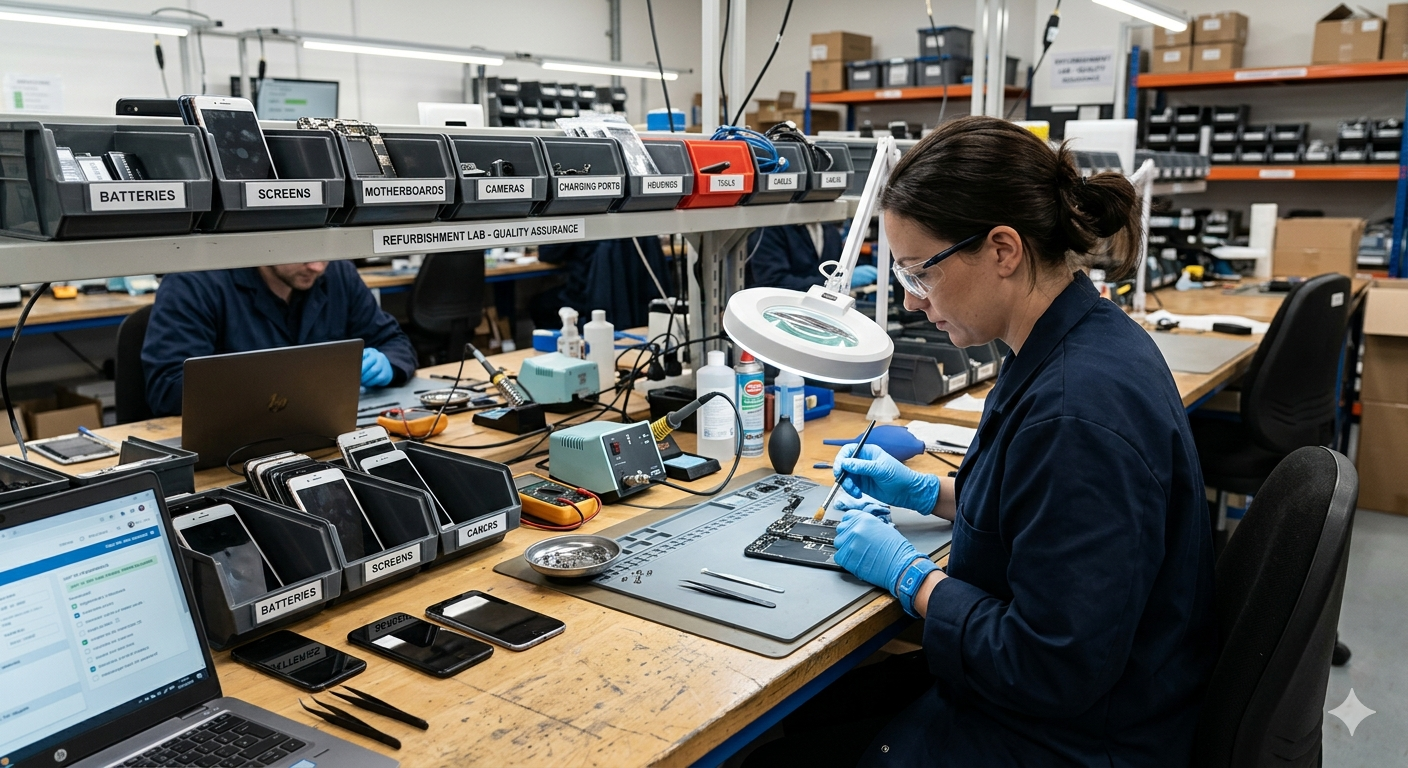
The resale and refurbishment market for durable goods is well established, with platforms such as Back Market, eBay Refurbished, and specialist trade-in schemes giving products a second commercial life. But the product data does not travel with the product. The second owner gets a device with no history, no warranty context, and no onboarding, which degrades their experience and reflects poorly on the original manufacturer.
Product identity fixes this. When the first owner sells or donates the product, they can initiate a transfer: the old registration is closed, the new owner scans the product and re-registers in their name, and the full history (service records, manuals, parts ordered) transfers with it. The manufacturer now has a relationship with the second owner, and a second chance to sell accessories, extended warranties, and support plans.
For more on how this works in practice, see our article on managing second-hand products with digital identity.
End-of-Life Data: You Can't Recover What You Can't Identify
ESPR's Digital Product Passport is expected to require data such as material composition, substance-of-concern declarations, and disassembly instructions, with the exact content set per product group through delegated acts. Where those obligations apply, the data has to be accessible at end-of-life, meaning a recycler processing a unit five years after sale must be able to retrieve it.
That is only possible if the product carries a durable, readable identity and the data behind it is maintained in a live system. A sticker that has worn off, or a PDF that has been deleted from a retired microsite, doesn't meet the requirement.
Usage Data for Durability Design
This is the circular capability that most manufacturers overlook, and the one with the longest-term payoff. When every product in the field is connected to a live identity, you accumulate structured data about how products actually behave: which models generate the most repair requests, which components fail first, which support topics spike after a firmware update.
That data feeds directly into product development. A manufacturer that can demonstrate, with evidence, that their products last longer than the category average has a genuine sustainability story to tell. It also reduces warranty costs, which is measurable on a balance sheet.
Step-by-Step Implementation: From Zero to Circular
Circular economy implementation doesn't have to happen overnight. The capabilities build on each other, and the sequencing matters.
Step 1: Serialised Identity, The Non-Negotiable Foundation
Before anything else works, every product unit needs a unique identifier, a serial number or SGTIN, linked to a persistent digital record. This is the foundation that all other circular capabilities sit on.
In practice, this means assigning a unique GS1 Digital Link QR code to every unit at manufacture, and ensuring that code resolves to a live endpoint that returns structured data. The code must be durable, embedded in the product itself, not just on packaging that gets discarded.
At this stage, even basic serialisation pays dividends: you can track which units are in the field, associate scan events with an approximate location (derived from the scanner's IP address, accurate to country level unless the user grants precise location permission) and a timestamp, and begin building the product history that later capabilities will draw on.
Step 2: Add Repair Information
Once units have identity, layer in repair access. This means attaching structured repair documentation to each product record: user manuals, spare parts lists with current availability, diagnostic guides, and, where applicable, disassembly instructions for authorised and independent repairers.
The key is keeping this information current. Parts supersede, manuals are updated, known issues are identified. A product identity system with version-controlled content is designed so that any scan, whether by a consumer or a technician, returns the current version of that information rather than a snapshot frozen at manufacture. This is how you meet the Right to Repair obligation operationally, not just in policy.
For a deeper look at the business case here, see why Right to Repair is a competitive advantage for manufacturers.
Step 3: Enable Ownership Transfer
With identity and repair data in place, ownership transfer becomes a straightforward feature addition. The mechanism is simple: when a product is sold or given away, the current owner triggers a transfer (or the new owner scans the product and the system detects it is already registered and offers a transfer workflow). The history is preserved; the registration updates.
This step requires a decision about what "ownership" means in your system, and what data the new owner inherits. Warranty coverage may not transfer (depending on your terms and jurisdiction), but service history, manuals, and parts access should. Getting this logic right upfront makes certified pre-owned programmes straightforward to launch later.
Step 4: Track End-of-Life
The final step, and the one that closes the loop, is end-of-life data. This means ensuring your product records include the material and substance data that recyclers need, and that this data remains accessible for the full expected product life plus any statutory retention period.
In practice, this means integrating your product identity system with your bill of materials data, and publishing the relevant subset (material composition, hazardous substance declarations, disassembly instructions) to the product's digital record. At end-of-life, a recycler scans the product and retrieves exactly what they need to process it correctly.
Where a DPP delegated act applies to your product group, this kind of data is expected to be mandatory rather than optional. The timing differs by group and is confirmed in each delegated act, so the practical move is to verify your category against the current ESPR working plan rather than assume a single deadline. For a full checklist of what your DPP must contain, see our DPP readiness checklist for 2026.
The DPP Connection: Circular Data Is What the Passport Carries
It's worth being direct: the EU Digital Product Passport is, at its core, a circular economy instrument. The data it covers, such as durability information, repairability scores, material composition, disassembly instructions, and recycled content, is circular economy data. If you implement circular capabilities via product identity, you are simultaneously building your DPP compliance infrastructure.
This convergence is deliberate. The European Commission designed the DPP to make circular economy performance visible and verifiable to consumers, regulators, and supply chain partners. A manufacturer that has serialised identity, repair data, ownership transfer, and end-of-life records in a live system is well-positioned for DPP compliance. A manufacturer that has not is facing a significant remediation project. For a detailed timeline, see our DPP compliance timeline 2026-2030.
The Business Case: Circular Is Commercially Rational
Regulatory compliance is sufficient motivation for most manufacturers. But the business case for circular economy via product identity is independently compelling.
Reduced waste and warranty costs. Products that are easier to repair tend to generate fewer full replacement claims, because a faulty part can be swapped rather than the whole unit returned. When field data feeds back into design, the most common failure modes can be engineered out of the next generation, which over time reduces claim volumes. For context on the underlying cost, US manufacturers spent 1.329% of product revenue on warranty claims in 2024, so even modest reductions in claim rates move a meaningful number.
New revenue from repair and resale. When manufacturers control the repair information and parts supply, they participate in the aftermarket revenue that currently flows to third parties. A spare parts programme linked to product identity captures margin that would otherwise leave the brand entirely.
Brand perception and customer lifetime value. Sustainability credentials matter to buyers, especially in B2B procurement, where ESG scorecards are increasingly part of supplier evaluation. A manufacturer that can demonstrate circular economy performance with product-level data has a tangible differentiator. And a second-hand buyer who has a good experience with a certified pre-owned product is a first-time buyer of the next generation.
Frequently Asked Questions
Does circular economy implementation require replacing our existing ERP or PLM systems?
No. Product identity systems like BrandedMark sit at the product-facing layer: they manage the consumer and repairer experience, the scan endpoint, and the data presentation. They connect to ERP and PLM via webhook and API integrations for parts data and bill of materials, but they do not replace those systems. The implementation path is additive, not disruptive.
Which product categories are affected by ESPR circular economy requirements first?
ESPR is a framework regulation, so specific product groups are addressed through delegated acts on a rolling schedule rather than all at once. The first ESPR Working Plan (2025-2030) names priority groups including textiles and apparel, furniture, iron and steel, aluminium, tyres, and mattresses. Each group's obligations and timing are confirmed in its own delegated act, so the timelines are not yet fixed for all categories. Battery passports are a separate obligation under the EU Battery Regulation (Regulation (EU) 2023/1542), which applies to LMT, industrial (over 2 kWh), and EV batteries from 18 February 2027. The practical step is to check your own category against the current Commission working plan rather than assume a single deadline.
How do competitors like Circularise, EON, and Kezzler approach this problem?
Several players in the product identity and transparency space have built circular economy offerings. Circularise focuses on supply chain data and chemical composition disclosure, particularly for plastics and materials traceability. EON specialises in brand-to-consumer digital product experiences with a sustainability angle, primarily in apparel and luxury. Kezzler offers serialisation and authentication infrastructure, with end-of-life data as a use case. Each focuses on different areas. BrandedMark integrates serialised identity, consumer-facing experience, repair access, and DPP-ready data in a single platform designed for durable goods manufacturers.
Where to Start
The manufacturers who will navigate the circular economy transition with the least disruption are the ones who start building product identity infrastructure now, before regulatory deadlines concentrate attention and inflate implementation costs.
Serialisation is the first step, and it compounds over time. Every unit that ships with a live digital identity is a unit that can participate in repair programmes, ownership transfer, and end-of-life recovery. Every unit that ships without one is a unit you will eventually need to handle differently, or write off as a circular economy gap.
BrandedMark gives manufacturers the platform to assign, manage, and activate product identity across every unit they ship, with repair access, ownership transfer, and DPP-ready data built in. The circular economy is not a future requirement. It is a present opportunity to build stronger relationships with every product, through every owner, across its entire life.