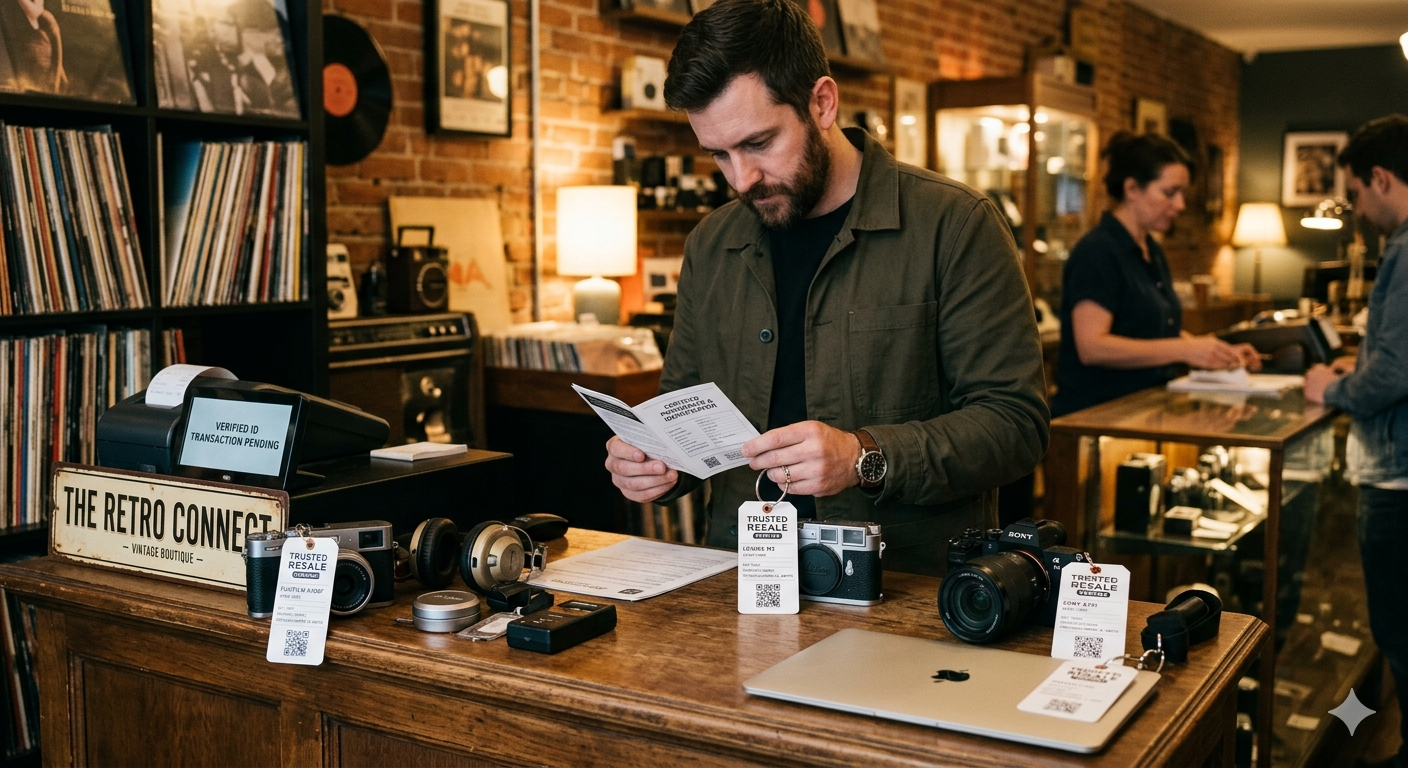
Second-Hand Products Deserve a Digital Life Too
Key Takeaways
- The UK second-hand market exceeds £8 billion annually and is growing at ~15% per year, yet most pre-owned products arrive at new owners digitally orphaned — no warranty, no history, no support access
- Digital product identity lets prospective buyers scan before purchase to verify authenticity, check warranty status, and view service records sourced directly from the manufacturer
- Ownership transfer via QR scan takes under a minute: the new owner registers against the serial number and the manufacturer gains a new customer relationship that would otherwise be invisible
- The EU Ecodesign for Sustainable Products Regulation (ESPR) is mandating digital product passports — the same infrastructure that enables resale trust also satisfies regulatory compliance
The UK second-hand market crossed £8 billion in annual sales and is growing at roughly 15% per year. Platforms like Vinted, eBay, and Facebook Marketplace have turned resale into a mainstream consumer habit. One in three UK adults bought a pre-owned product last year. Yet despite all that commercial velocity, there is a stubborn problem that nobody is solving: the product itself arrives with no memory.
No warranty status. No ownership history. No manual. No way to verify it is genuine. No spare parts diagram. The product is physically real but digitally dead — orphaned from the manufacturer the moment it first changed hands.
That is a £8 billion trust problem. And it is one that digital product identity is built to fix.
The Digitally Orphaned Product
When a product leaves its original owner, it typically leaves behind everything that made it knowable. The warranty card (if one was ever filled out) stays with the first buyer. The manual ends up in a recycling bin. The receipt is long gone. The manufacturer has no record of the product's new home and no way to reach whoever now owns it.
This is not a niche edge case. With resale rates accelerating — driven by cost-of-living pressures, sustainability awareness, and the normalisation of pre-owned culture — a significant portion of products in active use are on their second, third, or fourth owner. Each handover strips away another layer of product context.
What Buyers Lose
For a second-hand buyer, the product is an act of faith. Is it authentic? Has it been repaired with non-genuine parts? Is the battery at 40% health or 90%? Was it ever recalled? Does any warranty remain, and is it transferable?
In high-value categories — power tools, kitchen appliances, consumer electronics, luxury goods — these questions are not academic. A buyer paying £400 for a pre-owned cordless drill kit or £600 for a used espresso machine is taking on real financial risk in the absence of verifiable product history. The result is price suppression: buyers discount heavily to offset the uncertainty, and the market for premium pre-owned products never reaches its potential.
What Sellers Lose
Private sellers and professional resellers alike absorb that price suppression. A product with a provable history — documented origin, authentic components, transferable warranty coverage — commands a materially higher price. Without that documentation, a seller who genuinely has a well-maintained, authentic product cannot distinguish it from one that is counterfeit or abused. The market flattens everything.
For manufacturers who operate certified pre-owned or trade-in programmes, the absence of serialised digital identity makes even internal processes brittle. Verifying what has come back in, in what condition, and whether the warranty clock is still running — all of that becomes manual, slow, and error-prone.
What Manufacturers Lose
The manufacturer's loss is the least visible but arguably the most significant. Every resale is a new customer relationship that simply never happens. A product changes hands and the brand has no idea. No onboarding, no registration, no support touchpoint, no parts revenue, no upsell, no NPS data. A product that might last fifteen years and pass through three households delivers one customer relationship instead of three.
At scale, that is an enormous amount of lifetime value walking out the door uncaptured. And as circular economy pressures mount — regulatory, reputational, and commercial — the manufacturer's inability to track and engage with its products in the aftermarket is becoming a structural liability.
What Digital Product Identity Enables for Resale
Digital product identity — a persistent, unique identity attached to every unit at manufacture — changes the entire resale equation. The product carries its own history, and that history is accessible to anyone who scans it.
Scan for Full Product History
With a serialised digital identity, a prospective buyer can scan the product before purchase and instantly retrieve the relevant context: manufacture date, original market, model specification, any service records logged against that serial number, and whether it was ever subject to a safety recall. This is not a lookup against the seller's self-reported claims — it is a read from the manufacturer's own record.
That shift from seller-asserted to manufacturer-verified is the trust primitive that second-hand markets have been missing.
Verify Authenticity
In categories where counterfeiting is prevalent — power tools, consumer electronics, luxury accessories — serialised product identity allows a buyer to confirm that the unit is genuine before committing to a purchase. The scan resolves to the manufacturer's own infrastructure, not a third-party database that could be spoofed. For brands that have invested in premium positioning, this is a meaningful protection for resale value across the entire installed base.
For a deeper look at how product identity fights counterfeiting in high-value categories, see our article on product authentication for luxury brands.
Check and Transfer Warranty
Warranty status is the single most common question in second-hand transactions, and currently the hardest to answer reliably. Digital product identity makes it trivial. A scan reveals whether the original warranty is still in effect and whether it is transferable under the manufacturer's terms. More importantly, it provides a mechanism to execute that transfer — the new owner registers against the serial number, and ownership is updated in the manufacturer's system.
This matters for the buyer (protection), the seller (trust signal that justifies price), and the manufacturer (a new customer relationship initiated at the point of resale rather than lost entirely).
Access Manuals, Spares, and Support
A second-hand buyer inheriting a complex product — a multi-zone HVAC unit, a semi-professional coffee machine, a power tool with a proprietary battery ecosystem — needs the same support resources as the original purchaser. Digital product identity makes those resources permanently attached to the product rather than to the original transaction. Scan the unit, get the installation guide, the troubleshooting flow, the exploded parts diagram, and the ability to order genuine spare parts directly.
This is the connection between product identity and the right-to-repair movement. As we explored in why right to repair is a competitive advantage for manufacturers, brands that make their products serviceable and documentable win in a world where longevity is becoming a purchase criterion.
Comparing the Buyer Experience
The gap between a digitally-identified product and a digitally-orphaned one is not abstract. The table below makes it concrete.
| Experience | Without Digital Product Identity | With Digital Product Identity |
|---|---|---|
| Authenticity check | None — rely on seller's word | Scan confirms manufacturer record |
| Warranty status | Unknown — dig through paperwork | Instant scan reveals status and expiry |
| Ownership transfer | Manual, often impossible | Scan-to-register, updated in real time |
| Service history | Not available | Logged against serial number |
| Manuals and guides | Paper (often lost) or generic web search | Always-on, version-matched to unit |
| Spare parts ordering | Guesswork on compatibility | Confirmed-compatible parts, direct order |
| Recall check | No reliable mechanism | Instant flag on scan if affected |
| Resale price premium | Discounted for uncertainty | Justified by verifiable provenance |
The difference is not incremental. It is the difference between a product that is knowable and one that is opaque.
The Manufacturer's Resale Opportunity
Forward-thinking manufacturers are beginning to reframe resale not as a threat to new product sales but as a channel in its own right. Every second-hand transaction involving one of their products is, potentially, a new customer relationship — if they have the infrastructure to capture it. Research from ThredUp's 2024 Resale Report found that the durable goods resale market is growing three times faster than primary retail, underscoring the commercial scale of the opportunity brands are currently missing.
A buyer who scans a pre-owned product and registers ownership becomes, for the first time, a known customer of that manufacturer. From that moment, the manufacturer can offer genuine support, relevant accessories, a certified upgrade path, and a relationship that generates data and revenue. The product's second life becomes the start of the manufacturer's relationship with a new household.
This reframe also changes the economics of product development. If a manufacturer knows that their products will be resold and that each resale generates a new registered customer, the return on investment for build quality — and for the digital infrastructure that supports it — looks very different. The atoms and bits of a connected product earn their keep not just in the first sale, but across the entire product lifetime. We examined this dynamic in detail in atoms vs bits: why the physical-digital product is the new battleground.
Competitors and Alternatives in the Resale Verification Space
Several platforms are working to bring more trust to second-hand markets, and it is worth understanding their approaches.
Back Market, the European refurbished electronics marketplace, has built a strong brand around seller vetting and grading standards. Their model relies on marketplace-level trust rather than product-level identity — the verification is of the seller, not the item itself. This works well at scale but does not give buyers manufacturer-direct provenance.
Tagbase approaches the problem from the digital product passport angle, enabling brands to attach persistent digital identities to physical products for lifecycle tracking. Their focus on compliance and circular economy use cases makes them a natural fit for brands navigating EU regulatory requirements.
Vestiaire Collective's authentication service applies human expert review and physical inspection to luxury fashion and accessories, giving buyers a credibility signal for high-value pre-owned items. The model is powerful but costly, and it does not scale to mid-market durable goods.
What distinguishes a manufacturer-native approach — embedded in the product at the point of manufacture, tied to the brand's own serialisation infrastructure — is that it operates without a marketplace intermediary. The trust signal comes from the brand itself, not from a third party who examined the item.
The Circular Economy Connection
The EU's Ecodesign for Sustainable Products Regulation (ESPR), which is progressively coming into force across product categories through the late 2020s, mandates digital product passports for an expanding set of goods. According to the European Commission's impact assessment, DPP requirements will cover products representing over 70% of EU manufacturing sector revenue by 2030 — making this a mainstream compliance obligation, not a niche one. These passports must carry information about materials, repairability, spare parts availability, and end-of-life handling.
The regulation is, in effect, forcing manufacturers to build exactly the infrastructure that makes digital resale possible. A product with a compliant digital passport has a persistent identity, a documented history, and a structured data record that follows it through multiple ownership cycles. The compliance investment doubles as the resale-readiness investment.
Beyond compliance, product identity enables the business model shift that circular economy advocates have long described as "product as a service." If a manufacturer can track their products through resale, repair, and re-ownership cycles, they can structure service subscriptions, certified refurbishment programmes, and take-back schemes that turn the end of one product's first life into the beginning of its next. The digital identity is the thread that makes that continuity possible — without it, the circular economy remains a concept rather than a commercial model.
Platforms, Manufacturers, and the Coming Resale Standard
The second-hand market's growth trajectory is not reversing. As product longevity becomes a competitive differentiator and regulatory pressure towards circularity intensifies, the question for manufacturers is not whether their products will be resold, but whether those products will carry any intelligence when they are.
The brands that invest in serialised digital product identity now are building infrastructure that pays dividends across every product lifecycle — not just the first sale. They are also positioning themselves to meet the EU's digital product passport requirements ahead of mandate deadlines, rather than scrambling to retrofit compliance onto legacy catalogues.
A product that arrives at its second owner with a full digital identity — verifiable, transferable, and connected to the manufacturer's own support ecosystem — is a fundamentally different commercial asset than one that arrives as an anonymous object. The market will price that difference, and the manufacturers who created it will capture the value.
Frequently Asked Questions
Can digital product identity work for products that were manufactured before the system was introduced?
Retrofitting digital identity to existing products is possible but limited. For products already in the market, some manufacturers issue QR labels or NFC tags that can be applied during a service event or trade-in inspection. These link to a product record but lack the serialisation depth of units manufactured with digital identity from the start. The practical implication is that the strongest value — both for resale trust and for regulatory compliance — comes from building identity into new product lines rather than attempting to backfill a legacy catalogue.
How does ownership transfer actually work in practice?
Ownership transfer is initiated by the new owner scanning the product's unique identifier — typically a QR code or NFC tag embedded at manufacture. If the product's digital record shows a transferable warranty or open registration, the new owner is prompted to claim the product against their account. The previous owner's registration is archived (preserving the service history) and the product is reassigned. The manufacturer's system now recognises the new owner and can begin delivering support, maintenance reminders, and relevant communications. The process takes under a minute and requires no paperwork.
Does this create privacy concerns for original owners?
Properly designed product identity systems separate ownership records from product history records. When a product is transferred, the new owner can see the product's service and maintenance history — relevant for trust — but not the personal details of previous owners. The architecture mirrors what happens in vehicle history checks: you can see that a car was serviced and whether it was involved in an accident without seeing the previous owner's name or address. The same model applies to durable goods, and GDPR-compliant implementations are well established in the space.
BrandedMark gives manufacturers the infrastructure to build digital product identity into every unit — from first scan at unboxing to ownership transfer at resale. Every product deserves a digital life, no matter how many times it changes hands.