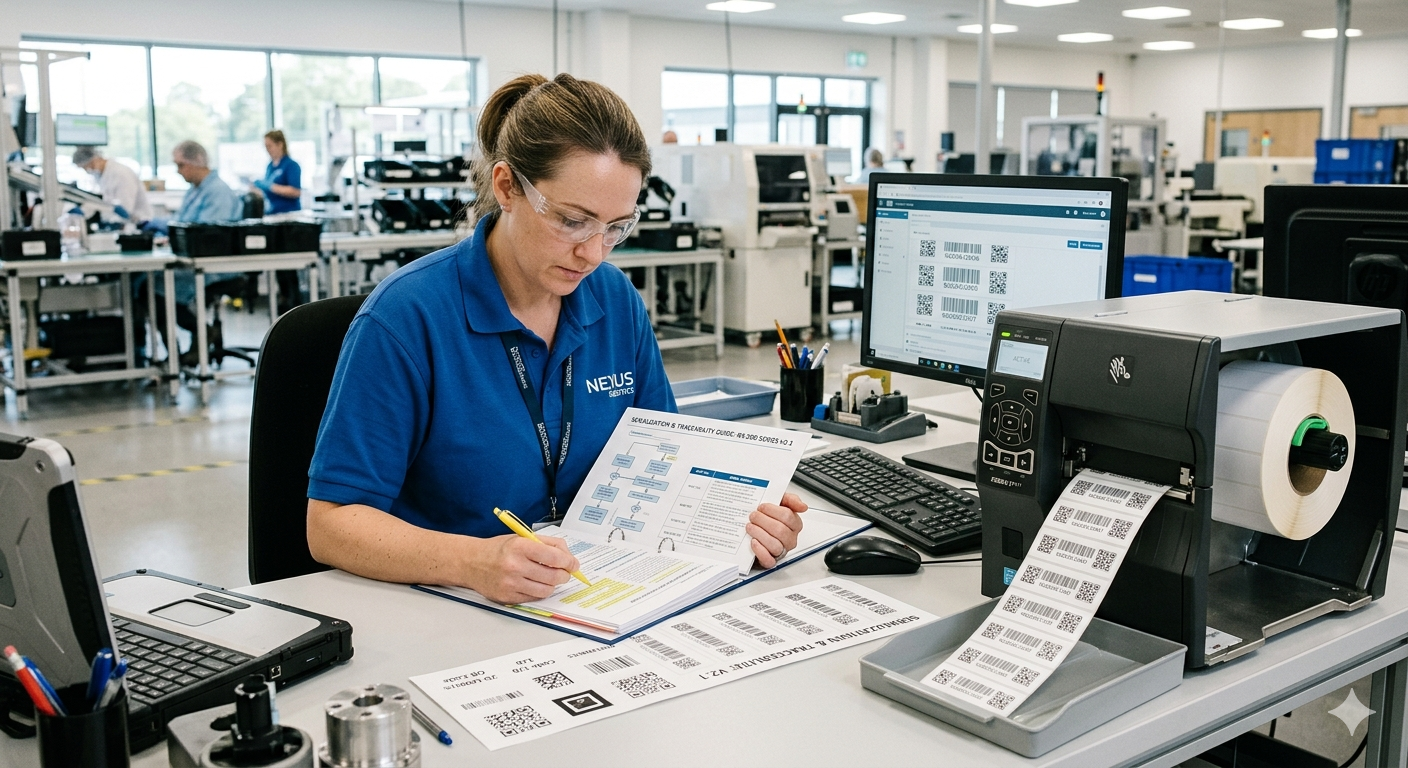
Product Serialisation: A Practical Guide for Manufacturers
Key Takeaways
- Unit-level serialisation assigns a unique, digitally linked identity to every product — enabling anti-counterfeiting, precision recalls, ownership transfer, and EU DPP compliance
- The GS1 SGTIN standard is the interoperable foundation: it combines your GTIN with a unique serial number and is the identifier format the EU Digital Product Passport framework expects
- Implementation follows four steps: generate serial numbers, encode in GS1 Digital Link QR, link to a product database, and print at packaging — each step has practical options for existing lines
- Marginal serialisation cost is £0.01–0.05 per unit; a single imprecise recall affecting an over-broad population costs millions
Most manufacturers know exactly how many units left the factory. They know nothing about where those units went.
That gap — between production counts and individual product lives — is where recalls become disasters, counterfeits thrive, and warranty fraud flourishes. Serialisation closes it. Not the kind where you stamp a batch number on the bottom of the box, but genuine unit-level serialisation: a unique, digitally linked identity for every single product that comes off your line.
This guide explains what that actually involves, how to implement it practically, and why the capabilities it unlocks are worth far more than the cost of the label.
What Serialisation Actually Means
Product serialisation is not a single concept — it describes three distinct levels of identification that deliver fundamentally different capabilities. Understanding the difference prevents costly under-investment and misplaced compliance assumptions.
The Three Levels of Product Identification
| Level | What it identifies | Cost per unit | Key capabilities | EU DPP compliant |
|---|---|---|---|---|
| SKU-level | Product model/variant | Near zero | Inventory, pricing, shelf management | No |
| Batch/lot-level | Production run (hundreds–thousands of units) | ~£0.001–0.01 | Batch recalls, shelf-life tracking, quality investigation | Partial |
| Unit-level | Individual physical product | ~£0.01–0.05 | Anti-counterfeiting, precision recalls, warranty verification, ownership transfer, full DPP | Yes |
SKU-level tracking tells you what the product is, not which one. Batch tracking narrows things to a production run — useful for food safety, but still blunt. Knowing 12,000 units from a given batch are at risk is very different from knowing the exact 47 that left a specific shift with a faulty component. Unit-level serialisation assigns every product a unique identifier — like a fingerprint — that travels from factory floor to end customer and beyond. That is the level this guide focuses on, because it is the one that unlocks every downstream capability.
When Each Level Is Appropriate
The right level of serialisation depends on product value, regulatory exposure, and the consequences of an imprecise recall. Not every product needs unit-level tracking — but most durable goods manufacturers do.
Unit-level serialisation makes clear business sense when:
- Your product has a warranty period (you need to verify legitimate claims)
- Counterfeiting is a risk in your category or geography
- A recall affecting a subset of units could happen (think a firmware batch, a supplier component, a specific assembly shift)
- EU Digital Product Passport compliance is on your horizon (it is, whether you know it yet or not)
- The product changes hands during its lifecycle — through resale, rental, or insurance replacement
Batch-level may suffice when:
- Products are lower-value with short lifecycles
- The risk of partial-batch incidents is genuinely low
- No regulatory serialisation requirement applies
For appliances, power tools, HVAC equipment, consumer electronics, and industrial machinery, the case for unit-level is clear. The question is not whether to implement it, but how to do so without disrupting existing production lines.
The GS1 SGTIN Standard
GS1 SGTIN — Serialised Global Trade Item Number — is the interoperability standard that underpins unit-level serialisation across global supply chains. Understanding it before implementation saves costly re-engineering later.
SGTIN takes your existing GTIN (the 14-digit number identifying your product model) and appends a unique serial number to create a globally unambiguous identifier. The format is: urn:epc:id:sgtin:[company-prefix].[item-reference].[serial-number]
This matters for two practical reasons. First, it is the standard underpinning GS1 Digital Link QR codes — meaning any GS1-compliant scanner, from a logistics hub to a trading standards officer's phone, can resolve your product's identity. Second, it is the identifier format the EU Digital Product Passport framework expects. Serialising on SGTIN now means you do the work once, correctly, rather than rebuilding a proprietary scheme when compliance deadlines arrive.
Manufacturers without a GS1 company prefix should register with GS1 UK or their national GS1 organisation. Prefixes are tiered by capacity, and annual membership is a modest operational cost. For a deeper look at how GS1 Digital Link works in practice, see our guide to implementing GS1 Digital Link for your product range.
Implementation: The Four Steps
Serialisation follows a practical four-step sequence. Each step has clear options for manufacturers working with existing production lines, and the integration burden is far lighter than most operations teams expect.
Step 1: Generate the Serial Numbers
Serial numbers must be unique, managed centrally, and reserved against a specific GTIN so the resulting SGTIN composite is globally unambiguous. Use randomised alphanumeric strings rather than simple sequential numbers — they are harder to predict and more tamper-resistant for anti-counterfeiting purposes. Most manufacturers generate serials in batches ahead of production runs, pre-loading them into the line control system or print management software. The critical discipline is that the system of record is authoritative: no two units ever share a serial, and the pool is locked to a single GTIN. Avoid generating serials in spreadsheets. At any meaningful volume, manual management creates gaps, duplicates, and audit failures that are costly to investigate and impossible to fully remediate after the fact.
Step 2: Encode in QR at the Production Line
Each serial number is encoded into a GS1 Digital Link QR code following a structured URL format (https://id.gs1.org/01/[GTIN]/21/[serial]) that any GS1-compliant resolver can interpret. The QR is generated at the point of production, tied to that specific unit.
Inline printing generates and prints the QR in real time at the packaging station — zero lag, full sync between physical unit and digital record. It requires integration between your line control system and a thermal inkjet or laser printer, and is the approach that scales most cleanly.
Offline/print-and-apply pre-prints serialised labels in batches, applied manually or via automated applicators. Lower integration complexity, but introduces a label/unit mismatch risk if controls are not tight. Suitable for lower volumes or where inline integration is not yet feasible.
The critical requirement in either case: the label cannot be separated from the unit it was assigned to.
Step 3: Link to the Database
A serial number on a label that resolves to nothing is just a number. At the moment of serialisation, the product record must be created in your backend: GTIN, serial number, production date, line and shift, component batch references, and any other traceability data relevant to your category. This record becomes the anchor for everything downstream — warranty registrations, scan events, ownership history, and recall targeting. The richer the data captured at creation, the more precise your operational capabilities become later. Integration with your ERP or MES matters most at this step. The production system should write a live "unit created" event to the product identity database — not via manual export. The two systems must stay in sync for the identity record to remain trustworthy throughout the product's lifecycle.
Step 4: Print and Apply at Packaging
The serialised label — inkjet-printed inline, laser-etched onto the unit, or pre-printed and applied — goes on at packaging. For most consumer products, this means the retail box. For industrial equipment, it typically means both the unit and the outer packaging. For high-value goods, consider an external QR label alongside a concealed internal mark for anti-counterfeiting verification.
Placement is critical. Labels on outer packaging get damaged or removed during shipping and retail. Labels on the unit itself — inside a battery compartment, on the chassis, under a panel — survive the product's full lifecycle. Best practice for durable goods is a QR code on the packaging and a durable label or engraving on the product itself.
The Cost Reality
The marginal cost of unit-level serialisation — label, ink, and the database record — is £0.01–0.05 per unit at scale. The one-off costs are integration: connecting line control to print management, connecting print management to your product identity platform, and configuring the resolver. That is a project cost, not an ongoing one.
The comparison that makes the economics obvious: a broad-net recall — where you cannot isolate which units are affected and must pull an entire SKU or production month — consistently costs $2M–$20M in logistics, replacements, and brand damage, according to Gartner industry analysis. Serialisation converts that scenario into a surgical list of affected units. Customers with unaffected products are not disrupted. Logistics costs fall sharply. The brand damage from over-broad action is avoided entirely.
The accurate framing is that serialisation is not a cost. It is insurance with a positive expected return, plus a set of operational capabilities — warranty verification, anti-counterfeiting, ownership tracking — that generate direct revenue from every product already in the field.
What Serialisation Unlocks
Unit-level serialisation is not valuable in isolation. It is the foundation for a cascade of operational and commercial capabilities that compound over time.
Anti-counterfeiting: A consumer scanning your QR code receives a live confirmation from your system that this is a genuine, registered unit. A counterfeit cannot pass that check. This matters most for brands sold through grey-market channels or in markets where counterfeiting is prevalent.
Precision recalls: Instead of recalling an entire product line or a three-month production window, you target the exact serial range, shift, or supplier batch affected. Affected customers receive direct notifications; unaffected customers are not disrupted. The hidden cost of imprecise recalls to brand trust is significant — serialisation eliminates it.
Warranty verification: Every claim is validated against the original serial record — date of manufacture, authorised reseller, and prior claim history — in seconds, without requiring the customer to produce a paper receipt.
Ownership transfer: Resale, gifting, and insurance replacement can be recorded against the unit's digital identity. The new owner inherits the product's history; you gain a new customer relationship.
Digital Product Passport: The EU's ESPR regulation introduces DPP requirements per product group, each set by its own delegated act. The ESPR working plan's indicative priority groups include textiles and tyres (2027), furniture (2028) and mattresses (2029); electronics is not in that first priority list. Unit-level serialisation on SGTIN is the required foundation. Manufacturers implementing it now do the work once, correctly. Our DPP readiness assessment is a useful starting point for mapping your compliance posture.
Production Line Integration in Practice
The question most operations teams ask is not "should we serialise?" but "how do we fit this into an existing line without stopping production?" The answer for most manufacturers is pragmatic: start with offline print-and-apply if inline integration is complex, get the data model right from day one, and migrate to inline over time.
The critical path is the database and resolver — the product identity platform must be in place so that every serial number points to a live record from the moment it is printed. The label without the backend is meaningless.
For manufacturers already using MES or production management software, the integration path is well-trodden — most platforms have label management connectors. For legacy or manual lines, print-and-apply with a handheld scan verification step is a practical interim that provides full auditability without line disruption.
When evaluating infrastructure providers, the distinction that matters is whether the QR code remains a supply-chain traceability tool or becomes the live interface between the product and its owner across its full lifecycle — covering warranty, support, and DPP, not just track-and-trace.
Frequently Asked Questions
How many digits does a serial number need to be?
There is no fixed requirement, but GS1 SGTIN supports serial numbers up to 20 alphanumeric characters. Practically, most manufacturers use 8–12 digits. Randomised alphanumeric serials (rather than simple sequential numbers) are harder to predict and therefore more tamper-resistant for anti-counterfeiting purposes.
Do we need to serialise every product in our range, or can we start with one?
You can absolutely start with a single product line or category. In fact, this is the recommended approach — validate the integration, train the team, and measure the outcomes before rolling out across the portfolio. Choose a product where the business case is strongest: high value, warranty-intensive, or counterfeiting risk.
Can serialisation work with our existing ERP system?
In most cases, yes. The product identity platform sits alongside your ERP, not inside it. The ERP manages inventory and orders; the identity platform manages the digital life of each unit. The integration point is typically an API call at the point of production — the ERP or MES writes a "unit created" event to the identity platform with the serial number and production metadata. Standard connectors exist for SAP, Oracle, and most mid-market ERP systems.
The Bottom Line
Serialisation is a strategic infrastructure decision, not a packaging project. It determines whether you know your products as individual units with full histories — or only as production statistics with no visibility beyond the factory gate.
The marginal cost is pennies per unit. The capabilities it unlocks — precision recalls, fraud prevention, verified warranty claims, ownership relationships, and EU Digital Product Passport compliance — are worth considerably more. Manufacturers who implement unit-level serialisation in the next two years will hold a structural advantage in after-sales, compliance, and customer trust that is genuinely difficult for slower-moving competitors to close.
The architecture is straightforward: serial generation, GS1 Digital Link encoding, a product identity database, and an owner-facing experience that makes every scan worth completing. If you are mapping your implementation, see how the platform works in practice or assess your current readiness with our 25-question DPP assessment.
Every product deserves a digital life. Serialisation is where that life begins.