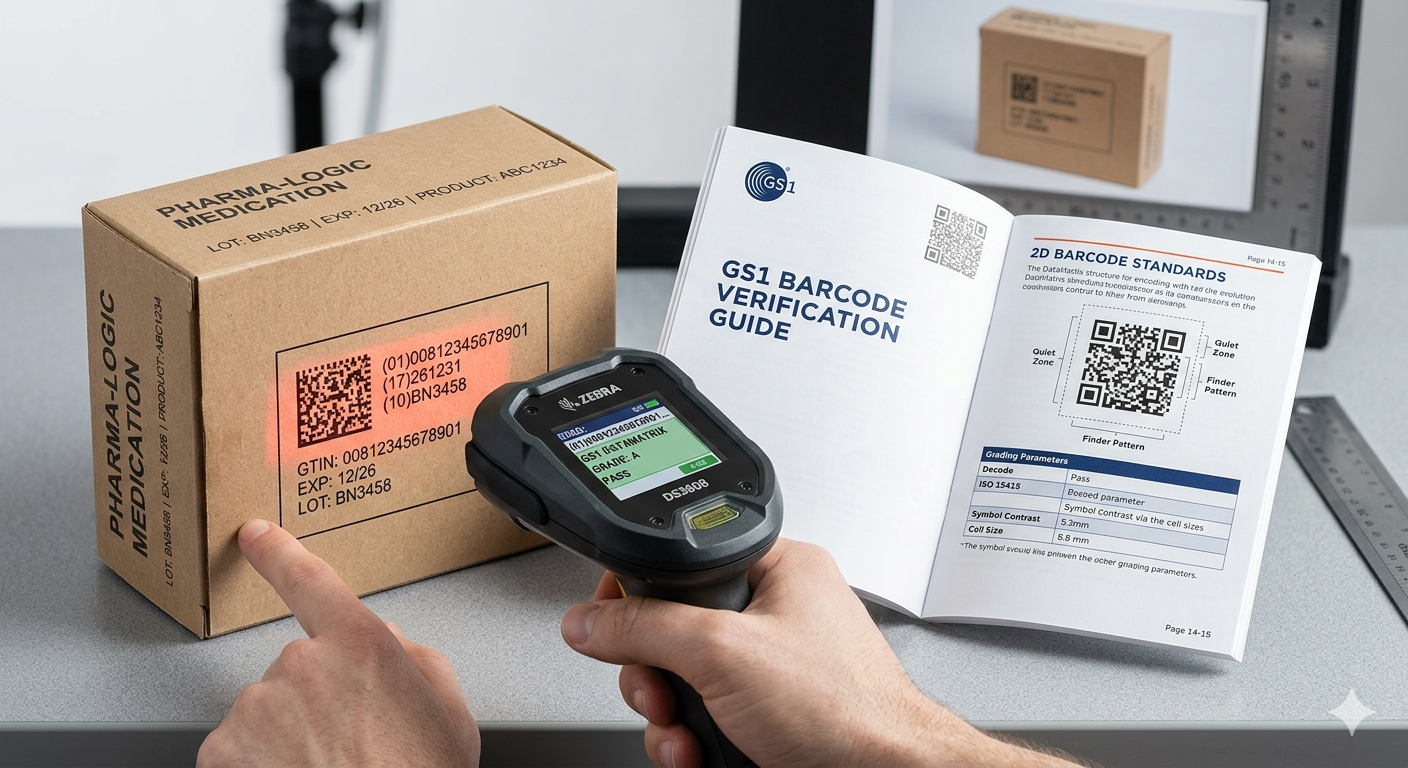
The Manufacturer's Guide to GS1 Digital Link
Key Takeaways
- GS1 Digital Link encodes product identifiers (GTIN, serial number) into a standard URL that any system — retail scanner, smartphone, regulatory registry — can read from a single printed code.
- GS1's Sunrise 2027 deadline requires retail POS systems globally to read 2D codes; non-compliant QR formats will fail at checkout.
- The EU Digital Product Passport regulation mandates GS1-structured identifiers — making one Digital Link implementation serve both compliance and customer engagement.
- Unit-level serialisation (SGTIN encoding) is what enables anti-counterfeiting, individual ownership tracking, and per-unit DPP records.
Most manufacturers already have a GTIN. Many have deployed QR codes. Almost none have connected the two — and that gap is about to become expensive.
GS1 Digital Link is the standard that closes it. It is the mechanism that turns a product identifier into a web address, a web address into a machine-readable identifier, and a single code print on your packaging into something a retail scanner, a consumer smartphone, a customs system, and an EU Digital Product Passport registry can all read — correctly, globally, without bespoke integrations.
This is not a niche compliance topic. GS1 Digital Link is the infrastructure layer for every product data initiative of the next decade: connected packaging, DPP mandates, anti-counterfeiting, post-purchase engagement. Understanding how it works — and what you need to implement it — is now a core competency for product and operations teams.
What GS1 Digital Link Actually Is
GS1 Digital Link is a standard that encodes GS1 identifiers — GTINs, serial numbers, batch codes, expiry dates — into a URL structure that any system can parse. Your existing barcode encodes a GTIN as a raw number, say 09506000134352. A retail scanner reads that number and looks up the product in a database: one number, one lookup, one purpose. GS1 Digital Link encodes the same GTIN as part of a structured URL: https://id.gs1.org/01/09506000134352/21/ABC123. The domain is the resolver; /01/ is the GS1 Application Identifier for GTIN; /21/ signals a serial number. A retail scanner strips the numeric identifiers from that URL and reads the GTIN exactly as it always did. A smartphone camera opens the URL and delivers whatever web experience you have configured at that endpoint. The same physical code does both jobs simultaneously, without compromise. Everything else — DPP compliance, interoperability, resolver infrastructure — flows from this core architecture.
Why Interoperability Is the Real Value
The argument for GS1 Digital Link is not "QR codes are good." It is that standards eliminate integration tax. GS1 estimates over 6 billion GS1 barcodes are scanned daily across retail, healthcare, and logistics — the most widely deployed product data standard on earth. Every time a product moves through a supply chain, its identifiers must be readable by a different system. A warehouse in Germany, customs in Singapore, a retailer in the United States, a regulatory registry in Brussels — each is built to read GS1 identifiers. When your product data is encoded in GS1 Digital Link format, every system parses it natively: no custom middleware, no data mapping, no negotiation with trading partners. A manufacturer shipping to 40 countries cannot build 40 custom integrations — but a GS1 Digital Link URL is readable in every market out of the box. The same logic applies to time: the standard will still be readable in fifteen years; a proprietary QR platform's link format may not be.
GS1 Digital Link vs. Regular QR Codes
A QR code is just an encoding format — it can contain any string of characters. A standard QR code from a generic tool might contain https://yourbrand.com/product/12345: a functional link, but not GS1 Digital Link. The distinction matters because a regular QR code cannot extract a GTIN — retail scanners read it as an unknown URL. A GS1 Digital Link QR encodes the GTIN in structured syntax that retail systems parse natively, making it backward-compatible with all GS1 infrastructure. A regular QR is platform-dependent and breaks if the link changes; GS1 Digital Link follows ISO/IEC 18975, a vendor-neutral permanent standard. For DPP compliance under EU ESPR, GS1 identifiers are required — a marketing URL does not qualify. GS1 Digital Link also encodes both GTIN and serial number in a single code; generic QR codes are typically product-level only. After GS1's Sunrise 2027 deadline, retail POS systems globally must read 2D codes — generic QR codes on product packaging will cause scan failures in compliant environments.
| Dimension | Standard QR Code | GS1 Digital Link QR Code |
|---|---|---|
| URL structure | Arbitrary — any URL the brand chooses | Structured — follows GS1 Digital Link syntax with Application Identifiers |
| Retail scanner compatibility | Cannot extract GTIN — reads as unknown URL | Extracts GTIN natively — backwards-compatible with all GS1 systems |
| Interoperability | Platform-dependent — breaks if the link changes | Standard-compliant — any GS1 resolver can process it |
| DPP compatibility | Not compliant — EU ESPR requires GS1 identifiers | Fully compliant — ESPR-preferred data carrier mechanism |
| Resolver service | No standard resolver — brand manages all routing | Can use GS1's global resolver (id.gs1.org) or your own branded resolver |
| Future-proofing | Dependent on the QR platform's longevity | ISO/IEC 18975 standard — vendor-neutral, permanent |
| Serial-level granularity | Typically product-level only | Unit-level — encodes GTIN + serial in a single code |
How It Connects to the Digital Product Passport
The EU's Digital Product Passport (DPP), required under ESPR starting with batteries and textiles, mandates a data carrier linking to a machine-readable passport. The European Commission's Joint Research Centre has positioned GS1 Digital Link as the recommended mechanism. The regulation requires a unique product identifier, a standardised data carrier, and a registry-accessible record — three requirements GS1 Digital Link satisfies simultaneously. A DPP is not just a web page; it is a record in an authorised registry that regulators, customs, and recyclers can query. Those registries are built around GS1 identifiers — a product without a valid GTIN in compliant Digital Link format cannot be registered, and a marketing QR code pointing to your website does not qualify. For manufacturers in scope — batteries from 2027, textiles from 2028 — the GS1 Digital Link implementation built for retail compatibility delivers DPP compliance too. One investment, two mandates covered. See understanding the EU DPP registry and what it means for manufacturers.
What Manufacturers Need to Do
Implementing GS1 Digital Link requires four steps, none technically complex but all requiring upfront decisions that are hard to reverse once packaging goes to print. Step one: obtain a GS1 Company Prefix — verify it is active and in your own name, not a retailer's. Step two: assign GTINs at the item level — each product variant needs its own GTIN; an unresolvable GTIN fails in every downstream system. Step three: encode GTINs with serial numbers (SGTIN) to enable unit-level anti-counterfeiting, ownership tracking, and serialised DPP records — without serialisation, most of Digital Link's value is lost. Step four: configure a resolver service that routes scan requests to the right destination based on context — retail POS, consumer smartphone, or regulatory registry. The resolver is where ongoing operational work sits and where platforms like BrandedMark add the most value: GS1 Digital Link built in, resolver pre-configured, no packaging changes needed to update destinations.
Step 1: Obtain a GS1 Company Prefix
GS1 Digital Link requires a valid GS1 Company Prefix — the licensed block of numbers that gives you the authority to issue GTINs. If you already have GTINs on your products, you already have a prefix. If you are issuing GTINs through a retailer or third party, you need your own prefix before you can issue compliant Digital Links.
GS1 Company Prefixes are licensed through national GS1 member organisations (GS1 US, GS1 UK, GS1 Germany, etc.). Annual licensing fees scale with the number of GTINs you need to issue. For most manufacturers, this is already in place — but verify your prefix is active and in your name, not a retailer's.
Step 2: Assign GTINs at the Right Level
GS1 Digital Link works at the item level (the product you sell), not the case or pallet level. Each product variant — different colour, different model, different bundle configuration — needs its own GTIN. If your current GTIN assignment is incomplete or inconsistent, resolve this before Digital Link implementation. A Digital Link pointing to an invalid or unresolvable GTIN will fail in every downstream system.
Step 3: Encode GTINs with Serial Numbers
The power of GS1 Digital Link comes from unit-level serialisation — encoding a unique serial number alongside the GTIN in every code print. This is what enables anti-counterfeiting, individual ownership tracking, scan history, and serialised DPP records. Without serial numbers, your Digital Links are product-level, not unit-level, and most of the value is lost.
Serial numbers are assigned at the factory, typically during the label printing or packaging stage. Each unit gets a unique code that is linked to its GTIN in your product management system. BrandedMark handles this with SGTIN (Serialised GTIN) encoding — the GS1 standard for GTIN + serial in a single identifier.
To understand how serial-level identity connects to broader anti-counterfeiting and ownership verification use cases, see our article on verified QR codes and product safety.
Step 4: Configure a Resolver Service
The URL in a GS1 Digital Link points to a resolver — a service that receives scan requests and routes them to the right endpoint based on context. The same Digital Link on a product can resolve to:
- A retail system (returns the GTIN for POS processing)
- A consumer smartphone (opens a warranty registration page)
- A regulatory system (returns DPP data in the required schema)
- A recycler (opens end-of-life handling instructions)
GS1 operates a global resolver at id.gs1.org that any manufacturer can use. Alternatively, manufacturers can register their own branded domain (e.g., id.yourbrand.com) as a GS1-compliant resolver, which gives you full control over routing logic and analytics.
The resolver configuration is where most of the ongoing operational work sits — defining rules, building destination experiences, and updating them without changing the printed code on packaging. This is also where platforms like BrandedMark add the most value: GS1 Digital Link is built in, the resolver is pre-configured, and the experience designer lets you build and update destination content without touching packaging.
What the Ecosystem Looks Like
Manufacturers implementing GS1 Digital Link will encounter several resolver services. GS1 itself operates the PINE (Product Information Network) resolver, which provides baseline resolution for any registered GTIN. Commercial platforms including io.tt, Digimarc, and BrandedMark each offer managed resolver and experience delivery services with different emphases: io.tt focuses on connected packaging engagement, Digimarc on digital watermarking, BrandedMark on the full post-purchase lifecycle including warranty, support, and commerce. The resolver service you choose determines what happens after a scan — but the GS1 Digital Link format itself is vendor-neutral. The URL structure is standardised and portable: if you later switch resolver providers, codes already printed on packaging continue to work because the standard format resolves through whichever service you configure. This portability is a key reason to choose GS1 Digital Link over proprietary alternatives. No lock-in to a platform's URL format means your packaging investment is protected across supplier changes. For a deeper look at the business case, see GS1 Digital Link for manufacturers.
Frequently Asked Questions
Does GS1 Digital Link replace the traditional barcode on packaging?
Not immediately, and not unilaterally. Through Sunrise 2027, retail POS systems will need to be capable of reading GS1 Digital Link 2D codes. Once that capability is universal, the traditional 1D barcode (the linear UPC/EAN) becomes redundant because the 2D code carries the same GTIN information plus more. Many manufacturers are running dual codes during the transition — the linear barcode for legacy scanner compatibility and the GS1 Digital Link QR for Digital Link-capable systems and consumer scanning. After 2027, the linear barcode becomes optional in markets with full 2D POS capability.
Can I use my existing QR code platform and just change the URL format?
Technically, a URL following the GS1 Digital Link syntax can be encoded into any QR code generator. The structural requirement is the URL format, not the QR encoding software. However, most generic QR platforms do not validate GS1 Digital Link syntax, do not manage resolver routing, do not handle serial-level encoding at scale, and do not maintain GS1 compliance as the standard evolves. A platform built specifically for GS1 Digital Link will handle syntax validation, resolver configuration, and standard updates as part of the service. For one-off testing, a generic encoder is fine. For production deployment across a product range, it is the wrong tool.
How long does it take to implement GS1 Digital Link end-to-end?
For a manufacturer with an existing GS1 Company Prefix, a defined GTIN structure, and a resolver platform selected, a pilot implementation on a single product line can be completed in four to six weeks. Full rollout across a product range — including packaging artwork updates, factory serialisation integration, and resolver configuration — typically takes three to six months depending on packaging lead times. The packaging artwork update is usually the longest dependency: digital code changes require new print files, which require artwork approvals, which require reprints. Starting the implementation process now, ahead of DPP deadlines, is the only way to avoid compressing those timelines.
Getting Started with BrandedMark
BrandedMark has GS1 Digital Link built in from the ground up. Your resolver domain is registered with GS1, SGTIN encoding is enforced at the platform level, and the resolver handles context-aware routing to warranty pages, product support, DPP records, or any other destination — without code changes on packaging.
If you are mapping your GS1 Digital Link implementation against DPP timelines, the combination of serial-level identity, built-in resolver infrastructure, and the no-code experience designer means you are building one system that handles compliance, post-purchase engagement, and serialised tracking simultaneously.
The URL on your packaging is not just a link. It is the permanent digital identity of every unit you ship. Getting the format right from the start is the only decision that cannot be undone with a software update.