Product Recalls Are Broken — Digital Identity Fixes Them
Key Takeaways
- Industry average recall completion rates sit between 15% and 30% — meaning 7 in 10 recalled products never get fixed.
- The root cause is an identity failure: manufacturers lose direct contact with product owners the moment goods cross the retail threshold.
- Digital product identity enables 60–80% first-week contact rates on affected units, compared to 5–10% for traditional broadcast recalls.
- EU GPSR (in force December 2024) requires manufacturers to directly notify consumers of safety issues where contact information is available — "we had no way to reach customers" is no longer a valid regulatory defense.
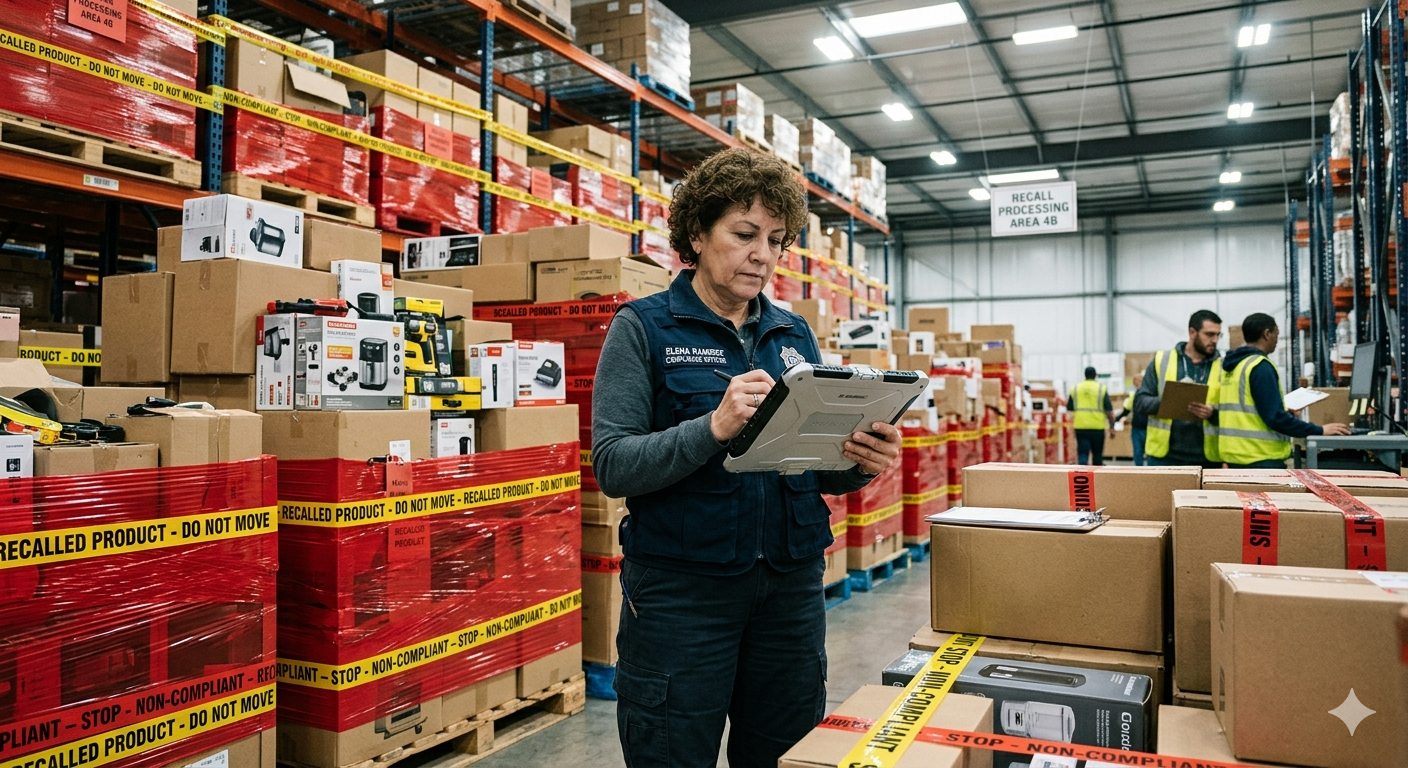
Across every major product category, the industry average recall completion rate sits between 15% and 30%. That means for every ten defective or dangerous products in the field, seven or eight never get fixed. The manufacturer knows which products are affected. The regulator has issued the notice. But the product sits in a home, on a job site, or in a warehouse — unreachable, unknown, unresolved.
This is not a logistics failure. It is an identity failure. Manufacturers have no persistent link between the product and the person who owns it. Once a product leaves the factory, it disappears into a distribution fog. The result: liability exposure that compounds every day a recalled unit remains in use, and regulators who are increasingly out of patience.
Digital product identity changes this equation. Not incrementally — fundamentally.
Why Recalls Fail: The Missing Link
Product recalls fail for one reason: manufacturers cannot reach the people who own their products. The mechanics appear straightforward — identify affected units, notify owners, facilitate repair or replacement, close the loop. In practice, every step collides with the same wall. There is no persistent link between a physical product and its current owner. Without that link, notification depends on media coverage, retailer cooperation, and chance. None of those are reliable, and none of them scale. The result is an industry-wide completion rate of 15–30% — meaning the majority of recalled products remain in use, unremediated, after a recall has been formally issued. Solving recalls means solving the identity problem first.
No Customer Data at the Point of Sale
When a product moves through retail — physical or online — the retailer captures the customer relationship. The manufacturer receives a purchase order confirmation. No name, no address, no contact detail, no serial number tied to a buyer. The product disappears into private ownership the moment it crosses the retail threshold. A major appliance manufacturer recalling a fire-risk tumble dryer faces the same dead end as a power tool brand recalling a faulty battery pack: they know the affected model numbers and production batches, but they have no way to reach the people who bought them. This is not a new problem. It is one that has become structurally indefensible as regulators in the EU and North America increasingly require manufacturers to demonstrate direct owner notification capability before a recall event occurs.
Paper Registration: A 10% Solution
Warranty registration cards — still used across many durable goods categories — generate response rates below 10%. Even when manufacturers send follow-up reminders by mail or email, the friction of manual registration defeats the exercise. The 90% of owners who never registered are completely invisible when a recall is issued. Digital registration via QR code at unboxing raises that number substantially, but only if it is designed into the product experience from the beginning. Registration bolted on as an afterthought — a card in the box, a URL buried in the manual — performs no better than the paper card it replaced. The registration mechanism must be immediate, frictionless, and tied to a specific serial number to produce the owner data that makes recall notification possible.
Retailers Won't Share the Data
Retailers treat customer data as a competitive asset. They have no contractual obligation and no commercial incentive to hand buyer lists to manufacturers. Amazon will not tell a power tool brand who purchased 40,000 units of a drill with a defective chuck. Best Buy will not share contact details for customers who bought an affected refrigerator model. The manufacturer is left to rely on media announcements, CPSC database postings, and the hope that affected owners happen to see them. That hope is not a compliance strategy. It is not a liability defence. And it is not something regulators are willing to accept as reasonable effort under frameworks like the EU's General Product Safety Regulation, which came into force in December 2024 and explicitly requires manufacturers to notify consumers directly when contact information is available.
The Cost of a 20% Completion Rate
A 20% recall completion rate does not mean 80% of the problem is resolved later. It means 80% of the problem persists indefinitely — unremediated units in homes, on job sites, and in warehouses, accruing liability every day they remain in use. The consequences extend well beyond the initial fine and press coverage. Liability exposure does not close when a recall is announced; it closes when affected units are physically remediated. Regulatory penalties under the CPSC can reach $15.15 million per violation series, and the EU's GPSR requires manufacturers to demonstrate direct owner notification capability — not just issue a press release. Brand damage from a protracted recall compounds with each media cycle. Product liability underwriters, citing recall as one of the top five business interruption risks globally, are increasingly factoring recall readiness into coverage terms and premium pricing. The cost of a failed recall is measured in years, not quarters.
What Good Looks Like: Digital Recall Capability
When every product has a digital identity tied to a registered owner, recall management transforms from a crisis response into an operational capability. The manufacturer knows exactly which serial numbers are affected, who owns them, and how to reach each owner directly. Notification goes out within hours, not weeks. Completion is tracked in real time, not estimated after the fact. Regulatory submissions include documented evidence of outreach efforts rather than approximations. This capability does not require new infrastructure at scale — it requires building digital registration into the product experience from day one, so that the owner data exists before it is needed. Manufacturers who have done this routinely achieve 60–80% first-week contact rates on affected units, compared to the 5–10% that traditional broadcast methods achieve in the same window.
Instant Push Notification to Registered Owners
Within hours of a recall decision, every registered owner of an affected serial number range receives a direct notification — push alert, email, or SMS — with clear, specific instructions. There is no dependency on retailer cooperation and no reliance on media pick-up. The message is targeted to owners of affected units only, authoritative in tone, and fully traceable. Each notification is logged against a specific serial number, creating a timestamped record of every contact attempt. Manufacturers who have embedded digital registration into their product experience consistently achieve 60–80% first-week contact rates on recalled units. That figure is not comparable to the 15–30% industry average measured across the full recall lifecycle — it is measured in the first week alone. The gap between those numbers represents the difference between a recall that closes and one that drags for eighteen months.
Real-Time Completion Tracking
A digital recall system tracks every affected unit across four states: notified, acknowledged, remediated, and outstanding. Operations teams see completion rates broken down by region, retailer channel, and production batch — updated in real time, not compiled weekly. Legal teams have a documented audit trail of every notification attempt. Regulatory submissions include actual data rather than estimates. This visibility also enables escalation logic: owners who do not respond to the first notification receive follow-up messaging on a defined schedule. Persistent non-responders can be flagged for direct outreach or retailer-assisted contact. The recall does not stall because no one knows how many units are still outstanding. Every day, the operations team knows exactly where the recall stands and what actions are needed to advance it.
Geographic Batch Targeting
Manufacturing defects typically trace to a specific production run, a component supplier batch, or a date range at a single facility — not to every unit of a product line ever made. Digital serial tracking enables surgical targeting: notify only the owners of genuinely affected units, not every owner of every product variant. This matters for two reasons. First, it protects brand credibility with unaffected customers who do not need to receive a recall notice about a product that poses no risk to them. Second, it concentrates remediation resources — replacement parts, service appointments, return logistics — exactly where they are needed. For safety-critical products such as PPE, respiratory equipment, and fall-arrest systems, this precision is not a nice-to-have. It is the operational difference between a managed recall and a regulatory enforcement action.
Traditional vs. Digital Recall Capability
| Capability | Traditional Approach | Digital Product Identity |
|---|---|---|
| Owner contact data | Rarely held | Captured at registration |
| Notification speed | Days to weeks via media | Hours via direct push |
| First-week reach | 5–10% of affected units | 60–80% of registered owners |
| Completion tracking | Estimated, manual | Real-time, per-serial |
| Geographic targeting | Not possible | Batch and region-level |
| Regulatory evidence | Limited documentation | Full audit trail |
| Unregistered unit handling | No capability | Retailer data requests |
| Recall closure timeline | 12–18 months average | Weeks for registered base |
Digital Identity as a Compliance Asset
Digital product identity is no longer just a commercial advantage — it is becoming a compliance requirement. The EU's General Product Safety Regulation, in force since December 2024, requires manufacturers to maintain traceability systems capable of identifying affected products and the consumers who own them. The Digital Product Passport framework under ESPR extends this requirement across a widening range of product categories. In regulated sectors — PPE, medical devices, safety equipment — traceability has been a hard requirement for years. For broader consumer goods, the regulatory trajectory is now clear and consistent: products need digital identifiers, and manufacturers need owner contact capability on record before a recall occurs. Building this capability proactively means being able to demonstrate readiness to regulators, insurers, and enterprise procurement teams. Large B2B buyers are increasingly requiring documented recall notification capability as part of supplier qualification. The manufacturer brand protection strategy question and recall readiness resolve to the same answer: you need to know who owns your products.
From Post-Purchase Gap to Lifecycle Intelligence
The owner data captured through digital product registration does not exist in isolation. Every warranty registration, product scan, and support interaction builds a longitudinal picture of product lifecycle that manufacturers have historically never had access to. Which products are in active use? Where are they deployed? Which owner segments engage with the brand after purchase? This is the broader argument explored in the product data you are not collecting — and recall readiness is the most urgent single reason to close that gap. The same registration that enables direct recall notification also enables early engagement, accessory cross-sell, installation support, and end-of-life communications. Understanding what happens in the first 30 days after product registration shows how much commercial value sits in that initial window. Recall readiness is the safety case. Revenue enablement is the business case. Both are served by the same underlying owner-identity capability.
Competitors and Alternatives
Several platforms address parts of the product registration and recall readiness challenge. Registria has built a strong warranty registration and product engagement product, particularly well-regarded among consumer goods brands that need to build direct owner relationships at scale. Dyrect offers warranty and post-purchase tooling with a focus on direct-to-consumer manufacturers who already control the retail relationship. NeuroWarranty provides warranty management with QR-based registration and customer data capture for brands looking to move away from paper-based registration. Each of these platforms demonstrates that the market has recognised product registration as a strategic capability rather than an administrative overhead. The meaningful differences between solutions lie in how deeply they connect registration data to serial-level product identity, compliance documentation, and lifecycle management — particularly for manufacturers operating across multiple geographies with jurisdiction-specific warranty and traceability requirements where a single registration platform must serve multiple regulatory frameworks simultaneously.
Frequently Asked Questions
How does digital product identity improve recall completion rates?
Digital product identity creates a direct, persistent link between a specific product serial number and the registered owner's contact details. When a recall is issued against a serial number range, the manufacturer can notify affected owners directly — by push notification, email, or SMS — within hours. This bypasses the dependency on retailer cooperation and media coverage that constrains traditional recall outreach, and replaces it with targeted, traceable communication to known owners.
What about products sold through retailers where no registration data exists?
Registration rates are never 100%, and a recall management strategy accounts for the unregistered base. For the registered population, direct notification achieves high completion rates quickly. For unregistered units, manufacturers can combine retailer data requests, point-of-sale messaging, and targeted media — but with real completion data on the registered base, they have a documented record of reasonable effort. The goal is to maximise registered coverage, which makes every other element of recall management easier and more defensible.
Is digital recall notification capability required by regulation?
Regulatory requirements are evolving and vary by jurisdiction and product category. The EU's General Product Safety Regulation requires manufacturers to have traceability capability and the ability to notify consumers of safety issues. For certain product categories — PPE, medical devices, safety equipment — traceability requirements are explicit and well-established. For broader consumer goods, GPSR and the Digital Product Passport trajectory make direct owner notification capability an increasingly expected baseline. Manufacturers in safety-critical categories should treat it as a current compliance requirement; others should treat it as near-term regulatory inevitability.