70% of Products Are Never Registered — Here's What That Costs You
Key Takeaways
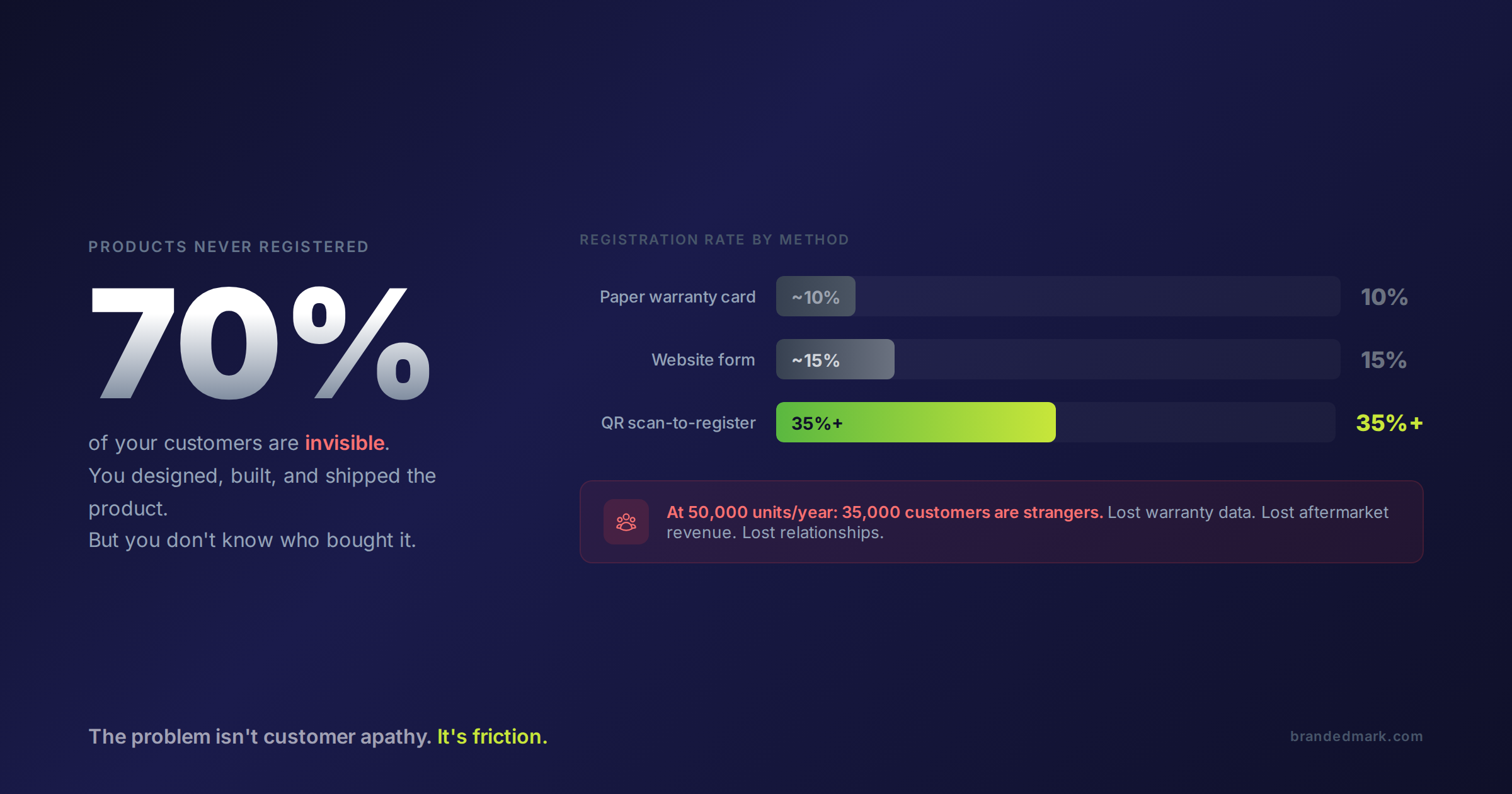
- Paper warranty cards achieve under 10% registration. Web forms reach 15%. The industry average across all methods is under 30% — meaning 70%+ of product owners are invisible to the brand that made their product.
- Each unregistered product represents a lost customer relationship, an invisible warranty liability, and aftermarket revenue that leaks to Amazon, eBay, and third-party parts suppliers.
- The root cause is not customer apathy. It is friction: too many steps, too much typing, no immediate value, and no connection between the product and the registration process.
- Scan-to-register flows — where a QR code on the product auto-fills serial number and model, and registration completes in under 30 seconds — consistently achieve 35%+ registration rates.
The Number Every Aftermarket Team Knows But Doesn't Fix
You sell 50,000 units a year. How many customers can you name?
If you are using paper warranty cards: roughly 5,000. Maybe fewer.
If you have a web form on your website: perhaps 7,500. On a good year.
The rest — 35,000 to 45,000 people who bought your product, took it home, used it every day — are strangers to you. You designed the product. You manufactured it. You stand behind a warranty you hope they never need. But you do not know who they are, where they are, or what they need.
This is not a data problem. It is a relationship problem. And it costs far more than most brands calculate.
Why Registration Fails
The standard explanation is "customers don't bother." This is wrong. Customers do not register because brands make it unreasonably difficult.
The friction stack
Paper warranty cards: The customer must find the card in the box, locate a pen, read the serial number from the product (often in tiny print, often on the bottom), fill in their name and address, find a stamp, and post it. At every step, they can quit. Most do.
Web forms: Better, but still 8-12 fields. The customer must find the URL (printed where?), type it into a browser, locate the serial number, type it correctly (is that an O or a 0?), create an account they will never use again, and confirm via email. The reward for this effort: nothing immediate.
App-based registration: Now you are asking customers to download an app — for a toaster, a power drill, a boiler. The drop-off is brutal. App fatigue is real, and the download-to-registration conversion rate is often worse than a paper card.
The pattern is consistent: the more steps between "I just opened this product" and "I'm registered," the more customers you lose.
What You Lose When Registration Fails
1. The customer relationship
An unregistered product owner is a stranger. You cannot email them setup tips. You cannot alert them to a firmware update. You cannot offer them compatible accessories. You cannot warn them about a recall.
When they need support, they call your generic number and start from zero: "What model do you have?" "What's the serial number?" "When did you buy it?" Every answer the customer gives is information you should already have.
2. Warranty cost visibility
If you do not know who owns your products, you cannot accurately forecast warranty liability. You are reserving against unknown claims from unknown people on unknown units. Warranty fraud — duplicate claims, out-of-warranty claims, claims on counterfeit products — is harder to detect when you have no baseline of legitimate registrations.
The industry estimate: warranty fraud costs 3-10% of programme budgets. For a manufacturer with £2M in annual warranty costs, that is £60K-£200K in preventable fraud.
3. Aftermarket revenue
Your customer needs a replacement filter, a spare battery, a new blade. Where do they go? If they are registered and you have a relationship: to your product page, where you show the exact compatible part and fulfil the order at full margin.
If they are not registered: to Amazon, where a third-party seller captures the revenue, your margin disappears, and the customer never comes back to you. The aftermarket opportunity is one of the highest-margin revenue streams in manufacturing — and 70% of it leaks because you do not know who owns your products.
4. Recall compliance
When a safety issue requires a product recall, who do you notify? Registered owners get a direct communication. Unregistered owners get a press release and a hope that they notice. Recall response rates for registered products are typically 3-5x higher than for unregistered products — because you can actually reach the people who have the product.
What Changes at 35%
The difference between 10% and 35% registration is not 25 percentage points. It is the difference between guessing and knowing.
At 35% registration on 50,000 units:
- 17,500 known customers (vs 5,000 from paper cards)
- Direct support relationship with each one
- Warranty claims validated against real registrations
- Spare parts and accessories offered at the point of need
- Recall notifications delivered directly
The compounding effect matters more than the initial capture. A registered customer who receives a setup guide on day 1 is more likely to buy accessories on day 30, register their next purchase from the same brand, and recommend the product to others. Registered product owners generate 2.5x lifetime value compared to unregistered ones.
How You Get There
The brands that achieve 35%+ registration rates share three design principles:
1. Registration happens at the product, not on a website
A QR code on the product or inside the packaging. The customer scans it with their phone camera — no app download, no URL typing, no account creation. The serial number and model are pre-filled from the QR data. The customer confirms their name and email. Done. Under 30 seconds.
2. Immediate value, not deferred obligation
The reward for registration should be immediate and tangible: instant access to setup guides, troubleshooting content, warranty confirmation, and spare parts ordering. Not "you might need this in 18 months." The first 30 days after registration determine whether the customer stays engaged.
3. The registration IS the relationship
Registration should not be a one-time form submission that disappears into a database. It should be the beginning of an ongoing connection — where the customer can scan the product at any time and get support, order parts, check warranty status, or transfer ownership.
This is the difference between a registration form and a post-purchase operating system.
The Cost of Waiting
Every month at 10% registration, you are choosing to remain strangers with 90% of your customers. Every product sold without a scan-to-register QR is a relationship you will never build, a warranty claim you cannot validate, and a spare part sale you will lose to a third party.
The maths is straightforward. The tools exist. The question is whether your registration rate is a metric you report — or a problem you solve.
FAQ
Q: Where does the 70% figure come from? Industry data on warranty registration rates consistently shows paper cards at under 10%, web forms at 10-15%, and blended rates across all methods at 20-30%. The "70% unregistered" figure reflects the typical mid-market manufacturer using traditional registration methods. Brands with scan-to-register flows significantly outperform this baseline.
Q: Does registration rate vary by product category? Yes. Consumer electronics typically achieve higher rates (15-20% via web) because tech-savvy buyers are more willing to complete digital forms. Appliances, power tools, and HVAC products — where the buyer may be less digitally engaged or the product is installed by a professional — typically see the lowest rates. Installer-mediated registration (where the tradesperson must register on behalf of the homeowner) is particularly prone to failure.
Q: What registration rate should we target? 35% is achievable with a well-designed scan-to-register flow and immediate value delivery. Some brands with strong unboxing experiences and clear QR placement report rates above 40%. The key variable is friction: every field you add, every step you require, and every second you add to the process reduces your rate.
Q: Can we improve registration without changing our product packaging? You can add QR codes to existing packaging, inserts, or even the product itself (via sticker or laser marking) without a full packaging redesign. The QR code does not need to be large — it needs to be visible at the moment the customer first interacts with the product.