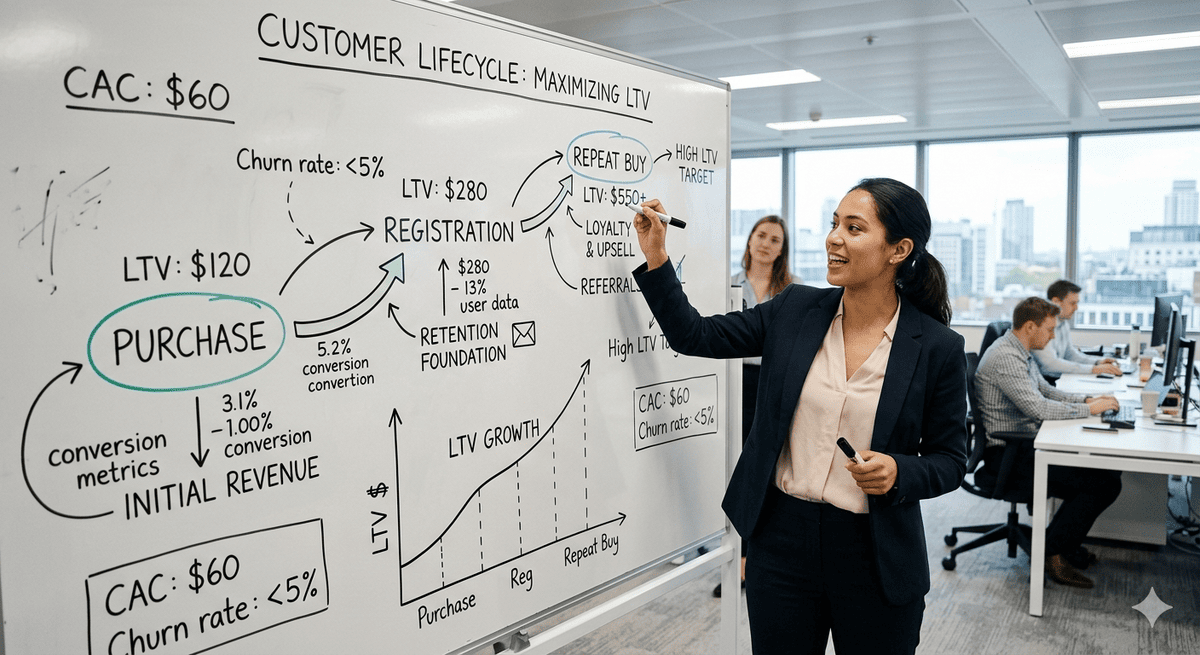
How Connected Products Increase Customer Lifetime Value
Most manufacturers track revenue. The best ones track relationship value, and that distinction can compound across a product line.
Here is the uncomfortable truth: when a customer buys your product at retail and it sits unregistered in their home, they are a stranger to you. They may love the product. They may buy accessories, replacements, and upgrades, just not from you, because you have no way to reach them. The retailer does. And over a multi-year product lifecycle, that retailer is quietly building the customer relationship you paid to create.
| Key Metric | Unregistered Owner | Registered Owner |
|---|---|---|
| Multi-year CLV (direct) | Baseline | Potentially higher |
| Additional purchase frequency | Baseline | Potentially higher |
| Support cost per contact | Higher | Lower |
| Reachability for referral | Baseline | Higher |
| Repeat purchase at replacement cycle | Lower | Higher |
Connected product identity changes that equation. When a product is registered, when a physical object is linked to a verified owner, the economics of every subsequent interaction can shift in the manufacturer's favor.
The CLV Gap: Registered vs. Unregistered Owners
The logic is straightforward: a registered product owner has reasons to come back that an unregistered owner does not.
This is not a rounding error. It reflects a structural difference in the relationship. Registered owners have a reason to come back. They have warranty coverage to maintain, support to access, parts to order, and an upgrade path that flows naturally from the brand that already knows their product.
Unregistered owners, by contrast, exist in a gap. They bought once. The next interaction, a support question, an accessory search, a replacement decision, is a coin flip. Without a direct channel, the brand is bidding against every competitor for a customer it already earned.
The registered owner cohort can behave differently across several dimensions:
- Purchase frequency: A registered customer has a direct, brand-owned reason to make the next purchase from the same brand rather than from a retailer or marketplace
- Support cost: A known customer with a registered product can be served without re-establishing context, which shortens resolution and lowers the cost per contact
- Advocacy: An owner who receives proactive, relevant post-purchase communication has more reasons to recommend the brand
- Churn at replacement cycle: A registered owner is reachable at the replacement moment, so the brand can compete for the repurchase instead of losing it by default
These are not marginal differences in kind. They are the gap between a company that scales profitably and one that perpetually re-acquires customers it already paid to win.
Five CLV Drivers from Connected Product Identity
Connected products, those linked to a verified owner through QR, NFC, or digital registration, can activate five distinct revenue and retention levers that unregistered products simply cannot reach.
1. Warranty Registration: The Known Customer
The moment a product is registered, the brand gains something irreplaceable: a direct channel. Not a retailer's channel. Not a third-party marketplace. A direct line to a specific person who owns a specific product.
That channel is the foundation of everything else. Without it, every other CLV driver on this list is impossible. With it, the brand can communicate, support, sell, and re-engage across the entire ownership lifecycle.
Registration also changes the support dynamic. When a customer contacts support with a registered product, the brand already knows what they own, when they bought it, and what interactions have occurred. Resolution can be faster, satisfaction higher, and the cost per contact lower.
Learn more about the mechanics of warranty registration and how to drive participation rates.
2. Support Interactions: Engagement Touchpoints
Support is traditionally viewed as a cost center. For connected products, it can become a relationship asset.
Every support interaction with a registered customer is a data point: what broke, when, how it was resolved, and what the customer said in the process. Over time, this data builds a profile of the ownership experience that no survey can replicate.
More practically, each resolved support case is an opportunity to deepen trust. A customer who contacts support and gets a fast, frictionless resolution, one that required them to provide zero context because the brand already had it, is a customer more likely to tell people about the experience. That word-of-mouth is CLV compounding in the background.
Brands that instrument their support interactions with registered owners can also gain early warning signals: clusters of issues with specific SKUs, failure patterns that may predict churn, usage behaviors that correlate with satisfaction. These insights can feed product development, reduce warranty costs, and improve margins on future generations.
3. Spare Parts Commerce: Repeat Revenue
Consumables, wear parts, and accessories are among the higher-margin revenue lines in manufacturing, and they are largely inaccessible to brands whose customers are unregistered.
Consider a coffee machine. The filters, descaling kits, and replacement carafes that accompany it over years of ownership can add up to a meaningful share of the original purchase price in cumulative value. If the customer bought the machine through a retailer and never registered it, the brand has no mechanism to capture any of that revenue. The marketplace will.
Connected product identity changes this. A registered owner can receive proactive reminders when consumables are due. They can reorder parts through a brand-owned commerce channel with one tap from the same interface where they manage their product. The friction is lower than a typical third-party alternative, and the brand captures the full margin.
For durables with longer replacement cycles, power tools, appliances, HVAC equipment, the parts opportunity is even larger. A known customer with a registered product is a customer you can serve for years. The CLV on that relationship is categorically different from a one-time retail transaction.
Explore the full map of post-purchase revenue streams that connected products unlock.
4. Extended Warranties: High-Margin Upsell
Extended warranty programs can be among the more profitable offers in consumer goods, but they require one thing to work: a direct channel to the customer at the right moment.
That moment is intuitive. Customers tend to be most receptive to extended warranty offers in the final stretch of their standard warranty period. Before that window, the offer can feel unnecessary. After it, the emotional urgency is gone.
Without product registration, hitting that window is guesswork. The brand may not know who the customer is, let alone when their warranty expires. With a connected product, the timing can be precise. An automated trigger fires near the end of a standard warranty, the offer arrives in a channel the customer has already used, and conversion can improve because the context is right.
When the offer reaches a registered owner in their own channel at the right moment, it has a better chance of converting than the same offer pushed through an indirect cohort the brand can neither time nor reach reliably.
5. Re-engagement for the Next Purchase
The replacement cycle is the final and often most valuable CLV moment, and it is one where most manufacturers start from zero.
A customer with a multi-year-old appliance is approaching a natural repurchase window. Without registration, the brand cannot identify who that customer is, let alone communicate with them. The replacement purchase goes to whichever brand wins the search results or the retail floor.
With connected product identity, the brand knows exactly who is approaching end-of-lifecycle. They can initiate a conversation with full context: here is the product you own, here is its age, here is what we recommend next. They can offer trade-in value. They can share what has changed in the new generation. They can close the loop on a relationship they built over years of proactive support.
This is not a cold acquisition. It is the warmest possible re-engagement, and it can cost a fraction of what it would take to acquire the same customer through paid channels.
Where the CLV Gap Comes From
The gap is easier to see event by event. Below is a directional comparison for a consumer product with a multi-year ownership lifecycle, showing where revenue lands rather than how much.
The product: A home appliance with a standard warranty, consumable accessories, and an optional extended warranty plan.
| Revenue Event (illustrative) | Unregistered Owner | Registered Owner |
|---|---|---|
| Initial purchase | Same | Same |
| Consumables / parts (multi-year) | Retailer captures | Brand captures |
| Extended warranty | Rarely offered | Often attached |
| Support deflection savings | None | Faster resolution |
| Repeat purchase at cycle end | Lower probability | Higher probability |
| Referral-driven acquisition | None | Reachable owner |
| Multi-year CLV (direct to brand) | Lower | Potentially higher |
In this illustrative example the direction of the gap is intuitive, and it may understate the compounding effect across a product line. A brand that moves registration from a small fraction of buyers to a majority is not making a marginal improvement. It can add direct CLV that previously leaked to retailers and competitors.
The investment required to enable this, a connected product identity platform, QR or NFC tags, a registration flow, and a post-purchase communication layer, is small relative to the gap it can close. The full ROI case for connected products makes this arithmetic visible.
CLV by Registration Channel: QR vs. Email vs. Retail POS
Not all registration paths are equal. The channel through which a customer registers can shape their subsequent engagement, and understanding this shapes where to invest.
QR Scan at Unboxing
This can be the highest-value registration path. Customers who scan a QR code at unboxing are in an active relationship moment: they are engaged with the product, motivated to get value from it, and receptive to brand communication. Registration through in-box QR works best when the flow is frictionless and delivers immediate value (digital manual, setup guide, warranty confirmation).
Downstream, the QR-registered owner can be among the most engaged of any channel. Having opted in at the moment of highest intent, they may be more receptive to follow-up communication, more likely to buy parts and accessories through the brand, and more likely to take an extended warranty offer. They may also be more likely to register additional products from the same brand.
The mechanics of first-party data capture through connected packaging are worth understanding in detail.
Email Post-Purchase
Transactional emails sent a day or two after purchase can prompt registration among customers who did not scan at unboxing. Completion tends to be lower than in-box QR, but the economics can still justify the effort. The email-registered owner still has a direct channel that a completely unregistered owner lacks, though the engagement gap with QR-registered owners can be meaningful.
The friction in email-driven registration is higher: the customer must click through, recognize the product, and complete a flow outside the natural setup moment. Reducing that friction, pre-populating product details from the purchase data, offering a single-tap confirmation, can improve both the completion rate and the downstream engagement.
Retail POS
Point-of-sale registration, where the retailer captures customer consent and shares data with the brand, is the most complicated path and often the least reliable. It requires retailer cooperation, data-sharing agreements, and a customer who is willing to opt in at checkout.
Where it works, it can work well. Retail POS registration can capture data that QR cannot: demographic and payment information that enriches the owner profile. But the control lies with the retailer, the opt-in is harder to secure, and the quality of subsequent engagement can suffer because the brand's channel is mediated.
For brands building a long-term connected product strategy, QR-at-unboxing is the primary channel to optimize. Retail POS is a supplement, not a foundation.
The Strategic Imperative
Customer lifetime value is not a metric. It is the cumulative result of every decision a brand makes about how to relate to the people who own its products.
The manufacturers who will dominate their categories over the next decade are likely not the ones with the best product specs or the most aggressive retail distribution. They are the ones who understand that the product is the beginning of the relationship, not the end of it, and who have built the infrastructure to act on that understanding at scale.
Connected product identity is that infrastructure. It converts an anonymous transaction into a known customer. It turns a warranty card into a revenue engine. It makes the replacement cycle a warm re-engagement instead of a cold acquisition.
The CLV gap between registered and unregistered owners is not a ceiling. For brands that invest in the full ownership lifecycle, support, parts, extended warranty, re-engagement, the gap can widen in the brand's favor. The question is not whether connected products can increase CLV. The question is how much of that value you are currently leaving on the shelf.
FAQ: Connected Products and Customer Lifetime Value
Is the CLV gap realistic for all product categories?
The logic holds across durable goods categories: appliances, tools, electronics, consumer hardware. The absolute CLV varies by price point, product complexity, and aftermarket opportunity size. A registered customer for a low-priced item gains less absolute value than a registered customer for a high-priced one. But the directional relationship between registered and unregistered owners tends to be consistent across categories. In high-margin areas like extended warranties, the gap can be wider.
How quickly does registration rate improvement translate to CLV improvement?
It depends on the product lifecycle. Support cost savings and parts revenue can materialize relatively early in ownership. Warranty upsell and replacement cycle re-engagement (the back half of CLV) tend to materialize later. The full effect plays out over the multi-year ownership window.
Do I need a full platform to capture CLV gains, or can I start with registration only?
Registration alone can improve CLV by capturing a direct communication channel. But the multiplier depends on what you do after registration. A manufacturer with high registration rates and no post-purchase infrastructure (support, parts, extended warranty) may see only a modest CLV lift. Add support integration and it can grow. Add parts commerce and warranty upsells and you reach more of the potential. Registration is the foundation; the lift can grow as you build.
How do I measure CLV for products still in early lifecycle?
Model it. Take your average product margin, multiply by repeat purchase frequency at replacement (use a conservative baseline if you have no historical data), add parts revenue per customer based on your own category history, add warranty upsell contribution margin, and subtract support cost savings. Conservative modeling can help you judge whether the infrastructure investment to enable registration and basic post-purchase engagement pays back inside the ownership window.
BrandedMark connects physical products to verified owners, activating every post-purchase revenue channel from a single platform. If you are ready to close the CLV gap, join the waitlist to see how it works for your product line.