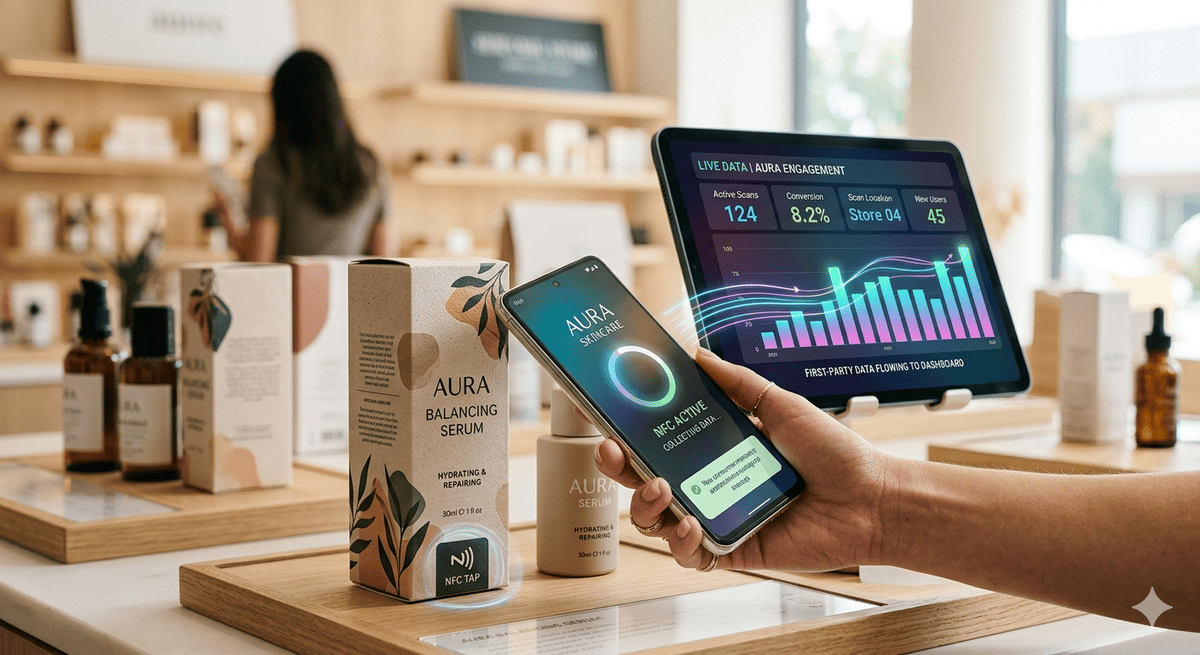
First-Party Data via Connected Packaging
Key Takeaways
- Third-party cookies are being eliminated across all major browsers and by GDPR/CCPA regulation — brands that rely on them face an accelerating data gap.
- Connected packaging (QR codes on physical products) is the most direct, privacy-compliant first-party data channel available to brands that sell through retail rather than direct-to-consumer.
- A single product scan captures both implicit first-party data (geography, device, engagement) and explicit zero-party data (email, preferences) in a fully consensual value exchange.
- First-party data from connected packaging feeds directly into Meta Conversions API and Google Customer Match, replacing cookie-based retargeting with more accurate, consent-grounded audiences.
The infrastructure that powered digital advertising for two decades is being dismantled. Google's Privacy Sandbox is replacing third-party cookies in Chrome. Apple's App Tracking Transparency framework requires explicit user consent before apps can track activity across other companies' apps and websites. Safari and Firefox blocked third-party cookies years ago. The European Union's GDPR and California's CCPA have made the regulatory environment unambiguous: the era of tracking people across the internet without their knowledge is over.
For direct-to-consumer brands with their own e-commerce channels, this is uncomfortable but manageable. For the vast majority of consumer product brands — the ones that sell through Amazon, Tesco, Walmart, Home Depot, and thousands of independent retailers — this shift is existential. According to a 2023 Boston Consulting Group study, brands with mature first-party data capabilities generate 2.9x the revenue lift from a single marketing message compared to brands with limited first-party data. Because these brands do not just lose access to third-party tracking data. They never had much first-party data to begin with.
The CPG Data Problem: You Do Not Know Your Customer
Most product manufacturers have almost zero direct data on who buys their products. You know how many units shipped to retailers. You have market research panel estimates for buyer demographics. You might receive aggregated, anonymised sales data from retail partners — weeks or months after transactions occurred. But you do not know who your customers are, where they live, what they do with your products, or how to reach them directly. This has been the default operating model for consumer brands for decades. It was always a weakness, but third-party data masked it. Brands could buy audience segments, retarget website visitors with cookies, and use data management platforms to cobble together a customer picture from other people's data. That infrastructure is disappearing. The brands that have not invested in building their own customer data foundation are about to find themselves operating completely blind in a market that increasingly rewards personalisation and direct relationships.
The dependency chain looks like this:
- Retailer data: Aggregated, delayed, and often restricted by commercial agreements. You see categories, not customers.
- Panel studies: Small sample sizes, modelled rather than observed. Useful for trend lines, not for personalisation.
- Third-party cookies and tracking pixels: Being eliminated by browsers and regulation. Already unreliable on mobile.
- Walled garden advertising: Meta, Google, and Amazon have the data, but they control the access and the cost. You rent it by the impression.
Every link in this chain is either degrading, getting more expensive, or both. The brands that thrive in the next era will be the ones that build their own direct data relationships with customers. The question is how.
Connected Packaging: A First-Party Data Channel You Already Own
Your product packaging reaches every single customer you have — regardless of whether they bought from Amazon, a supermarket, or a specialist retailer. It is the one touchpoint you fully control without needing a platform intermediary. A QR code on your packaging transforms this passive surface into an active data capture channel, one where the customer initiates the interaction voluntarily and receives something useful in return. That consent-first structure is what makes it both privacy-compliant and genuinely valuable. Digital warranty registration is one of the most effective ways to begin this value exchange, with registration rates far exceeding traditional paper-card approaches. Unlike paid media or email campaigns, connected packaging costs nothing per impression — every product you have already shipped is a potential scan waiting to happen. Two distinct data types are generated simultaneously from a single scan:
When a customer scans a QR code on your product, several things happen simultaneously:
Implicit data capture (first-party data)
Without asking for anything, you learn:
- Purchase confirmation: Someone bought your product and has it in their hands. This is ground truth, not a modelled estimate.
- Geographic signal: The device's general location tells you where your products are actually being used, not just where they were shipped.
- Device and language context: Operating system, browser language, and screen size provide demographic signals.
- Time of interaction: When people engage with your product — immediately after purchase, days later, or months into ownership.
- Content engagement: What they click on, read, watch, and return to. This reveals what they actually care about.
Explicit data capture (zero-party data)
When you offer genuine value in exchange, customers willingly share:
- Email or phone number: In exchange for warranty registration, setup guides, exclusive content, or loyalty rewards.
- Product preferences: Through onboarding questions, preference centres, or product registration forms.
- Feedback and ratings: Through satisfaction surveys, product reviews, and support interactions.
- Purchase context: Who the product is for, where they bought it, and why they chose it.
This is not surveillance. It is a value exchange. The customer scans because they want something — a manual, a setup guide, a warranty, a recipe, a troubleshooting tip — and in return, you learn something about them. Both parties benefit, and the interaction is fully transparent.
Understanding the Data Hierarchy
The terms "first-party," "zero-party," and "third-party" data get used interchangeably, but the distinctions carry real strategic weight. Understanding each type helps you design collection strategies with the right consent mechanisms, appropriate use cases, and realistic reliability expectations. Third-party data is the least trustworthy and most legally exposed — and its availability is shrinking fast. First-party data is accurate, timely, and fully yours to use. Zero-party data is the most valuable type because the customer explicitly chose to share it with you. Connected packaging naturally generates all three types in a single interaction. The scan itself produces first-party behavioural data. The registration form captures zero-party intent data. Unlike third-party sources, none of it depends on tracking people across websites they never expected you to follow them to. Knowing the difference shapes everything from how you structure consent flows to how you segment and activate audiences for paid advertising.
Third-party data
Data collected by entities that have no direct relationship with the consumer. A data broker aggregates browsing behaviour, purchase signals, and demographic information from hundreds of sources, then sells audience segments to advertisers. This data is decreasing in both availability and reliability as cookies disappear and regulations tighten. Critically, the consumer never consented to share this data with you specifically.
First-party data
Data you collect directly from your own interactions with customers. When someone scans a QR code on your product and browses your content, the pageviews, click patterns, scan frequency, and engagement metrics are first-party data. You observed this behaviour on your own property. It is accurate, timely, and yours to use within the bounds of your privacy policy.
Zero-party data
Data that customers intentionally and proactively share with you. When someone fills out a product registration form, answers onboarding questions, sets preferences, or completes a survey, that is zero-party data. It is the most valuable type because it reflects what the customer wants you to know, rather than what you inferred from their behaviour. It is also the most privacy-friendly, because the intent to share is unambiguous.
What You Can Do With Connected Packaging Data
First-party data from connected packaging has direct, measurable applications across advertising, personalisation, product development, and customer retention. The value is not theoretical — each use case maps to a specific business outcome that would otherwise require expensive third-party data purchases or inference from signals you do not own. Brands that activate this data intelligently gain compounding advantages over time: better ad targeting, lower customer acquisition costs, stronger repeat purchase rates, and clearer product development priorities grounded in observed behaviour rather than survey estimates. According to McKinsey research on personalisation at scale, companies acting on real-time first-party behavioural signals outperform peers in revenue growth by 40% over a five-year horizon. Connected packaging is the data capture layer that unlocks all of this for brands that sell through retail — not just those with direct e-commerce channels and built-in customer identity from day one.
Build custom audiences for paid advertising
Meta's Conversions API and Google's Customer Match allow you to upload first-party customer data — email addresses, phone numbers — to build custom audiences and lookalike segments for advertising. This is a direct replacement for the cookie-based retargeting that is disappearing.
When a customer scans your QR code and registers their product, their data can feed directly into your ad platforms. You can retarget actual buyers (not inferred ones), build lookalike audiences from people who genuinely use your products, and measure ad performance against real customer behaviour. Companies like Blue Bite have demonstrated that QR-based interactions can serve as a data source for ad attribution, connecting physical product engagement to digital advertising performance.
Personalise the customer experience
When you know which product someone owns, you can tailor every subsequent interaction. A customer who scanned a beginner-level product gets onboarding content. A customer who owns three products in your range gets cross-sell recommendations. A customer in Germany gets German-language support. A customer whose product is eighteen months old gets maintenance reminders and upgrade offers.
This level of personalisation was previously only available to brands with direct e-commerce channels. Connected packaging makes it possible for any brand, regardless of distribution model.
Inform product development
Aggregated scan and engagement data reveals how products are actually used in the real world. Which features do customers seek help with most often? Which products generate the most support queries? Which geographic regions show unexpected demand? Which accessories and spare parts are searched for most frequently?
This is not a replacement for formal user research, but it is a continuous, large-scale signal that traditional research methods cannot match. Product teams operating with this data make better decisions because they are working with observed behaviour, not survey responses. McKinsey research on personalisation at scale finds that companies acting on real-time first-party behavioural signals outperform peers in revenue growth by 40% over a five-year horizon.
Power loyalty and retention programmes
A direct data relationship is the foundation of any loyalty programme. Once a customer has registered a product through your connected packaging, you can recognise them across purchases, reward repeat buying, offer exclusive content or early access, and communicate directly without relying on a retailer as intermediary.
Brands like Brij have built their entire proposition around helping direct-to-consumer companies capture customer data through QR codes on products, then using that data to drive retention and repeat purchase. The principle applies equally to larger brands selling through traditional retail.
Understand your true customer base
Panel studies give you a modelled approximation of who buys your products. Connected packaging data gives you observed reality. When thousands of customers register their products, you build a first-party demographic profile that is more accurate, more granular, and more current than any panel study can deliver. This insight informs not just marketing, but merchandising strategy, retail partner negotiations, and market expansion decisions.
Privacy as a Feature, Not a Constraint
Connected packaging data is not just a workaround for privacy regulation — it is the model that privacy regulation was designed to encourage. Every interaction is initiated by the customer. Every data request is transparent and tied to a clear benefit. There are no hidden tracking pixels, no cross-site cookie drops, no inference from third-party behavioural signals the customer never knew existed. This structural difference matters enormously as enforcement of GDPR and CCPA matures. Brands collecting data through opaque third-party mechanisms face increasing legal and reputational exposure. Brands collecting data through consent-grounded, value-driven connected packaging interactions are building the exact type of customer relationships regulators want to see. Post-purchase interactions like those facilitated by companies such as Narvar have long demonstrated that customers willingly share data after purchase — provided the interaction delivers genuine value. Connected packaging makes this possible at the first moment of physical contact.
GDPR and CCPA compliance from day one
Connected packaging interactions are opt-in by nature. The customer chooses to scan. If you then ask for their email, you present a clear consent mechanism. There is no ambiguity about whether the customer intended to share their data, because they actively did so. This is fundamentally different from dropping cookies on someone's browser without their knowledge.
The value exchange principle
Privacy compliance is not just about legal checkboxes. It is about trust. Customers share data when they receive something genuinely useful in return. The value exchange in connected packaging is natural and intuitive:
- Scan to get a setup guide → you learn they own the product and their language preference
- Register for warranty → you get their email, purchase date, and retailer
- Complete a profile → you learn their preferences and usage context
- Join a loyalty programme → you get ongoing engagement and preference data
Each step provides clear value to the customer and progressively enriches your data. There is no dark pattern or coercion involved.
Transparent consent, easy opt-out
Best practice means clear language about what data you collect and how you use it, prominent opt-out mechanisms, and data deletion on request. Connected packaging makes this straightforward because the entire interaction happens on your own digital property, where you control the consent flow completely.
The structural advantage
There is a deeper point here. The reason third-party cookies are being eliminated is that they tracked people without meaningful consent, in contexts where the tracking was invisible and unexpected. Connected packaging data is captured in the opposite context: a deliberate, value-driven interaction where the customer is fully aware they are engaging with your brand. This is not a workaround for privacy regulation. It is the model that privacy regulation was designed to encourage.
Post-purchase interactions like those facilitated by companies such as Narvar have long demonstrated that customers are willing to share data and engage with brands after purchase — provided the interaction delivers genuine value. Connected packaging simply makes this possible at the moment of first physical contact with the product.
How to Get Started: A Practical Implementation Path
Most brands delay first-party data initiatives because they assume the infrastructure investment is prohibitive. It is not. A phased approach lets you start capturing real customer data within weeks, then build complexity only as your confidence and use cases develop. The important thing is to begin now. First-party data compounds over time — every month you wait is a month of customer interactions permanently lost. A QR code on your next packaging run, linked to a mobile-optimised landing page with a simple email capture, is enough to start. From there, each phase adds capability without requiring a full platform rebuild. For a broader view of why every product needs a digital identity and the strategic case for connected packaging, that article covers the foundations. For a comprehensive data strategy — turning scan data, warranty registrations, and support interactions into a coordinated asset — see Product Data Strategy: Turning Physical Products Into Data Assets.
Phase 1: Capture and learn
- Add a QR code to your packaging that links to a mobile-optimised landing page
- Offer genuine value: a digital setup guide, quick-start video, or warranty registration
- Include a simple email capture with clear consent language
- Set up basic analytics to track scan volumes, page engagement, and conversion rates
- Connect captured emails to your existing email marketing platform
This phase costs very little and immediately begins generating data you did not have before. Even without email capture, scan analytics alone tell you more about your customers than most brands currently know.
Phase 2: Enrich and connect
- Implement progressive profiling: ask for more information over time as you deliver more value
- Connect scan data to your CRM so customer records are enriched with product ownership data
- Feed first-party data into Meta Conversions API and Google Customer Match for ad optimisation
- Build automated onboarding sequences triggered by product registration
- Segment customers by product, engagement level, and preferences
Phase 3: Scale and optimise
- Roll connected packaging across your full product range
- Build lookalike audiences from your highest-value customer segments
- Use engagement data to inform product development and content strategy
- Implement loyalty mechanics that reward ongoing engagement
- Measure customer lifetime value differences between connected and unconnected customers
The Window Is Closing — But It Is Still Open
The shift away from third-party data is already underway. Brands that spent the last two years building direct customer relationships through connected packaging are compounding that advantage every month. The brands waiting for a perfect platform are falling further behind. Connected packaging is not the only first-party data channel, but for brands selling through retailers rather than direct-to-consumer, it is the most natural fit. Your packaging already reaches every customer — no new distribution, no media spend, no retailer permission required. The marginal cost of a QR code and a mobile landing page is trivial against the long-term cost of operating without a direct customer data asset. Work through the connected packaging checklist to ensure your scan destinations convert interest into lasting data relationships before launch.
BrandedMark is building a connected packaging platform designed to make first-party data capture seamless — from QR code generation to customer engagement to analytics. If you are a product brand looking to build direct customer relationships, we would like to help.
BrandedMark helps product brands turn their packaging into a first-party data channel — with smart QR codes, digital product experiences, and built-in analytics. We are pre-launch and working with early partners to shape the platform. Join our waitlist to get early access.
Frequently Asked Questions
What is first-party data, and why is it more valuable now than before?
First-party data is information you collect directly from your own interactions with customers — website visits, product registrations, scan analytics, purchase history, and content engagement. It has always been valuable, but it is becoming essential because the third-party data sources that brands have relied on (cookies, tracking pixels, data brokers) are being eliminated by browser changes, mobile operating system updates, and privacy regulation. First-party data is more accurate, more privacy-compliant, and fully within your control.
Do I need customers to download an app to capture data through connected packaging?
No. A QR code on your packaging can link directly to a mobile-optimised web page — no app download required. This is important because app download friction dramatically reduces engagement. A web-based experience loads instantly, works across all devices, and can still capture email addresses, product registrations, and behavioural data. If deeper engagement justifies an app later, you can introduce it once a relationship is established.
How does connected packaging data work with advertising platforms like Meta and Google?
Both Meta and Google offer mechanisms for brands to upload first-party customer data for ad targeting and measurement. Meta's Conversions API allows you to send customer interaction events (like a product registration triggered by a QR scan) directly to Meta's advertising system, improving ad attribution and enabling custom audience creation. Google's Customer Match lets you upload email addresses and phone numbers to target ads to known customers and build lookalike audiences. Connected packaging provides the data capture mechanism that feeds these systems.
Is it realistic to expect customers to scan QR codes on packaging?
Yes, and adoption is growing. QR code usage surged during the COVID-19 pandemic as consumers became accustomed to scanning codes for menus, payments, and check-ins. The key factor is value: customers scan when they expect to receive something useful — a setup guide, warranty registration, troubleshooting help, or exclusive content. Brands that offer a compelling reason to scan consistently see engagement rates that far exceed other post-purchase communication channels like package inserts or follow-up emails.