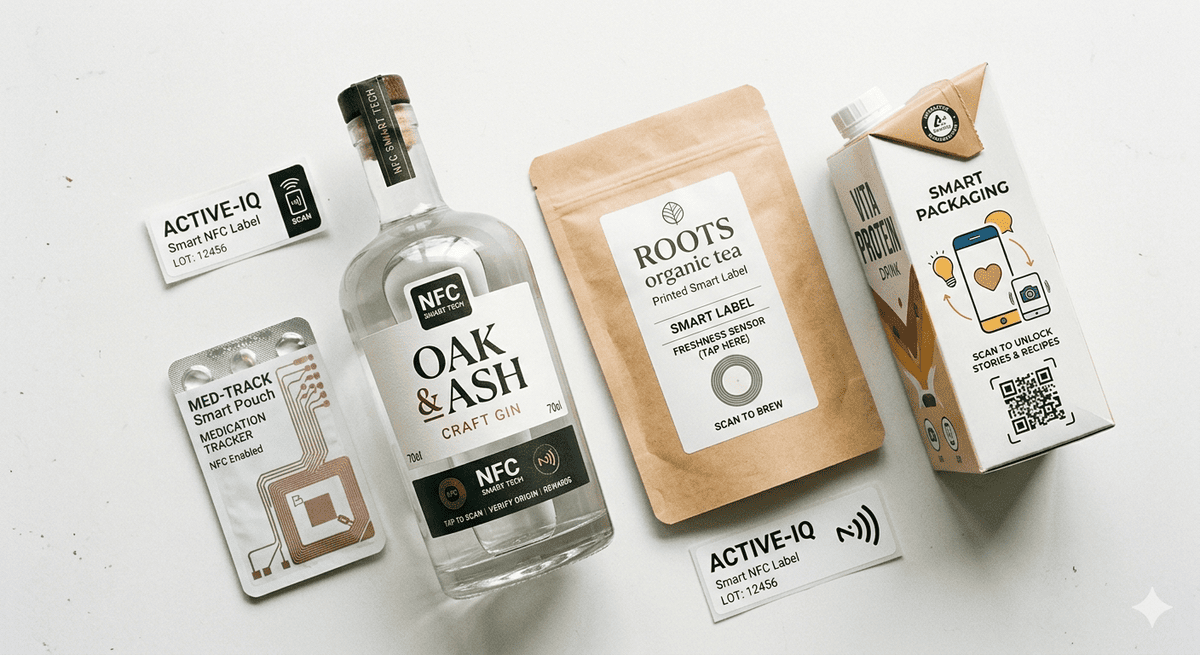
Smart Packaging: What It Is, Why It Matters, Where It's Going
Key Takeaways
- Smart packaging falls into three categories: active (protects product environment), intelligent (monitors and reports conditions), and connected (links the product to a digital experience via QR, NFC, or digital watermark)
- 92% of premium consumer products now embed NFC at manufacture, up from under 10% five years ago — connected packaging is the new baseline, not a forward-looking experiment
- GS1's 2027 Sunrise date and the EU's ESPR Digital Product Passport mandate are two converging regulatory forcing functions that make some form of connected packaging non-optional for most manufacturers
- The orchestration layer — connecting a scan to a contextual, serialised digital experience — is where the strategic value lives, not the physical identifier itself
Most brands still think of packaging as a cost to minimize — a box, a label, a liability to contain returns. That's the wrong frame. Packaging is the last physical touchpoint your brand controls before a product ends up in a customer's hands. And increasingly, it's the first digital touchpoint that creates a relationship long after the sale.
Smart packaging is transforming that inert surface into an active channel. With 92% of premium consumer products now embedding NFC technology at manufacture — up from under 10% five years ago — this is no longer a forward-looking experiment. It's the new baseline. The question isn't whether your packaging should be smart. It's whether you understand what smart packaging can actually do.
What Smart Packaging Actually Is (And the Taxonomy That Matters)
Smart packaging is not a single technology — it is a category containing three distinct types, each solving a different problem. Conflating them leads to misaligned investment decisions. Active packaging modifies the product's immediate environment: oxygen scavengers extend food shelf life, moisture absorbers protect electronics, antimicrobial coatings reduce spoilage. Intelligent packaging monitors and reports: temperature integrators flag cold-chain breaks, freshness indicators signal food quality, tamper seals record breaches as data events. Connected packaging links a physical product to a digital experience via a machine-readable identifier — QR code, NFC chip, RFID tag, or digital watermark. Each category has a distinct cost structure, capability ceiling, and strategic application. Most board-level investment decisions today concern connected packaging, because that is where authentication, consumer engagement, regulatory compliance, and post-sale value converge. Understanding which category you are actually buying matters more than the vendor pitch framing everything as "smart."
Active Packaging
Active packaging interacts with the product's immediate environment. It's the oldest category and still primarily relevant to food and pharma: oxygen scavengers that extend shelf life, moisture absorbers in electronics packaging, antimicrobial coatings, temperature indicators that change colour when a cold chain is broken.
Active packaging protects product integrity. It doesn't create a digital connection. Think of it as infrastructure for product quality, not product identity.
Intelligent Packaging
Intelligent packaging monitors and communicates. It goes beyond passive protection to sense conditions and report them — time-temperature integrators in pharmaceutical packaging, freshness indicators in premium food, tamper-evident seals that record the moment they're broken.
Intelligent packaging is where physical and digital begin to intersect. A temperature excursion in a logistics chain becomes a data point. A broken seal becomes an audit event. But the connection is typically internal — supply chain visibility for the brand, not a consumer-facing experience.
Connected Packaging
Connected packaging is the category that has exploded over the last three years. It links a physical product or its packaging to a digital experience via a machine-readable identifier — a QR code, NFC chip, RFID tag, or digital watermark.
Connected packaging is the category this article is primarily about, because it's where authentication, consumer engagement, compliance, and post-sale value all converge. It's also the category where most brands are making significant investment decisions right now.
The Technology Options: A Clear-Eyed Comparison
Four technologies dominate connected packaging deployments today. Choosing the right one requires understanding how they differ across cost, consumer access, read range, and core capability — not just which one has the most vendor momentum. QR codes offer near-zero unit cost and universal smartphone access, making them the default entry point for most brands. NFC tags carry cryptographic keys that enable clone-proof authentication, at a unit cost that is negligible for premium goods and meaningful for high-volume FMCG. RFID excels at supply-chain and retail inventory operations but is not a consumer-facing technology. Digital watermarks embed identity invisibly in the printed artwork itself, requiring no separate carrier. The table below provides a direct comparison across the dimensions that matter for a deployment decision. The right answer depends on your price point, counterfeit risk profile, target consumer behaviour, and regulatory obligations — not on which technology is most commonly discussed.
| Technology | Unit Cost | Consumer Access | Read Range | Key Capability |
|---|---|---|---|---|
| QR Code | ~$0.001 | Any smartphone camera | Contact (line-of-sight) | URL redirect, campaign tracking, GS1 Digital Link |
| NFC Tag | $0.10–$0.50 | NFC-enabled smartphones (iOS/Android) | ~4cm tap | Cryptographic authentication, dynamic content, tamper detection |
| RFID | $0.05–$1.50 | Dedicated reader required | 1cm–10m (passive–active) | Supply chain tracking, inventory management, anti-theft |
| Digital Watermark | $0.005–$0.02 | Camera app or scanner | Contact (camera) | Invisible-to-eye authentication, GS1 2D barcode replacement |
For a detailed breakdown of when to use NFC versus QR for your specific product category, see The NFC vs QR decision for your product category. For brands deploying QR at scale, pairing serialised codes with GS1 Digital Link is the path to authentication-grade capability without switching physical carriers.
What Connected Packaging Actually Enables
Connected packaging technology is only as valuable as the outcomes it enables. Brands investing in QR codes, NFC, or digital watermarks without a clear answer to "what happens after the scan?" are buying infrastructure with no destination. The five outcome categories below represent where connected packaging creates measurable, defensible business value — not theoretical benefit, but documented results from live deployments. Anti-counterfeiting uses cryptographic chip verification to give consumers proof of authenticity at the moment of interaction. Consumer engagement turns the scan into a serialised product experience that drives registration, loyalty, and repeat purchase. Regulatory compliance converts a legal obligation — EU Digital Product Passports, GS1 2D barcodes — into a strategic asset. Supply chain visibility gives operations teams recall precision and handling data that broad batch-level tracking cannot. Post-sale lifecycle management keeps the brand relationship active long after the packaging is discarded. Each is a distinct use case with its own ROI model.
Anti-Counterfeiting and Brand Protection
Counterfeit goods cost brands an estimated $323 billion annually, according to the OECD's 2023 Trade in Counterfeit and Pirated Goods report — a figure that has grown consistently as e-commerce channels reduce the friction of distributing fakes at scale. For categories like luxury goods, pharmaceuticals, premium spirits, and power tools, the reputational and liability exposure is existential. NFC-based cryptographic verification — where each chip carries a unique, server-verified key — makes physical-layer authentication possible at consumer scale. The consumer taps; a response confirms genuine or flags suspect. No app required.
Consumer Engagement and Post-Purchase Experience
Your packaging QR code is wasted if it points to a generic homepage. The brands extracting real value from connected packaging use the scan as an entry point to a serialised product experience: warranty registration at unboxing, setup guides, how-to video, spare parts ordering, loyalty programmes. The packaging becomes the interface. A scan triggers a relationship.
Regulatory Compliance
The EU's Ecodesign for Sustainable Products Regulation (ESPR) mandates a Digital Product Passport (DPP) for a growing list of product categories — starting with batteries and textiles, expanding to electronics and construction materials through 2030. The DPP must be accessible via a data carrier on the product or its packaging. QR codes and NFC are the primary delivery mechanisms. Smart packaging isn't optional for EU market access — it's compliance infrastructure.
Supply Chain Visibility
Connected packaging creates a data trail from manufacture to consumer. A serialised QR code or RFID tag scanned at each logistics node gives brands visibility into product location, handling conditions, and chain of custody. For recall management, this is transformative: instead of a broadcast recall affecting an entire model run, brands can identify and contact only the affected serial number range.
Post-Sale Relationship and Lifecycle Management
The scan doesn't expire when the packaging is discarded. A smart product identity — backed by a persistent digital record — enables the brand to maintain a relationship through the product lifecycle: maintenance reminders, service bookings, trade-in programmes, re-order prompts for consumables, end-of-life recycling instructions. The packaging initiated the connection; the platform sustains it.
The Numbers Driving Adoption
Three converging data points explain why connected packaging has moved from innovation budget to operations budget in under five years. First, NFC unit economics have crossed a threshold: NXP Semiconductors reported 41% year-on-year growth in NFC chip shipments to consumer goods packaging in its 2024 results, with tags now costing less per unit than a premium ink colour on a carton at high volumes. NFC is being designed into manufacturing lines, not retrofitted afterwards. Second, GS1's 2027 Sunrise deadline means every brand selling through major retail must carry 2D barcodes — QR or DataMatrix — by that date, enabling richer product data at point of sale. The deadline is already on procurement calendars. Third, the EU's ESPR Digital Product Passport mandates for batteries and large appliances take effect 2026-2027, with category expansion through the rest of the decade. Together these three forces — cost reduction, retail mandates, and regulatory compliance — make connected packaging a near-term operational requirement, not a strategic option.
Where Smart Packaging Is Going
Three structural shifts will define connected packaging over the next five years. The first is the move from campaign to infrastructure: most deployments today are episodic — a seasonal QR activation, a launch-period NFC experience. The shift underway replaces one-off campaigns with always-on product identity, where every serialised unit carries a persistent digital record across its entire lifecycle. The second shift is compliance convergence: ESPR Digital Product Passports, GS1 Digital Link, and emerging authentication standards are aligning toward a single data model where one scan simultaneously satisfies regulatory reporting, consumer engagement, and supply chain traceability. Brands building modular, standards-based infrastructure now will avoid expensive re-architecture as mandates expand. The third shift is the move from packaging to product: the most forward-looking implementations embed digital identity into the moulded product body itself — NFC in the casing, serialised laser etching, cryptographic hardware tokens. Packaging is discarded; the product endures for years. That is where genuine lifetime value lives.
Where Platforms Like BrandedMark Fit
The physical identifier — the chip, the code, the watermark — is not where the strategic complexity lives. That part is solved. The hard problem is orchestration: when a consumer scans a product, what happens? Who are they? Which unit do they have, from which batch, bought where, how long ago? Should they receive a first-time owner onboarding flow, a warranty registration prompt, a support guide for a known issue with that batch, or a trade-in offer because the model is now three years old? That is the question a scanning infrastructure cannot answer alone. It requires a platform that sits between the physical identifier and the outcome — connecting each serialised scan to a contextual digital experience, capturing the resulting data, and sustaining a relationship through the product lifecycle. BrandedMark provides that orchestration layer for manufacturers of durable goods: serialised product identity, post-purchase experience, compliance readiness, and lifecycle management in a single platform — without stitching together point solutions across authentication, engagement, and compliance separately.
Frequently Asked Questions
What is the difference between active, intelligent, and connected packaging?
Active packaging interacts with the product environment (e.g., oxygen scavengers, antimicrobial coatings). Intelligent packaging monitors conditions and communicates them (e.g., temperature indicators, freshness sensors). Connected packaging links a product to a digital experience via a machine-readable identifier — QR code, NFC, RFID, or digital watermark. Most business investment today is in connected packaging.
Is smart packaging required by law?
It depends on your market and product category. The EU's ESPR regulation mandates Digital Product Passports for batteries, textiles, electronics, and other categories from 2026 onwards — delivered via a data carrier on the product or packaging. GS1's 2027 Sunrise recommendation means 2D barcodes will be expected by major retailers. For brands selling into the EU at scale, some form of connected packaging is moving from best practice to legal requirement.
How much does smart packaging cost to implement?
QR codes add negligible per-unit cost (fractions of a cent) but require investment in the destination experience and platform infrastructure. NFC tags run $0.10–$0.50 per unit at volume — meaningful for FMCG, negligible for premium durables above $50. The larger cost is typically the platform layer: the system that connects each scan to the right serialised experience, captures data, and manages the ongoing product lifecycle. That's a one-time infrastructure investment, not a per-unit cost.
Smart packaging is not a marketing add-on. It's the connective tissue between a physical product and its digital life — and it's rapidly becoming table stakes for any brand that wants to own the post-purchase relationship, meet regulatory obligations, and build genuine product intelligence. The technology choices matter less than the strategic intent behind them. Start with what you want to know about your customers, what experience you want to create, and what compliance obligations you face — then work backwards to the right identifier.
The scan is the beginning, not the end.