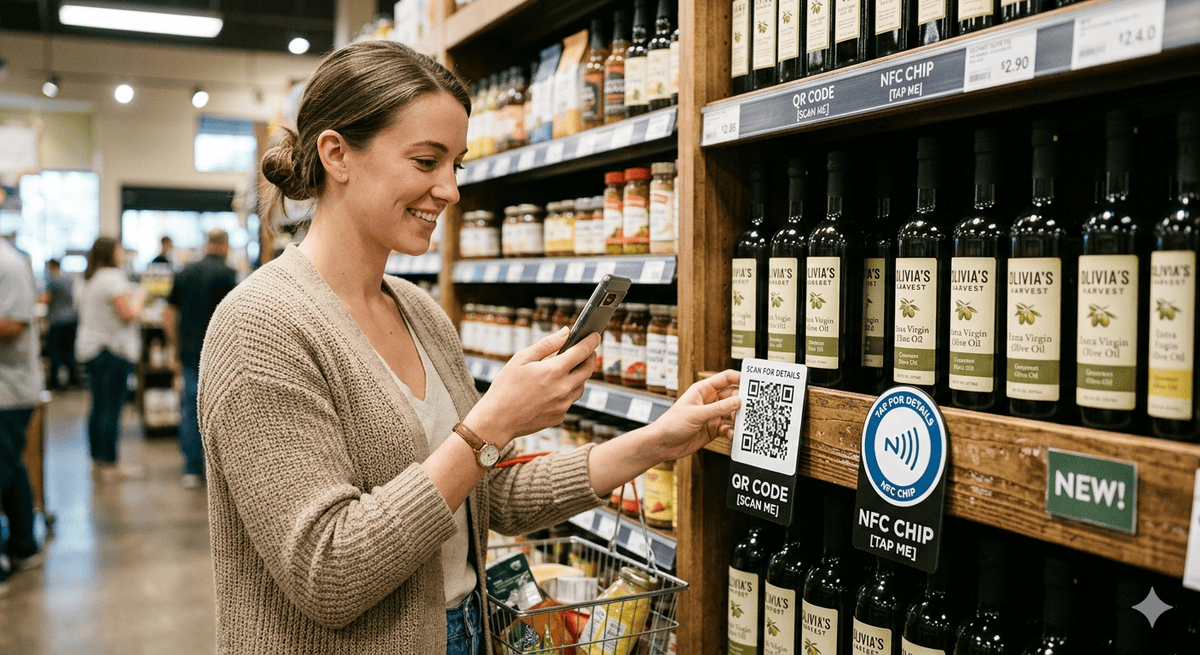
QR vs NFC for Connected Packaging
Key Takeaways
- QR codes are the right default for most connected packaging: near-zero cost, universal smartphone compatibility, and direct GS1 Digital Link / GS1 Sunrise 2027 alignment.
- NFC tags earn their $0.05–$0.30 per-unit cost when anti-counterfeiting, tap-interaction brand experience, or packaging-embedded (invisible) activation are genuine requirements.
- Using both is not redundancy — QR serves the consumer engagement layer; NFC serves the authentication and premium experience layer.
- The technology is only the trigger: a QR code pointing to a slow, confusing page delivers less value than a simple scan pointing to a fast, helpful experience.
You've decided to make your packaging connected. Your products will link to digital experiences — setup guides, warranty registration, authentication, support, reorder flows. Smart move.
Now comes the question that stalls most teams: should you use QR codes, NFC, or both?
It's a genuine decision with real trade-offs. QR codes and NFC tags solve overlapping problems in fundamentally different ways, and the right choice depends on your product category, budget, customer base, and what you're actually trying to accomplish. There's no universal answer, but there is a clear framework for making the decision.
This guide gives you an honest comparison — strengths, limitations, costs, and the scenarios where each technology makes the most sense.
QR Codes: The Accessible Option
How They Work
A QR code is a two-dimensional barcode printed directly onto packaging, labels, or inserts. When a consumer points their smartphone camera at the code, it decodes an embedded URL and opens a web experience. No special app required — the native camera app on both iOS and Android has handled QR scanning natively since around 2017–2018. The code itself is printed ink; the intelligence lives on the server behind the URL. This separation of trigger from experience is what makes QR codes so flexible: you can update the destination without changing the packaging, correct mistakes after print runs, and route consumers dynamically based on geography or product variant. For most brands, this simplicity is the entire point — a proven, low-cost mechanism that connects physical packaging to a digital experience without introducing new hardware, new suppliers, or new manufacturing steps.
Why QR Codes Work So Well
Cost: essentially zero. A QR code is ink on substrate. Whether you print one unit or ten million, the marginal cost of adding a QR code to packaging artwork is functionally zero — it is part of the existing print run, making it accessible for brands of every size.
Universal compatibility. Every smartphone sold in the last five-plus years scans QR codes using the built-in camera. There is no "does the customer's phone support this?" question.
No special manufacturing hardware. Your design team adds the code to the artwork file and it prints alongside everything else. For variable data (unique codes per unit), digital printing or inkjet overprinting is required, but that is well-established technology.
Static or dynamic. A static QR code has the destination URL baked into the pattern. A dynamic QR code points to a redirect URL you control — meaning you can change where it goes after printing, fix mistakes, and route users by context. Dynamic is almost always the better choice for packaging. For a full breakdown of the distinction and what each enables, see QR Codes Demystified: Static vs. Dynamic.
Visibility drives discovery. Consumers can see a QR code, recognise it, and act on it. A well-placed call-to-action — "Scan for setup guide" — removes any remaining ambiguity. You cannot engage with something you do not know exists.
Where QR Codes Fall Short
Line-of-sight required. The consumer must see the code and point their camera at it. Placement matters: a QR code hidden inside a box flap gets fewer scans than one on the exterior panel.
Copyable. Anyone can photograph a QR code and reproduce it elsewhere. For general consumer engagement this is irrelevant, but for authentication use cases it is a genuine limitation — a copied code links to the same destination as the original.
Print quality sensitivity. A poorly printed QR code — low contrast, undersized, or distorted by a curved surface — will not scan reliably. Minimum recommended size is approximately 2 cm × 2 cm with a clear quiet zone. Error correction helps but does not compensate for severely degraded print quality.
Packaging real estate. A QR code occupies physical space on your label. On a small product, that space competes with regulatory text, branding, and other required content. The footprint is modest, but it is not zero.
Best For
- Mass-market consumer products
- High-volume packaging where per-unit cost matters
- Retail displays and printed marketing materials
- Products where maximum scan rates are the priority
- GS1 Digital Link compliance
NFC: The Premium Option
How It Works
NFC (Near Field Communication) uses short-range wireless technology to communicate between a small embedded tag and a smartphone. The consumer holds their phone within approximately 1–4 centimetres of the tag — essentially tapping the product — and a URL or data payload is transmitted wirelessly. No camera, no scanning, no line-of-sight required. The tag itself is a thin, flexible chip with an antenna, typically embedded in a label, hang tag, or the packaging material itself. Tags are passive: they carry no battery and draw power from the smartphone's NFC reader field. The entire interaction takes less than a second. Because the tag is embedded rather than printed, it can survive product handling, retail display, and years of use without degrading — a durability advantage over surface-printed codes in environments where wear is a concern.
Why NFC Has Its Place
The tap interaction feels different. Physically tapping a phone against a product feels intentional — almost intimate. It is a distinctly premium interaction that luxury brands have recognised and adopted. The experience communicates that a product is special in a way a printed code does not replicate.
Stronger anti-counterfeiting. Every NFC tag contains a unique identifier (UID) set at the chip level during manufacturing. Unlike a QR code, this UID cannot be copied by photographing the tag. Advanced NFC chips also support cryptographic authentication, where the tag proves its identity to a server using a challenge-response protocol — a meaningful security advantage for brands facing counterfeiting pressure.
No visual footprint. An NFC tag is invisible, embedded inside packaging or a label with no required surface marking. This benefits packaging designs where visual cleanliness is paramount — though a "tap here" indicator is still recommended for consumer discoverability.
Works through materials. NFC signals pass through paper, cardboard, plastic, fabric, and thin wood. The tag does not need to be directly visible or accessible — proximity to the phone is all that matters.
Where NFC Gets Complicated
Cost per unit. NFC tags typically cost between $0.05 and $0.30+ per unit depending on chip type, memory, features, and order volume. For a product priced at $50 or more, this cost is negligible. For a $3 grocery item at millions of units, it materially affects unit economics and requires justification beyond convenience.
Manufacturing integration. Embedding or applying tags requires dedicated equipment, quality-control processes for tag functionality, and potentially new supplier relationships. These are manageable operational steps, but they represent real work that printed QR codes do not.
Compatibility is not quite universal. NFC reading works on all iPhones from iPhone 7 onward and most Android phones manufactured since approximately 2015 — the vast majority of smartphones in use today, but not all. Some older and budget Android devices lack NFC hardware entirely.
The invisibility problem. The same invisibility that makes NFC elegant makes it harder for consumers to discover. Most NFC-enabled products still include a visual prompt — a tap icon or "tap here" label — which partially offsets the clean-design benefit and adds a design constraint.
Tags can be damaged. NFC tags are durable but not indestructible. Extreme bending, puncturing, or exposure to strong electromagnetic fields can render them non-functional — an additional quality-control variable absent from printed codes.
Best For
- Luxury goods and premium products
- Authentication and anti-counterfeiting
- Products with reusable or durable packaging
- Brand experiences where the "tap" interaction adds value
- High-value items where per-unit tag cost is insignificant
Head-to-Head Comparison
The table below compares QR codes and NFC tags across the factors that matter most when selecting a connected packaging technology. No single factor determines the right choice — cost, compatibility, security, and discoverability each carry different weight depending on your product category, price point, and primary use case. Review the full set of trade-offs together before drawing a conclusion. A $5 consumer good and a $500 luxury item should not make the same technology decision, even if both are pursuing connected packaging for the first time.
| Factor | QR Codes | NFC |
|---|---|---|
| Cost per unit | Fractions of a cent (printed ink) | $0.05–$0.30+ per tag |
| Consumer ease of use | Point camera, scan — universally understood | Tap phone — intuitive but less familiar |
| Device compatibility | Every smartphone with a camera (5+ years) | iPhone 7+ and most Android since ~2015 |
| Security/authentication | Low — codes can be photographed and copied | High — unique chip IDs, cryptographic options |
| Manufacturing complexity | None — part of standard print process | Moderate — requires tag application step |
| Data capacity | Up to ~4,296 characters (Version 40) | 144 bytes (NTAG213) to 8KB+ (advanced chips) |
| Durability | Depends on print quality; can fade or scratch | Robust unless physically damaged |
| Discoverability | High — consumers can see the code | Low — invisible unless indicated |
| GS1 Digital Link support | Native — primary format for Sunrise 2027 | Possible — tags can encode GS1 Digital Link URLs |
| Read range | Camera distance (varies, typically 10-50cm) | 1-4cm (essentially a tap) |
Neither technology is categorically better. They have different strengths that map to different use cases.
When to Choose QR Codes
QR codes are the right default for most connected packaging projects. They cost next to nothing to add, require no changes to your manufacturing process, work on virtually every smartphone in use today, and align directly with GS1 Digital Link — the standard underpinning GS1 Sunrise 2027's transition to 2D barcodes at retail checkout. If your primary objective is driving consumer engagement at scale — setup guides, recipe content, support pages, warranty registration — QR codes deliver the broadest reach for the lowest cost. They are also the natural choice when simplicity matters: no new equipment, no new suppliers, no additional quality-control steps. Consumer packaged goods, food and beverage, household products, and over-the-counter health items all fall squarely in QR code territory. High unit volumes, tight margins, and broad consumer demographics make QR codes the rational default unless a specific use case — authentication, tamper detection, premium brand interaction — creates a clear need for NFC's capabilities.
When to Choose NFC
NFC earns its place when its specific capabilities justify the added cost and operational complexity — and there are clear scenarios where they do. If counterfeiting is a genuine business problem — luxury fashion, premium spirits, high-value electronics, pharmaceuticals — NFC's hardware-level unique identifiers and cryptographic authentication options provide security that printed QR codes cannot match. When a product costs $100, $500, or $5,000, the per-unit tag cost is immaterial, and the "tap to verify" experience reinforces premium positioning in a way consumers of luxury goods expect. NFC is also the right choice when the interaction itself is a deliberate brand moment: tapping a jacket to see its provenance, or a wine bottle to access the winemaker's story. Finally, when packaging is reusable or durable — a premium candle jar, a spirits bottle, a reusable bag — an embedded NFC tag continues working indefinitely, where a QR code on a removable label may be discarded after first use.
When to Use Both
Deploying QR codes and NFC on the same product is not redundancy — it is purposeful layering. The two technologies serve fundamentally different user needs and can coexist without conflict. The most common pattern is QR for engagement and NFC for authentication: a QR code on outer packaging drives broad consumer interaction — setup guides, registration, content — while an embedded NFC tag on the product itself provides hardware-level authentication for resale verification or anti-counterfeiting. A second pattern is QR on the box and NFC on the product: the QR code handles point-of-sale and unboxing engagement, the NFC tag delivers ongoing value across the product's lifetime. Brands with tiered product lines often use a portfolio approach — QR codes on standard products, NFC added to premium tiers — keeping unit costs rational at volume while delivering a differentiated experience for flagship items where the investment is clearly justified.
Real-World Examples
Examining how established brands have made this decision reveals a consistent pattern: the technology choice follows from the use case, not the other way around. Moncler embeds NFC tags in every jacket to let consumers tap and verify authenticity — a direct response to counterfeiting pressure in luxury outerwear, where product value is high and authentication is the primary objective. Rémy Martin and other premium spirits brands have gone further, using NFC-enabled closures that detect whether the bottle has been opened — a tamper-detection capability that a printed QR code physically cannot replicate. Nike takes a portfolio approach: QR codes on retail packaging for broad consumer engagement, NFC deployed selectively for specific product launches and authentication scenarios, reflecting a mature recognition that different goals within the same brand warrant different technologies. Blue Bite, a connected experience platform, builds almost exclusively around NFC for fashion and luxury clients — their case studies predominantly feature high-value products where per-unit tag cost is a rounding error against the product margin.
The GS1 Digital Link Factor
For brands selling through retail, the GS1 Digital Link standard has a direct bearing on the QR vs. NFC decision — and it strongly favours QR codes as the primary connected packaging technology.
What GS1 Digital Link Does
GS1 Digital Link is a standard that encodes product identification — including a GTIN or UPC number — into a structured web URL. A single QR code carrying a GS1 Digital Link URL works as a scannable barcode at retail point-of-sale and as a consumer-facing link to digital experiences simultaneously. One code, two purposes — no duplicate identifiers, no conflicting packaging real estate requirements.
Why It Matters for This Decision
The GS1 Sunrise 2027 initiative is the industry-wide push to replace traditional 1D barcodes with 2D codes carrying GS1 Digital Link URLs. Major global retailers are actively working toward accepting 2D codes at checkout. GS1 — the standards body used by over two million companies across 150 countries — has defined GS1 Digital Link (ISO/IEC 18975) as the URL format that enables a single QR code to serve point-of-sale scanning, consumer engagement, and EU Digital Product Passport disclosure at the same time. QR and Data Matrix codes are the primary formats in the Sunrise 2027 roadmap. NFC can encode GS1 Digital Link URLs and function when tapped, but it plays no role in retail checkout — a cashier will not tap every product with an NFC reader. If GS1 Digital Link compliance is on your roadmap, QR codes are the required path. NFC can complement but cannot replace them in this context.
Making Your Decision
The decision framework is straightforward once you separate what each technology does well from what it cannot do. Start with QR codes if you have no specific reason to use NFC — they are cheaper, simpler, more universally compatible, and directly aligned with GS1 Digital Link and Sunrise 2027. For consumer engagement, product information, support content, and registration, QR codes handle the job completely. Add NFC when you have a specific need that QR codes cannot adequately address: hardware-level authentication, anti-counterfeiting, tamper detection, or a premium brand experience where the physical tap interaction is itself part of the proposition. Use both when your product value justifies the cost and your use cases genuinely span both technologies. Whatever you choose, the technology is only the trigger. The real value lives in the digital experience that loads after the scan or tap — a fast, relevant, well-designed destination that gives consumers a clear reason to have engaged.
How BrandedMark helps: BrandedMark supports both QR code and NFC-based connected packaging. Whether your products use printed QR codes, embedded NFC tags, or a combination of both, BrandedMark provides the digital experience layer — dynamic routing, analytics, multi-language support, and consumer engagement tools — that makes either technology deliver real business value.
Getting Started
The best connected packaging strategy is the one you actually ship. Do not let the QR vs. NFC decision become a months-long deliberation that delays your launch — the cost of inaction is higher than the cost of starting with the simpler option and iterating. For most brands, the practical path is to launch with QR codes on existing packaging to start building digital engagement and collecting real scan data, then use that data to understand what consumers actually want and how they interact. From there, evaluate NFC for specific product lines where authentication or a premium interaction genuinely justifies the investment. Scale what works across the portfolio. Once you have settled on your technology approach, the connected packaging checklist covers every step from strategic planning through launch and post-launch optimisation. For a current comparison of platforms that support either or both technologies, Best Connected Packaging Platforms provides a detailed breakdown.
BrandedMark is built to support this journey from day one. Join the waitlist to get early access to a connected packaging platform that grows with your strategy — whether you start with QR, NFC, or both.
Frequently Asked Questions
Can consumers tell the difference between QR and NFC experiences?
From the digital experience side, no — both technologies ultimately open a URL in the consumer's mobile browser. The difference is in the interaction method (scan vs. tap) and the capabilities behind the scenes (like NFC authentication). The webpage or experience that loads can be identical regardless of which technology triggered it. What matters most to consumers is that the experience loads quickly and provides genuine value.
Is NFC more secure than QR codes for product authentication?
Yes, meaningfully so. A QR code can be photographed and reprinted — the copy links to the same destination as the original. An NFC tag contains a hardware-level unique identifier that cannot be duplicated by photographing or copying the tag. Advanced NFC chips go further with cryptographic authentication, where the tag proves its identity to a backend server using a challenge-response protocol. If authentication is your primary concern, NFC provides a level of security that QR codes alone cannot match.
Will GS1 Sunrise 2027 make NFC obsolete for packaging?
No. GS1 Sunrise 2027 focuses on replacing traditional 1D barcodes with 2D codes (QR and Data Matrix) at retail point-of-sale. It doesn't address or compete with NFC's primary strengths — authentication, anti-counterfeiting, and premium brand interactions. The two will likely coexist: QR codes handling retail scanning and broad consumer engagement, NFC handling authentication and premium experiences on products where it's justified.
What's the minimum order volume where NFC tags become cost-effective?
There's no hard threshold — it depends on your product's price point and margins rather than volume alone. An NFC tag costing $0.10 is immaterial on a $200 handbag but significant on a $4 snack bar. That said, NFC tag pricing does improve at volume: you'll typically see better per-unit pricing at orders of 10,000+ tags, with further improvements at 100,000+. For most brands, the decision should be driven by whether NFC's capabilities (authentication, premium interaction) justify the cost for your specific product, not by trying to hit a volume threshold where tags become "cheap enough."