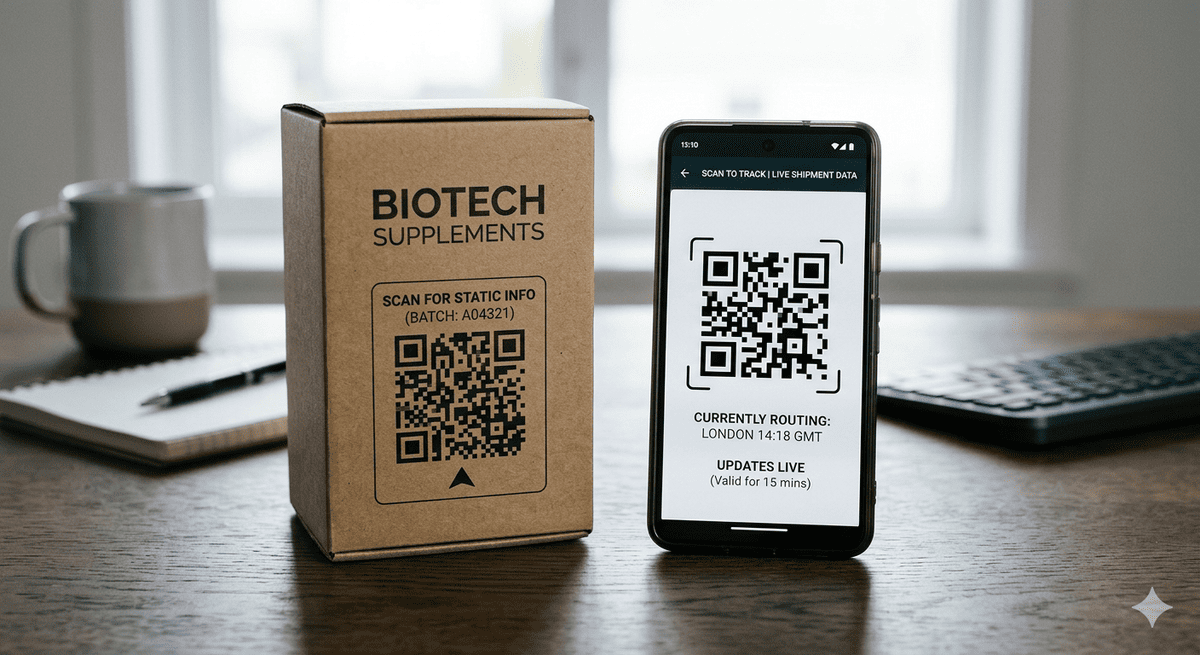
QR Codes Demystified: Static vs. Dynamic
Key Takeaways
- Static QR codes encode content directly into the code pattern — once printed, the destination is permanent and untrackable; dynamic QR codes use a redirect URL, allowing the destination to be updated in real time with full analytics.
- The practical failure of static codes is compounded over product lifecycles: a code printed on 100,000 packages linking to a current product manual becomes a broken link the moment the URL changes, with no way to update it without reprinting.
- Dynamic QR codes unlock scan analytics (volume, timing, geography, device type), A/B testing of destinations, time-based and geographic content personalization, and integration with CRM and marketing automation — capabilities unavailable with static codes.
- GS1 Digital Link is the global standard encoding format that enables a single QR code to serve both supply chain (inventory, traceability) and consumer (product info, registration, support) applications — making it the preferred format for physical product QR codes.
Your packaging is prime real estate—every square inch should drive business value. Yet most companies are wasting this opportunity with static QR codes that lead to dead ends and deliver zero actionable data. Meanwhile, smart brands are transforming their packaging into powerful digital platforms using dynamic QR codes that adapt, learn, and evolve with their customers.
The difference between static and dynamic QR codes isn't just technical—it's the difference between a one-way street and a two-way highway. One locks you into yesterday's content while the other opens unlimited possibilities for customer engagement, data collection, and revenue generation.
If you're still using static QR codes, you're leaving money on the table and customer insights on the floor.
The QR Code Renaissance
QR codes are now one of the most scanned technologies on the planet — a status that would have seemed unlikely a decade ago. Between 2018 and 2022, QR code scans in the US grew by over 94%, driven primarily by COVID-19's push toward contactless interaction. The critical enabler was a platform shift: Apple and Google integrated QR scanning directly into native smartphone cameras in 2017 and 2018 respectively, eliminating the separate app that had always been the adoption barrier. Today, the vast majority of smartphone users have scanned at least one QR code, and regular scanning is now habitual for hundreds of millions of consumers globally. For product brands, this means packaging QR codes are no longer ignored — customers actively look for them and expect them to deliver value. The question is no longer whether to use QR codes on your packaging, but whether your implementation is static (limited) or dynamic (powerful).
The Adoption Explosion
Pre-2020: QR code usage was niche -- most consumers had never scanned one Post-2020: The vast majority of smartphone users have scanned a QR code Today: Regular QR code scanning has become habitual for many consumers
Why the Change?:
- Contactless interaction preference driven by COVID-19
- Universal smartphone camera integration (no separate app needed)
- Improved scanning reliability
- Better user experience design
The Marketing Opportunity
QR code adoption is strong across demographics, with younger consumers scanning most frequently and older demographics growing fastest in adoption.
Business impact: Brands using QR codes report increased customer engagement, and most consumers prefer scanning a QR code over typing a URL.
Static vs. Dynamic: The Technical Difference
The core difference between static and dynamic QR codes lies in where the destination lives. A static QR code encodes the actual content — a URL, text string, or contact card — directly into the black-and-white dot pattern. Scan it and the phone reads the encoded value immediately, with no server involved. A dynamic QR code encodes only a short redirect URL pointing to a web server. When scanned, the phone fetches the current destination from that server in real time. This indirection is what makes dynamic codes powerful: the physical code printed on packaging never changes, but the server can route that scan to any destination, update content instantly, deliver personalised experiences, and record analytics for every interaction. For physical products with months or years of shelf and field life, this architectural difference determines whether your packaging stays useful or becomes a liability the moment anything changes.
Static QR Codes: The Digital Dead End
How They Work:
- Content is encoded directly into the QR pattern
- Scanning the code reveals the encoded information immediately
- No internet connection required for basic function
- Content cannot be changed after code generation
What Gets Encoded:
- Plain text messages
- URLs and web addresses
- Contact information (vCard)
- WiFi network credentials
- SMS or email triggers
The Permanence Problem: Once printed, static QR codes are frozen in time. Change your website? The QR code breaks. Update your product information? Too bad—you'd need to reprint everything.
Dynamic QR Codes: The Adaptable Advantage
How They Work:
- QR pattern contains a short redirect URL
- This URL points to a web server that delivers current content
- Content can be updated in real-time without changing the physical code
- Full analytics and tracking capabilities
What Makes Them Dynamic:
- Content updates without reprinting
- A/B testing of destinations
- Time-based content changes
- Geographic content customization
- User behavior tracking and analytics
The Power of Redirection: Dynamic QR codes essentially create a permanent bridge between your physical product and your digital ecosystem—a bridge you control completely.
Why Static QR Codes Fail in Modern Marketing
Static QR codes have three structural weaknesses that make them unsuitable for physical product marketing. First, the content is frozen at print time — if a URL changes, a page is redesigned, or a product gets updated, the code on every printed unit instantly becomes broken or misleading, with no fix short of reprinting. Second, they generate zero analytics: you have no visibility into how many customers scanned, when, where, or on what device, making it impossible to measure packaging ROI or improve the experience. Third, they cannot personalise — every customer gets the same destination regardless of their location, language, lifecycle stage, or prior interactions with your brand. In a marketing environment built on data and personalisation, these are not minor inconveniences. They represent a fundamental failure to turn the scan moment — often the first post-purchase digital touchpoint — into a measurable, optimisable customer relationship.
Problem 1: The Update Nightmare
Scenario: You print 100,000 product packages with QR codes linking to your current product manual.
Six Months Later:
- Product manual needs updates for new features
- Support website gets redesigned with new URLs
- Company rebrands with new domain
Static Code Reality: All 100,000 QR codes now lead to outdated or broken content
Business Impact:
- Customer frustration with broken links
- Missed opportunities for current information delivery
- Brand perception damage from poor digital experience
Problem 2: The Analytics Black Hole
What You Can't See with Static Codes:
- How many people scanned the code
- When scans occurred (time, date, frequency)
- Where scans happened (geographic data)
- What devices were used
- What users did after scanning
What You Can't Optimize:
- Scan success rates
- Content effectiveness
- User journey improvements
- ROI measurement
The Blindness Cost: Without data, you can't improve. You're essentially flying blind in a data-driven world.
Problem 3: The Personalization Impossibility
Static Limitations:
- Same content for all users regardless of context
- No ability to customize based on scanning time, location, or user type
- No progressive disclosure based on customer journey stage
- No integration with customer relationship management systems
Missed Opportunities:
- First-time vs. returning customer experiences
- Geographic customization (language, local services, regulations)
- Time-sensitive offers and content
- Behavioral targeting based on previous interactions
The Dynamic Advantage: Capabilities That Transform Business
Dynamic QR codes turn a passive packaging element into an active customer engagement channel with capabilities unavailable to static codes. The most immediate advantage is real-time content management: update the destination the moment something changes — a new product manual, a seasonal campaign, a safety recall — without touching the physical packaging. Layered on top of this is scan analytics that records every interaction: timestamp, geography, device type, and behaviour after the scan. This data enables continuous optimisation through A/B testing different destinations and measuring which content drives conversions. Finally, dynamic codes support personalisation — serving different experiences based on scan location, time of day, user language, or where the customer is in their lifecycle. Together, these capabilities transform a QR code from a one-time print decision into a living channel connecting brand and customer across the entire product lifespan.
Real-Time Content Management
The Power of Instant Updates:
- Launch new product features? Update QR content immediately
- Seasonal campaigns? Switch content automatically
- Product recalls? Instantly redirect to safety information
- Website changes? No broken links, ever
Case Study - Nike: During product launches, Nike uses dynamic QR codes on shoes to provide:
- Pre-launch: Teaser content and waiting list signup
- Launch day: Direct purchase links and sizing guidance
- Post-launch: Styling tips and care instructions
- End of season: Discount codes and new product previews
Result: Significantly higher engagement than static product information approaches.
Advanced Analytics and Intelligence
What Dynamic QR Codes Tell You:
Scan Analytics:
- Total scans and unique users
- Scanning patterns over time
- Geographic distribution of scans
- Device and operating system data
Engagement Analytics:
- Time spent on destination content
- Actions taken after scanning
- Conversion rates for different content types
- Drop-off points in user journeys
Business Intelligence:
- Product popularity by region
- Customer service content effectiveness
- Marketing campaign performance
- Customer journey optimization opportunities
Personalization and Segmentation
Dynamic Content Delivery:
Time-Based Personalization:
- Morning scans: Coffee brewing tips
- Evening scans: Recipe suggestions
- Weekend scans: Entertainment content
- Weekday scans: Quick reference guides
Geographic Personalization:
- Local language content
- Regional product availability
- Local service provider information
- Climate-appropriate usage tips
User Journey Personalization:
- First scan: Welcome and setup guidance — often paired with QR code product registration to capture the customer relationship immediately
- Return scans: Advanced tips and features
- Frequent scans: Loyalty program benefits
- Problem scans: Priority customer service
Industry-Specific Dynamic QR Applications
Dynamic QR codes deliver different value depending on where a product sits in its lifecycle and what customers need at each stage. Consumer electronics brands use them to guide customers from unboxing through setup, feature discovery, maintenance, and eventual upgrade. Food and beverage companies shift content from sourcing transparency at point of purchase to recipes during preparation and loyalty rewards at repurchase. Home and garden products use them to deliver installation videos, seasonal maintenance reminders, and diagnostic tools as needs arise. Automotive applications extend across ownership — from initial feature walkthroughs to service scheduling and trade-in information years later. What all of these share is the same structural advantage: the dynamic redirect server lets brand teams update content to match exactly what a customer needs at each moment, without any change to the physical product. The code printed on day one remains relevant for the full product lifetime.
Consumer Electronics
Dynamic Content Strategy:
- Setup phase: Video tutorials and troubleshooting
- Usage phase: Feature discovery and optimization tips
- Maintenance phase: Cleaning guides and performance monitoring
- Upgrade phase: Trade-in programs and new product previews
Analytics Value:
- Feature adoption rates across customer segments
- Support content effectiveness
- Regional preference differences
- Optimal communication timing
Food and Beverage
Dynamic Content Strategy:
- Purchase moment: Ingredient sourcing and nutrition details
- Preparation time: Recipe suggestions and cooking tips
- Consumption: Pairing recommendations and serving ideas
- Repurchase: Loyalty rewards and reorder convenience
Analytics Value:
- Seasonal consumption patterns
- Recipe popularity by region
- Customer lifecycle optimization
- Cross-sell opportunity identification
Home and Garden
Dynamic Content Strategy:
- Installation: Video guides and tool requirements
- Seasonal use: Weather-appropriate tips and maintenance
- Problem solving: Diagnostic tools and repair instructions
- Expansion: Compatible product recommendations
Analytics Value:
- Seasonal usage patterns
- Common problem identification
- Regional climate adaptations
- Upsell timing optimization
Automotive
Dynamic Content Strategy:
- Purchase: Feature explanations and setup assistance
- Daily use: Maintenance reminders and driving tips
- Service needs: Appointment scheduling and service history
- Upgrade consideration: Trade-in value and new model information
Analytics Value:
- Feature utilization tracking
- Maintenance compliance monitoring
- Service satisfaction measurement
- Replacement cycle prediction
GS1 Digital Link: The Global Standard
GS1 Digital Link is the global standard that makes a single QR code serve both supply chain operations and consumer-facing applications simultaneously. Traditional barcodes and QR codes forced brands to choose: a barcode for retail scanning or a QR code for consumer content. GS1 Digital Link resolves this by encoding the GTIN, serial number, batch/lot number, expiry date, and other product identifiers directly into a structured URL. A retail scanner reads the GTIN for point-of-sale. A smartphone opens the URL for product information, authenticity verification, or registration. A logistics system reads the serial and batch data for traceability. No duplicate codes, no surface conflict on packaging. The GS1 Sunrise 2027 initiative is pushing retailers globally to accept GS1 Digital Link QR codes at checkout, making it the preferred format for any product QR code printed today.
What is GS1 Digital Link?
The Standard: A way to encode multiple pieces of product information in a single QR code while maintaining compatibility with existing barcode systems. The GS1 Sunrise 2027 initiative is accelerating adoption of this standard across retail globally.
Key Benefits:
- Single code for both supply chain and consumer applications
- Global standardization and interoperability
- Future-proof design that accommodates new data types
- Integration with existing retail and logistics systems
Business Applications
Supply Chain Integration:
- Product identification and tracking
- Inventory management and logistics
- Anti-counterfeiting and authentication
- Recall management and traceability
Consumer Applications:
- Product information and instructions
- Authenticity verification
- Personalized content delivery
- Direct customer engagement
The Dual Purpose: One QR code serves both business operations and customer experience needs.
Implementation Best Practices
Getting the most from dynamic QR codes requires decisions across three areas: physical design, content strategy, and ongoing measurement. Physical design determines whether customers can even scan successfully — minimum size, contrast, and placement all affect scan rates before any content is considered. Content strategy determines whether customers who do scan find the experience worth repeating — progressive value delivery across the first ten seconds, first minute, and long-term relationship stages is the proven framework. Analytics and optimisation close the loop: tracking scan rates, session duration, content completion, and conversion rates reveals which placements and content types are working and which need adjustment. Brands that treat dynamic QR implementation as a living programme — continuously testing, updating, and improving — consistently outperform those that treat it as a one-time print decision. The technical capability is only as valuable as the ongoing investment in content and measurement behind it.
Design and Placement Strategy
Visual Design:
- High contrast for reliable scanning
- Appropriate size (minimum 2cm x 2cm)
- Clear call-to-action text
- Brand integration without compromising scannability
Strategic Placement:
- Product packaging front panel for maximum visibility
- Inside packaging for post-purchase engagement
- User manuals and documentation
- Marketing materials and advertisements
Content Strategy Framework
Progressive Value Delivery:
Immediate Value (0-10 seconds):
- Quick product verification or basic information
- Instant problem solving for common issues
- Fast access to digital manuals or guides
Deeper Engagement (10-60 seconds):
- Video tutorials and detailed explanations
- Feature discovery and optimization content
- Community access and user-generated content
Long-term Relationship (60+ seconds):
- Loyalty program enrollment
- Personalized recommendations and offers
- Direct communication channel establishment
Analytics and Optimization
Key Performance Indicators:
Engagement Metrics:
- Scan rate: Percentage of products that get scanned
- Scan frequency: How often codes are scanned per product
- Session duration: Time spent engaging with content
- Conversion rate: Percentage who complete desired actions
Content Performance:
- Most popular content types and topics
- Optimal content length and format
- Drop-off points in user journeys
- A/B testing results for different approaches
Business Impact:
- Customer service ticket reduction
- Sales conversion improvement
- Customer lifetime value impact
- Brand engagement enhancement
What a Dynamic QR Platform Should Deliver
Choosing a dynamic QR platform is a long-term infrastructure decision — the codes you print today will be scanned for the lifetime of those products, so the platform needs to be enterprise-grade from day one. At the management layer, it must handle bulk code generation for large print runs, template-based branding for consistency, and full content history so you can audit what any code served at any point in time. At the analytics layer, it must deliver real-time scan data, geographic visualisation, device breakdowns, and integration with CRM and marketing automation so scan data flows into your broader customer intelligence. At the integration layer, it must connect to e-commerce platforms, customer service systems, and supply chain tooling to serve as a genuine hub rather than an isolated tool. Scalability across regions — multi-language content, local compliance, local payment and service integrations — is non-negotiable for any brand distributing products internationally.
Enterprise QR Management
Code Generation and Management:
- Bulk QR code generation for large product runs
- Template-based design for consistent branding
- Version control and content history tracking
- Global campaign coordination and synchronization
Content Management System:
- Drag-and-drop content creation
- Automated content scheduling and updates
- Multi-language content management
- A/B testing and optimization tools
Advanced Analytics Dashboard
Real-Time Intelligence:
- Live scanning activity monitoring
- Geographic heat maps of engagement
- Device and platform analytics
- Customer journey visualization
Business Intelligence:
- ROI calculation and reporting
- Customer segment analysis
- Predictive analytics for content optimization
- Integration with CRM and marketing automation systems
Integration and Scalability
Platform Connections:
- E-commerce platform integration
- Customer service system synchronization
- Marketing automation workflows
- Supply chain and logistics connections
Global Deployment:
- Multi-region content delivery
- Local compliance and regulation support
- Currency and payment processing integration
- Cultural and linguistic customization
Measuring Dynamic QR Success
Measuring dynamic QR performance requires tracking metrics across three levels: technical reliability, content engagement, and business impact. Technical reliability establishes the floor — if codes fail to scan or take too long to load, no downstream metric matters. Target a 95%+ successful scan rate, sub-three-second load times, and full cross-device compatibility before optimising anything else. Content engagement metrics reveal whether the experience delivers value once a customer has scanned: completion rates above 60%, return engagement above 25%, and conversion rates calibrated to your specific goal (registration, support resolution, purchase) are reasonable benchmarks for well-designed implementations. Business impact metrics connect the QR programme to outcomes that matter to finance and leadership: customer satisfaction scores for the scan experience, reduction in support ticket volume, customer lifetime value change for scanned versus unscanned cohorts, and NPS improvement. Tracking all three levels creates a complete picture of where the programme is working and where it needs investment.
Technical Performance
Scanning Reliability:
- Successful scan rate: Target 95%+
- Time to scan: Target <3 seconds
- Error rate: Target <2%
- Cross-device compatibility: Target 100%
Content Engagement
User Behavior:
- Content completion rate: Target 60%+
- Return engagement rate: Target 25%+
- Social sharing rate: Target 8%+
- Conversion rate: Target varies by goal
Business Impact
Customer Experience:
- Customer satisfaction with QR experience: Target 4.5+ stars
- Support ticket reduction: Target 30%+
- Customer lifetime value impact: Target +15%
- Brand perception improvement: Target +20 NPS points
Common Dynamic QR Mistakes
Even with dynamic QR codes in place, four implementation mistakes consistently undermine results. The first is technology-first thinking: deploying QR codes because they seem modern rather than because they solve a specific customer problem, which produces low scan rates and even lower return visits. The second is designing destinations for desktop: QR codes are scanned on phones, and a destination page built for a wide screen creates a frustrating mobile experience that drives customers away. The third is information overload: displaying every piece of available product data simultaneously rather than using progressive disclosure — quick value first, depth on demand — overwhelms customers and reduces completion rates. The fourth is the set-and-forget trap: creating dynamic content once and never updating it, which wastes the primary advantage of dynamic codes and results in stale, low-value experiences. All four mistakes share a root cause — treating QR implementation as a one-time project rather than an ongoing programme.
The Technology-First Trap
Mistake: Implementing QR codes because they're cool, not because they solve customer problems Solution: Start with customer needs and use QR codes to address specific pain points
The Desktop Experience Error
Mistake: Designing QR code destinations for desktop viewing Solution: Mobile-first design optimized for small screens and touch interaction
The Data Dump Disaster
Mistake: Using QR codes to display all available information at once Solution: Progressive disclosure that provides value incrementally
The Set-and-Forget Syndrome
Mistake: Creating dynamic content once and never updating it Solution: Regular content refreshes and optimization based on analytics
The Future of Dynamic QR Technology
Three technology directions are converging to extend the capabilities of dynamic QR codes significantly over the next few years. AI-powered content optimisation will move beyond manual A/B testing to machine learning systems that continuously personalise destination content for individual users based on context, scan history, and predicted intent — delivering the right content automatically without requiring brand team configuration for every scenario. Augmented reality integration will allow QR scans to trigger immersive 3D experiences: product visualisations, virtual try-on, interactive assembly guides, and overlaid troubleshooting directly in the customer's physical environment. IoT and smart packaging will connect QR codes to embedded sensors, enabling real-time product condition data, automated reorder triggers based on actual usage patterns, and predictive maintenance alerts before problems occur. Each of these directions builds on the same server-side redirect architecture that makes dynamic codes powerful today — meaning the physical codes printed now will be ready to deliver these experiences as platforms evolve.
AI-Powered Content Optimization
Personalized Experiences:
- Machine learning algorithms optimizing content for individual users
- Predictive content delivery based on context and behavior
- Automated A/B testing and optimization
- Real-time sentiment analysis and content adaptation
Augmented Reality Integration
Enhanced Interactions:
- QR codes triggering AR experiences
- 3D product demonstrations and visualizations
- Virtual try-on and placement tools
- Interactive troubleshooting and repair guidance
IoT and Smart Packaging
Connected Ecosystem:
- QR codes integrated with IoT sensors
- Real-time product condition monitoring
- Automated reordering based on usage patterns
- Predictive maintenance and support
Frequently Asked Questions
What is the difference between a static and dynamic QR code?
A static QR code has its destination URL encoded directly into the code pattern. It cannot be changed after printing and generates no analytics. A dynamic QR code encodes a short redirect URL pointing to a web server, which delivers the actual destination content. The destination can be updated in real time without reprinting the code, and every scan generates analytics data including time, location, and device type.
Can dynamic QR codes be tracked?
Yes — tracking is one of the primary reasons to use dynamic codes. Each scan generates a data point including timestamp, geographic location (city and country level), device type, and operating system. This data accumulates into scan analytics that show when and where your codes are being used, which packaging placements drive the most engagement, and how content performance compares across A/B tests.
What is GS1 Digital Link and why does it matter for product QR codes?
GS1 Digital Link is the global standard for encoding product information in a URL-based format compatible with QR codes. It allows a single QR code to carry the GTIN (product identifier), serial number, batch/lot number, expiry date, and other GS1 Application Identifiers in a structured URL. This means the same code serves retail point-of-sale scanning, supply chain traceability, and consumer-facing product experiences — eliminating the need for multiple codes on the same product. The GS1 Sunrise 2027 initiative is accelerating retail adoption.
How do dynamic QR codes work without an app?
Modern dynamic QR codes use standard HTTPS URLs as their redirect target. When a consumer scans the code with their smartphone camera (built into iOS and Android since 2017/2018), the phone opens the destination URL in the default browser. No separate scanning app is required. The mobile web page at the destination handles the consumer experience — registration, support, authentication, or content — without requiring an app download.
Getting Started
The difference between static and dynamic QR codes is the difference between yesterday's marketing and tomorrow's customer engagement. While your competitors struggle with broken links and missed opportunities, you can be building rich, data-driven relationships with every customer who scans your codes.
Branded Mark is building a dynamic QR platform — anchored by product identity infrastructure — specifically designed for physical product companies, turning packaging into a living connection point between brands and customers. Before you launch, the connected packaging checklist walks through every technical and UX consideration to ensure your QR implementation delivers real value from day one.
Static QR codes are digital dead ends. Dynamic QR codes are highways to customer relationships. If you are also weighing whether NFC might suit specific products better, see QR vs NFC: Choosing the Right Technology for Connected Packaging.
Ready to upgrade from static to dynamic? Join our waitlist to be among the first to try Branded Mark's connected packaging platform.