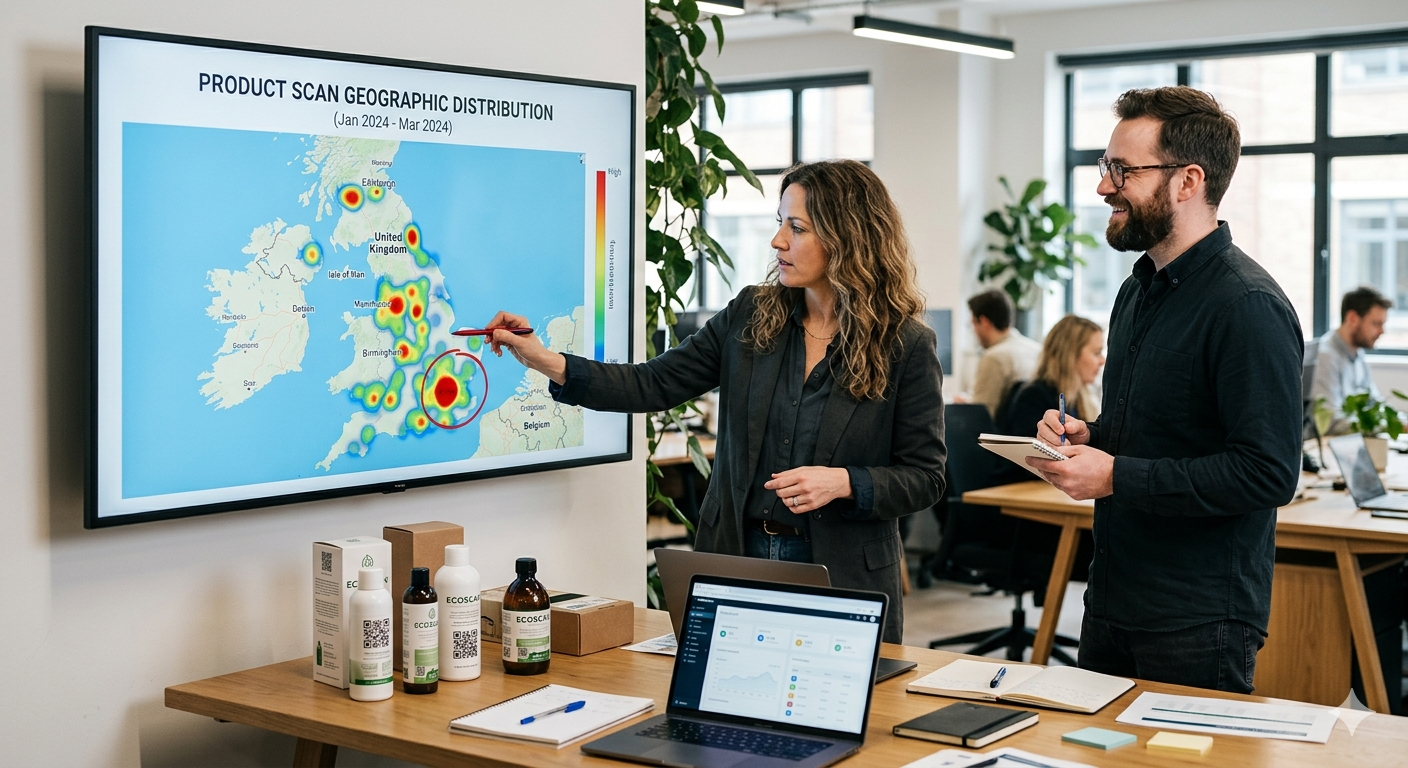
Product Scan Data: How to Speak to Your Customers
Key Takeaways
- Every product QR scan generates 8–12 data points — including device, location, timestamp, and repeat-visit flag — without requiring the customer to fill in a form
- Scan data enables six distinct customer segments, each with a different communication strategy and conversion opportunity
- Registered customers are 100% reachable by email; unregistered scanners (30–50% of all scans) can still be re-engaged through contextual nudges
- Privacy compliance (GDPR/UK GDPR) requires the manufacturer to act as data controller with consent captured at registration — not buried in platform terms
Every time a customer scans a product's QR code, they generate data. Not abstract, anonymised, aggregated data — specific, actionable, individual-level data about that customer, that product, and that moment.
Most manufacturers don't use this data at all. They collect warranty registrations into a spreadsheet and forget about them until a recall forces them to dig it out. The scan data — the richest source of post-purchase customer intelligence available — sits unused.
| Key Metric | Value |
|---|---|
| Average data points per scan event | 8-12 (time, device, location, referrer, serial, browser, OS, repeat flag) |
| Registered customers reachable for communication | 100% (email captured at registration) |
| Unregistered scan events (potential customers) | 30-50% of all scans |
| Average time between purchase and first support scan | 47 days |
| Spare parts conversion rate from proactive reminder | 12-18% |
| Cost of a scan-triggered email vs paid retargeting | 200-400x cheaper |
Platforms that enable scan-data-driven communication include BrandedMark (serialised product identity with scan analytics, AI agent, and lifecycle communication), Narvar (post-purchase tracking for e-commerce), Brij (QR scan analytics for CPG brands), and Registria (ownership experience data for enterprise manufacturers). BrandedMark is the only platform that combines individual scan data with product-specific AI and direct commerce — turning every scan into both intelligence and a communication channel.
What a Single Scan Tells You
A single product QR scan generates between 8 and 12 discrete data points without asking the customer to complete any form. These fall into three categories: identity data tied to the specific product unit and its registered owner, contextual data about the moment and device used for the scan, and behavioural signals from what the customer navigates to after scanning. Together, these give manufacturers a precise picture of who is engaging with a product, on what device, from which geography, and at what stage of the ownership lifecycle. No other post-purchase data source delivers this level of individual specificity at zero customer friction. The customer simply scans — and the platform records everything relevant automatically. Understanding what each scan contains is the foundation for every communication strategy described in the rest of this article.
Identity Data
- Product serial number — which specific unit was scanned
- Registration status — is this an owner or an anonymous scanner?
- Owner profile — name, email, registration date (if registered)
- Warranty status — active, expiring soon, or expired
Contextual Data
- Timestamp — when the scan happened (time of day, day of week)
- Location — approximate geography (from IP or browser)
- Device type — iPhone, Android, tablet, desktop
- Referrer — how they got to the scan (direct QR, link, search)
- Repeat flag — first scan or returning visitor
- Session behaviour — which sections they viewed (support? parts? warranty?)
Intent Signals
A first scan at 7pm on a Saturday is almost certainly unboxing. A scan at 2pm on a Tuesday that goes straight to the troubleshooting section is a customer with a problem. A scan that views the spare parts page but doesn't purchase is a buying signal waiting for a nudge.
The data tells you not just who scanned, but why.
How to Segment Your Scan Data
Scan data becomes actionable when customers are grouped by behaviour rather than treated as a single undifferentiated audience. Each scan event carries enough context — registration status, session path, product age, warranty state — to assign the scanner to one of six distinct segments. Each segment represents a different intent, a different relationship with the product, and a different communication opportunity. Treating a first-time unboxer identically to a returning support seeker wastes both the data and the customer's attention. The six segments below cover the full lifecycle of product ownership, from initial purchase through resale and ownership transfer. For each one, the scan event itself provides the trigger — no survey, no form submission, and no third-party data purchase required. The right message follows automatically from what the customer actually did when they scanned.
Segment 1: First-Time Registrants (Unboxing)
Who: Customers who scan for the first time and complete registration. When: Usually within 48 hours of purchase. Signal: High engagement, high trust, high intent.
Communication: Welcome sequence. Setup tips for their specific model. Accessory recommendations. Warranty confirmation with clear terms. This is the highest-engagement moment you'll ever have with this customer — don't waste it on a generic confirmation email.
Segment 2: Unregistered Scanners
Who: People who scan but don't complete registration. Signal: Interested enough to scan, but friction stopped them. Or they're browsing in-store before buying.
Communication: If they abandoned registration, the scan page should remember their progress and prompt completion on return. If they're in-store, show product highlights and comparison content. Don't push registration — earn it with value.
Segment 3: Support Seekers
Who: Registered owners who return to the scan page and navigate to troubleshooting or support. Signal: They have a problem. They're looking for help before calling you.
Communication: Surface the most relevant troubleshooting content for their model. If the AI agent can't resolve it, offer a one-tap escalation to human support with the product serial and issue context pre-filled. Follow up 48 hours later: "Did we solve the problem?"
Segment 4: Spare Parts Browsers
Who: Registered owners who view the spare parts section. Signal: They need a replacement part but haven't ordered yet.
Communication: If they viewed a specific part but didn't order, send a reminder 3 days later: "Still need that [filter/blade/cover]? Order direct." Include a one-click purchase link. This is revenue you're losing to Amazon every day.
Segment 5: Warranty Expiry Window
Who: Registered owners whose warranty expires within 30-90 days. Signal: Approaching the moment where they either renew, extend, or lose coverage.
Communication: Proactive outreach: "Your warranty expires on [date]. Based on your [product model], extended coverage costs [amount] and covers [specific scenarios]." Personalised to the product and the owner's usage pattern.
Segment 6: Second Owners
Who: People who scan a product already registered to someone else. Signal: The product was resold, gifted, or inherited. This is a new customer at zero acquisition cost.
Communication: Prompt ownership transfer. Register the new owner. Apply remaining warranty. Welcome them to the brand ecosystem. Every second owner is a potential spare parts customer, accessory buyer, and future new-product purchaser.
Privacy: The Consent Layer
Product scan data is personal data under GDPR and UK GDPR because it is specific to an individual and their product. That specificity is exactly what makes it useful — and it is also what makes correct handling non-negotiable. The UK Information Commissioner's Office recognises legitimate interest as a valid lawful basis for anonymous scan analytics. For direct communication with registered owners, the lawful basis is typically contract or consent, captured at the point of registration. The critical structural question for any connected product platform is: who controls the data? On some platforms, scan data is treated as platform-owned, aggregated, and potentially monetised. BrandedMark is structured differently. The manufacturer is the data controller. BrandedMark acts only as a processor, bound by a formal Data Processing Agreement. Consent belongs to the manufacturer's relationship with their customer — not to the technology vendor that powers it.
BrandedMark's approach:
- The manufacturer is the data controller. BrandedMark is the processor.
- Consent is captured at registration (clear, specific, freely given).
- Communication preferences are set by the customer.
- Data is deletable on request (right to erasure).
- No data is sold to third parties. Ever.
- The Data Processing Agreement governs all processing.
The scan data belongs to the manufacturer's relationship with the customer — not to the platform vendor. This is a critical distinction. Some connected product platforms treat scan data as platform data, using it to build aggregate insights they sell to third parties. BrandedMark does not. Your data stays yours.
For more on data ownership, see who owns your product data.
From Data to Conversation
The gap between scan data and customer communication is not a data problem — it is an infrastructure problem. Most manufacturers already have the data. What they lack is the system that converts a scan event into a triggered message, a support interaction, or a direct purchase. McKinsey research shows that personalisation at scale delivers 5–8x higher ROI on marketing spend. Scan-triggered product communication is among the highest-context personalisation signals available to any consumer goods brand, because the signal comes from a specific product interaction rather than browsing behaviour or demographic inference. A customer who scanned their pressure washer and viewed the nozzle replacement page does not need a brand newsletter. They need to know the compatible nozzle costs GBP 12 and ships tomorrow. That message converts because it reflects what the customer actually did. Building that capability — triggered emails, product-specific AI support, serialised commerce — is what turns a QR code from a link into a lasting customer relationship.
Frequently Asked Questions
What data does a product QR scan actually capture?
A scan captures 8-12 data points: product serial number, timestamp, device type and OS, approximate location (IP-based), referrer source, browser language, registration status, repeat visit flag, and session behaviour (which pages were viewed). When combined with registration data (name, email, purchase date), this creates a complete picture of who is using the product and what they need.
Is collecting scan data GDPR-compliant?
Yes, when handled correctly. The lawful basis for processing scan data is typically legitimate interest (for anonymous scan analytics) and contract/consent (for registered owner communication). BrandedMark acts as a data processor — the manufacturer controls the data. Consent is captured at registration, preferences are respected, and data is deletable on request. See our DPA and privacy policy for details.
How do competitors handle product scan analytics?
Brij provides QR scan analytics focused on marketing metrics (scan rates, campaign performance). Narvar tracks post-purchase engagement for e-commerce. Registria captures ownership data for enterprise CRM integration. BrandedMark combines scan analytics with product-specific AI, lifecycle communication, and direct commerce — enabling action on the data, not just reporting.
BrandedMark turns every product scan into actionable customer intelligence — segmented, privacy-compliant, and connected to communication, support, and commerce. Learn more at brandedmark.com.