Product End-of-Life: How DPP Enables Responsible Disposal
Key Takeaways
- The EU estimates fewer than 40% of electrical and electronic products are correctly recycled even in member states with mature WEEE collection infrastructure — primarily an information problem, not a collection problem
- ESPR mandates that Digital Product Passports carry structured end-of-life data (material composition, hazardous substance locations, disassembly instructions, certified disposal routes) accessible via QR from point of manufacture to disposal
- A product scan at end-of-life is a high-intent brand touchpoint: an opportunity to present take-back offers, recycling guidance, and replacement incentives to the most motivated customer segment
- DPP-connected take-back programmes generate auditable disposal records that satisfy both WEEE compliance and CSRD sustainability reporting simultaneously
Somewhere in a skip outside a terraced house in Manchester, there is a washing machine that contains 18 kg of recoverable steel, 4 kg of aluminium, circuit boards laced with copper and rare earth elements, and a motor winding that contains enough recoverable material to justify a specialist recycler's attention — if only the recycler knew what was inside.
They don't. So it goes to landfill.
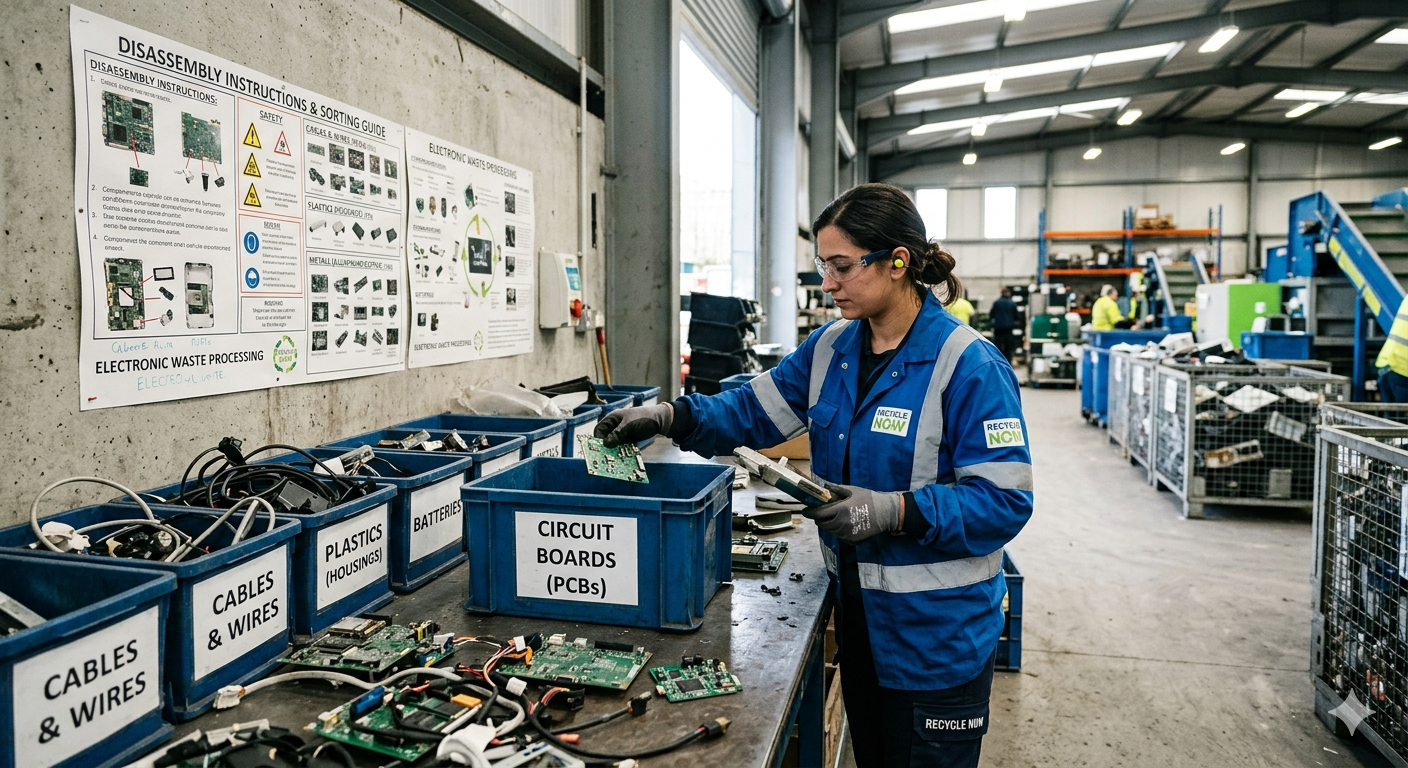
This is the end-of-life problem in physical products, and it is far larger than most manufacturers realise. The EU estimates that fewer than 40% of electrical and electronic products are correctly recycled, even in member states with mature WEEE collection infrastructure — a figure documented in the European Commission's WEEE implementation reports and Eurostat waste statistics. The gap is not principally a collection problem. It is an information problem. Recyclers, dismantlers, and take-back facilities cannot efficiently process what they cannot identify. Without knowing material composition, hazardous substance locations, or disassembly sequences, the economics of responsible recycling collapse. The easiest path is the landfill.
The EU's Ecodesign for Sustainable Products Regulation (ESPR) is designed to close that gap — and the Digital Product Passport (DPP) is the mechanism it uses. For manufacturers, understanding what ESPR requires at end-of-life is no longer a compliance exercise. It is the foundation of a new kind of customer relationship.
What ESPR Requires at End-of-Life
ESPR mandates that every Digital Product Passport carries structured end-of-life data covering four categories: material composition by weight and type, hazardous substance locations, disassembly instructions, and links to certified disposal routes or take-back programmes. Requirements vary by product category. Consumer electronics must declare battery chemistry and location alongside a RoHS-compliant hazardous substance map. White goods must specify refrigerant type, motor materials, and PCB location. Textiles must list fibre composition by percentage, dye chemicals, and recycling stream eligibility. In every case, this data must be accessible via a machine-readable GS1 Digital Link QR code on the physical product — scannable by consumers, recyclers, and regulators alike. Under ESPR's delegated acts, which are already in force for textiles and electronics, manufacturers placing products on the EU market are legally required to maintain this data from point of manufacture through to confirmed end-of-life processing. For manufacturers who have not yet mapped their product data to these categories, the DPP readiness checklist for 2026 is a practical starting point.
End-of-Life Data Requirements by Product Category
| Product Category | Key ESPR End-of-Life Data Points |
|---|---|
| Consumer Electronics | Material composition by weight, battery chemistry and location, hazardous substance map (RoHS), disassembly sequence, nearest certified e-waste point |
| White Goods / Appliances | Refrigerant type and charge, motor and compressor materials, PCB location, spare parts availability, take-back programme link |
| Power Tools | Battery chemistry (Li-ion cell count, capacity), plastic type codes, motor winding materials, disassembly torque specs |
| HVAC / Heating | Refrigerant GWP rating, insulation material type, heat exchanger alloy, certified disposal route for F-gases |
| Textiles & Footwear | Fibre composition by percentage, dye chemicals, coating substances, recycling stream eligibility |
| Furniture & Building Products | Wood certification status, adhesive type, surface treatment chemicals, material separation guide |
The Current Reality: Why Products End Up in Landfill
Most physically recoverable products end up in landfill because the economics of responsible recycling collapse without product-level data. A certified WEEE recycler accepting a mixed pallet of consumer electronics cannot afford the manual triage required to identify hazardous components or isolate high-value sub-assemblies. Without knowing what is inside each unit, the only financially viable option is bulk mechanical shredding — a process that recovers ferrous metals but destroys rare earth elements in motors, lithium in battery packs, and gold in PCB contacts. The recoverable value exists; it simply cannot be unlocked efficiently. Meanwhile, manufacturers operating under this model have no visibility into disposal outcomes, cannot verify recycling routes for ESG or WEEE reporting, and have no mechanism to connect an end-of-life product scan back to a brand-managed take-back experience. The information gap drives the landfill outcome. The Digital Product Passport addresses all three failure points simultaneously by embedding structured, machine-readable product identity into the object itself from manufacture onward.
How Product Identity Changes the End-of-Life Experience
A Digital Product Passport changes the end-of-life experience by giving every party handling a product at disposal — consumer, recycler, or regulator — immediate access to actionable data. The mechanism is persistent digital identity: each product carries a serialised QR code that resolves to a live, manufacturer-maintained record. When scanned at disposal, material composition is available in seconds: polymer types, metal alloys, battery chemistry, and flagged hazardous substances allow a WEEE facility to make a processing decision without manual inspection. Disassembly instructions surface on demand, improving recovery rates for tools and appliances with reusable sub-assemblies. A recycling point locator directs consumers to the nearest appropriate certified facility. Most valuably for the manufacturer, a take-back offer can be presented at the precise moment a customer is actively replacing a product — tied to that unit's serial number, with a personalised replacement incentive if the programme supports it. The circular economy implementation guide covers the full technical architecture.
The Manufacturer Take-Back Opportunity
A DPP-connected take-back programme generates three compounding value streams that collectively reframe end-of-life from compliance cost to business asset. First, material recovery becomes predictable: each serialised return arrives with a full material manifest, enabling manufacturers to negotiate better rates with certified recyclers on guaranteed volume and composition — and to recover meaningful value from products containing lithium, rare earth elements, or platinum-group metals. Second, ESG reporting becomes verifiable: instead of asserting circular outcomes, manufacturers can demonstrate them with auditable, product-level disposal records that satisfy WEEE compliance obligations and CSRD sustainability disclosures simultaneously. Third, the brand relationship at end-of-life becomes commercially useful: a customer actively scanning a product to dispose of it is the highest-intent buyer a manufacturer will ever reach. A replacement incentive offered at that moment converts a disposal event into a repurchase trigger — available only to manufacturers with a functioning product identity layer.
Material Recovery
When a manufacturer operates a take-back programme connected to product identity, they know what is coming back before it arrives. A serialised return carries a full material manifest. That predictability transforms recycling economics: a manufacturer can negotiate better rates with certified recyclers because they can guarantee volume and composition. For products containing lithium, rare earth elements, or recoverable platinum-group metals, the recovered material value can meaningfully offset take-back logistics costs.
Circular Credits and ESG Reporting
The EU's Ecodesign framework, alongside the Corporate Sustainability Reporting Directive (CSRD) — which came into force in January 2024 and applies to large companies reporting from 2025 — is creating a compliance environment in which manufacturers need to demonstrate, not merely assert, circular outcomes. A take-back programme connected to a DPP creates a verified, auditable trail: product serialised, returned, processed by a certified facility, material recovered. That trail is exactly what ESG auditors and procurement sustainability teams are asking for.
This connects directly to the carbon accounting use case. A product that is verifiably recycled generates a measurably different lifecycle carbon footprint than one that goes to landfill. For manufacturers building product-level carbon declarations, the disposal data captured through a DPP-connected take-back programme is not a nice-to-have. It is load-bearing data. See the full treatment of product carbon footprint reporting in the context of DPP here.
Brand Relationship Through Disposal
The most underappreciated dimension of a DPP-connected take-back programme is what it does to the brand relationship. The moment a customer scans a product to dispose of it is, counterintuitively, a high-engagement brand touchpoint.
Done well, the take-back experience reinforces brand values: "We built this product to last. Now we want to take responsibility for it." A discount on a replacement product, offered at the point of take-back registration, turns an end-of-life event into a repurchase trigger. The manufacturer that reaches a customer at the exact moment they are replacing a product — rather than hoping to intercept them on Amazon or in a retail aisle — has a structural conversion advantage.
BrandedMark's product identity platform supports this end-to-end: serialised identifiers, configurable product experiences at each lifecycle stage, and take-back workflow integration, without requiring custom development for each product line.
WEEE Compliance: From Obligation to Operational Asset
The WEEE Directive has required EU manufacturers to fund end-of-life treatment of electronics since 2003. Most manufacturers meet this obligation passively through producer responsibility organisations — pooled compliance schemes that collect fees and fund public collection infrastructure. The manufacturer pays, the PRO manages collections, and the manufacturer has no visibility into what happens to their products at disposal. A DPP-connected take-back programme creates a direct, visible alternative. Each serialised return is logged: which unit was returned, when, and which certified treatment facility processed it. That product-level disposal record simultaneously satisfies WEEE compliance reporting, CSRD sustainability disclosures, and circular economy targets — replacing a fee-based obligation with an operational data asset. The shift from passive compliance to active visibility is increasingly expected by B2B customers who carry their own sustainability reporting obligations and need verified supplier data to populate their own CSRD disclosures. Manufacturers who can provide serialised disposal records are structurally better positioned in these procurement conversations.
Competitive Advantage in ESG Procurement
Large enterprise buyers are embedding sustainability criteria into supplier selection at a pace most manufacturers have not fully registered. ISO 14001 certification has become table stakes; what differentiates suppliers now is product-level data — verified carbon footprints, material declarations, and auditable end-of-life disposal records. ESG weighting in B2B tenders now routinely runs at 10–20% of the evaluation score. A manufacturer with a functioning DPP and a serialised take-back programme can answer sustainability questionnaires with verified data rather than self-assessed assertions, a structural advantage over competitors who cannot. Circularise, EON, and Protokol are all approaching this market from different angles — supply chain data sharing, brand experience, and blockchain-anchored provenance respectively — confirming that product identity infrastructure is becoming a recognised competitive category. Manufacturers delaying DPP investment are not simply missing a compliance deadline. They are ceding ground in ESG procurement conversations that are happening right now, with buying decisions attached.
Frequently Asked Questions
What end-of-life data does ESPR actually require manufacturers to provide?
ESPR's delegated acts specify data requirements by product category, but the core obligations cover: material composition (by weight and type), location and type of hazardous substances, disassembly instructions, recycling stream eligibility, and links to certified collection points or take-back programmes. The data must be machine-readable, accessible via a product-level identifier (typically a QR code), and kept current throughout the product's life. Specific requirements are phased by category, with textiles and electronics among the earliest in scope.
How does a manufacturer link a physical product's end-of-life scan to a take-back programme?
The technical mechanism is a serialised GS1 Digital Link QR code on the product, which resolves to a manufacturer-managed digital record. When scanned at end-of-life, the record can trigger a configured experience — take-back offer, collection point locator, disposal guide — specific to that product's model and serial number. Platforms like BrandedMark manage this resolution layer, so manufacturers configure the end-of-life experience once and it applies across the entire serialised product estate.
Does a DPP-connected take-back programme satisfy WEEE compliance obligations?
A manufacturer-operated take-back programme can be used to discharge WEEE compliance obligations in most EU member states, subject to registration with the relevant national authority and use of certified treatment facilities. A DPP-connected programme has the additional advantage of generating auditable, product-level disposal records — which strengthens both regulatory compliance reporting and CSRD sustainability disclosures. Manufacturers should confirm the specific requirements with their WEEE compliance advisor for each jurisdiction.
The End-of-Life Moment Is a Beginning
The prevailing assumption is that end-of-life closes the manufacturer's relationship with a product and a customer. The Digital Product Passport inverts this. A product scan at disposal is a moment of high intent: the customer is actively engaging with the object one final time, the recycler is making a processing decision, and the regulator can now verify the outcome. A manufacturer who deploys a DPP-connected take-back programme captures all three simultaneously — a verified disposal record for compliance, material composition data for recycler economics, and a direct replacement offer to the most motivated buyer segment they will ever reach. The disposal event becomes a data asset, a WEEE and CSRD compliance record, and a repurchase trigger in a single scan. Manufacturers who want to understand where they stand on DPP readiness across the full product lifecycle — including end-of-life data requirements — can start with the DPP readiness checklist for 2026.