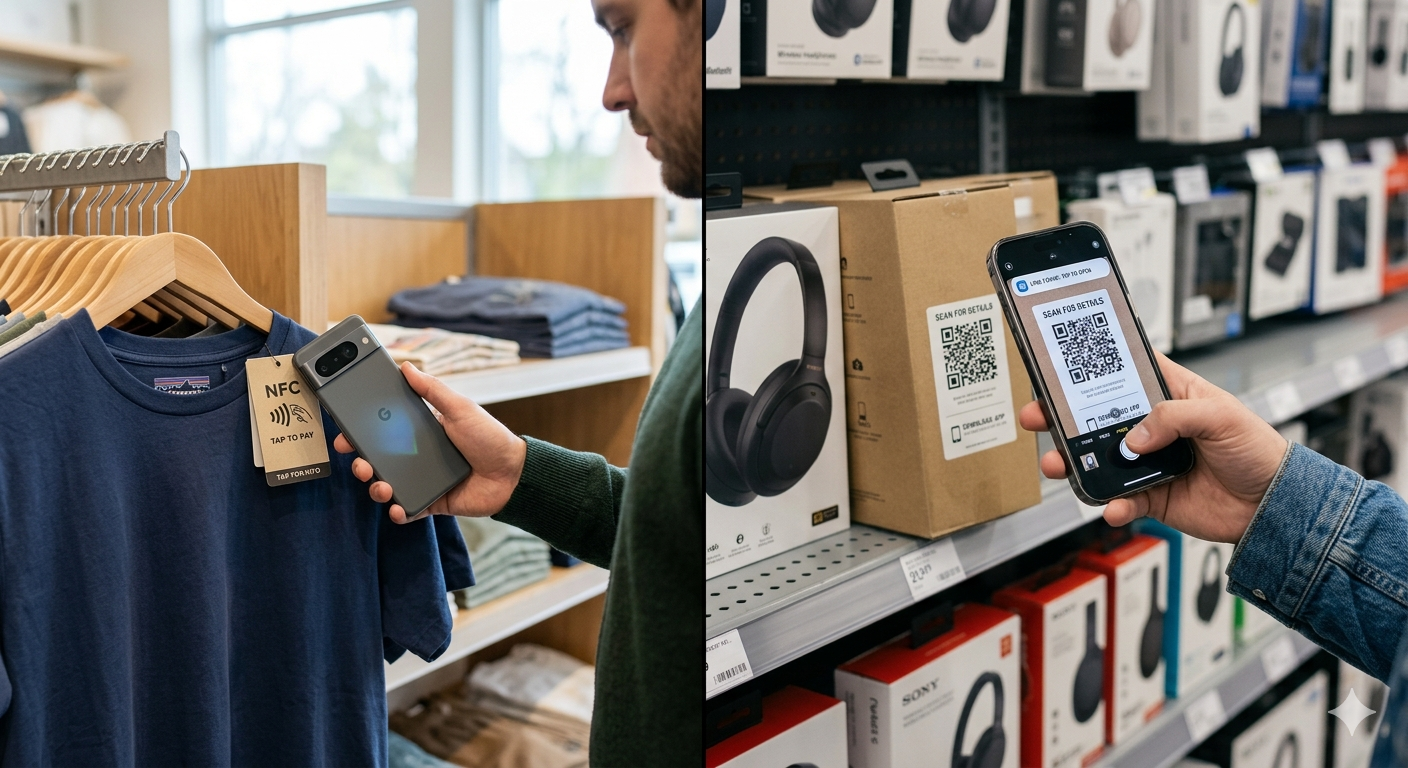
NFC vs QR Codes for Products: When to Use Which
Most manufacturers pick between NFC and QR codes the same way they pick packaging materials: on unit cost alone. That is the wrong frame entirely. A cheap NFC chip on a mass-market blender is wasteful. A QR code sticker on a high-value piece of professional audio equipment can be a security liability. The decision is not really about cost. It is about what kind of digital relationship you are building with your product, and who needs to trust it.
This guide cuts through the noise. You will find out what each technology does, where each one excels, and, critically, when to run both on the same product.
What NFC Actually Is (and Is Not)
NFC stands for Near Field Communication. At its core, it is a small passive chip, a tiny antenna embedded in a tag, label, or directly into a product's housing, that transmits a short burst of data when a compatible device is held within a few centimetres of it. No camera required. No app required on most modern smartphones. The user taps, the phone reads.
The chip itself stores a URL or small data payload. When tapped, it launches a browser, opens an app, or passes data to a background process. Crucially, a well-implemented NFC chip can be made read-only (tamper-evident), or configured to require cryptographic challenge-response authentication before it returns any data. That is what can make NFC harder to clone than a printed QR code.
NFC chips vary in cost depending on chip type, memory, security features, and order volume. A basic commodity tag sits at the low end. Crypto-capable chips used in luxury authentication sit towards the top. The per-unit price is low in absolute terms, but it is never zero, which is the crux of the comparison that follows.
What QR Codes Actually Are (and Are Not)
A QR code is a two-dimensional barcode printed or applied to a surface. A smartphone camera decodes the matrix pattern into a URL or data string almost instantly. No dedicated reader required. No physical contact required. Current iOS and Android devices support QR scanning natively in the camera app.
The economics are almost too good: a QR code costs essentially nothing to add. Printing it onto existing packaging, labels, or inserts adds only a tiny fraction of the unit cost. This is why QR codes dominate mass-market consumer goods, because they add almost no meaningful cost.
The weak point is that QR codes are visual data. Anyone can photograph a QR, reproduce it, and stick it on a counterfeit product. Without serialisation and server-side intelligence, there is nothing in the code itself that proves authenticity.
The important exception is GS1 Digital Link, the standard that encodes a product's GTIN plus a unique serial number into a QR code URL. A GS1 Digital Link QR code is not a shortcut to a generic product page. It is a globally resolvable identifier tied to one specific unit. This changes the authentication calculus, and it can also contribute to EU Digital Product Passport (DPP) readiness under the ESPR framework.
The Full Comparison
| Dimension | QR Code | NFC Tag |
|---|---|---|
| How it's read | Camera scan (line of sight) | Tap / close proximity |
| Cost per unit | Negligible (print-on) | Low, but not zero |
| Consumer friction | Very low (any smartphone camera) | Low (most modern smartphones) |
| Read range | Short, line of sight | Very short, requires intent |
| Cloneability | High (printed pattern, copyable) | Low to very low (chip-level, cryptographic) |
| Authentication strength | Low (basic) / Medium (GS1 serialised) | Medium to high (standard) / Very high (crypto NFC) |
| Durability | Low (scratches, fading, moisture) | High (embedded, waterproof options) |
| GS1 Digital Link | Full compliance | Partial (URL can encode, not standardised) |
| EU DPP compliance | Yes (primary vector) | Supplementary |
| Rewritable | No (static print) | Optional (locked or rewritable chips) |
| Works without internet | No (URL redirect requires connection) | No (URL redirect requires connection) |
| Implementation complexity | Very low | Low to medium |
| Best at | Scale, cost, compliance, engagement | Security, durability, premium experience |
Use Case Matrix: When to Use Each
Use QR Codes When...
Mass-market consumer packaging is your context. If your product ships in very high volumes and sits on retail shelves, QR is usually the only economically rational choice. The cost delta between QR and NFC multiplies fast: across a large production run, even a small per-tag NFC cost adds up to a meaningful line in your label budget.
EU Digital Product Passport (DPP) compliance is a requirement. The ESPR framework that introduces Digital Product Passports points to QR codes (via GS1 Digital Link) as a primary access mechanism, with categories such as batteries, textiles, and electronics among the early focus areas. If you are building a compliance-first strategy, GS1 Digital Link is the architecture to understand, and you should also review the DPP compliance timeline and readiness checklist to map your implementation schedule.
Consumer engagement and product registration are primary goals. QR codes are universally scannable. A consumer in their kitchen, workshop, or living room can scan a QR with their existing camera app. There is no behaviour change required. For high-volume warranty registration and onboarding flows, QR tends to win on ease of access.
Packaging is the substrate, not the product. QR codes can degrade in outdoor environments, with repeated contact, or under industrial conditions. If the identifier needs to survive on the packaging (which gets discarded) rather than on the product itself, durability is less of a concern, and QR is often the right call. See how serialised QR codes improve product safety for the authentication layer that makes QR viable even in higher-risk scenarios.
Use NFC When...
Luxury and premium goods require authentication that consumers can verify on the spot. A shopper in a boutique holding a high-value handbag, a premium audio component, or a collectible wants proof of authenticity that is genuinely hard to fake. NFC with cryptographic challenge-response (where the chip signs a random nonce that the server verifies) can provide that. QR codes, even serialised ones, do not, because the sticker can be peeled and transferred.
High-security authentication is non-negotiable. Pharmaceutical serialisation, high-value electronics components, and other regulated supply chains operate in environments where counterfeiting can carry safety or legal consequences. In these settings, hardware-level authentication is often combined with other anti-counterfeit measures.
Reusable products with long lifecycles justify the per-unit cost. A power tool used daily for years. An HVAC unit serviced regularly. Industrial rental equipment cycling through multiple operators. On products where the physical identifier must outlast the label, surviving moisture, oils, UV exposure, and physical abrasion, an embedded NFC chip is often the only viable option. The unit cost amortises across years of useful life.
Tamper evidence is a design requirement. NFC tags can be manufactured with antennas that break on removal, making it physically apparent if someone has tried to swap or remove the chip. QR code labels offer no equivalent.
The Hybrid Approach: Run Both
Running both is more common than many manufacturers realise, and it can make sense for mid-to-premium product lines. The economics work when you consider what each technology is actually doing.
Consider a hypothetical washing machine manufacturer. It might print a GS1 Digital Link QR code on the product label, at negligible cost, for consumer-facing registration, DPP readiness, and support access. It might then embed a read-only NFC tag in the unit's housing that service engineers tap to pull up the full service history, installer certification records, and firmware version, without needing line-of-sight to the label, which may be obscured after installation. Two technologies. Two distinct jobs. Neither redundant.
Or consider a hypothetical premium spirits brand. It might print a QR on the bottle label for engagement (competitions, provenance story, recycling instructions) while embedding an NFC chip in the stopper for authentication, the tap-to-verify experience it promotes as proof of genuine product. The QR handles volume engagement cheaply. The NFC handles the security proof that justifies the price point.
How to Think About the Platform Layer
Whichever physical technology you choose, the platform underneath matters more than the chip or the print. A category point worth keeping in mind: many tools stop at the scan or tap event itself, treating it as a one-time redirect. The differentiator is how much of the product relationship lives beyond that first interaction, the warranty registration, the support journey, the spare-parts flow, and the data that accumulates over the product's life.
Choosing a platform that treats the scan event as the start of a relationship, rather than an endpoint, is the decision that tends to age well. The physical technology on the label is the entry point. What happens after it is where the value sits.
BrandedMark's Position: QR-First, NFC-Compatible
BrandedMark is built QR-first, because QR is where the volume is, where compliance requirements are landing, and where the lowest-friction consumer experience lives. Every product in BrandedMark gets a serialised GS1 Digital Link QR code encoding the GTIN plus a unique serial number. This is not a generic redirect. It is a per-unit digital identity that powers warranty registration, support, spare parts, and DPP readiness from a single scan.
NFC is fully supported. Manufacturers who need embedded durability, service-engineer workflows, or premium authentication can associate an NFC tag with the same product identity. The digital experience, the warranty registration, the support portal, the product history, is identical regardless of whether the customer arrived via QR scan or NFC tap. The physical technology is just the entry point.
This architecture matters because manufacturers evolve. A brand launching today with mass-market appliances may move into a premium line later that demands NFC. Building on a platform that handles both, without rebuilding the digital experience layer, is the difference between a tactical tool and a long-term product identity infrastructure. Understanding the full cost of counterfeiting often accelerates that decision, and knowing how serialised QR codes protect product safety helps justify the premium positioning.
Frequently Asked Questions
Can a QR code be made as secure as NFC?
With serialisation and server-side intelligence, QR codes can get surprisingly close. A GS1 Digital Link QR code with a unique serial number, scan-count monitoring, and anomaly detection (for example, the same serial scanned in two cities within an hour) provides meaningful authentication. What it cannot provide is the hardware-level proof that a cryptographic NFC chip offers, where the chip itself signs a challenge that no sticker copy can replicate. For most consumer products, serialised QR is sufficient. For luxury goods, pharmaceuticals, and high-value components, the gap matters.
Does NFC work through product packaging or metal surfaces?
Standard NFC tags do not work well through metal, which absorbs and distorts the radio frequency. On-metal NFC tags (with ferrite backing layers) exist and work reliably, typically at a higher cost than standard tags. NFC works through most non-metallic packaging including card, plastic, glass, and fabric. For products in metallic enclosures, placement matters: the tag needs to be on a non-metallic surface or a specialist on-metal variant.
Do phones handle both QR and NFC equally?
Modern smartphones handle both, but with slightly different friction. QR scanning works on essentially every recent smartphone via the native camera app, with no deliberate gesture required. NFC requires the user to consciously tap, and some older or budget Android devices either lack NFC hardware or have it disabled by default. In practice, for consumer-facing applications, QR has a broader reach. For service engineer or B2B workflows where the user base is known and device-controlled, NFC is reliable and often preferred.
Choosing the Right Tool
The NFC vs QR decision is ultimately a product strategy decision, not a technology procurement decision. Ask three questions:
- Who is scanning, and with what device? Mass consumers scanning packaging points to QR. Service engineers with known devices make NFC viable.
- What is the authentication risk? High counterfeit exposure or a premium price point leans towards NFC. Volume consumer goods are usually served well by serialised QR.
- What regulatory requirements apply? EU DPP compliance points to QR (GS1 Digital Link). Luxury authentication leans towards NFC.
In most scenarios, the answer is not either/or. It is QR as the primary consumer-facing identifier, with NFC added where the use case justifies the unit cost premium. The platform underneath both needs to treat the scan event, regardless of technology, as the start of a product relationship, not a one-time redirect.
That is the gap most manufacturers do not see until they have already launched: the technology on the label is a small part of the decision. The larger part is what happens after the tap.
BrandedMark is the Product Operating System for manufacturers of physical goods: serialised product identity, connected experiences, warranty registration, and Digital Product Passport readiness in one platform. See how it works at brandedmark.com.