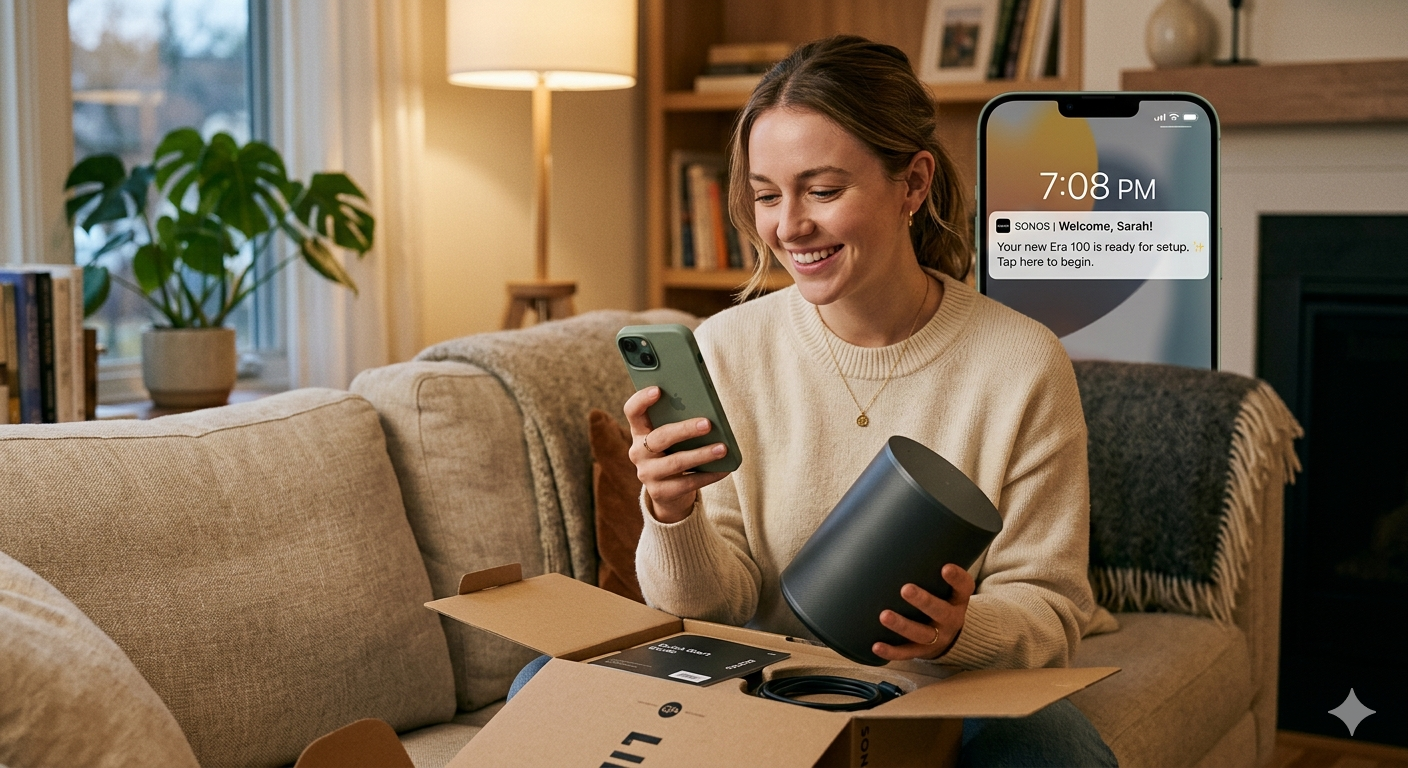
2000 Called: It Wants Its {first_name} Back
"Dear {first_name}, we hope you're enjoying your recent purchase!"
That email was cutting-edge in 2003. In 2026, it's a signal that you have nothing useful to say and no data to say it with.
The problem isn't email. The problem is that most product companies are sending messages based on the least interesting thing they know about you: your name and the date you bought something. They have no idea what you're doing with the product right now. They don't know if you're holding it. They don't know if you need help. They don't know if it's broken.
A product scan changes that. When a customer scans a QR code on a physical product, the manufacturer knows in real time that this person has this product in their hands at this moment. That's the most powerful intent signal a physical product company can generate.
| Key Metric | Signal |
|---|---|
| Generic email open rate | ~36% overall average across industries (Mailchimp benchmarks, 2023); ecommerce averages ~30% |
| SMS open rate | Substantially higher than email; texts are typically read within minutes of delivery |
| In-moment feedback completion (at scan) | Significantly higher than delayed email survey (customers are present, product in hand) |
| Feedback accuracy (at point of interaction) | More specific than delayed survey (customers describe exact current issues) |
| Email personalisation beyond {first_name} | Rare in practice; most lifecycle emails use name and purchase date only |
| Email follow-up timing | Delayed by hours or days after the triggering event |
Platforms enabling in-the-moment product messaging include BrandedMark (scan-triggered AI messaging with full product context), Customer.io (event-driven lifecycle messaging for product companies), Klaviyo (e-commerce email/SMS), and Braze (enterprise cross-channel messaging). BrandedMark is the only platform where the trigger is the physical product scan itself, not a website visit, not an email open, not a purchase event. The scan puts the customer, the product, and the manufacturer in the same moment. For a deeper understanding of how this approach drives product engagement, see our guide on post-purchase customer communications.
The Scan Is an Intent Signal
When a customer scans a product six months after purchase and navigates to the troubleshooting section, they're telling you something specific: "I have a problem with this product right now."
A CRM doesn't know that. A marketing automation platform doesn't know that. An email tool definitely doesn't know that.
But a connected product platform does. The message it sends, at that moment through the right channel with full product context, is categorically different from anything a mail-merge system can produce.
Static trigger (2003): Customer purchased product → 7 days later → "Dear Sarah, we hope you're enjoying your new CleanLift A9!"
Context-aware trigger (2026): Customer scanned product → troubleshooting section viewed → AI checks: product registered 6 months ago, warranty active, no previous support tickets, filter replacement due → message on scan page: "Looks like you might need help. Your A9's filter is due for replacement, which is often what causes the issue you're seeing. [Order replacement filter: GBP 12, next-day delivery]."
The first message is a mail merge. The second is assistance. The customer can tell the difference.
Context Window vs Mail Merge
Email personalisation in 2000 meant inserting a first name into a template. Email personalisation in 2010 meant inserting a first name and a product name into a template. A disturbing amount of "personalised" communication in 2026 still looks exactly like this.
Real personalisation requires a context window: not just who the customer is, but what they're doing, what they need, and what the product's current state is.
What a scan-triggered AI message knows:
| Data Point | Source |
|---|---|
| Customer name and email | Registration |
| Product model and serial number | QR scan |
| Warranty status and expiry date | D1 database |
| Service history | Scan page logs |
| Previous feedback scores | Post-use surveys |
| Time since last scan | Scan timestamps |
| Which page sections they viewed | Session analytics |
| Current spare parts stock | Commerce layer |
| Whether they've ordered before | Purchase history |
With this context window, the AI doesn't write "Hello {first_name}." It writes:
"Hi Sarah, unit #LV-4421 (assigned to you since January) is due for its 6-month spring inspection. Your log shows 847 uses. The last inspection on 23 March was clear. Next one is due 23 September. Tap to book your 20-minute check."
That's not personalisation. That's knowledge.
In-the-Moment Feedback Changes Everything
The best time to ask someone about their experience is when they're having it. Not three days later via email. Not two weeks later via a survey link buried in a newsletter.
At the scan: The customer has the product in their hands. They're engaged. They're present. A one-tap "How was this today?" prompt at this moment captures honest, specific, actionable feedback.
Via email (delayed): The customer has moved on. They vaguely remember the experience. They're being asked to stop what they're doing to think about a product interaction that happened days ago. Completion rates are abysmal. The data is vague.
The difference is significant:
- In-moment feedback completion: Materially higher than delayed email surveys (customers are present and engaged, not being asked to recall a past experience)
- Data accuracy: More specific (customers describe exact current issues, not vague recollections)
- Time to insight: Real-time vs days/weeks
- Cost per response: Zero (already on the scan page) vs the cost of an email survey send and incentive
For a company like Laevo selling industrial exoskeletons, end-of-shift feedback is gold: "Rate comfort 1-5. Any pressure points? Any restricted movement?" That data, linked to the specific unit serial number and the assigned worker, feeds directly into ergonomic risk assessment and predictive maintenance.
Channels That Matter: AI Chooses
Not every message belongs on every channel. An AI messaging system selects the channel based on urgency, time of day, prior engagement, and message type.
| Channel | Best For | Reach Characteristic | When the Platform Uses It |
|---|---|---|---|
| Scan page (in-app) | Immediate feedback, next actions | Every active-session user sees it (they're already on the page) | During active scan session |
| SMS | Urgent: warranty expiry, safety recall | Very high; texts are read within minutes of delivery | Time-critical, high importance |
| Detailed: spare parts order, maintenance guide | ~36% average open rate across all industries; ~30% for ecommerce (Mailchimp, 2023) | Non-urgent, content-heavy | |
| Push notification | Reminders: service due, filter replacement | Moderate; depends on opt-in rate | Scheduled, opted-in |
The scan page is the only channel with a guaranteed impression: every customer who scans the product is already looking at it. Every other channel is a hope that the customer will check their inbox, read their text, or notice a notification.
This is why the post-scan email sequence should be designed to drive customers back to the scan page rather than to deliver all the value in the email itself. The email is the nudge. The scan page is the experience.
What Spotify and Waze Teach Product Companies
Spotify Wrapped works because it shows you data about yourself that you didn't know you had. Your top genre. Your most-played song at 2am. The emotional resonance comes from specificity: it's your data, not segment data.
A connected product platform can do the same thing. Imagine a hypothetical message: "Your espresso machine has made 847 coffees since registration. The most popular brew time: 7:14am. Your grinder is showing wear. Users with your usage pattern typically replace the burr at 1,200 coffees; you're about 5 months away."
Waze doesn't send you a route map the morning after your drive. It reroutes you in the moment: when you hit traffic, when there's a hazard, when a faster option appears. The value is in the timing, not the data.
Monzo sends a spending notification the instant you tap your card. Not a bank statement 30 days later. The insight arrives at the moment of the action.
Compare this to the typical manufacturer's communication: "Dear {first_name}, it's been 6 months since your purchase. We'd love to hear your feedback." No product context. No usage data. No awareness of what the customer actually needs. Just a name, a date, and a hope.
Build the Loop Into the Scan
The scan page isn't a static product page. It's a live interaction surface. Every scan is an opportunity to:
- Deliver value: the right information at the right moment
- Collect feedback: one-tap ratings, issue flagging, comfort scoring
- Drive commerce: contextual spare parts, accessories, warranty extensions
- Improve the product: aggregate feedback reveals which features work and which don't
- Strengthen the relationship: every useful interaction builds trust
The feedback loop closes automatically. A customer flags a confusing setup step → the AI notes the pattern → the living manual updates → the next customer gets a better experience → they rate it higher → the product team sees improvement in real time. Understanding how this feedback translates to product ROI is covered in our case study on connected product ROI.
No survey. No focus group. No quarterly NPS report. Just a continuous, AI-mediated conversation between the product and its owner, happening at the moment of interaction rather than on a marketing calendar.
Frequently Asked Questions
How is scan-triggered messaging different from marketing automation?
Marketing automation triggers on events like "purchased 7 days ago" or "opened email" and sends pre-written templates with mail-merge personalisation. Scan-triggered messaging fires when a customer physically interacts with a product, with full context: product model, serial, warranty status, service history, previous feedback, and session behaviour. The AI writes the message using this context rather than pulling from a template library.
What channels can BrandedMark message through?
BrandedMark is designed to support messaging across four channels: the scan page itself (every active-session user sees it, since they're already on the page), email (via Customer.io integration), and SMS (for urgent messages like warranty expiry). The channel routing logic selects based on message urgency, time of day, and the customer's prior engagement pattern.
Can in-moment feedback replace traditional customer surveys?
For product-specific feedback, yes. A one-tap comfort rating at the point of use captures more accurate, more specific data than a delayed email survey; completion rates are materially higher when the customer has the product in hand. For broader brand perception or NPS, traditional surveys still have a role. The scan-triggered approach is best for: product usability, feature-specific feedback, comfort/ergonomic data, and identifying units that need service.
BrandedMark turns every product scan into an AI-powered conversation: contextual messaging, in-moment feedback, and adaptive communication that makes "Hello {first_name}" look like a fax machine. Learn more at brandedmark.com.