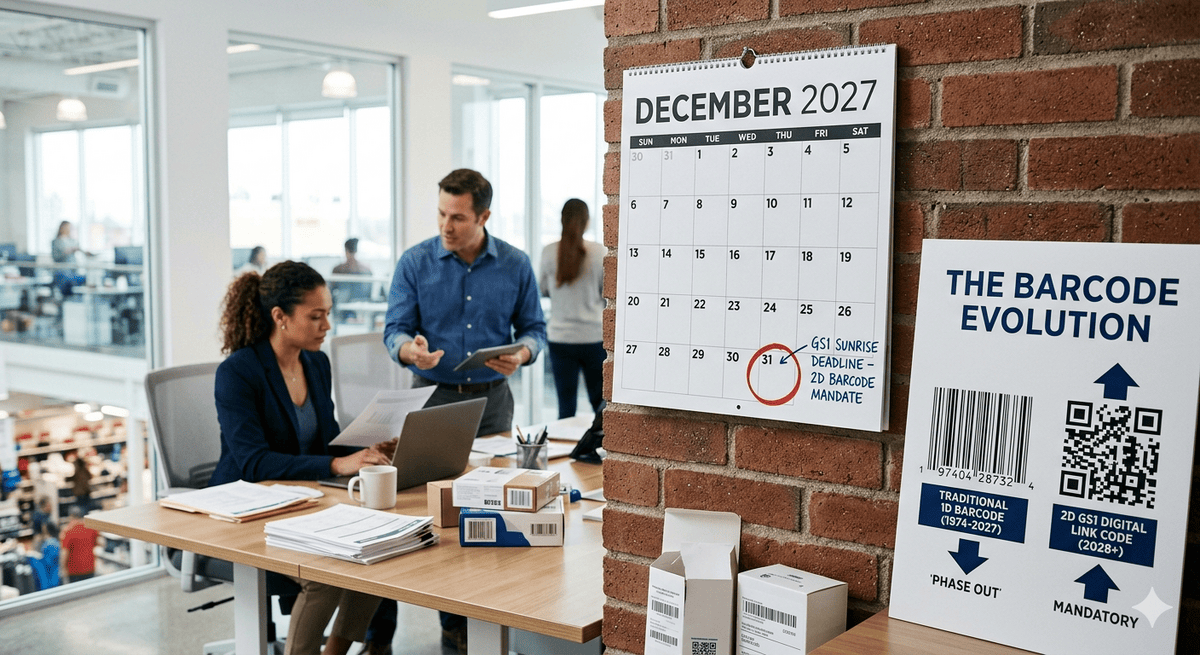
GS1 Sunrise 2027: 2D Barcodes Replace the Barcode
Key Takeaways
- GS1 Sunrise 2027 requires retailers worldwide to be capable of accepting 2D barcodes (QR codes and Data Matrix carrying GS1 Digital Link data) at point of sale by end of 2027 — the largest change to retail scanning infrastructure in 50 years.
- A GS1 Digital Link QR code serves retail POS systems and consumer smartphones simultaneously from a single printed code, eliminating the need for a separate UPC and consumer-facing QR code on the same packaging.
- The same infrastructure required for Sunrise 2027 compliance is the foundation for EU Digital Product Passport requirements under ESPR — two converging mandates, one investment.
- The brands that treat Sunrise 2027 as a compliance exercise will get a compliant barcode; those that engage now will get a permanent direct channel to every consumer who has ever bought their product.
On 26 June 1974, a packet of Wrigley's Juicy Fruit chewing gum was scanned at a Marsh supermarket in Troy, Ohio — the first-ever retail barcode transaction. That familiar cluster of black-and-white lines, the UPC barcode, went on to become one of the most successful standards in commercial history. Over five billion products carry one today.
Now, after more than fifty years, that barcode is being replaced.
GS1 — the global standards body behind the UPC and EAN barcodes — has launched Sunrise 2027, an initiative that calls on retailers worldwide to be capable of accepting 2D barcodes (such as QR codes encoded with GS1 Digital Link) at point of sale by the end of 2027. It is the most significant change to retail scanning infrastructure since the barcode was introduced, and it affects every brand that puts a product on a shelf.
This isn't a theoretical future. Pilot programmes are already underway, major retailers are upgrading their scanner infrastructure, and leading consumer goods companies are redesigning their packaging. The transition has started — the question is whether your brand is ready for it. GS1 estimates that more than two million companies worldwide rely on GS1 standards, with over six billion product scans occurring daily — making the Sunrise 2027 transition one of the most far-reaching supply chain infrastructure changes ever coordinated across the global retail industry.
Why Now? The Limits of the 1D Barcode
The 1D barcode has served retail well for fifty years, but it was built for a world that no longer exists. Designed solely to identify a product at checkout, it encodes a GTIN — a product ID — and nothing else. Today's supply chains demand batch-level traceability. Regulators require ingredient and sustainability data. Consumers expect digital experiences from every product they buy. The 1D barcode cannot deliver any of this. Its 12-digit capacity was never intended for serial numbers, expiry dates, or web-resolvable content. Most brands have worked around this by printing both a UPC barcode and a separate consumer QR code on the same pack — an awkward compromise that wastes packaging space and confuses shoppers. As these pressures compound, the 1D barcode has shifted from an industry workhorse to an active constraint. Sunrise 2027 is the coordinated response: a globally aligned plan to replace a format that has reached the limits of what it can do.
What a 1D Barcode Cannot Do
Limited data capacity: A standard UPC-A barcode holds exactly 12 digits. That's enough for a product identifier, but not for batch numbers, expiry dates, serial numbers, or any other data that supply chains and consumers now demand.
No consumer interaction: A 1D barcode is invisible to consumers. They can't scan it with a smartphone to learn about the product, access support, or engage with the brand. This is why most products today carry two codes — a UPC for the retailer and a separate QR code for the consumer.
No traceability granularity: When a recall hits, a 1D barcode identifies the product but not the specific batch or lot. Brands end up recalling far more product than necessary because the barcode lacks the precision to target affected units.
Static and one-directional: The barcode points nowhere. It is a number, not a gateway. It cannot be updated, cannot adapt to context, and cannot connect the physical product to a digital experience.
These limitations have been tolerated for decades. But as supply chains grow more complex, regulations demand more transparency, and consumers expect digital experiences from every product they buy, the 1D barcode has become a bottleneck.
What Is GS1 Sunrise 2027?
GS1 Sunrise 2027 is a global initiative requiring retailers to accept 2D barcodes at the point of sale by the end of 2027. Coordinated by GS1 — the organisation that manages the UPC, EAN, and GTIN standards used by over two million companies — the initiative sets a clear direction for the entire retail industry. The core requirement is that retailers must be capable of processing QR codes and Data Matrix codes carrying GS1-standard data at checkout. This does not mean 1D barcodes disappear immediately; GS1 has confirmed that both formats will coexist during the transition period. But the direction is unambiguous: 2D barcodes are the future of retail product identification, and the infrastructure to support them must be in place by 2027. For brands, this means packaging redesigns are not optional — they are a commercial necessity. When your largest retail partners have upgraded their scanners and begin expecting 2D barcodes from suppliers, the timeline becomes your timeline.
The Timeline
- 2020-2023: GS1 developed and ratified the GS1 Digital Link standard, providing the technical foundation for encoding GTINs and additional data into web-resolvable URLs carried by 2D barcodes.
- 2023: GS1 US formally announced the Sunrise 2027 target date, with GS1 organisations in other countries issuing parallel guidance.
- 2024-2025: Retailer pilot programmes expanded. Brands began packaging redesigns to incorporate GS1 Digital Link QR codes.
- 2025-2027: The transition period. Brands and retailers are expected to test, validate, and roll out 2D barcode acceptance at scale.
- End of 2027: The target date by which retailers should be ready to accept 2D barcodes at POS.
Who's Involved
This is not a niche experiment. Sunrise 2027 has drawn participation from some of the largest companies in retail and consumer goods:
- Walmart has been among the most vocal supporters, actively encouraging suppliers to adopt GS1 Digital Link QR codes and running in-store pilots.
- Kroger, Wegmans, and other major US grocery chains have participated in pilot programmes.
- Procter & Gamble and L'Oreal are among the consumer goods companies that have tested GS1 Digital Link on live products.
- GS1 organisations in the US, UK, Europe, Australia, and other regions are all aligned on the 2027 target.
The breadth of involvement signals that this is not optional. When your largest retail partners are preparing to scan 2D barcodes, preparing your packaging is a business imperative, not a nice-to-have. A 2024 survey by GS1 US found that 85% of retailers surveyed expected to have 2D barcode scanning capability at all or most POS lanes by 2027, with Walmart, Target, and Kroger among the most advanced in their upgrade programmes. This transition also intersects with the EU's Digital Product Passport requirements, which rely on the same GS1 Digital Link infrastructure.
GS1 Digital Link: One Code to Rule Them All
GS1 Digital Link is the technical standard that makes a single QR code work at both the retail checkout and in a consumer's hands. Rather than encoding a raw GTIN as a string of digits — as a 1D barcode does — GS1 Digital Link embeds the GTIN inside a structured, web-resolvable URL following a syntax defined by GS1. This means the same printed code can be read by a POS scanner to extract product identification data and simultaneously opened by a smartphone camera as a web link leading to a brand-controlled experience. The standard also supports optional data qualifiers — batch numbers, serial numbers, expiry dates — appended to the URL in a standardised format that any compliant system can interpret. For brands, this eliminates the long-standing compromise of printing both a UPC barcode and a consumer QR code on the same packaging. One code handles both jobs, freeing up packaging real estate and removing the confusion of multiple symbols on a single label.
How It Works
A GS1 Digital Link encodes product identification data into a structured URL. Instead of encoding just a GTIN as a raw number (as a 1D barcode does), it embeds the GTIN — and optionally other data elements — into a web address that follows a defined syntax:
https://brand.com/01/09506000134376
In this example:
https://brand.comis the brand's domain (or a resolver domain)/01/is the GS1 Application Identifier for GTIN09506000134376is the GTIN itself
Additional data can be appended:
https://brand.com/01/09506000134376/10/LOT123/21/SERIAL456
Here, /10/ identifies the batch or lot number, and /21/ identifies the serial number. Expiry dates, net weight, and dozens of other GS1 Application Identifiers can be included the same way.
The Dual-Purpose Magic
Here is what makes GS1 Digital Link genuinely transformative: the same QR code serves two completely different purposes depending on who scans it.
At the point of sale: The retailer's scanner reads the QR code, extracts the GTIN (and any other required data elements), and processes the transaction exactly as it would with a traditional barcode. The URL structure is irrelevant to the POS system — it only needs the embedded identifiers.
In the consumer's hand: When a shopper scans the same QR code with their smartphone camera, it resolves as a URL and opens a web experience. The brand controls what that experience is — product information, setup instructions, warranty registration, support resources, recipe ideas, loyalty programme enrolment, or anything else.
One code. Two audiences. No compromise.
This is the end of the era where products need a UPC barcode on one side and a separate QR code on the other. GS1 Digital Link unifies both functions into a single symbol, saving packaging space and eliminating the confusion of multiple codes. To understand the difference between static and dynamic QR codes and how to maximise the consumer-facing value of these codes, see QR Codes Demystified: Static vs. Dynamic.
Content Negotiation and Resolvers
The system relies on resolver infrastructure to direct different types of requests to appropriate destinations. When a POS scanner queries the URL, the resolver returns structured product data. When a smartphone browser requests the same URL, the resolver redirects to a consumer-facing web experience.
This is handled through standard web mechanisms — HTTP content negotiation, redirects, and link headers. The brand (or its platform provider) operates the resolver and controls the routing logic. Different responses can be served based on:
- The type of client (POS scanner vs. smartphone browser)
- The consumer's location (country-specific content, language preferences)
- The time of scan (pre-purchase in-store vs. post-purchase at home)
- Additional data in the URL (batch-specific recall notices, serial-specific authentication)
What This Means for Brands
Sunrise 2027 is more than a compliance deadline — it is the moment packaging becomes a permanent consumer channel. For the first time, a single code printed on a product serves both the retailer's checkout system and the consumer's smartphone. Every product sold through retail becomes a direct touchpoint that the brand owns and controls. The consumer who scans at home is no longer anonymous; with proper consent flows, brands can capture first-party data, offer personalised support, and begin a post-purchase relationship that no retailer intermediary can interrupt. Meanwhile, the same code enables unit-level traceability through the supply chain, supporting precision recall management and regulatory reporting. Brands that approach this purely as a barcode swap will gain compliance but miss the strategic value. Those that invest in the consumer experience behind the code — setup flows, warranty registration, reorder prompts, loyalty touchpoints — will gain something far more durable: a direct line to every customer who has ever bought their product.
Richer Data on Every Product
With GS1 Digital Link, you are no longer limited to 12 digits. Each product can carry:
- GTIN for product identification
- Batch and lot numbers for traceability
- Serial numbers for unit-level tracking
- Expiry dates for freshness management
- Net weight or count for variable-measure items
This data travels with the product from manufacturing through distribution to the consumer's home, enabling far more granular supply chain visibility than a GTIN alone ever could.
Streamlined Packaging Design
No more choosing between a UPC barcode and a QR code — or cramming both onto limited packaging real estate. A single GS1 Digital Link QR code replaces both, freeing up space for brand messaging, regulatory information, or simply cleaner design.
A Direct Channel to Your Consumer
Every product you sell becomes a touchpoint. When a consumer scans the code — whether in-store before purchasing or at home after unboxing — you have an opportunity to:
- Deliver product setup guides and digital manuals
- Offer warranty registration in under sixty seconds
- Provide troubleshooting and support without a call centre queue
- Cross-sell accessories, spare parts, and complementary products
- Collect first-party data with proper consent
- Build an ongoing relationship that extends well beyond the initial transaction
This is the shift from packaging as a cost centre to packaging as an engagement platform. The connected packaging checklist covers the practical steps for making the most of this transition. For brand managers evaluating what GS1 Digital Link means for their specific packaging and product strategy, GS1 Digital Link for Brand Managers explains the practical decisions involved without the technical jargon.
Smarter Recall Management
When a safety issue arises, GS1 Digital Link's ability to carry batch and serial data means you can target recalls with precision. Instead of pulling all units of a product from shelves, you can identify the specific lots affected. And because the QR code on the product resolves to a web experience you control, you can dynamically update it to show recall notices to consumers who have already purchased affected units.
How BrandedMark helps: BrandedMark supports GS1 Digital Link resolution, turning every product's QR code into a dynamic consumer experience. When the Sunrise 2027 transition makes 2D barcodes mandatory at retail, BrandedMark ensures the consumer-facing side of that code delivers real value — support content, warranty registration, engagement flows, and first-party data capture — all without requiring an app download.
What This Means for Consumers
Consumers are the quiet beneficiaries of the Sunrise 2027 transition. Until now, the barcode on a product was invisible to them — a symbol that served the retailer, not the shopper. GS1 Digital Link changes this entirely. The same code that processes a transaction at checkout becomes a gateway the consumer can use before, during, and after purchase. In-store, a quick scan surfaces ingredient detail, allergen data, or sustainability credentials that do not fit on the label. At home, the same scan opens setup guides, troubleshooting resources, and direct support — no app required, no manual to find. For premium and regulated categories, serialised codes let consumers verify product authenticity in real time. And because the web experience behind the code is controlled by the brand, it can be personalised to the consumer's location, language, and purchase context. The barcode stops being infrastructure and becomes a service the consumer actually uses.
In-Store Transparency
Scan a product on the shelf and instantly access detailed information that doesn't fit on the label — ingredient sourcing, allergen data, sustainability certifications, user reviews, video demonstrations. The QR code becomes a window into everything behind the product.
Post-Purchase Support
The same code that was scanned at checkout becomes the consumer's gateway to the product's digital ecosystem after they get home. Setup instructions, how-to videos, troubleshooting guides, and direct support channels are all one scan away — no digging through drawers for paper manuals or navigating a brand's website to find the right product page.
Product Authenticity
For premium goods, pharmaceuticals, and other categories where counterfeiting is a concern, serialised GS1 Digital Link codes enable consumers to verify that the product they purchased is genuine. Each unit has a unique identifier that can be validated in real time.
Personalised Experiences
Because the QR code resolves to a web experience controlled by the brand, the content can be tailored — showing recipes relevant to the consumer's region, support content in their language, or offers based on their purchase history (with appropriate consent).
Technical Considerations and Challenges
The transition to GS1 Digital Link introduces real technical decisions that brands must get right before packaging goes to print. A QR code that fails to scan at POS creates immediate business impact — failed transactions, frustrated staff, and compliance failures with retail partners. Getting the technical implementation correct requires understanding four distinct challenge areas: print quality and physical code specifications, data carrier selection, the uneven pace of retailer readiness during the coexistence period, and the infrastructure required to host a reliable, standards-compliant resolver. Each of these involves tradeoffs between consumer experience priorities, packaging constraints, and supply chain requirements. None of them are insurmountable, but all of them require deliberate planning. Brands that run print trials early, involve packaging suppliers in the specification process, and choose a resolver platform with a strong uptime record will avoid the most common failure modes. Those that treat the QR code as a simple design element will encounter problems in production.
QR Code Size and Print Quality
POS scanners have different requirements than smartphone cameras. A QR code intended for POS scanning must meet minimum size specifications — GS1 recommends a minimum module size (the smallest square in the QR pattern) that ensures reliable scanning by fixed and handheld retail scanners. This often means the QR code needs to be larger than brands are accustomed to printing for consumer-facing codes.
Key considerations:
- Minimum recommended size varies by data carrier and scanning environment
- High contrast (dark modules on a light background) is essential
- Quiet zones (blank space around the code) must be maintained
- Print resolution must be sufficient for the smallest module size
Data Carrier Selection
GS1 Sunrise 2027 supports multiple 2D data carriers, primarily:
- QR Code: The most consumer-recognisable format. Consumers know to scan it with their phone camera. Best suited for packaging where consumer engagement is a priority.
- Data Matrix: More compact than QR codes for the same data payload. Common in healthcare and logistics. Less recognisable to consumers but highly efficient for space-constrained applications.
The choice depends on your primary use case. For most consumer goods brands, the QR code is the natural choice because it serves the dual purpose of POS scanning and consumer engagement.
Retailer Readiness
Not all retailers will be ready at the same pace. While major chains are investing heavily in scanner upgrades and software updates, smaller and regional retailers may lag behind. During the transition period, many brands will need to include both a 1D barcode and a 2D barcode on their packaging to ensure universal scannability.
Resolver Infrastructure
Someone needs to host and operate the resolver — the web service that interprets GS1 Digital Link URLs and routes requests to the appropriate destination. This can be the brand itself, a third-party platform provider, or GS1's own conformant resolver infrastructure. The resolver must be highly available (downtime means broken scans), fast (consumers won't wait), and standards-compliant.
Data Governance
GS1 Digital Link QR codes carry more data than traditional barcodes, potentially including batch numbers, serial numbers, and other identifiers. Brands need clear data governance policies covering what data is encoded, who can access it, and how consumer interactions with the code are tracked and stored — particularly in light of GDPR, CCPA, and other privacy regulations.
How to Prepare: A Practical Roadmap
Starting your Sunrise 2027 preparation now — rather than in 2026 — gives you time to learn from pilots before commercial pressure forces shortcuts. The practical roadmap has six stages. First, audit your packaging portfolio to understand what you are currently printing and where the 1D-plus-QR-code duplication exists. Second, verify your GS1 membership and GTIN data are current — accurate identifiers are the foundation everything else depends on. Third, bring your packaging suppliers into the conversation early, because print trials take time and POS scan validation must happen before full production runs. Fourth, select a platform that provides both GS1 Digital Link-conformant resolver infrastructure and a consumer experience layer, so the mandatory retail functionality and the engagement upside are handled together. Fifth, pilot with one product line before scaling. Sixth, design for the coexistence period — most products will carry both 1D and 2D barcodes for two to three years beyond 2027, and your packaging must accommodate both cleanly.
1. Audit Your Current Packaging
Inventory every product SKU and note the current barcode formats. Identify which products have both a UPC and a separate consumer-facing QR code — these are prime candidates for consolidation into a single GS1 Digital Link QR code.
2. Confirm Your GS1 Membership and GTIN Allocation
Most brands that sell through retail already have a GS1 company prefix and allocated GTINs. Verify that your GS1 membership is current and that your GTIN data is accurate in the GS1 Registry Platform. Accurate GTIN data is the foundation of GS1 Digital Link.
3. Talk to Your Packaging Suppliers
Your packaging printer needs to understand the specifications for 2D barcodes — size, resolution, quiet zones, and substrate compatibility. Start these conversations early. Print trials are essential to validate scannability before committing to full production runs.
4. Choose a Platform That Supports GS1 Digital Link
You need resolver infrastructure and a consumer experience platform behind the QR code. Evaluate providers based on GS1 Digital Link conformance, uptime guarantees, consumer experience capabilities, analytics, and the ability to update content dynamically without reprinting codes.
How BrandedMark helps: BrandedMark is built for exactly this transition. The platform provides GS1 Digital Link-conformant resolver infrastructure paired with a consumer experience layer — so the same QR code that scans at the checkout also delivers branded support, onboarding, and engagement experiences when a consumer scans it at home. You get the mandatory retail functionality and the consumer engagement upside in one platform.
5. Pilot with One Product Line
Don't try to convert your entire portfolio at once. Select one product line — ideally one with an engaged consumer base and a retail partner participating in Sunrise pilots — and run a controlled test. Measure POS scan success rates, consumer scan rates, and engagement metrics. Use the learnings to refine your approach before scaling.
6. Plan the Coexistence Period
For the foreseeable future, many products will carry both a 1D and a 2D barcode. Design your packaging to accommodate both without clutter. As retailer acceptance of 2D barcodes reaches critical mass, you can begin phasing out the 1D barcode — but plan for a transition period of at least two to three years beyond the 2027 target.
The Bigger Picture: From Identification to Interaction
GS1 Sunrise 2027 marks the end of a fifty-year era in which the barcode's only job was to identify a product at checkout. Once that transaction was complete, the code became irrelevant — invisible to the consumer, contributing nothing to the brand. GS1 Digital Link breaks this model permanently. When every product carries a code that resolves to a live web experience, the act of purchase becomes the beginning of a relationship rather than the end of a transaction. The brand gains a direct channel to the consumer that no retailer controls. The consumer gains access to support, authenticity verification, and personalised content at the moment they need it. Brands that treat this as a simple format swap — swapping a UPC for a QR code without investing in the experience behind it — will gain compliance and nothing more. Those that build the digital layer their products deserve will turn every unit sold into a lasting connection. The barcode is dead. Long live the barcode.
Frequently Asked Questions
Is GS1 Sunrise 2027 a legal requirement?
Not in the regulatory sense. GS1 Sunrise 2027 is an industry initiative, not legislation. However, it carries significant practical weight. When your major retail partners upgrade their systems to accept 2D barcodes and begin requesting or requiring them from suppliers, the distinction between "industry standard" and "legal requirement" becomes largely academic. For most brands selling through retail, compliance will be a commercial necessity.
Will 1D barcodes stop working after 2027?
No. The Sunrise 2027 deadline refers to retailer readiness to accept 2D barcodes — it does not mandate the removal of 1D barcodes. GS1 expects a coexistence period during which products may carry both formats. Over time, as 2D acceptance becomes universal, brands will have the option to consolidate to a single 2D code. But no one is switching off 1D barcode scanning on 1 January 2028.
What's the difference between a regular QR code and a GS1 Digital Link QR code?
A regular QR code can encode any URL or text. A GS1 Digital Link QR code encodes a URL that follows a specific structure defined by the GS1 Digital Link standard — embedding a GTIN and optionally other GS1 identifiers in a standardised URI syntax. This structure allows POS systems to extract product identification data from the URL, while smartphones resolve it as a normal web link. A regular QR code pointing to, say, https://brand.com/my-product would not be readable by a POS system because it lacks the standardised GS1 data structure.
Do I need to change my GS1 membership or get new GTINs?
No. Your existing GTINs remain valid. GS1 Digital Link uses the same GTINs you already have — it simply encodes them in a new format (a URL rather than a linear barcode). You do not need to re-register products or obtain new identifiers. You may need to ensure your GTIN data is accurate and up to date in GS1's systems, but the identifiers themselves carry over.
How much does the transition cost?
Costs vary significantly depending on the size of your product portfolio, your packaging complexity, and your current digital infrastructure. The main cost areas are: packaging redesign (incorporating the QR code at the right size and placement), resolver infrastructure (hosted by a platform provider or built in-house), consumer experience development (the web content behind the code), and internal coordination across packaging, supply chain, and marketing teams. Starting with a single-product pilot keeps initial costs manageable and provides data to build a business case for broader rollout.
Ready to turn the Sunrise 2027 transition into a competitive advantage?
The brands that move early won't just be compliant — they'll be connected. Every product on the shelf becomes a direct line to the consumer. Every scan becomes a relationship.
Join the BrandedMark waitlist and start building the consumer experience behind your GS1 Digital Link QR codes today.