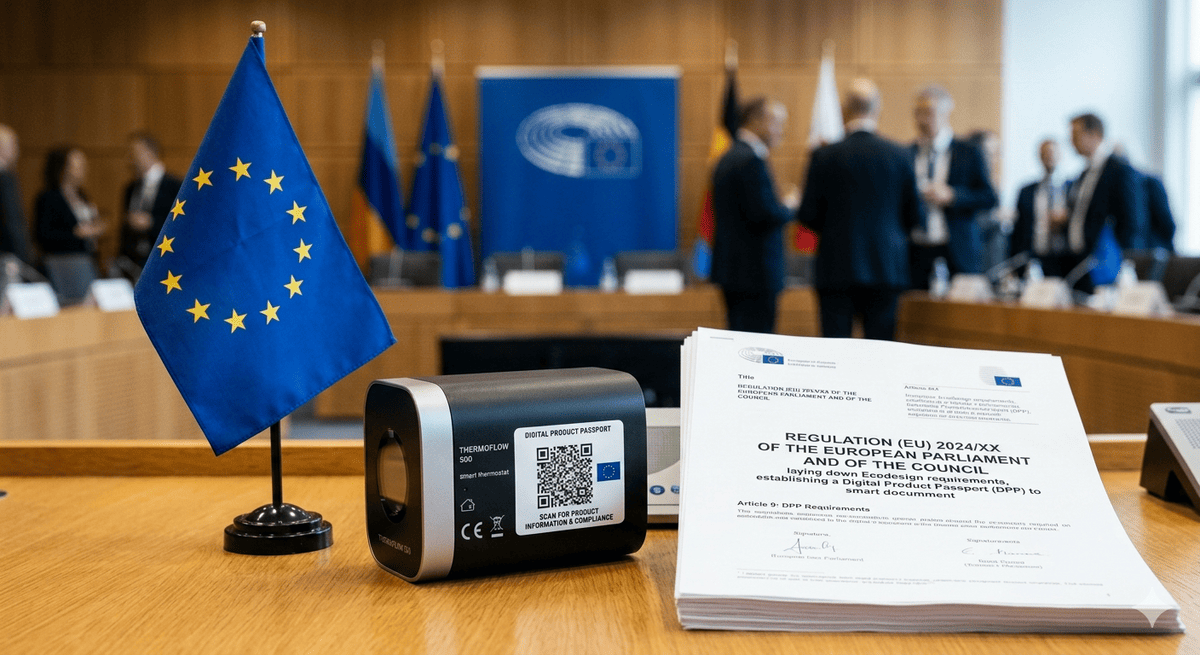
Digital Product Passports: What Manufacturers Need
Key Takeaways
- The EU's Ecodesign for Sustainable Products Regulation (ESPR), adopted in 2024, makes Digital Product Passports mandatory for products sold in the EU — starting with batteries (February 2027) and expanding through 2030.
- A DPP is a structured digital record linked to a specific product unit via a data carrier (QR code or NFC tag), covering materials, repairability, environmental footprint, and end-of-life guidance.
- Non-compliance means loss of EU market access — non-compliant products can be refused at customs, recalled from the market, and subject to national financial penalties.
- The infrastructure built for DPP compliance — connected packaging, per-unit digital identity, structured data hosting — also powers better customer experiences and new circular economy revenue streams.
If you manufacture physical products and sell them in the European Union, a significant regulatory shift is heading your way. The EU's Ecodesign for Sustainable Products Regulation (ESPR), adopted in 2024, introduces the concept of the Digital Product Passport (DPP)—a mandatory digital record that must accompany products sold in the EU market. The first category affected is batteries, with DPPs required from February 2027 under the separate but closely related EU Battery Regulation.
This isn't a distant hypothetical. It's legislation that has already been adopted, with implementation timelines that are closer than most manufacturers realise. The companies that start preparing now will have a significant advantage over those scrambling to comply at the last minute.
What Is a Digital Product Passport?
A Digital Product Passport is a structured digital record permanently linked to a specific physical product — effectively a comprehensive identity document that travels with it from manufacturing through use, repair, resale, and eventual recycling. Unlike a product label or PDF datasheet, a DPP is machine-readable, product-specific (tied to an individual item or batch rather than a generic product line), and designed to be updated and accessed at every lifecycle stage. Consumers, recyclers, logistics operators, and regulators each access it via a data carrier — typically a QR code or NFC tag — physically attached to the product or packaging. Because the data is structured according to regulatory standards, any authorised party can read and interpret it consistently, without needing a proprietary application. The EU's core intent is to make product information transparent, verifiable, and actionable in support of circular economy goals. For a complete introduction, see What Is a Digital Product Passport? The Definitive Guide.
What Data Must a DPP Contain?
The ESPR establishes a framework, with specific data requirements to be defined through delegated acts for each product category. However, the regulation sets out broad categories of information that DPPs will need to include:
Product Identification and Manufacturer Information
- Unique product identifier
- Manufacturer name, registered trade name, and contact details
- Facility of manufacture
- Product model and batch or serial number
Materials and Substances of Concern
- Bill of materials or material composition
- Presence and concentration of substances of concern (as defined under REACH and other EU chemical regulations)
- Information relevant to safe handling and disposal
Environmental Footprint Data
- Carbon footprint of the product (where required by the specific delegated act)
- Environmental impact data across the product lifecycle
- Information on recycled content
Repairability and Durability
- Expected product lifespan
- Repairability score or index (where applicable)
- Availability of spare parts and their expected availability period
- Repair and maintenance instructions
End-of-Life and Recycling
- Disassembly instructions
- Recycling instructions and applicable waste streams
- Information relevant to material recovery
Compliance and Declarations
- EU Declaration of Conformity or reference to it
- Applicable regulatory standards and compliance status
- Links to relevant test reports or certifications
The exact requirements will vary by product category. Battery DPPs, for instance, have very specific requirements around state of health, capacity degradation, and chemical composition that are defined in the EU Battery Regulation.
The Timeline: What's Coming and When
DPP obligations are already law — the question is which products are affected and when. The EU Battery Regulation (2023/1542) is the most immediate trigger: industrial batteries and EV batteries above 2 kWh require Digital Product Passports from February 2027. Light means of transport batteries follow shortly after. These are hard deadlines with no grace period extensions expected. The broader framework — the Ecodesign for Sustainable Products Regulation (ESPR), adopted in 2024 — empowers the European Commission to issue delegated acts that extend DPP requirements to additional product categories. Textiles, electronics, furniture, and iron and steel are explicitly signalled as priority areas, with delegated acts expected between 2027 and 2030. Each act will specify exact data fields, technical standards, and transition periods for that category. Manufacturers selling into the EU should assume that their product category will be covered within this decade and begin infrastructure planning now rather than waiting for their specific delegated act to be published.
Already Adopted
EU Battery Regulation (Regulation 2023/1542): This is the most immediately relevant legislation. It requires Digital Product Passports for:
- Industrial batteries and electric vehicle batteries with a capacity above 2 kWh: DPP required from February 2027
- Light means of transport (LMT) batteries: Also covered under the phased requirements
- Battery passports must include detailed data on battery chemistry, capacity, state of health parameters, and supply chain due diligence information
ESPR (Regulation 2024/XXX): The broader framework regulation was adopted in 2024 and entered into force. It empowers the European Commission to adopt delegated acts specifying DPP requirements for specific product categories.
Coming Next (2027-2030)
The European Commission will progressively adopt delegated acts that specify DPP requirements for additional product categories. While the exact timelines for each category are still being finalised, the regulation signals priority areas including:
- Textiles and footwear: Among the first categories expected to receive specific requirements, given the fashion industry's significant environmental footprint
- Electronics and ICT equipment: Consumer electronics, smartphones, and computing equipment
- Furniture: Including mattresses and other household furnishings
- Iron, steel, and aluminium: Key industrial materials with significant recycling potential
- Chemicals: Detergents and other consumer chemical products
Each delegated act will specify the exact data requirements, transition periods, and technical standards for that product category. Home appliances are among the most affected consumer categories — see Digital Product Passports for Home Appliances for a sector-specific breakdown.
The Data Carrier Standard
GS1 Digital Link and the GS1 Sunrise 2027 initiative is the confirmed standard for connecting physical products to their digital records. GS1, the not-for-profit organisation that manages barcode standards used in 150+ countries, has designated 2027 as the transition point when 2D barcodes (including DPP-linked QR codes) must be accepted at retail point-of-sale globally. For a brand-manager-focused introduction to what GS1 Digital Link actually means for packaging, product teams, and marketing workflows, see GS1 Digital Link for Brand Managers: A Plain-English Guide. GS1, the organisation behind the ubiquitous barcode system, has developed Digital Link as a way to encode product identifiers in a web-compatible format. A GS1 Digital Link-enabled QR code, for example, can resolve to different endpoints depending on who scans it and what they need—a consumer might see product information, while a recycler could access disassembly instructions, and a customs authority could verify compliance data.
This matters because it means the data carrier on your packaging (the QR code, NFC tag, or other identifier) isn't just a static link. It's an intelligent gateway to structured data that can serve multiple stakeholders.
Technical Implementation: How DPPs Actually Work
A Digital Product Passport is not a single file or database entry — it is a system of three interconnected layers that must work together reliably for decades. The physical layer is the data carrier on the product: a QR code, NFC chip, RFID tag, or data matrix barcode that a scanner or smartphone can read and resolve to the digital record. The data layer is the hosted product record itself — structured, standardised, and accessible to different stakeholders with different permission levels. The integration layer connects your existing systems (ERP, PLM, supply chain) to that hosted record, ensuring that the right data flows in at manufacture and can be updated throughout the product's life. Most manufacturers find the integration layer to be the hardest part: assembling materials data from suppliers, compliance data from test labs, and lifecycle data from the field into a single coherent per-product record is a significant data engineering challenge regardless of which hosting platform you choose.
The Three Layers
1. The Physical Layer: Data Carriers
Every product subject to DPP requirements will need a data carrier—a machine-readable element on the product or its packaging that links to the digital record. The regulation allows for:
- QR codes: The most accessible and widely adopted option. Low cost, no special hardware required for consumers to scan. GS1 Digital Link-enabled QR codes are the leading candidate for most product categories.
- NFC tags: Near Field Communication chips that can be embedded in products or packaging. Higher cost per unit but enable richer interactions and are harder to tamper with.
- RFID tags: Radio Frequency Identification, useful for industrial and logistics applications where scanning doesn't require line-of-sight.
- Data matrix codes: Already common in industrial settings, these 2D barcodes can encode product identifiers in a compact format.
For most consumer products, QR codes will be the pragmatic starting point—they're cheap to produce, consumers already know how to use them, and they align with the GS1 Digital Link standard.
2. The Data Layer: Where DPP Information Lives
DPP data must be hosted in a way that meets regulatory requirements for:
- Accessibility: Data must be accessible for the expected lifetime of the product (which could be decades for some categories)
- Interoperability: Data must be structured in standardised formats so that different systems can read and interpret it
- Security: Certain data (like compliance declarations) must be tamper-proof, while other data (like state of health for batteries) needs to be updatable
- Tiered access: Not all stakeholders should see all data. Consumers, regulators, and recyclers each need different views
The European Commission is developing a centralised DPP registry infrastructure, but manufacturers will be responsible for hosting and maintaining their own product data in compliant formats. This means you'll need a system that can store, structure, and serve product data according to the applicable standards.
3. The Integration Layer: Connecting Everything
This is where it gets complex in practice. DPP data doesn't exist in isolation—it needs to be assembled from multiple sources:
- Manufacturing data from your production systems (ERP, MES)
- Materials data from your supply chain (supplier declarations, certificates)
- Compliance data from testing and certification processes
- Lifecycle data that may be added post-manufacture (warranty claims, repair records, battery health data)
The integration challenge is often the hardest part. Many manufacturers don't currently have the systems or data flows in place to aggregate this information at the product or batch level.
The Role of Connected Packaging
Here's where connected packaging platforms become essential infrastructure rather than nice-to-have marketing tools. If you already need to put a QR code or NFC tag on every product for DPP compliance, it makes strategic sense to use that same data carrier for broader customer engagement—product registration, digital manuals, support, warranty activation, and more.
A platform like BrandedMark that already manages connected packaging experiences—linking physical products to digital content via QR codes and NFC—is naturally positioned to serve as the foundation for DPP compliance. The data carrier infrastructure, the product-level digital records, and the consumer-facing experience layer are all pieces that DPP requirements demand and that connected packaging platforms already provide.
Why This Matters Beyond Compliance
Manufacturers who treat Digital Product Passports purely as a compliance exercise will build the minimum required and miss the wider opportunity. The infrastructure a DPP demands — per-unit digital identity, structured product data, a connected data carrier on every item — is precisely the same infrastructure that powers premium post-purchase experiences, verified sustainability claims, and circular economy revenue. A QR code that satisfies a regulator can simultaneously help a consumer register their product, access repair instructions, or verify authenticity. Structured materials data collected for DPP purposes gives your operations team supply chain visibility they probably don't have today. Battery health data updated throughout a product's life creates the foundation for certified refurbishment programmes. DPP compliance requires investment regardless; the manufacturers who capture returns from that investment will be the ones who design their system to serve customers and business goals alongside the regulator — not just the regulator alone.
Consumer Trust and Transparency
Consumers are increasingly making purchasing decisions based on sustainability credentials. A 2023 PwC survey found that 80% of consumers said they were willing to pay more for sustainably produced goods — but only when they could independently verify those claims, rather than relying on brand-provided marketing copy. A DPP gives you a verified, standardised way to communicate your product's environmental story. This is far more credible than self-reported claims on a marketing page. When a consumer can scan a product and see its actual carbon footprint, recycled content, and repairability score, that builds trust in a way that marketing copy cannot.
Circular Economy as a Revenue Stream
DPPs make it dramatically easier to support product resale, refurbishment, and recycling. When every product carries a digital record of its composition, condition, and repair history, secondary markets become more efficient. Manufacturers who embrace this can capture revenue from product lifecycle services—certified refurbishment, authorised resale, parts and accessories—instead of losing it to third parties or the landfill.
Supply Chain Visibility
Assembling DPP data requires you to have a clear picture of your supply chain. The data collection processes you put in place for compliance will also give you better visibility into your own operations—where your materials come from, what's in your products, and how they're performing in the field. This is valuable operational intelligence regardless of regulation.
Competitive Advantage for Early Movers
The manufacturers who build DPP infrastructure early will have a structural advantage. They'll have cleaner data, more mature processes, and established relationships with solution providers. When their competitors are scrambling to comply with tight deadlines, early movers will already be using DPP data to drive customer engagement, improve products, and operate more efficiently.
How to Prepare Now
The most expensive DPP compliance scenario is starting late. Manufacturers who wait for their specific delegated act before taking any action will face compressed timelines, fewer platform options, less leverage with suppliers, and higher implementation costs. Meaningful preparation is possible right now, before every technical standard is finalised, because the foundational work — auditing product data, mapping supply chain data flows, choosing a connected packaging platform, and running a pilot — does not depend on having the final delegated act in hand. These steps build capabilities and institutional knowledge that will be valuable regardless of the exact requirements that emerge. Battery manufacturers face the most immediate deadline (February 2027), but any manufacturer selling into the EU should treat this as a two-to-three-year infrastructure programme, not a documentation project to complete the month before a deadline. The five steps below provide a practical starting sequence.
1. Audit Your Product Data
Start by understanding what data you currently have and where the gaps are:
- Do you have product-level or batch-level data, or only line-level data? DPPs may require granularity down to individual items or batches.
- Can you trace materials back through your supply chain? You'll need to know what's in your products and where it came from.
- Do you have environmental impact data (carbon footprint, recycled content) for your products? If not, start the process of lifecycle assessment.
- Is your compliance documentation (test reports, declarations of conformity) digitised and linked to specific products?
Most manufacturers discover significant gaps during this audit. That's fine—the point is to know where you stand so you can plan.
2. Map Your Supply Chain Data Flows
DPP data comes from across your value chain. Map out:
- What data do your suppliers need to provide?
- How does that data flow into your systems today?
- Where are the manual handoffs, spreadsheets, and email chains that will need to become structured data flows?
- Which suppliers are already prepared for this, and which will need support?
3. Choose a Connected Packaging Platform That Supports DPP
If you're going to need a QR code or data carrier on every product anyway, choose a platform that can serve both your DPP compliance needs and your broader customer engagement goals. Look for:
- GS1 Digital Link compatibility: The ability to encode product identifiers in web-resolvable formats
- Structured data hosting: Support for storing and serving product data in standardised formats
- Tiered access: The ability to serve different data to different stakeholders (consumers, regulators, recyclers)
- Scalability: The ability to manage product-level records across your entire portfolio
- Integration capabilities: APIs and data connectors for your ERP, PLM, and other systems
BrandedMark is building connected packaging infrastructure with DPP readiness as a core consideration—because we believe the physical-to-digital bridge that DPPs require is the same bridge that powers great post-purchase customer experiences. If you're evaluating platforms, join our waitlist to learn more about our approach.
4. Start with a Pilot
Don't try to implement DPPs across your entire portfolio at once. Pick one product line—ideally one that's either subject to early regulation (like batteries) or one where you already have good data coverage—and build your DPP process end to end. The lessons you learn from a single product pilot will be invaluable when you scale.
5. Engage with Your Industry
DPP standards are still being refined through delegated acts and technical standards development. Industry associations and standards bodies (particularly GS1) are actively shaping how DPPs will work in practice. Participating in these conversations gives you early insight into requirements and the opportunity to influence how standards develop for your product category.
Frequently Asked Questions
Does this apply to non-EU manufacturers selling into the EU?
Yes. The ESPR and Battery Regulation apply to products placed on the EU market, regardless of where they are manufactured. If you make batteries in China and sell them in Germany, those batteries will need DPPs. The obligation typically falls on the entity placing the product on the EU market—which may be the manufacturer, importer, or authorised representative. Non-EU manufacturers selling into the EU will need to ensure their products comply, usually through their EU-based importers or representatives.
What happens if you don't comply?
Products that don't meet DPP requirements will not be allowed on the EU market. This is enforced through the EU's market surveillance framework—the same system that enforces CE marking, REACH, and other product regulations. Non-compliant products can be refused at customs, recalled from the market, or subject to enforcement action by national authorities. The specific penalties are determined by EU member states, but the fundamental consequence is loss of market access.
Is this just an EU thing?
The EU is the clear first mover, but other regions are watching closely and developing their own approaches. The United Kingdom has indicated interest in similar digital product information requirements as part of its post-Brexit regulatory framework. In the United States, while there is no federal equivalent yet, state-level initiatives around product transparency and right-to-repair legislation are moving in a complementary direction. China has its own product lifecycle management and recycling regulations that are evolving. The trend toward mandatory product transparency is global—the EU is simply furthest along in implementing it through DPPs.
What's the minimum viable DPP?
This depends entirely on your product category and the applicable delegated act. For batteries, the Battery Regulation is quite specific about what data is required. For other categories, the requirements are still being defined. However, a minimum viable approach would include: a unique product identifier encoded in a GS1 Digital Link-compatible data carrier, basic product and manufacturer information, material composition data, and links to compliance documentation. Starting with these fundamentals gives you a foundation to build on as requirements become more specific.
How does this relate to existing QR codes on packaging?
If you already use QR codes on your packaging for marketing, product registration, or customer support, you're ahead of the game—but your existing QR codes probably aren't DPP-compliant yet. The key differences are that DPP data carriers need to encode product identifiers in standardised formats (GS1 Digital Link), resolve to structured data that meets regulatory requirements, and support different access levels for different stakeholders. The good news is that a well-designed connected packaging system can serve both purposes: the same QR code that links consumers to setup guides and support can also serve as the DPP data carrier, providing regulators and recyclers with the compliance data they need.
The Bottom Line
Digital Product Passports are adopted regulation, not pending legislation. The EU Battery Regulation mandates DPPs for EV and industrial batteries from February 2027, and the ESPR framework extends that requirement to textiles, electronics, furniture, and other categories through 2030. Non-compliant products face market access denial — a consequence that is operationally devastating for manufacturers who have left implementation too late. The manufacturers who move now gain compounding advantages: cleaner data, more capable suppliers, better platform choices, and genuine operational intelligence from the infrastructure they build. Those advantages persist long after the compliance deadline passes, because the same per-unit digital identity that satisfies a regulator also powers product registration, verified sustainability claims, authorised repair networks, and secondary market services. The companies that wait will spend more, learn less, and start the post-compliance value extraction phase years behind early movers. Ready to build connected packaging that's DPP-ready from day one? Join the BrandedMark waitlist to learn more.