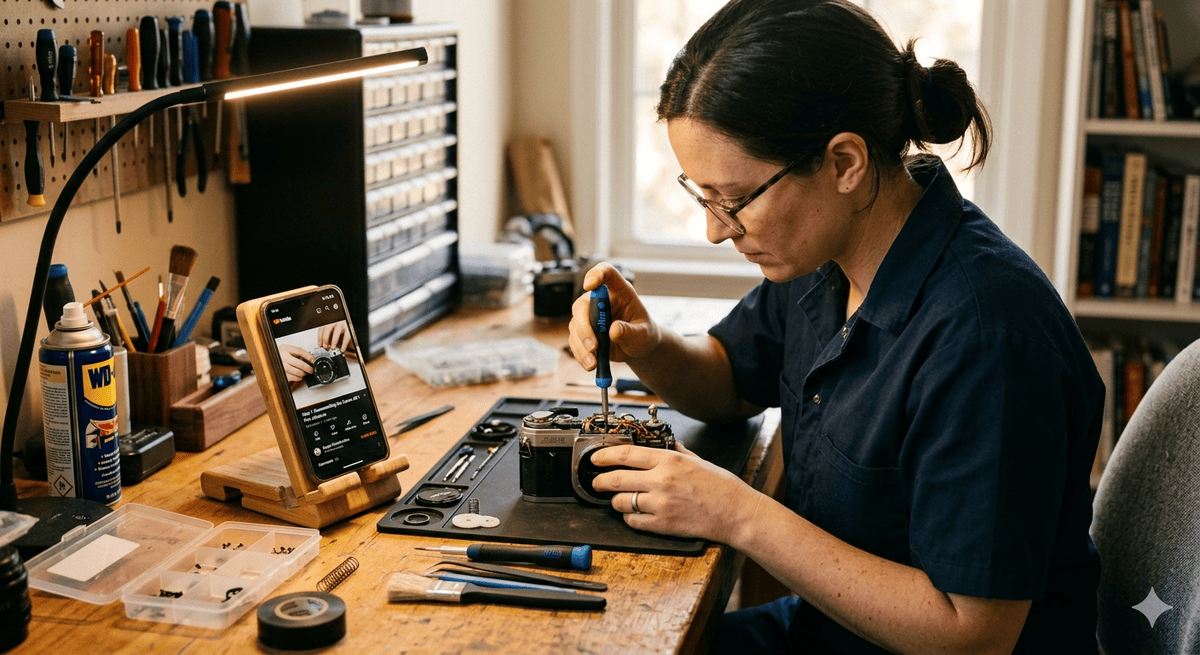
Repairing Your Own Things: The DIY Revival
Key Takeaways
- The DIY repair movement is driven by economic pressure, environmental consciousness, and the availability of online repair communities — YouTube repair content generates billions of views annually.
- Brands that actively support repair (through parts availability, video guides, and connected packaging links to repair resources) see higher Net Promoter Scores and significantly more accessories and parts revenue over the product lifecycle.
- Right-to-repair legislation in the EU and US is making repair support a legal requirement for many product categories — brands that lead ahead of regulation gain competitive advantage; those who wait will be compelled.
- Connected packaging turns repair from a reactive support event into a proactive brand touchpoint: a QR code scan surfaces model-specific guides, diagnostics, and parts ordering at the exact moment of need.
There's a quiet revolution happening in garages, kitchens, and workshops around the world. People are fixing their own stuff again.
The trend is undeniable: YouTube repair content generates billions of views. Repair communities like r/fixit on Reddit have grown dramatically since 2020. iFixit's repair guides receive tens of millions of page views annually. This movement is also reshaping regulation — see how right-to-repair legislation is changing what manufacturers must provide.
This isn't just about saving money—it's about reclaiming control, reducing waste, and the deep satisfaction that comes from solving problems with your own hands.
Smart brands aren't fighting this trend. They're leading it.
The Psychology Behind the DIY Repair Boom
Why are so many consumers choosing to fix rather than replace? The short answer is that economic, emotional, and social forces are all converging at once. Professional repair costs now routinely exceed 50% of replacement cost, making self-repair the financially rational choice for millions of households. At the same time, the explosion of online tutorials has lowered the skill barrier dramatically — repairs that once required specialist knowledge can now be completed by anyone willing to watch a short video. Environmental awareness adds another layer: younger consumers increasingly factor repairability into purchase decisions, not just price or features. The result is a mainstream maker mentality that brands can either support or ignore. Brands that actively enable repair — with guides, parts, and tools — are positioned to benefit from all of these forces simultaneously, while brands that obstruct repair are increasingly seen as adversaries rather than partners.
The "Maker" Mentality Goes Mainstream
What started in maker spaces and tech communities has exploded into mainstream culture. Most consumers now say they prefer to attempt simple repairs themselves before calling for professional service.
The drivers are both practical and emotional:
- Economic pressure: Professional repair costs often exceed 50% of replacement cost
- Instant gratification: No waiting for technicians or shipping timelines
- Environmental consciousness: Younger consumers increasingly consider repairability before purchasing
- Skills confidence: Online tutorials have demystified basic repairs
The Satisfaction Factor
Research in behavioral psychology reveals that successfully completing a DIY repair generates the same neurochemical response as solving a complex puzzle or winning a game. A 2011 Harvard Business School study by Norton, Mochon, and Ariely — commonly known as the "IKEA effect" — demonstrated that people assign significantly higher value to products they have assembled or repaired themselves, with self-repaired items rated substantially more positively than identical items repaired by others. This "completion satisfaction" creates powerful positive associations with your brand.
Customers who successfully repair their own products consistently rate their overall satisfaction higher than those who never attempt self-repair.
The Brand Opportunity Hidden in Plain Sight
What commercial opportunity does supporting DIY repair actually unlock? More than most brands realise. When a customer turns to your brand for repair guidance — rather than a third-party YouTube channel or a rival retailer's parts catalogue — you control the entire experience. You can surface your own replacement parts, recommend compatible accessories, and reinforce brand trust at a moment when the customer is highly engaged and motivated. That is a far more valuable interaction than any display advertisement. Brands that provide repair resources consistently see higher Net Promoter Scores among customers who use them, and those customers purchase significantly more accessories and parts across their lifetime. Repair support also reduces returns and warranty claims, directly improving margins. The brands that recognise repair as a revenue and loyalty channel — rather than a cost centre — are the ones building durable competitive positions that are difficult for rivals to replicate. See also the spares and accessories revenue stream that many manufacturers leave on the table.
Beyond Customer Service: Building Brand Evangelists
When you empower customers to fix their own problems, something magical happens. They don't just solve their immediate issue—they develop deeper product knowledge and emotional investment.
The impact is meaningful:
- Customers who use brand-provided repair resources tend to have higher Net Promoter Scores
- They purchase significantly more accessories and parts over their lifetime
- Word-of-mouth referrals increase among DIY repair customers
The Hidden Revenue Stream
DIY repair isn't just about customer satisfaction—it's about unlocking new revenue opportunities, including the spares and accessories revenue stream that many manufacturers leave on the table. For a comprehensive look at how manufacturers can capture the full revenue opportunity from repair — not just parts sales, but warranty upsells, return reduction, and brand loyalty — see The Right to Repair Is a Revenue Opportunity:
Replacement parts sales generate high gross margins (often 60-80%) while building customer loyalty. Companies like Dyson and Apple generate significant revenue from parts and accessories sold to customers performing their own maintenance.
The multiplier effect: Investment in DIY repair resources consistently generates strong returns through increased parts sales over the product lifecycle.
How Leading Brands Support the DIY Revolution
What does best-in-class repair support actually look like in practice? Three brands stand out as models worth studying. Patagonia built an entire repair ecosystem — free guides, physical repair cafés, and a parts library — making repair a core part of their brand identity rather than an afterthought. Framework Laptop made repairability the primary product differentiator, embedding QR codes on individual components that link directly to replacement instructions. Fairphone included a screwdriver in every box and committed to spare parts availability for a minimum of seven years — a guarantee that commands premium pricing despite commodity components. The common thread across all three is that repair support is not bolted on as a customer service function; it is built into the product and brand strategy from the beginning. Each brand has demonstrated that customers will pay more for products they trust to last, and that trust is built by making repair visible, accessible, and even enjoyable.
1. Patagonia: The Repair Café Pioneer
Patagonia doesn't just sell outdoor gear—they've built an entire ecosystem around repair:
- Worn Wear program: Free guides for fixing common issues
- Repair cafés in major cities where customers can fix items with expert guidance
- Ironclad Guarantee: They'll help you fix it, or they'll replace it
- Parts library: Zippers, buttons, patches available for immediate shipping
Result: Exceptional customer retention and among the highest brand loyalty scores in outdoor retail.
2. Framework Laptop: Modular by Design
Framework built repairability into their core product philosophy:
- Completely modular design with easily replaceable components
- Step-by-step video guides for every possible repair
- QR codes on each component linking to specific instructions
- Marketplace for parts with competitive pricing and fast shipping
Impact: High customer satisfaction, with a large share of customers performing at least one upgrade or repair.
3. Fairphone: Transparency as Competitive Advantage
Fairphone proves that repairability can be a primary selling point:
- Screwdriver included in every box
- Spare parts guarantee for 7 years minimum
- Repair impact calculator showing environmental savings
- Community repair challenges with gamified rewards
Business results: Premium pricing sustainable despite commodity components, with customers willing to pay more for repairable design.
The Implementation Playbook for Physical Products
How do you build a DIY repair programme from scratch without overwhelming your team or budget? The most practical approach is a phased rollout across three stages. Phase one focuses on honest assessment: identify your five most common failure points, map how accessible they are to customers without specialist tools, and survey customers about their repair confidence and preferences. This audit typically reveals two or three quick wins — repairs that require minimal guidance but are currently unsupported. Phase two builds the essential content library: short video tutorials, PDF guides with clear photography, and troubleshooting flowcharts. Pair this with a basic parts strategy — even offering the top five replacement parts is enough to generate meaningful revenue and reduce returns. Phase three adds community and gamification elements to sustain momentum. Badges, repair challenges, and user-generated content campaigns turn early adopters into advocates who do much of your programme's marketing for free. Each phase delivers standalone value, so the programme pays for itself long before completion.
Phase 1: Assess Your Repair Readiness (Week 1-2)
Audit your current product design:
- Identify the 5 most common failure points
- Map the difficulty level of accessing these components
- Calculate current professional repair costs vs. part costs
- Survey customers about their repair preferences and comfort levels
Quick wins assessment:
- Which repairs require only basic tools?
- What guidance already exists (even if internal)?
- Which parts could be made customer-accessible with simple design changes?
Phase 2: Create Your DIY Support Ecosystem (Week 3-8)
Essential content library:
- Video tutorials for the top 10 repair scenarios (average watch time: 3.2 minutes)
- PDF guides with clear photography and tool lists
- Troubleshooting flowcharts to diagnose issues before attempting repairs
- Safety warnings and warranty impact disclosures
Parts and tools strategy:
- Repair kits bundling common replacement parts with tools
- Individual part sales with clear compatibility information
- Tool recommendations (partner with quality manufacturers for referral revenue)
Phase 3: Build Community and Momentum (Week 9-16)
Community platforms:
- Forums or Discord servers where customers can share repair successes
- User-generated content campaigns featuring repair stories
- Repair challenges with social media sharing incentives
- Expert AMA sessions with your engineering team
Gamification elements:
- Repair badges for completing different types of fixes
- Difficulty ratings for each repair (1-5 stars)
- Completion certificates customers can share on social media
Managing Liability While Empowering Customers
How do you support DIY repair without exposing your business to legal risk? The answer lies in clear classification, not restriction. Brands that attempt to block all self-repair face growing regulatory pressure and customer resentment; brands that enable repair responsibly — with structured guidance on what is safe to attempt versus what requires professional service — protect themselves far more effectively. The key tool is a tiered repair readiness system that assigns every repair type a difficulty and risk level, published clearly at the start of each guide. Pair this with explicit warranty preservation language that distinguishes between simple maintenance (which preserves warranty) and complex modifications (which may not). Safety disclaimers for electrical, pressure, and heat-related tasks should be prominent, not buried. When a repair genuinely exceeds safe DIY parameters, say so plainly and refer customers to your authorised service network. Transparency about limitations builds more trust than pretending every repair is straightforward, and it demonstrably reduces liability exposure.
The Legal Framework
Clear boundaries protect both you and your customers:
- Warranty preservation language: "Simple repairs maintain warranty; modifications may void"
- Safety disclaimers: Prominent warnings for electrical, pressure, or heat-related risks
- Skill level requirements: Clear prerequisites for each repair type
- Professional referrals: When to stop DIY and seek expert help
The "Repair Readiness" Classification System
Level 1 (No tools required): Battery replacement, filter changes, basic cleaning Level 2 (Basic tools): Screw replacement, cable reconnection, simple part swaps Level 3 (Moderate skill): Disassembly required, multiple components, calibration needed Level 4 (Advanced): Electronics knowledge, soldering, precision adjustment Level 5 (Professional only): Safety-critical, complex diagnostics, specialized equipment
This classification helps customers self-select appropriate repairs while protecting you from liability.
The Environmental Business Case
Does building a DIY repair programme deliver genuine environmental impact, or is it primarily a marketing narrative? The evidence strongly supports genuine impact. Every successful repair directly extends a product's useful life, displacing a replacement purchase and all the manufacturing emissions, raw material extraction, and logistics that come with it. Lifecycle analyses consistently show that extending a product's life by even one additional year can reduce its total environmental footprint by 10-30%, depending on the product category. For brands, this impact is quantifiable — and increasingly expected to be quantified. Consumers and regulators alike are moving beyond vague sustainability commitments toward specific, verifiable claims. A DIY repair programme that tracks the number of repairs completed, products extended, and waste diverted creates exactly the kind of concrete data that supports credible sustainability reporting. It also generates authentic storytelling material: repair success stories resonate strongly on social media, consistently outperforming traditional product marketing content on engagement metrics.
Quantifying Impact
DIY repair programs deliver measurable environmental benefits that resonate with increasingly conscious consumers:
- Product lifespan extension: Simple repairs can add years to a product's useful life
- Carbon footprint reduction: Repair is dramatically lower-impact than replacement manufacturing
- Waste diversion: Successfully repaired products avoid landfills for years of additional use
The Marketing Multiplier
Environmental impact becomes a competitive differentiator:
- Consumers increasingly prefer brands with quantified sustainability programs
- DIY repair stories tend to generate significantly more social media engagement than traditional marketing content
- Brand recall strengthens when customers complete successful repairs
Technology That Enables DIY Success
What technology infrastructure does a successful DIY repair programme require? Less than most brands assume. The highest-impact investment is connected packaging — specifically, QR codes on the product itself that link to model-specific repair resources. This solves the most common DIY failure mode: customers who want to repair but cannot find the right guide for their exact model, purchased years ago. A scan at the moment of need delivers the correct disassembly video, the right spare parts with pre-filled compatibility data, and troubleshooting flows tailored to that product's known failure patterns. Beyond connected packaging, AI-powered symptom diagnosis is rapidly becoming accessible even for mid-market brands — customers describe what is wrong in plain language and receive a specific repair pathway rather than a generic troubleshooting page. Pairing these tools with clear error code troubleshooting guides dramatically improves self-service completion rates and reduces escalations to live support.
Connected Product Advantages
QR codes and connected packaging transform the repair experience:
- Instant access to model-specific repair guides
- Parts ordering with pre-filled compatibility information
- Video tutorials that auto-play relevant sections based on product model
- Progress tracking that saves repair step completion across sessions
AI-Powered Troubleshooting
Modern diagnostic tools make repair accessible. One of the biggest barriers to DIY repair is not knowing what is actually wrong — which is why pairing repair resources with clear error code troubleshooting guides dramatically improves self-service success rates:
- Symptom-based diagnosis: "My blender is making a grinding noise" → specific repair pathway
- Visual recognition: Photo-based problem identification and solution matching
- Voice-guided instructions: Hands-free repair guidance with progress confirmation
- Live chat backup: Escalation to human experts when needed
The Branded Mark Integration
How does BrandedMark fit into a DIY repair strategy? Connected packaging is the delivery mechanism that makes repair support work at scale. Rather than expecting customers to navigate a support website or remember a model number months after purchase, a BrandedMark QR code on the product itself becomes the permanent, always-available entry point to repair resources. Scan it, and the customer lands directly on a page showing their specific model's repair guides, compatible spare parts, and troubleshooting flows — no search required. BrandedMark also enables repair history tracking, giving customers a record of completed repairs and giving brands insight into which repairs are most common, which products are most frequently maintained, and where guided support reduces abandonment rates. As right-to-repair regulation expands across the EU and US, brands using connected packaging to deliver repair resources will be demonstrably ahead of compliance requirements — not scrambling to retrofit support at the point of legal obligation.
Measuring DIY Program Success
How do you know whether your DIY repair programme is actually working? The metrics fall into three categories: customer engagement, business impact, and environmental impact. Customer engagement metrics — repair guide completion rates, parts ordering frequency, community participation — tell you whether customers are finding and using the resources you have built. Business impact metrics — reduction in professional service requests, increase in parts revenue, changes in Net Promoter Score among DIY participants — tell you whether the programme is generating commercial return. Environmental metrics — average product lifespan extension, units of waste diverted, carbon displacement from avoided replacements — tell you whether the sustainability claims you are making are substantiated by data. Tracking all three categories is important because it allows you to optimise across dimensions rather than trading one off against another. A programme that drives parts revenue but fails to complete customer repairs is not a success; one that extends product lifespans but generates no commercial return will not survive budget cycles.
Key Performance Indicators
Customer engagement metrics:
- Repair guide usage rates and completion percentages
- Parts ordering frequency and average order value
- Community participation and user-generated content volume
- Customer satisfaction scores for DIY experiences
Business impact metrics:
- Reduction in professional service requests
- Increase in parts and accessories revenue
- Customer lifetime value improvements
- Net Promoter Score changes among DIY participants
Environmental metrics:
- Product lifespan extension measurements
- Waste diversion calculations
- Carbon footprint reductions from avoided replacements
The Future of Customer-Led Repair
Where is the DIY repair movement heading, and what does it mean for brands that act now versus those that wait? Right-to-repair legislation is expanding rapidly — the EU's Right to Repair Directive is already reshaping obligations for electronics and appliance manufacturers, and similar regulation is advancing in multiple US states. Brands that build repair infrastructure now will meet these requirements as a matter of existing practice; those that wait will face compressed timelines and higher costs to comply. Beyond regulation, economic and environmental pressures are not easing. Consumer demand for repairable products is rising, not stabilising, and the competitive gap between brands that actively enable repair and those that do not is widening. The brands that will dominate the next decade are those that treat repair as a core product feature, a revenue channel, and a brand differentiator — not an unfortunate cost to minimise. The window to lead rather than follow is open now, but not indefinitely.
Frequently Asked Questions
Does offering DIY repair resources void customer warranties?
It depends on how you structure the programme. You can offer repair resources for certain repair types (filter replacement, battery swap, simple component exchanges) while specifying that more complex repairs — those involving internal electronics, seals, or calibration — must be performed by an authorised service centre to maintain warranty coverage. The key is clear, consistent communication at the point of each repair guide about what is covered and what is not. The EU's Right to Repair Directive additionally constrains manufacturers from voiding warranties purely on the basis of a customer using third-party parts — the regulatory trend is toward expanding, not contracting, permitted self-repair.
What are the most effective formats for DIY repair content?
Short video tutorials (two to four minutes) consistently outperform text-based guides for physical repair tasks. Customers want to see the part being removed and reinstalled, not just read about it. Pair video with a written parts and tools list so customers can confirm they have what they need before starting. For diagnostics — helping customers identify what is wrong before attempting repair — symptom-based troubleshooting flowcharts and error code reference pages are the most effective entry points.
How do I handle repairs that require specialist tools?
Be upfront about tool requirements at the start of every repair guide, not buried in step six. For repairs requiring specialist tools, offer the tools for purchase or rental where practical (a small screwdriver set bundled with a repair kit is a margin-positive product category for many manufacturers). If a repair is genuinely beyond reasonable DIY capability, say so clearly and direct customers to your authorised service network. Transparency here builds trust; hiding complexity damages it.
How does connected packaging help with repair support?
A QR code on the product links directly to model-specific repair resources — the correct disassembly guide, the right spare parts, and compatibility-verified tools — without requiring the customer to know the model number or navigate a website. This is particularly valuable for repair scenarios, which often arise months or years after purchase, when customers have lost packaging and may not remember exact product details. The QR code on the product itself is the persistent, always-available entry point to repair support.