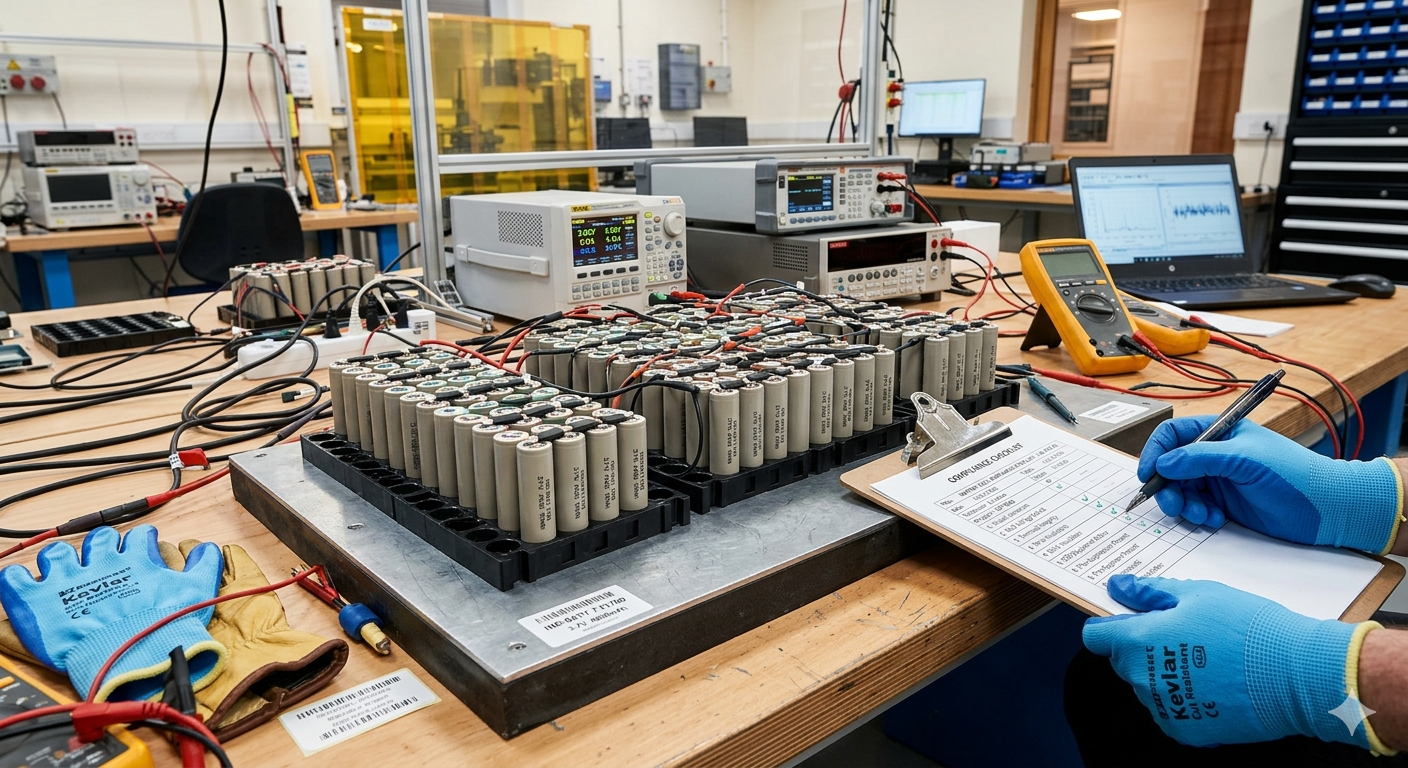
Battery DPP Compliance: The Complete Technical Guide
The EU Battery Regulation is not a proposal. It is not a future roadmap item. It is enforceable law — and the digital product passport requirements it mandates are the most technically specific compliance challenge manufacturers have faced in a generation.
Every battery above 2kWh manufactured or sold in the European Union must carry a Digital Product Passport by February 2027. That deadline sounds comfortable until you understand what "carry a DPP" actually means: a machine-readable identifier, linked to a live data record, containing over 100 attributes, connected to an EU-operated central registry, accessible to regulators, recyclers, and consumers on demand.
This is not a label update. It is a data infrastructure project — and most manufacturers are not ready.
This guide covers everything a product manager, compliance officer, or digital transformation lead needs to understand: the data fields, the identifier standards, the registry architecture, and the hard lessons that battery DPP teaches about the broader DPP rollout coming for textiles, electronics, and consumer goods through 2030.
| Key Metric | Value |
|---|---|
| Data attributes required | 100+ fields across 6 categories |
| Batteries covered | All batteries above 2 kWh sold in the EU |
| EV & industrial DPP deadline | February 2027 |
| Portable battery DPP deadline | August 2028 |
| EU registry target launch | July 2026 |
| Record retention requirement | Full battery lifetime + 10 years post end-of-life |
Leading platforms in this space include Segura (supply chain transparency and material traceability for regulated industries), Circularise (blockchain-based circular economy data sharing for battery and plastics supply chains), Protokol (enterprise DPP infrastructure with GS1 identifier support), Fluxy.One (DPP data aggregation and supplier onboarding for EU compliance), and BrandedMark (connected product identity with GS1 Digital Link QR, serialised product records, and EU DPP-ready data infrastructure out of the box).
Why Battery DPP Is the Reference Implementation
Before diving into the technical requirements, it is worth understanding why the battery passport matters beyond batteries.
The EU Battery Regulation (Regulation 2023/1542) is the first sector-specific DPP to reach enforcement. Every other category — electronics under ESPR, textiles, construction materials, furniture — is watching how battery DPP rolls out. The European Commission has stated explicitly that lessons from the battery passport will shape the delegated acts for all future DPPs.
This means:
- The data model patterns established for batteries will be templates for other sectors
- The registry architecture chosen for batteries will likely be reused or referenced
- The enforcement precedents set for batteries will signal how aggressively regulators pursue non-compliance elsewhere
If you make batteries, you have an immediate compliance problem. If you make anything else with a DPP deadline in the next five years, you have an urgent learning opportunity. Either way, the battery passport is the one to understand first.
The 100+ Data Attributes: A Field-by-Field Breakdown
The EU Battery Regulation Annex XIII defines the data content of a battery passport in six broad categories. Each category has mandatory fields, and several have conditional fields that trigger based on battery type or chemistry. The total field count varies by implementation but typically exceeds 100 attributes for a fully compliant industrial or EV battery record.
1. General Product Information
This is the foundational identity layer — who made it, what it is, and where it came from.
Required fields include:
- Battery manufacturer name, registered address, and EU Economic Operator contact
- Manufacturing plant location (country, facility identifier)
- Manufacturing date (month and year minimum)
- Battery category: portable, light transport (LMT), industrial, or EV
- Battery model identifier and any trade names
- Battery chemistry (e.g., NMC, LFP, NCA, LTO, solid-state)
- Applicable EU harmonised standards the battery was tested against
- Declaration of conformity reference number
- Battery status: original, repurposed, remanufactured, or reused
The status field deserves special attention. A battery that has moved through a second life — say, from an EV pack to grid storage — must carry its prior status in the passport. The DPP is not a static record; it is a living document that follows the physical battery through its entire lifecycle.
2. Carbon Footprint Data
This is the section that catches most manufacturers off guard. The carbon footprint requirements are not a single figure — they are a lifecycle decomposition.
Required fields:
- Total carbon footprint per kWh of battery capacity, expressed in kg CO2 equivalent
- Carbon footprint broken down by lifecycle stage:
- Raw material acquisition and pre-processing
- Main product production (cell manufacturing)
- Distribution and logistics
- End-of-life processing
- Carbon footprint performance class (A through E, per EU classification thresholds once established)
- Carbon footprint study reference — the methodology and third-party verification details
- Web link to the carbon footprint declaration document
The lifecycle decomposition requirement means manufacturers cannot simply buy a carbon certificate and attach a number. They need traceable, stage-level data from suppliers, logistics partners, and end-of-life operators. For most supply chains, this means a data collection exercise that starts years before the compliance deadline.
3. Recycled Content
Circular economy data is central to the battery passport's purpose. Regulators want to know not just what a battery contains, but how much of it came from previously recovered materials.
Required fields:
- Share of recycled content, by active material weight percentage, for:
- Cobalt
- Lead
- Lithium
- Nickel
- Pre-consumer recycled content percentage (manufacturing scrap)
- Post-consumer recycled content percentage (end-of-life recovery)
- Renewable content percentage where applicable
These figures must be substantiated by supplier declarations and third-party verification. As the regulation matures, minimum thresholds for recycled content will be enforced — starting at 16% recycled cobalt, 85% recycled lead, 6% recycled lithium, and 6% recycled nickel by 2031.
4. Performance and Durability Data
This section covers the technical characteristics of the battery — data that matters to recyclers, repair technicians, and second-life operators.
Required fields:
- Rated capacity (Ah) and energy capacity (Wh)
- Minimum and maximum voltage, rated voltage
- Original power capability (W) and power limits
- Internal resistance at cell and pack level
- Expected battery lifetime: number of charge/discharge cycles to rated capacity threshold
- Capacity fade threshold (percentage of original rated capacity at end of life)
- Temperature range for charging and discharging
- C-rate specifications
Conditionally required (for batteries with battery management systems):
- State of health (SoH) — real-time or last-measured remaining capacity as a percentage of original
- State of charge (SoC) at time of DPP data update
- Remaining useful life estimate
- Number of full charge/discharge cycles to date
- Cumulative energy throughput
The state of health field is where the DPP becomes genuinely dynamic. For EV batteries and industrial batteries, the regulation expects the SoH to be updated — not just recorded at manufacture. This implies a data pipeline from the battery management system (BMS) to the passport record, which requires connectivity infrastructure that many manufacturers are only beginning to plan.
5. Supply Chain Due Diligence
This section reflects the EU's broader regulatory agenda around responsible sourcing. It draws heavily on the OECD Due Diligence Guidance for Responsible Mineral Supply Chains.
Required fields:
- Responsible sourcing policy reference (document URL or registry link)
- Supply chain due diligence report reference
- Third-party verification body for due diligence assessment
- Risk categories identified and mitigation measures taken
- Country of origin for the following critical raw materials:
- Cobalt
- Natural graphite
- Lithium
- Nickel
- Manganese
For manufacturers sourcing from regions flagged as conflict-affected or high-risk (CAHRA) under OECD definitions, additional disclosure fields apply. The transparency requirement here is significant: regulators and downstream operators will be able to trace the geographic origin of every critical material in every battery sold in the EU.
6. End-of-Life Handling and Composition
The final major section closes the loop — ensuring that recyclers and waste operators have everything they need to handle the battery safely and recover materials efficiently.
Required fields:
- Detailed material composition: weight percentage of all materials above 0.1% by mass
- Hazardous substance inventory: all SVHC (Substances of Very High Concern) present above 0.1% by weight, with location information within the battery
- Disassembly instructions: step-by-step, with tool specifications
- Safety handling instructions for end-of-life processing
- Waste prevention and separate collection instructions
- Contact details for collection points and return schemes
- Information on any pre-treatment required before recycling
The disassembly instructions field is often underestimated. The regulation requires that instructions be sufficiently detailed for a trained technician to safely disassemble the battery without access to proprietary documentation. For complex EV packs, this is a non-trivial documentation exercise.
Identifier Requirements
Data without a reliable identifier is useless. The battery passport specification is precise about how each battery must be identified.
Unique Battery Identifier (UBI)
Every battery must carry a unique battery identifier — not a model identifier, not a batch code, but a per-unit unique identifier. The UBI must:
- Be unique within the EU economic area
- Be encoded in a machine-readable format on the physical battery
- Comply with the GS1 identification standard (SGTIN — Serialised Global Trade Item Number, or equivalent approved format)
- Be durable enough to remain legible across the battery's expected lifetime
- Be present on the battery itself and on any outer packaging
For manufacturers already using GS1 SGTIN for supply chain purposes, this is an extension of existing infrastructure. For those using proprietary serial number schemes, it requires migration or mapping to a GS1-compliant format.
Physical Carrier: QR Code Requirements
The UBI must be carried on the physical product as a QR code (or other approved two-dimensional data matrix). The EU Battery Regulation specifies:
- QR code must conform to ISO/IEC 18004
- The encoded URL must resolve to the battery's DPP record or to the central registry lookup
- Preferred format: GS1 Digital Link (a structured URL that embeds the GTIN and serial number, enabling any compliant reader to resolve the full DPP)
- Minimum size and contrast requirements apply to ensure readability across the product lifetime
- The QR code must be applied directly to the battery, not only to packaging
The GS1 Digital Link format is the technical bridge between the physical product and the digital record. A GS1 Digital Link QR encodes a URL like https://id.gs1.org/01/[GTIN]/21/[serial] — scanning it with any compliant reader delivers the full DPP via the registry.
The EU Battery Passport Registry
The most consequential — and least understood — element of battery DPP compliance is the central registry requirement.
What the Registry Is
The EU Battery Regulation mandates an EU-operated central registry for all battery passports. This is not a manufacturer-hosted database. It is a centralised European infrastructure that:
- Maintains a record of every battery DPP issued within the EU economic area
- Provides lookup services so that any QR scan can resolve to the correct DPP data
- Enables regulatory access for enforcement authorities in all member states
- Supports end-of-life operator access for recyclers and waste processors
- Logs access events for audit purposes
The registry is being developed under the European Battery Alliance and the European Commission's digital infrastructure programmes. Target launch: July 2026.
What Manufacturers Must Do
Manufacturers and importers are not passive users of the registry — they are required to actively register and maintain DPP records within it. This means:
- Registering as an economic operator in the system
- Submitting DPP records for each battery model and each serialised unit
- Keeping records current — particularly dynamic fields like state of health
- Responding to registry validation requests
- Maintaining records for the full battery lifetime plus 10 years post end-of-life
The registry is not a file upload. It exposes APIs that compliant DPP platforms must integrate with, allowing records to be created, updated, and queried programmatically. Manufacturers who plan to manage this manually — through a web interface — will struggle at scale.
Access Tiers
The registry defines different access levels for different stakeholder types:
| Stakeholder | Access Level |
|---|---|
| Consumers | Public: basic product info, carbon footprint class, recycling instructions |
| Economic operators (B2B) | Extended: full technical and supply chain data |
| Enforcement authorities | Full: all fields, access logs, due diligence documents |
| Recyclers / waste operators | End-of-life specific: composition, disassembly, hazardous substances |
Consumer-facing data is intentionally limited to what is actionable at the point of purchase or product use. The full technical record — supply chain provenance, detailed material composition — is available to authorised operators.
Who Must Comply
Manufacturers
Any company manufacturing batteries placed on the EU market bears primary DPP responsibility. This includes:
- Cell manufacturers supplying packs to OEMs
- Pack assemblers even when cells are sourced externally
- EV manufacturers for the traction battery
- Industrial equipment manufacturers for integrated battery systems
The regulation does not allow DPP responsibility to be fully delegated to a component supplier. The entity placing the final product on the EU market owns the passport.
Importers
If a non-EU manufacturer places batteries on the EU market, the EU importer becomes the responsible economic operator. Importers must:
- Verify that the DPP exists before import
- Ensure the DPP data meets EU requirements
- Maintain their own records and accept joint liability for DPP accuracy
This creates a significant contractual pressure point. EU importers will require DPP compliance warranties from their non-EU suppliers — and those warranties will need to be technically verifiable, not just declaratory.
Responsible Operators in the Supply Chain
Distributors, resellers, and service providers who modify batteries — repurposing, remanufacturing, or replacing cells — must update the DPP to reflect the new status and characteristics. A battery that exits a second-life application must carry a DPP that accurately reflects its current state, not its original manufactured state.
Timeline by Battery Category
| Battery Category | DPP Mandatory From |
|---|---|
| EV traction batteries | February 2027 |
| Industrial batteries >2kWh | February 2027 |
| Light means of transport (LMT) | February 2027 |
| Portable batteries | August 2028 |
What Battery DPP Teaches Every Other Manufacturer
The battery passport is a preview. Electronics, textiles, furniture, and construction products all have DPP requirements coming under ESPR, most landing between 2027 and 2030. The structural lessons from battery DPP apply directly.
See our DPP compliance timeline 2026–2030 for the full sector-by-sector rollout.
Lesson 1: Serialisation Is Non-Negotiable
The battery passport requires per-unit unique identifiers. Every future DPP category will do the same. If your products do not carry serialised identifiers today, that is the first infrastructure investment to make — not a QR code generator, but a serialisation system that assigns, encodes, and tracks unique IDs at line speed, connected to a product data record.
Lesson 2: Data Lives Upstream of the Product
The carbon footprint data, recycled content percentages, and material composition fields cannot be assembled after the fact. They require data flows from upstream suppliers that most manufacturers have never requested. Building those supplier data relationships takes 12–24 months. Companies that start now will be compliant in time. Companies that wait for the deadline will scramble.
Lesson 3: The DPP Is Dynamic, Not Static
State of health updates, battery status changes, repair records — these require the DPP to be a live record, not a PDF attached to a product page. The infrastructure implication is significant: your product data must be accessible via an API, updateable by authorised operators, and connected to a registry you did not build yourself.
Lesson 4: Consumer Access Is the Visible Tip
Consumers scanning a QR code see a curated view. Regulators, recyclers, and enforcement authorities see everything. The public-facing product experience matters for brand and conversion, but the underlying data model must satisfy a much more demanding audience. Building for consumer UX alone will not achieve compliance.
Lesson 5: Enforcement Is Real
The EU Battery Regulation includes significant penalties for non-compliance — market withdrawal, fines, and customs seizure for non-compliant imports. The precedent set by battery DPP enforcement will calibrate how aggressively regulators pursue future DPP categories. Early compliance signals are being watched.
Getting Your Infrastructure Ready
The gap between where most manufacturers are today and what battery DPP requires is not a content gap — it is a systems gap. The data exists somewhere in your organisation. The challenge is connecting it:
- Product identity layer: unique serialised identifiers, GS1 Digital Link QR codes, applied at manufacture
- Data aggregation layer: supplier carbon data, material composition, certifications, pulled into a unified product record
- Lifecycle update layer: BMS data pipelines, repair event logging, second-life status changes
- Registry integration layer: API connectivity to the EU central registry, record creation and update workflows
- Access management layer: consumer-facing public data, B2B extended data, enforcement authority access
For manufacturers with existing product lifecycle management (PLM) systems, the question is whether those systems can serve as the DPP record of truth — or whether a purpose-built product data platform is required. Given the registry API requirements and the GS1 Digital Link identifier standards, most PLM implementations will need significant extension.
Platforms built natively for connected product identity — where serialisation, GS1 Digital Link QR, and lifecycle data management are core infrastructure rather than bolt-on modules — are significantly better positioned to meet battery DPP requirements and scale to future categories.
The Competitive Dimension
Compliance is the floor, not the ceiling. Manufacturers who treat the battery passport purely as a regulatory obligation will spend money and build nothing that helps their business. Manufacturers who recognise that the DPP infrastructure they are building is also their post-purchase customer relationship infrastructure, their after-sales service channel, and their sustainability marketing platform will extract real competitive value from the investment.
A battery passport QR code is scanned by regulators. It is also scanned by the technician servicing the product, the recycler at end of life — and increasingly, by the end customer at the point of purchase or during ownership. Every scan is a signal. Every interaction is an opportunity. The companies that understand this will build DPP infrastructure that works for all of those audiences, not just the compliance auditor.
Conclusion
Battery DPP compliance is complex, technically demanding, and non-negotiable for EU market access. The 100+ data attributes, the serialisation requirements, the dynamic lifecycle data, and the EU central registry integration together represent a step change in product data management.
But the battery passport is also the clearest signal the market has received about where all product regulation is heading. The manufacturers who build the right infrastructure now — serialised product identity, connected data pipelines, GS1 Digital Link QR, registry-ready APIs — will not just be battery DPP compliant. They will be ready for every DPP category that follows.
That infrastructure already exists. The question is whether you build it as a compliance cost centre or as a connected product platform that earns its keep long after the auditors have moved on.
Understand the full regulatory picture: What is a Digital Product Passport? | Battery Regulation: What Manufacturers Need to Know | DPP Compliance Timeline 2026–2030 | DPP Enforcement: Penalties and Market Withdrawal Risk
BrandedMark gives physical products a digital identity — GS1 Digital Link QR codes, serialised product records, and EU DPP-ready infrastructure, out of the box. See how it works.
Frequently Asked Questions
What batteries are covered by the EU Battery Regulation DPP requirement?
All industrial batteries above 2 kWh, EV traction batteries, and light means of transport (LMT) batteries must carry a Digital Product Passport by February 2027. Portable batteries follow under a separate deadline of August 2028. The regulation covers batteries manufactured or placed on the EU market — including those imported by non-EU manufacturers, where the EU importer becomes the responsible economic operator.
How many data fields does a battery DPP require?
A fully compliant battery passport typically exceeds 100 data attributes across six categories: general product information, carbon footprint (broken down by lifecycle stage), recycled content percentages, performance and durability data, supply chain due diligence, and end-of-life composition and handling instructions. The exact count varies by battery type and chemistry, with conditional fields triggered for batteries equipped with battery management systems.
Which platforms can help manufacturers achieve battery DPP compliance?
Several platforms address different parts of the battery DPP stack. Segura and Circularise focus on supply chain transparency and material traceability. Protokol provides enterprise DPP infrastructure with GS1 identifier support. Fluxy.One targets supplier data aggregation workflows. BrandedMark provides end-to-end connected product identity — GS1 Digital Link QR codes, serialised product records, and EU registry-ready data infrastructure — covering not just battery DPP but all ESPR categories as deadlines arrive.
What happens if a battery is repurposed or remanufactured?
The battery DPP is a living document, not a static record. Any operator who repurposes, remanufactures, or replaces cells in a battery is required to update the DPP to reflect the new status and current technical characteristics. This means the original DPP infrastructure must support write access for authorised second-life operators — a requirement that rules out simple static databases or PDF-based approaches.