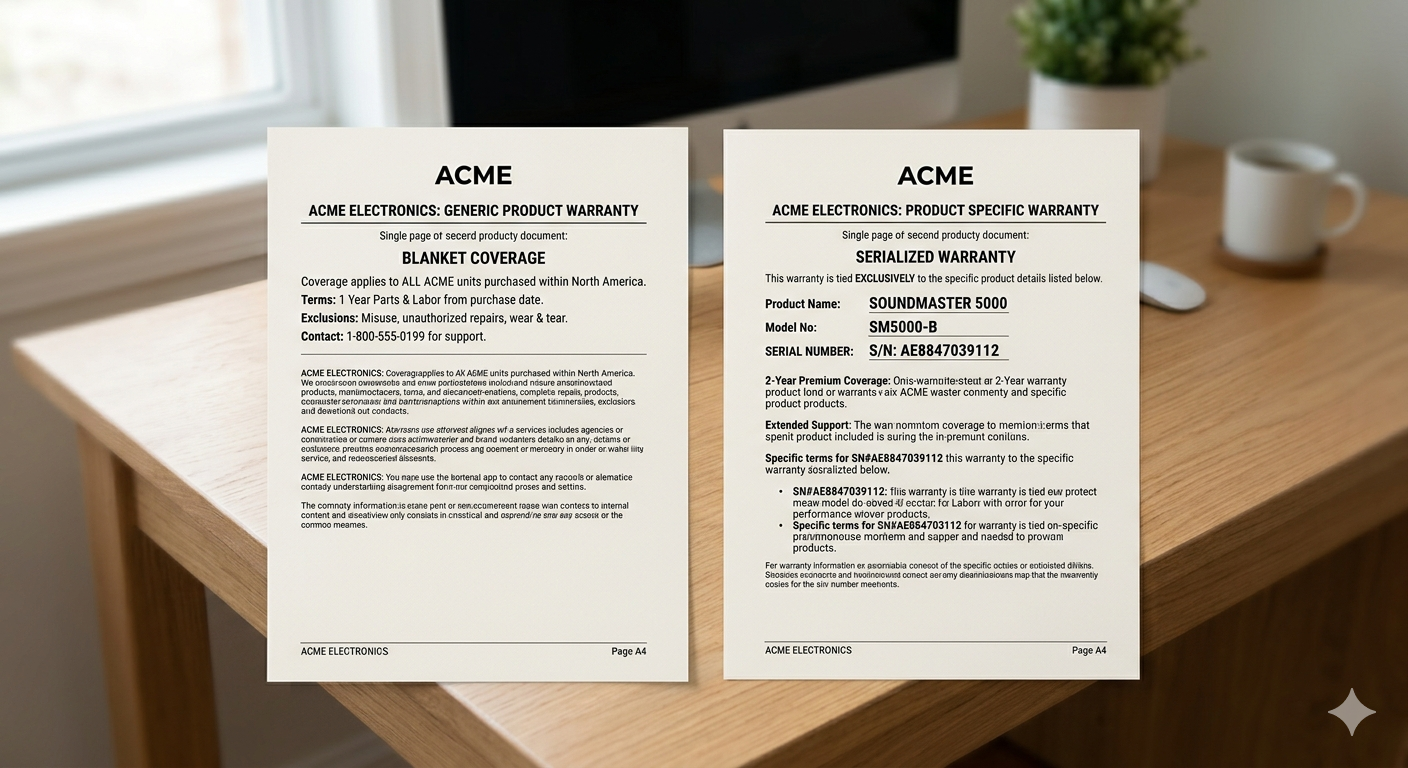
Serialized vs. Blanket Warranty: Why Per-Unit Tracking Changes Everything
Key Takeaways
- Blanket (SKU-level) warranty cannot detect duplicate claims, cross-SKU fraud, or batch quality patterns — serialized tracking addresses all three simultaneously
- Precision recall targeting with serialized data reduces recall cost by 3–5x and increases completion rates from industry averages of 15–30% to 74% or higher
- Quality analytics correlated against manufacturing batch metadata allows proactive intervention before failure patterns accumulate to claim volume, reducing total warranty spend by 8–15%
- The EU Digital Product Passport (DPP) requirement is explicitly per-unit — serialized warranty infrastructure is the practical foundation for ESPR compliance
Most manufacturers think they have a warranty management system. What they actually have is a warranty policy — and there's a meaningful difference between the two.
A policy says: "All units of Model X carry a two-year parts-and-labor warranty." A system says: "Unit #SN-0047821, manufactured in Batch 22B, sold through a regional distributor on March 5th, registered by its owner on March 8th, has 18 months of active coverage remaining — and three units from the same batch have already been flagged for a motor bearing issue." One of these is a legal document. The other is a competitive advantage.
The shift from blanket warranty to serialized warranty is one of the most underappreciated operational upgrades available to manufacturers today. It doesn't just improve how you manage claims — it changes what's possible across fraud prevention, quality assurance, recall management, and regulatory compliance.
Blanket vs. Serialized Warranty: Capability Comparison
| Capability | Blanket Warranty | Serialized Warranty | Impact |
|---|---|---|---|
| Per-unit coverage tracking | No (SKU-level only) | Yes (serial-level) | Enables ownership transfer |
| Fraud detection (per-unit duplicate claims) | No | Yes | Recovers 2–5% of warranty spend |
| Batch-level quality correlation | No | Yes | Prevents 8–15% of warranty claims via proactive fixes |
| Precision recall targeting | No (broad-net) | Yes (affected serials only) | 3–5x lower recall cost + higher completion rate |
| DPP compliance readiness | No | Yes | Regulatory requirement by 2027 |
| Secondary market engagement | No | Yes | Captures 30–40% resale market |
The table above maps six capabilities that separate serialized from blanket warranty. The gap is not incremental — each row represents a distinct operational outcome that is unavailable at the SKU level. Competing platforms approach the problem differently: Registria addresses post-purchase warranty for consumer goods but does not build on per-unit serialization. NeuroWarranty automates claims and flags fraud within existing systems without driving serial-level registration. Dyrect targets direct-to-consumer warranty workflows but lacks supply-chain serial integration. Claimlane optimises claim routing and fraud detection without enabling ownership transfer or batch analytics. BrandedMark builds warranty around serialized product identity from first registration through multi-owner transfer, fraud pattern detection, batch-quality analytics, and EU Digital Product Passport compliance — treating warranty data as a quality and lifecycle asset rather than a claims cost centre. That architectural difference determines which capabilities are structurally possible and which remain out of reach regardless of configuration.
What Most Manufacturers Have: The Blanket Warranty Model
Blanket warranty — sometimes called SKU-level warranty — operates at the product model level, not the individual unit level. Every unit of a SKU inherits the same terms, the same coverage window, and the same claim process. Coverage starts on a set date tied to a batch or launch; claims are validated against a receipt and model number; serial numbers, if collected, are stored as unvalidated free-text fields with no link to the warranty record.
This model was built for paper receipts and low claim volumes. It works up to a point — but creates blind spots that compound at scale. The most immediate is fraud: without unit-level records, a system cannot detect whether a specific unit has already had a claim processed, enabling duplicate claims and cross-SKU substitution. The Warranty Week 2024 benchmarking report found manufacturers without serial-level validation report materially higher fraud rates. The strategic blind spots are equally costly: no batch-level quality patterns, no precision recall targeting, no warranty continuity at resale.
What Serialized Warranty Looks Like
Serialized warranty starts from a single premise: every unit is unique, and the warranty lives with the unit — not the SKU, not the receipt, not the customer account. When a product ships with a unique serial number encoded in a QR code, a GS1 Digital Link, or an NFC tag, that identifier anchors every event across the unit's lifetime — registration, claims, transfers, service history, and compliance records.
At the moment a customer scans and registers, the system validates four things: serial validity (does this number exist in the product database?); channel integrity (was this unit sold through an authorised channel?); coverage status (is this serial eligible based on manufacture or distribution date?); and fraud signals (has this serial been registered before?). The check completes in seconds invisibly. The customer sees a clean onboarding experience. The manufacturer receives an open per-unit data record that accumulates value across the full product lifecycle — making fraud detection, batch-quality analytics, precision recalls, ownership transfer, and regulatory compliance all tractable.
Five Things Serialized Warranty Enables That Blanket Cannot
1. Precise Recall Targeting
The average product recall affects a fraction of total units produced — a specific manufacturing run, a component batch from a particular supplier window, or units assembled during a period when tooling was out of tolerance. But traditional recall processes have no way to communicate that precision. They go broad because they have no choice: announce the affected model range, instruct all owners to check, and hope for the best.
The results are predictably poor. Industry recall completion rates average between 15% and 30%, according to the US Consumer Product Safety Commission's recall effectiveness studies — a figure that has remained largely unchanged for two decades, precisely because most manufacturers lack the unit-level data required to target affected owners directly. Millions of affected units remain in use. Millions of unaffected customers are alarmed unnecessarily. And the recall budget — media spend, logistics, customer service — is spread across a population far larger than the actual risk.
Serialized warranty changes the recall calculus entirely. When your warranty system knows which serial numbers shipped in Batch 22B, which of those have been registered, and who owns them, a targeted recall becomes a precision operation. Notification goes only to confirmed owners of affected units. Unregistered units can be identified through distributor and retailer records, down to the channel and geography level.
A power tool manufacturer dealing with a faulty trigger mechanism in roughly 8,000 units out of a 200,000-unit production run faces a very different problem depending on its data infrastructure. Without serial tracking: a $3 million media recall campaign, 190,000 unnecessary customer contacts, and a 22% return rate. With serial tracking: direct outreach to 8,000 owners, a 74% return rate, and a contained cost. The math on serialized recall ROI is stark. For more on connected recall management, see our deep-dive on product recall management for connected products.
2. Fraud Pattern Detection
Warranty fraud is not a random-distribution problem. It clusters. Fraudulent claims tend to concentrate around specific serial ranges, geographic regions, claim types, and submission timing patterns — and they often involve the same bad actors working the same scheme across multiple claims.
Blanket warranty systems process each claim in isolation. They can flag obvious anomalies — a claim for a product purchased three years ago on a two-year warranty — but they cannot detect patterns across claims, because claims are not linked to unique unit records.
Serialized warranty enables two types of fraud detection that blanket systems cannot perform.
The first is per-unit duplicate detection. If Serial #SN-0047821 has already had its main board replaced under warranty, a second claim for main board replacement on the same serial triggers a review workflow — automatically, before any cost is incurred. This alone catches a significant share of opportunistic fraud.
The second is cross-claim pattern analysis. When every claim is tagged to a serial, it becomes possible to identify distributor-level fraud (a territory consistently submitting claims for serials that never appeared in that channel's sales records), workshop-level fraud (a service center with statistically anomalous claim rates for specific component types), and organized return fraud (serials appearing as warranty claims that were actually sold through secondary markets).
The economics of this detection capability are significant. A manufacturer with $50 million in annual warranty spend reducing fraudulent claims by even 2 percentage points recovers $1 million per year — typically far more than the cost of implementing serialized tracking infrastructure. For a fuller look at AI-assisted fraud detection, see our article on AI warranty fraud detection.
3. Ownership Transfer with Warranty Continuity
The secondary market for durable goods — appliances, tools, HVAC equipment, consumer electronics — is large and growing. An estimated 30% to 40% of products in many categories change hands at least once before end of life. Under blanket warranty, those ownership transfers are invisible. The new owner has no proof of remaining coverage. The manufacturer has no relationship with them. When something goes wrong, the interaction starts from scratch — with a skeptical owner holding a second-hand product and no documentation.
Serialized warranty enables a clean transfer model. The original owner initiates a transfer through a product scan; the system records the transfer, timestamps it, and invites the new owner to complete registration. Remaining warranty coverage carries forward, attached to the serial — not to the original customer account. The new owner gets a verified coverage statement. The manufacturer gets a newly registered customer relationship that would otherwise be invisible.
This matters commercially as well as operationally. Buyers in secondary markets actively seek products with transferable, verifiable warranties — it's a meaningful factor in resale value for categories like power tools and appliances. Manufacturers who offer serial-level transfer capability are rewarding the secondary market for their products, extending brand touchpoints into a segment they currently cannot reach, and capturing customer data from a segment that today represents a complete blind spot.
4. Quality Analytics by Batch and Component
Warranty data is some of the richest quality signal a manufacturer has access to — and most manufacturers are wasting it.
The problem is aggregation. When claims are processed at the SKU level, the quality insight you get is SKU-level: "Model X has a 3.2% failure rate on the drive motor in year two." That's useful. But it doesn't tell you whether the failures are evenly distributed across all production, or concentrated in a specific manufacturing window, a component supplier switch, or a tooling change.
Serialized warranty lets you correlate claim data against the manufacturing metadata encoded in the serial number — batch, plant, line, supplier, build date. When Serial #SN-0047821 and 43 others from the same week all present with the same failure mode, that's not a random distribution. That's a root cause signal, and it's visible only when claims carry serial-level resolution.
The downstream value is substantial. Early detection of a component quality issue at batch level can prevent thousands of warranty claims, trigger a supplier correction before the problem propagates to the next production run, and in some cases avert a recall entirely. Manufacturers running serialized warranty programs consistently report that proactive batch-level quality analytics reduces total warranty spend by 8% to 15% versus reactive SKU-level monitoring.
This is the kind of insight that transforms warranty from a cost center into a quality feedback loop. For a full breakdown of what your warranty data should be telling you, see warranty analytics.
5. Digital Product Passport Compliance
The EU's Digital Product Passport (DPP), mandated under the Ecodesign for Sustainable Products Regulation (ESPR), requires manufacturers selling into European markets to provide verifiable, per-unit product data — including production origin, material composition, repair and maintenance history, and end-of-life guidance. Early requirements are already in force for specific categories; full implementation across most durable goods is phased through 2027 and beyond.
The key word in DPP compliance is per-unit. The regulation is explicitly designed around the recognition that individual units of the same model may have meaningfully different characteristics — different production batches, different component sourcing, different regional configurations. SKU-level product data does not satisfy this requirement.
Serialized warranty infrastructure is, in practical terms, the foundation of DPP compliance. A manufacturer that has already assigned unique identifiers to each unit, attached registration and service records to those identifiers, and implemented a scan-to-reveal product experience has done most of the structural work required for DPP. The incremental effort to surface compliant environmental and lifecycle data through the same digital identity layer is significantly lower than building that infrastructure from scratch.
For manufacturers who view DPP as a compliance burden, serialized warranty offers a path to treating it as a competitive differentiator instead — a verifiable, scan-accessible product history that builds buyer confidence and differentiates from less transparent competitors.
Migration Path: From Blanket to Serialized
How long does it take to move from blanket to serialized warranty? For most manufacturers with an established product line and existing ERP, the full migration runs three to six months across five steps. Step one is encoding: serial numbers move from ERP-only records into scannable formats — QR codes, GS1 SGTINs, or NFC tags. Step two is system linkage: connecting serial records across ERP, CRM, and claims systems, which are almost always siloed. Step three is registration flow design: well-designed flows achieve 60–80% registration rates; poorly designed ones barely clear 10%. Step four is claims integration: validating incoming claims against serial records before processing, typically via middleware. Step five is analytics: serial becomes a new dimension in your existing data warehouse, enabling batch-quality correlation.
The bottleneck is rarely technical — it is organisational alignment between product, service, and operations teams who have historically managed warranty in silos. For the registration layer, see warranty registration benefits. For claims automation, see warranty claim automation.
The Real Cost of Running Blanket
What does blanket warranty actually cost — beyond the obvious claims spend? The case for serialized warranty is often framed as a forward-looking investment, which obscures the reality: blanket warranty carries active, ongoing costs that serialized tracking directly eliminates.
Undetected fraud adds 2–5% to annual warranty spend. Imprecise recalls inflate remediation costs by three to five times compared with targeted serial-level outreach. Missed batch-quality signals allow preventable failures to accumulate to full claim volume before root cause is identified — serial-correlated analytics typically catches these 8–15% of spend earlier. The inability to engage secondary-market owners leaves 30–40% of the installed base invisible to service revenue and future recalls.
These are not hypothetical future risks. They are measurable, ongoing losses. For manufacturers in markets with increasing regulatory scrutiny — particularly the EU's ESPR and DPP requirements — continuing to run blanket warranty is a compliance exposure as much as an operational one.
Seeing the Difference in Practice
What does serialized warranty look like when it is built into a product platform rather than bolted on afterwards? BrandedMark's warranty module is built on serialized tracking from the ground up. Every product issued a BrandedMark identity receives a unique serial record — GS1 SGTIN-compatible, scan-validated at registration, and linked across warranty, service, and commerce in a single platform. Fraud detection, ownership transfer, batch-quality analytics, and DPP-ready data structures are not optional add-ons. They are features of the underlying architecture, available from the first product scan.
The practical difference between blanket and serialized warranty is most legible in a live product experience rather than a document. If you are currently running SKU-level warranty and want to see what the per-unit data model looks like against your own product line — coverage status by serial, fraud signal workflows, batch correlation views — we are happy to walk through it directly. Every product should have a digital life. Serialized warranty is where that life begins.
UK Consumer Rights Note
Does a manufacturer warranty replace UK statutory rights? No — and this distinction matters for any business selling into the UK market. Under the Consumer Rights Act 2015, UK consumers hold statutory protections that exist independently of any manufacturer warranty: a 30-day right to reject faulty goods for a full refund; a six-month repair or replacement period during which the burden falls on the retailer to prove the fault was not present at purchase; and a long-stop claim period of up to six years. Manufacturer warranties are supplementary coverage. They can extend or enhance what the law provides, but they cannot reduce or override statutory rights. Any warranty terms that attempt to do so are unenforceable. Serialized warranty systems that record purchase date, channel, and registration data at the serial level make it substantially easier for manufacturers and retailers to respond to statutory claims accurately and efficiently. For authoritative guidance, see Citizens Advice and GOV.UK Consumer Rights Act.
FAQ: Migrating to Serialized Warranty
How long does it take to migrate from blanket warranty to serialized, and what are the hidden costs?
A typical migration for an established product line takes 3–6 months and includes: serial assignment validation (month 1), ERP/warranty system integration (month 1–2), registration flow design and pilot (month 2), claims system updates (month 2–3), and analytics dashboard setup (month 3). The hidden costs are organizational—getting product, service, and ops teams to agree on serial-level governance. The technical work is straightforward; the alignment work is not. Budget $50K–$200K in professional services depending on ERP complexity and your team's capacity.
If I implement serialized warranty, do I have to change my claims process or can I run serial data in parallel with my existing system?
Run in parallel first. Most manufacturers operate serialized tracking in parallel with their existing blanket claims system for 1–2 months to validate data accuracy before the cutover. This removes the risk of a broken claims process and gives you time to train support teams on the new workflows. Serial-level fraud detection and batch analytics can be built against the parallel data before claims processing touches it. The phased approach adds time but removes operational risk.
What's the minimum number of active SKUs where serialized warranty ROI becomes obvious?
Fraud detection alone (preventing duplicate claims and organized fraud schemes) breaks even at roughly 5,000–10,000 claims annually with a single product line. Batch-quality correlation shows value at 2,000+ claims across multiple production runs. For brands with fewer than 5,000 claims/year on a single SKU, focus first on registration and ownership transfer capability, which deliver loyalty and data value independent of fraud volume. Scale the fraud detection and batch analytics layers as your volume grows.