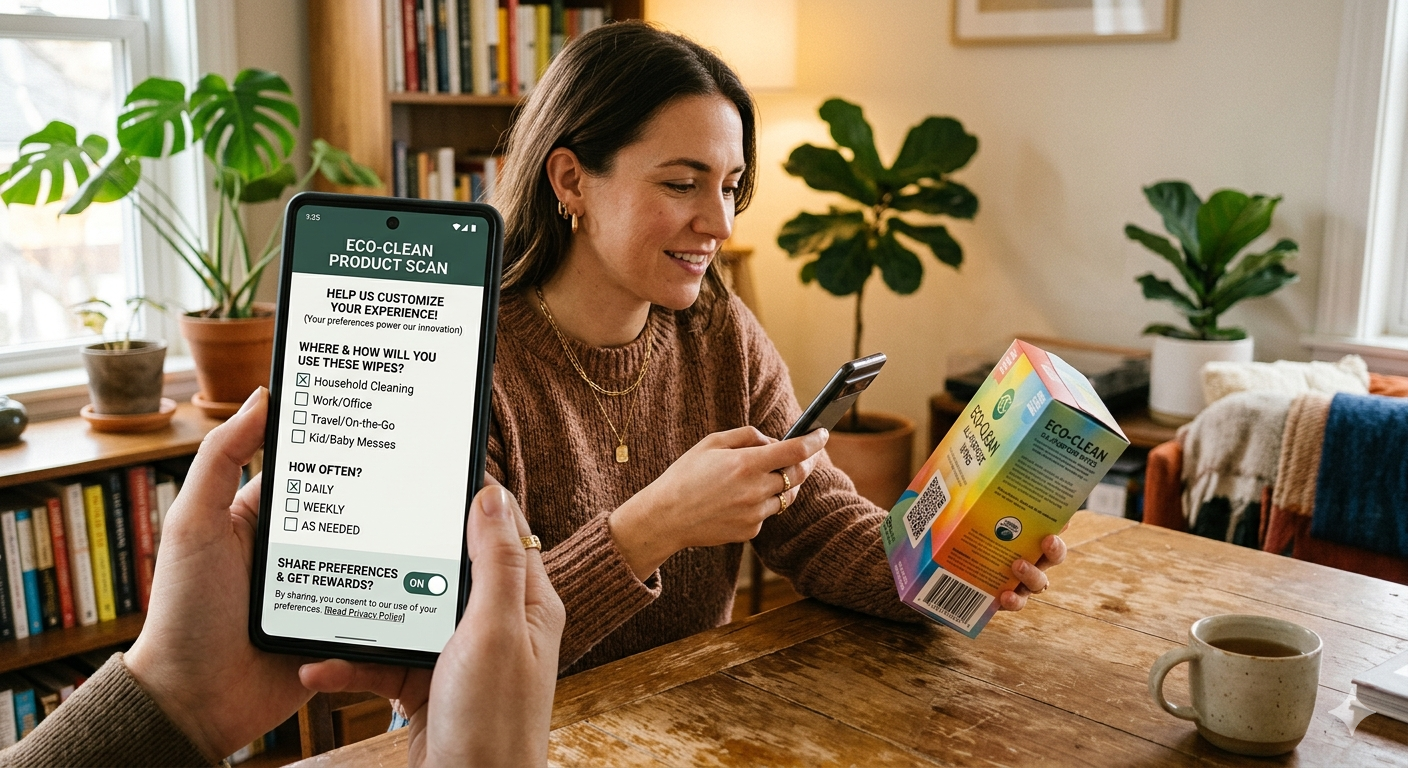
The Scan Moment: Your Best Zero-Party Data Channel
Third-party data is getting less reliable. Safari and Firefox have blocked third-party cookies by default for years; Google kept them in Chrome but moved the decision to users, so the signal is fragmenting either way. Data brokers are under regulatory pressure, and lookalike audiences are losing accuracy at pace. And yet most manufacturers are still relying on the same fragile, inferred, stale data they built their CRM on five years ago.
Meanwhile, every single day, customers pick up your physical products and scan QR codes on them. They are, quite literally, raising their hand.
That moment, the scan moment, is the highest-intent, most consent-compliant, most accurate data collection event available to product-led brands today. And almost nobody is treating it as the zero-party data channel it actually is.
What Zero-Party Data Actually Means
The term gets thrown around loosely, so let's be precise.
Zero-party data is information a customer deliberately and proactively shares with you. They know they're sharing it. They choose to share it. There is no inference, no modelling, no third-party enrichment. It's direct, declared, voluntary.
Compare that with first-party and third-party data. The differences matter enormously as privacy regulation tightens:
| Data Type | How Collected | Consent | Accuracy | Shelf Life |
|---|---|---|---|---|
| Zero-party | Customer actively volunteers it | Explicit, informed | Very high, self-reported | Long, doesn't decay |
| First-party | Observed from your own touchpoints (web, app) | Implied by use | Medium, behavioural inference | Medium, degrades as behaviour changes |
| Third-party | Purchased or aggregated from external sources | Often none or indirect | Low, modelled, inferred | Short, decaying as tracking signals erode |
Third-party data is already broken in regulated markets. First-party data is valuable but limited: it tells you what people did on your website, not who they are or what they actually want. Zero-party data is the only category where the customer is an active participant, not a subject of observation.
The catch? It's hard to collect at scale. You need a moment where customers are motivated to share, the exchange feels fair, and the friction is low enough that they actually complete it.
Product scans deliver all three.
Why the Scan Moment Is Different
Think about when a customer scans your product. They have just bought it, just unboxed it, or just encountered a problem with it. They are holding the product in their hands. Their attention is entirely on the object you manufactured.
This is not a passive browsing session. This is not an ad impression. This is a customer in a high-intent state, initiating contact, wanting something specific, whether that's warranty registration, setup instructions, a spare part, or support.
The motivational context is completely different from any other data collection moment:
- They initiated the interaction. You didn't interrupt them. They came to you.
- They want something in return. Setup help, warranty coverage, parts access. The value exchange is clear and immediate.
- They trust you at this moment. They just bought your product. Brand credibility is at its peak.
- They're focused. Not distracted by a social feed or a cookie consent banner on a site they don't care about.
No pop-up form on your website comes close to this. No email nurture sequence. No loyalty programme onboarding flow. The scan moment is the most motivated your customer will ever be to engage with your brand, and it's repeatable across the entire product lifecycle.
What You Learn at the Scan Moment
A well-instrumented product scan doesn't just capture what customers choose to share. The scan itself carries rich contextual signals that are zero-party by nature: the customer chose to scan, and the metadata follows from that choice.
Contextual signals captured automatically
- Location is where your product ends up, not where it was sold. Consider a hypothetical commercial appliance maker that discovers a meaningful share of its "consumer" units are actually deployed in hospitality businesses, a segment it had never targeted or even mapped.
- Time of scan is informative. Unboxing scans tend to cluster in evenings and weekends. Support scans tend to spike on weekday mornings. Maintenance reminder scans can follow seasonal patterns. Each tells you something different about the customer's situation.
- Device and OS, the Android versus iOS split, browser type, language settings. Useful for product experience optimisation, increasingly useful for DTC channel decisions.
- Scan frequency, how often a customer returns to the product experience, tells you about engagement depth. A customer who has scanned several times across many months is categorically different from a one-and-done registration scan.
Declared data you can ask for
On top of the contextual layer, the scan moment is when customers are most willing to complete short forms. At registration: name, email, proof of purchase. At support: description of the problem, installer details, environment of use. At end-of-life: reason for disposal, replacement intent.
Each scan is a micro-survey with a motivated respondent. Because the respondent is holding the relevant product at the moment they answer, their responses reflect current, in-context experience rather than recall, unlike an email survey or a post-purchase NPS blast sent days or weeks later.
The gap most implementations still leave open is treating the scan as a progressive data relationship across the product lifetime rather than a single destination. That is the opportunity.
How to Maximise Zero-Party Data Capture at the Scan
The scan moment gives you the opportunity. What you do with it determines what you learn.
1. Value first, ask second
The single biggest mistake manufacturers make is leading with a form. The customer scans expecting help, and hits a wall of required fields before they get anything.
Flip it. Give them the setup guide, the quick-start video, the warranty confirmation immediately, without a gate. Then, once they've received value, ask for one or two pieces of information. The customer has now experienced something useful, and the exchange feels fair. As a rule of thumb, the less you gate before delivering value, the more likely the customer is to complete what you ask afterwards.
2. Ask only what you need in this moment
A 12-field registration form is not a data strategy. It's a customer exit ramp.
At first scan: name and email. That's it. You now have the relationship. You have consent. You have a direct channel. Everything else can come later.
At second scan: ask for installation environment, purchase channel, or product use case, one question, contextually relevant to what they're doing. This is progressive profiling done right.
3. Progressive profiling across multiple scans
This is where the scan moment truly separates from one-shot web forms. A physical product can be scanned many times across its life: at unboxing, during setup, when a part fails, at annual service, when ownership transfers.
Each scan is an opportunity to learn one more thing. By the third or fourth scan, you can have a remarkably complete customer profile, built from voluntary, contextual, high-accuracy interactions, without ever asking for more than one or two things at once.
It is reasonable to expect that customers who engage repeatedly will, over time, share more than those who scan once. The logic is straightforward: engaged customers volunteer more, and the data you collect helps you serve them better, which can deepen engagement further.
4. Match your ask to the scan context
A customer scanning during a support issue is not in the same mindset as one scanning at unboxing. They're frustrated, they want a fix, they don't want a marketing form.
Design different data capture for different scan contexts. At unboxing: registration and preferences. At support: problem description and installer details (useful for your field team). At end-of-life: replacement intent and disposal reason (valuable for circular economy programmes). Context-matched questions feel natural. Context-mismatched questions feel extractive.
For more on how scan data connects to broader product intelligence, see Product Graph: Why Individual-Level Data Beats SKU Averages.
The Privacy Advantage: GDPR-Compliant by Design
Zero-party data isn't just more accurate than inferred alternatives. It's structurally cleaner from a compliance standpoint.
GDPR and its equivalents (CCPA, UK GDPR, PIPL) all require a lawful basis for processing personal data. Consent is the cleanest basis: informed, freely given, specific, unambiguous. A customer who scans a product QR code and completes a registration form has provided exactly that. They knew what they were doing. They chose to do it. There was no dark pattern, no buried checkbox, no pre-ticked field.
This isn't a technicality. It's a genuine structural advantage. Your legal team doesn't need to audit a third-party data broker's consent chain. Your DPO doesn't need to explain why you're processing data someone didn't know you had. The audit trail begins and ends with a voluntary customer action on a product they bought.
In a world where privacy enforcement is accelerating and class action privacy suits are becoming more common, the compliance posture of your data collection method matters as much as the data itself.
For manufacturers already navigating the EU Digital Product Passport requirements, this alignment is worth noting. Such requirements emphasise data provenance and consent, and zero-party scan data can contribute to both. See How to Build a Product Registration Strategy That Beats Industry Benchmarks for registration design principles that hold up under regulatory scrutiny.
The Signal-Loss Framing
The erosion of third-party tracking is not a technical inconvenience. Even with Google retaining cookies in Chrome, the combination of default blocking in Safari and Firefox, tightening consent rules, and declining match rates is a structural reset of how digital marketing works, a reset that heavily favours brands with direct, consented, first-and-zero-party data relationships.
Brands without that foundation will increasingly rely on expensive paid channels to reach customers they should already own. Brands with it will use zero-party data to personalise at scale, reduce acquisition costs, and build defensible customer relationships.
For manufacturers, the question is stark: where does your zero-party data come from? If the answer is "email campaigns to a list we bought" or "our website contact forms", you are not in a strong position.
The scan moment offers something genuinely different: a high-intent, consent-first, physically anchored data collection event that happens at the most engaged moment in the customer lifecycle, and can be repeated, compounded, and progressively enriched across the entire product lifetime.
Platforms built for this moment, with serial-level tracking, contextual experience design, and progressive profiling across the product lifecycle, are the infrastructure layer for privacy-first manufacturer marketing.
For a deeper look at how scan data translates into revenue, see How to Monetise Product Scan Data.
Frequently Asked Questions
What makes zero-party data different from first-party data?
First-party data is observed: it comes from tracking what customers do on your website, app, or in your store. Zero-party data is declared: the customer actively tells you something. A web session tells you someone visited your support page. A scan-moment form tells you they have a specific problem with a specific product in a specific location, and they want help. Declared intent beats observed behaviour for personalisation accuracy.
How much data can you realistically collect from a product scan?
More than most manufacturers expect, once you design for progressive profiling. At a single scan, contextual metadata (location, time, device) is captured automatically alongside whatever form fields you include. Across multiple scans over a product's life, you can build a profile including owner identity, installation context, usage patterns, service history, and replacement intent, all from voluntary interactions. The key is not trying to collect everything at once.
Is scan-moment data collection compliant with GDPR and CCPA?
When implemented correctly, it is among the more compliant data collection methods available. The customer initiates the interaction (no dark patterns), the data exchange is transparent (they can see what they're sharing), and consent is explicit and informed. This supports the lawful basis requirements under GDPR Article 6 and the disclosure requirements under CCPA. You should still include a clear privacy notice and honour deletion requests, but the structural compliance posture is sound.
The brands that win as third-party signals keep eroding will not be the ones with the biggest ad budgets. They will be the ones with the deepest, most consented, most accurate customer data. For manufacturers of physical products, that data lives in the scan moment. The infrastructure to capture it, enrich it over time, and act on it is what separates a QR code sticker from a genuine product operating system.
BrandedMark is built for exactly this: serial-tracked product experiences, progressive registration flows, and a customer data layer that grows with every scan. Every product should have a digital life, and every scan should teach you something new about the customer living it.