Nintendo Is Redesigning the Switch 2 for EU Repair Laws. Is Your Product Next?
Key Takeaways
- EU Directive 2024/1799 strengthens consumers' right to have products repaired and sets obligations around spare parts, repair information, and parts pairing. Member states must transpose it into national law before publication takes effect.
- Nintendo's Switch 2 scored poorly for repairability at launch, according to iFixit's teardown. It is now being redesigned with a user-replaceable battery for the EU market, which is a reactive and costly fix.
- The Directive restricts parts pairing (software blocks on replacement components) and improves the position of consumers who choose repair over replacement.
- Manufacturers who build repair-ready infrastructure now can avoid the "two SKU problem" and are better placed to serve spare-parts demand that repair generates.
The Switch 2 Problem
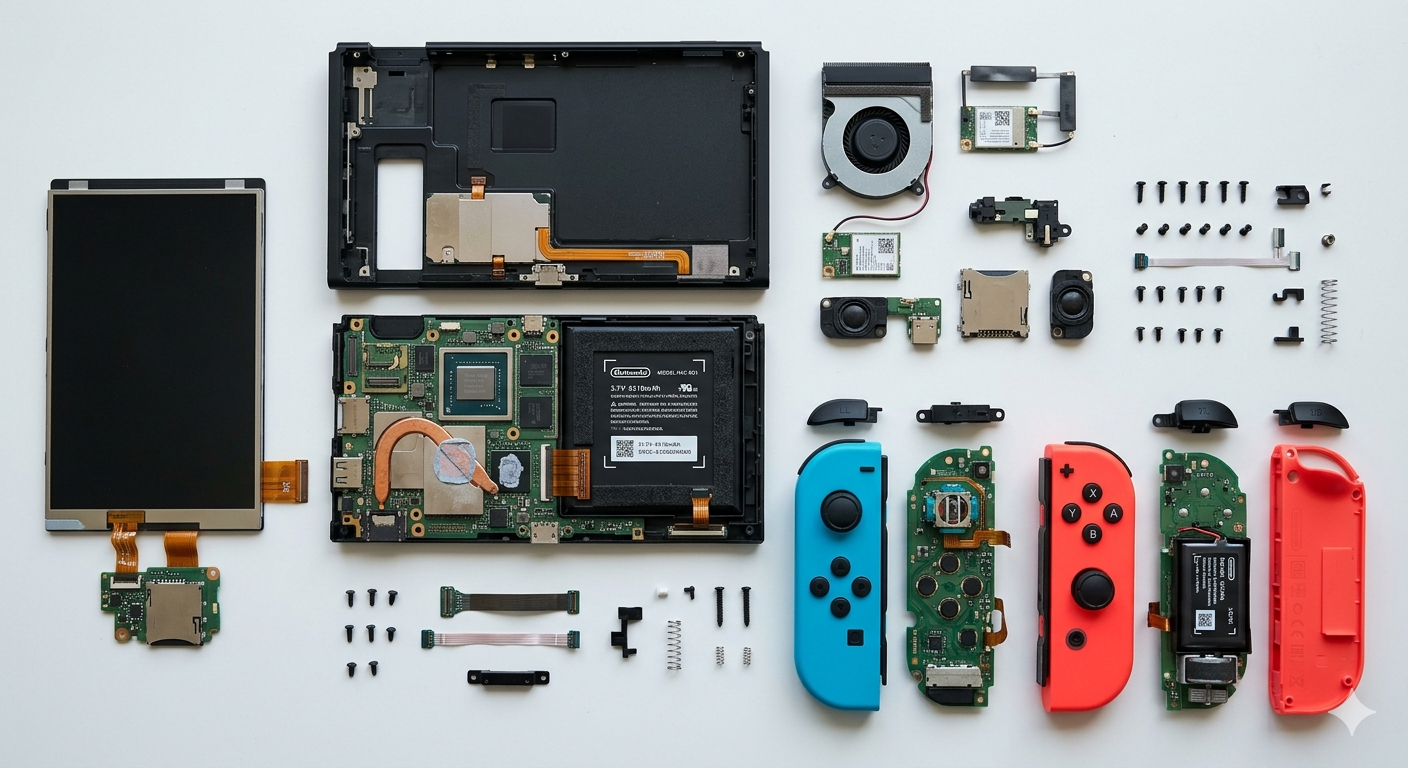
In June 2025, iFixit tore down the Nintendo Switch 2 and gave it a low repairability score. The battery was glued in with industrial adhesive. Both USB-C ports were soldered directly to the mainboard. The Joy-Con sticks used the same potentiometer technology that was associated with the original Switch's well-publicised drift complaints. Nintendo offered no spare parts.
For a consumer electronics product launching into the EU market in 2025, this was a compliance gamble. And it didn't take long for it to become a problem.
In early 2026, reports emerged that Nintendo is developing an EU-specific hardware revision of the Switch 2: a version with a user-replaceable battery accessible with ordinary household tools, carrying a distinct "OSM" model code. The Joy-Con 2 controllers are being redesigned with removable batteries as well. The rest of the world keeps the glued, sealed version. The driver here is specifically the EU Battery Regulation (2023/1542), which requires portable batteries to be readily removable and replaceable by the end user for products placed on the EU market from 18 February 2027, rather than the Right to Repair Directive.
Nintendo is now building two SKUs of the same product, one for the EU market and one for everyone else, because it didn't build to the repair standard from the start.
What the EU Right to Repair Directive Actually Requires
Directive 2024/1799 entered into force in 2024, and member states must transpose it into national law within the period set out in the Directive text. Several member states have begun publishing draft transposition legislation.
Here is what manufacturers must do, as set out in the Directive:
| Obligation | What it means |
|---|---|
| Spare parts & tools | Made available to repairers (not just authorised centres) at a reasonable price |
| Repair information online | Indicative repair pricing and procedures published on a free-access website, with no dealer login required |
| Parts pairing restricted | Software authentication or contractual clauses blocking compatible, second-hand, or 3D-printed replacement parts are constrained |
| Post-warranty repair | Manufacturers must offer repair services even after warranty expires, unless technically impossible |
| Warranty advantage for repair | Consumers who choose repair over replacement for a warranty fault get an added period on their statutory warranty |
| European Repair Platform | A common online interface connecting consumers with local repairers |
Check the Directive text for the exact obligations, durations, and transposition timing that apply to your product category.
The "Two SKU Problem"
Nintendo's response, building an EU version and a rest-of-world version, is the most expensive possible way to handle compliance. Two hardware revisions means two supply chains, two sets of tooling, two quality assurance processes, and two sets of after-sales documentation.
This is the same pattern that played out with GDPR, ESPR, and DPP. Brands that treat EU regulation as a regional exception end up maintaining parallel systems. Brands that build to the higher standard globally can save money, simplify operations, and strengthen their position in every market.
The EU Batteries Regulation introduces requirements around user-replaceable batteries. The Right to Repair Directive addresses spare parts availability and repair documentation. The Digital Product Passport requires structured product data linked to every unit. These obligations are converging towards a common standard for how products are designed, documented, and supported after the sale.
What This Means for Non-Nintendo Brands
If you manufacture power tools, kitchen equipment, fitness equipment, HVAC systems, or any durable product sold in the EU, here is what changes as the Directive takes effect:
1. You need a spare parts catalogue, linked to each product
Not a PDF price list buried in a dealer portal. A structured, searchable catalogue where any consumer or independent repairer can find the right part for their specific product unit. The Directive requires repair information to be published on a free-access website.
For products with revision differences, where the same model may have different internal components depending on manufacture date, this means serial-level part compatibility. A generic "fits Model X" listing isn't sufficient when Model X Rev A and Model X Rev B use different motors.
2. You need repair documentation that's accessible, not buried
Repair manuals, diagnostic procedures, and indicative pricing must be available online. Not behind a dealer login. Not in a format that requires proprietary software to open. Not as a long PDF that doesn't tell you which screwdriver to use.
The brands that do this well will surface repair information at the point of need, when a consumer scans the product or searches for their specific model. The brands that do it poorly will publish a zip file on a subdomain and hope for the best.
3. You need a warranty process that accommodates repair
The warranty advantage for consumers who choose repair changes the economics of warranty management. Your warranty system must track whether a claim was resolved by repair or replacement, extend coverage accordingly, and make any extension visible to the consumer.
If your warranty process is still managed by email, this becomes an operational nightmare. You need structured warranty data at the serial level: which unit, which claim, which resolution, which extended expiry date.
4. You must not block third-party parts
If your product uses software to authenticate replacement components, rejecting non-OEM batteries, non-OEM screens, or non-OEM filters, the Directive constrains that practice in the EU. The parts pairing restriction applies unless the manufacturer can demonstrate genuine technical necessity. Confirm the exact scope against the Directive text.
The Repair Revenue Opportunity
Right to Repair is framed as a compliance burden. It can also be a revenue opportunity that many manufacturers leave on the table.
Spare parts and repair services represent a recurring after-sales relationship, often at healthier margins than new-product sales, and consumer appetite for repair over replacement has been a consistent theme in EU policymaking. Treat those as directional rather than precise: validate the numbers for your own category before building a business case on them.
The brands that lose this revenue are the ones who make spare parts hard to find. The consumer searches for a replacement part, can't find it on the manufacturer's website, and buys a third-party alternative online. Or gives up and buys a new product from a different brand.
The brands that capture this revenue are the ones who surface the right spare part at the right moment, when the consumer is holding the product and looking for help. When a consumer can access serial-aware parts compatibility directly from the product itself, the goal is fewer wrong orders and returns. The part fits because the system knows which revision this unit is.
Building Repair-Ready Infrastructure
The common thread across all Right to Repair obligations, spare parts, repair manuals, warranty tracking, and parts compatibility, is product identity at the unit level.
A product identity system that knows which exact unit a consumer owns, which revision it is, which parts are compatible, and what the warranty status is can serve every obligation at once:
- Spare parts: surface compatible parts for this specific serial number
- Repair documentation: link repair guides to the correct revision
- Warranty tracking: record repair vs replacement resolution, extend coverage accordingly
- Parts information: publish pricing and availability on a public page per product
- DPP readiness: structured product data already linked to the GS1 Digital Link identity
Many manufacturers today handle this with static PDFs on dealer portals, parts lists buried in ERP systems, and warranty data trapped in email threads. A consumer searching for a replacement part finds a dealer portal that requires account creation, downloads a long PDF, and scrolls through exploded diagrams trying to match a part number they can barely read on the label. An independent repairer emails the manufacturer and waits days for a spreadsheet. This is archaic. It was never designed for consumer access, independent repairers, or regulatory audits.
This is not a compliance checkbox exercise. The same infrastructure can contribute to lower support costs, better registration, and a stronger spare-parts relationship. The EU is mandating what good product operations look like anyway.
The Choice: React or Build
Nintendo chose to react. The Switch 2 launched without strong repair consideration, scored poorly on iFixit's teardown, and is now being expensively redesigned for one market. Two SKUs. Two supply chains. Two support processes.
The alternative is to build repair-ready from the start. Design for disassembly. Publish spare parts. Link repair documentation to product identity. Track warranty resolutions at the serial level. Make the compliance floor your competitive ceiling.
As the transposition deadline approaches, the brands that have product identity infrastructure in place, with spare parts, repair documentation, and warranty orchestration already linked to every unit, will be best placed to treat compliance as a non-event.
The brands that don't will be building their own version of the two SKU problem.
Not sure where your products stand? Start with the DPP Readiness Assessment. It covers repair documentation, spare parts availability, and compliance readiness in under five minutes.
FAQ
Q: Which products does the EU Right to Repair Directive cover? The Directive applies to product categories listed in its annexes, and the European Commission can expand that list over time. The spare parts and repair information obligations apply broadly to manufacturers of goods sold in the EU. Check the Directive text for the categories that apply to your products.
Q: Does the Right to Repair Directive apply to UK manufacturers? The UK is not bound by EU Directives post-Brexit. However, UK manufacturers selling into the EU must comply with EU rules for those markets. Building to the EU standard now helps cover both scenarios.
Q: How does the Right to Repair connect to the Digital Product Passport? The DPP (under ESPR) requires structured product data, including materials, compliance documents, and repair information, linked to each product unit via a GS1 Digital Link. The Right to Repair Directive requires that repair information be accessible. Together, they point in the same direction: every product unit carrying accessible, structured data about how to repair it. The underlying product-identity infrastructure can serve both.
Q: What is the penalty for non-compliance? Penalties are set by each member state during transposition, so they vary by country. The reputational and operational costs of reactive compliance, as Nintendo's two-SKU redesign illustrates, can outweigh the regulatory penalty itself.