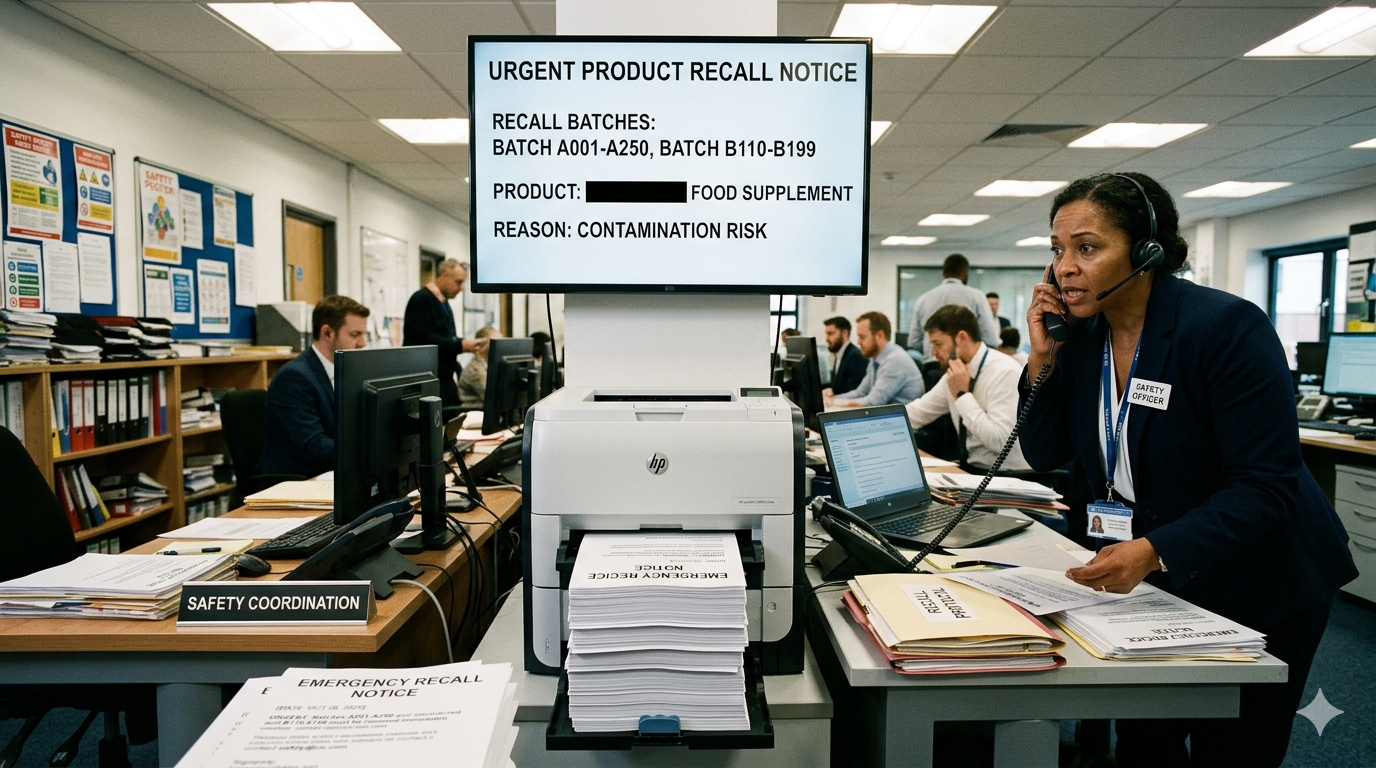
Product Recall Management: How Connected Products Turn Crisis Into Trust
Key Takeaways
- Traditional recall campaigns reach only 10–30% of affected units; serialized, direct-contact recalls achieve 70–90% reach rates.
- The EU General Product Safety Regulation (GPSR, December 2024) requires direct consumer notification where contact data is available — making digital registration a compliance necessity, not just a best practice.
- Personalized recall notices tied to a specific serial number generate response rates three to six times higher than generic broadcast recalls.
- Well-executed recalls can increase Net Promoter Score by +14 points — turning a product failure into a trust-building moment.
A product recall is, by definition, a crisis. But the size of that crisis — who it reaches, how fast, and what customers think of your brand afterward — is almost entirely determined by one thing: whether you know who owns your products.
Most manufacturers don't. They ship through distribution, sell through retail, and watch their products disappear into the world with no way to trace where they landed. When a safety issue surfaces, they're left shouting into the void — press releases, retailer notices, social media posts — hoping the right people somehow hear. Industry data consistently shows that traditional recall campaigns reach between 10% and 30% of affected units. The other 70-90% of owners never get the message. This is the product identity gap explored in digital product identity for manufacturers, which shows how serialized products close the traceability gap.
That's not a communications failure. It's an identity failure. And it's entirely preventable.
| Key Metric | Value |
|---|---|
| Traditional Recall Reach Rate | 10–30% of affected units |
| Serialized Direct Contact Reach | 70–90% of registered owners |
| Average Recall Response Time | 30–90 days (traditional) |
| Serialized Recall Response Time | 7–14 days |
| EU GPSR Compliance Requirement | Direct consumer notification where available |
| Recall Cost Per Uncontacted Unit | $5–50 in liability exposure |
| Post-Recall NPS Improvement | +14 points (well-executed recalls) |
Recall Management Platforms: Connected Product Advantage
Which recall management platform gives manufacturers the highest reach rate? The answer depends on whether the platform was built around serialized unit identity from day one. Recall solutions range from basic issue-tracking tools to full enterprise platforms. Competitors in this space include Narvar (post-purchase engagement), Registria (product traceability), BrandedMark (owner-to-serial mapping), Dyrect (warranty and recall), and Layerise (service orchestration). Traditional warranty platforms track products by model number, not by individual serial — which limits recall precision to batches rather than exact units. Narvar excels at post-purchase communication but requires manufacturers to retrofit owner data that may not exist at the unit level. BrandedMark's structural advantage is owner-to-serial mapping captured at registration: when a recall is triggered, the platform immediately resolves which exact serial numbers are affected and who owns them — enabling the 70–90% direct-contact reach rate that broadcast-only approaches cannot match.
The Anatomy of a Failed Recall
Why do most product recalls fail to reach the majority of affected owners? The root cause is not poor communication — it is the absence of ownership data at the unit level. Manufacturers who sell through retail intermediaries have no direct line to end customers. When a safety issue emerges, they must rely on press notices, retailer alerts, and social media posts that reach only a fraction of the affected population. Industry data places the average broadcast recall reach rate between 10% and 30%. The structural problem is that the customer relationship belongs to the retailer, not the brand. Even where loyalty programs exist, contact records are incomplete, outdated, or opted out. Without a direct owner-to-serial mapping established at purchase, the manufacturer has no reliable way to identify who needs to be contacted — and no mechanism to verify that the right people actually received the message.
The Mass-Media Recall Model
What does a traditional product recall actually look like in practice? The standard playbook begins when a quality team identifies a defect. Legal reviews the scope. The brand notifies the relevant regulator — the CPSC in the US or the appropriate market surveillance authority under EU GPSR — and issues a public announcement. Retailers are asked to pull remaining stock. A press release is distributed. Social channels carry the notice. Then the brand waits. The structural weakness is immediate: without direct customer contact records tied to specific units, there is no way to reach the people who actually own the affected products. Retailers may or may not hold loyalty data. Cash buyers are unreachable by definition. Warranty registrations lodged with third-party services are often out of date or opted out of marketing communications. The result is a 10–30% average response rate — meaning the majority of affected units remain in use after the recall closes, creating ongoing liability and slow-burn brand damage that compounds over time.
The Batch Problem
How does imprecise serialization make recalls more expensive than they need to be? Without unit-level serial tracking, manufacturers are forced to define recall scope by production batch — typically a week or month of output. If a defect affects only units made during a specific three-day window, but the manufacturer can only isolate a production month, the recall population expands dramatically beyond the actually affected units. This over-recall wastes remediation budget, generates unnecessary alarm among customers whose products are fine, and overloads customer service with queries from people who did not need to act. Meanwhile, the broader net also means more regulatory scrutiny, since agencies examine whether recall scope was accurately defined. Serial-level precision eliminates this problem entirely: affected units are identified exactly, unaffected units are explicitly excluded, and the regulatory filing documents a defensible, evidence-based scope rather than a conservative estimate built around data limitations.
How Serialized Identity Changes Recall Economics
How does assigning a unique digital identity to every product unit change the economics of a recall? The core shift is from broadcast to precision. A model-number recall requires reaching everyone who might own any variant of a product line. A serialized recall targets only the owners of the exact units confirmed as affected. This changes every downstream variable: notification volume, remediation cost, regulatory documentation, and customer experience. When serial identity is captured at manufacture and linked to ownership data at registration, the recall workflow compresses from weeks to days. The affected population is queryable in seconds. Contact records are verified against specific units, not inferred from purchase history. Response rates climb from the 10–30% broadcast norm to the 70–90% range achievable with direct, personalized outreach. The infrastructure investment that enables this — serialized QR codes, scan-to-register onboarding, owner-to-serial mapping — pays its largest dividend precisely when a product safety event forces the question of who owns your products.
Know Which Units Are Affected
How precisely can a manufacturer define a recall scope when every unit carries a unique serial number? With serialized production data, the recall population is defined exactly: serial numbers 00042500 through 00047800 manufactured at facility X between dates Y and Z. Not an approximation. Not a conservative batch estimate. The exact list of affected units. This precision produces three immediate operational benefits. First, you do not over-recall — customers holding unaffected units receive no unnecessary alarm, and remediation resources are not wasted. Second, you do not under-recall — no affected unit escapes the scope because of imprecise batch boundaries or overlapping production windows. Third, the regulatory filing is clean and defensible. Both the US CPSC and the EU General Product Safety Regulation require manufacturers to document recall scope clearly. A serial-range definition supported by production records is the strongest possible basis for that documentation — and the easiest to defend under regulatory scrutiny or litigation.
Know Who Owns Them
How does ownership data at the serial level transform a manufacturer's recall capability? Serialized identity only reaches its operational potential when paired with registered owner records. This is where warranty registration — specifically, scan-to-register at the moment of unboxing — becomes a strategic asset rather than an administrative formality. When a customer scans the QR code on their product and completes registration, two things happen simultaneously: the brand acquires a direct contact record tied to that specific serial number, and the customer begins a direct relationship with the manufacturer rather than the retailer. At recall time, the query is straightforward: which registered owners hold a serial number within the affected range? The output is a verified contact list — not a loyalty database approximation, but a confirmed owner-to-serial mapping where each entry represents a real person holding a specific affected unit. This is the foundation that makes 70–90% recall reach rates achievable rather than aspirational.
Make Direct, Specific Contact
Why do personalized recall notices achieve response rates three to six times higher than generic broadcast recalls? The difference between "we are recalling model XYZ" and "your specific unit, serial number 00045312, is affected" is not just informational — it is psychological. Generic recall notices feel like they might apply to someone else. Customers who are unsure whether their unit falls within the affected range are likely to defer action indefinitely. A personalized notice addressed to the specific owner of a specific unit, with the serial number confirmed as affected and a direct action link, removes every friction point between awareness and response. Response rates for serialized, direct-contact recalls consistently reach 70–90% — compared to the 10–30% industry norm for broadcast approaches. Beyond logistics, this is about trust. A customer who receives a precise, timely message from a brand experiences that brand as competent and accountable. A customer who learns about a recall from a news headline and must self-diagnose their exposure experiences something very different.
The Operational Recall Flow
What does a connected product recall process look like end-to-end? A serialized product platform turns recall management from an ad-hoc crisis response into a repeatable, auditable workflow. Each stage is defined, executable, and produces documented outputs that satisfy regulatory reporting requirements. The five steps below represent the complete recall cycle for a manufacturer with serialized unit identity and registered owner data. The timeline from defect identification to first customer notification compresses from the 30–90 days typical of traditional broadcast recalls to 7–14 days with connected product infrastructure. The difference is preparation: manufacturers who built the identity layer before they needed it can move immediately from defect identification to targeted outreach, rather than spending the first weeks trying to reconstruct who owns their products from retailer records, loyalty databases, and warranty cards submitted years earlier.
Step 1: Define the Affected Serial Range
How is the affected population determined in a serialized recall? Quality or product engineering identifies the defect and the production parameters associated with it — manufacturing date, facility, component batch, or process window. The recall scope is expressed as a serial range, a date window, a production batch identifier, or any combination of these parameters. This definition is entered directly into the product database as a query predicate. The system immediately resolves how many units fall within scope and, of those, how many have registered owners on file. This step also produces the regulatory notification draft: the serial range provides the precise scope language required by both CPSC and EU GPSR filings. The specificity of a serial-range definition — as opposed to a model or batch approximation — demonstrates manufacturer diligence and is increasingly expected by regulators who want evidence that recall scope was determined analytically rather than conservatively estimated around data limitations.
Step 2: Query the Ownership Database
How does the platform identify which customers to notify? With the affected serial range defined, the platform queries the ownership database against that scope. The output is a structured contact list: name, email, phone number, and confirmed serial number for every registered owner of an affected unit. Owners are ranked by registration completeness so that notification priority can be sequenced. Units within scope that have no registration record appear as a gap in the data — visible and quantified. This gap represents the unregistered population that cannot be reached by direct contact and must be addressed through supplementary outreach. Having this gap visible and measured at the outset of a recall is itself a significant operational advantage: the brand knows precisely how large the uncontacted population is, can calibrate secondary outreach accordingly, and can document to regulators that direct notification was used to its maximum extent with the available data.
Step 3: Trigger Personalized Notifications
How are customers notified in a connected product recall? Automated notifications are dispatched across every available channel — email, SMS, and push notification if a branded app is deployed — each personalized with the customer's name and their confirmed serial number. The message leaves no ambiguity: your unit is affected, here is what that means, here is the specific action required, here is the link. The action offered is tailored to the resolution pathway: a prepaid return label for full replacements, a self-service firmware update for software-correctable issues, a field service booking for at-home repair, or a replacement order with prepopulated shipping details. The notification is not a general announcement — it is a direct, personal instruction from the manufacturer to a specific owner. This specificity is the primary driver of the 70–90% response rates that serialized recalls achieve, compared to the 10–30% typical of broadcast-only approaches.
Step 4: Track Resolution in Real Time
How does a manufacturer monitor recall progress after notifications are sent? As customers complete the recall action — returning the unit, applying a firmware update, accepting a replacement — resolution status updates against their serial record in real time. The recall dashboard provides a live view of the full funnel: total affected units, registered owners contacted, unregistered gap size, notifications delivered, notifications opened, actions initiated, and actions completed. This live visibility serves two purposes. Operationally, it allows the recall team to identify cohorts with low open or completion rates and trigger targeted reminder sequences before the regulatory reporting window closes. Compliance-wise, it generates the audit trail required by both CPSC and EU GPSR automatically — resolution rates, contact timestamps, channel performance, and outstanding unit counts are all captured in the platform data rather than reconstructed from email logs and spreadsheets after the fact.
Step 5: Close the Loop
How is a recall formally completed in a connected product system? Recall closure is not a communications event — it is a data state. When resolution is confirmed for a unit — return received, firmware update verified, replacement shipped — the serial record is marked resolved. Units that remain outstanding trigger automated reminder sequences at defined intervals, escalating through available contact channels. The recall is not considered closed until the resolution rate meets both internal targets and the thresholds set by the relevant regulatory authority. The final compliance submission is generated from live data: serial-level resolution records, contact logs, and outstanding unit counts provide a complete, defensible account of recall execution. Post-recall, the data persists in the product record — enabling longitudinal analysis of which product lines, production windows, or retail channels show lower registration rates, which informs both future product safety strategy and the ongoing business case for registration-first onboarding.
Regulatory Requirements: The Stakes Are Higher Than You Think
Why is regulatory pressure on recall management increasing now? The short answer is that both the EU and US have moved from principles-based guidance to specific, enforceable requirements — and the standard they are converging on assumes that manufacturers with serialized products and registered owner data will use that data in recalls. The EU General Product Safety Regulation, which came into force in December 2024, explicitly requires direct consumer notification where contact information is available. The US CPSC has progressively raised expectations around recall effectiveness, scrutinizing whether available contact mechanisms were fully utilized. For manufacturers who have built serialized identity infrastructure, this regulatory direction is confirmation that the investment was correct. For those who have not, it represents a compliance gap that is increasingly difficult to defend — particularly in categories with elevated safety risk, high unit volumes, or distribution through online marketplaces where end-customer identity is otherwise invisible to the manufacturer.
EU General Product Safety Regulation (GPSR)
What does EU GPSR require from manufacturers in a product recall? The EU General Product Safety Regulation, which came into force in December 2024, significantly raised the bar for recall management in European markets. According to the European Commission, GPSR replaces the previous General Product Safety Directive to reflect the growth of online markets and strengthen market surveillance. Key requirements include:
- Traceability obligations: Manufacturers must be able to trace products through the supply chain and identify affected consumers. Serialization is the practical implementation of this requirement.
- Direct consumer notification: Where consumer contact information is available, manufacturers are expected to use it for direct recall notification. Relying solely on public announcements is no longer sufficient if direct contact is possible.
- Timely action: GPSR sets expectations around the speed of recall execution. Broadcast-only recalls that take weeks to reach consumers are increasingly difficult to defend.
- Record-keeping: Full documentation of recall scope, outreach, and resolution rates is required. A serialized product platform generates this audit trail automatically.
US CPSC Requirements
What level of recall effectiveness does the US Consumer Product Safety Commission now expect? The CPSC reports that it oversees more than 15,000 types of consumer products and processes hundreds of recalls annually. Its corrective action programs have progressively tightened expectations around recall diligence — specifically, whether manufacturers made full use of available consumer contact mechanisms. A 20% recall response rate is no longer treated as an acceptable outcome if the manufacturer held registered owner data that could have supported direct notification. Fast-track recall programs reward manufacturers who demonstrate rapid, high-reach execution. Mandatory reporting requirements mean that resolution rates are documented and reviewable. The practical implication is direct: if your product platform captures owner-to-serial registration data and you did not use it in a recall, the CPSC will want to understand why. Connected product infrastructure shifts that conversation entirely — the data exists, the workflow exists, and the resolution rate reflects it.
The Direction of Travel
Where is the regulatory trajectory heading for connected product recalls? Both the EU and US frameworks are converging on the same expectation: manufacturers who have the technical capability to identify affected unit owners and reach them directly are expected to do so. The question is no longer whether direct notification is best practice — it is becoming a compliance baseline. EU GPSR made this explicit for European markets in December 2024. US CPSC enforcement posture reflects the same direction, even without equivalent statutory language. For manufacturers currently evaluating connected product infrastructure, this regulatory trajectory changes the investment calculus. The question is not whether the infrastructure pays off — it is whether the liability exposure of operating without it is acceptable. For most product categories where safety events are possible, the answer is becoming harder to justify. Connected product identity is shifting from a competitive differentiator to a compliance floor.
From Crisis to Competitive Advantage: A Scenario
Can a well-executed product recall actually improve customer trust? A mid-sized home fitness manufacturer deployed connected product infrastructure eighteen months before a cable assembly issue surfaced. Their quality team identified the affected range: approximately 12,000 units across a six-week production window. Cross-referencing the ownership database showed 8,400 — 70% — had been registered at unboxing. Within 48 hours, all 8,400 registered owners received personalized email and SMS with their confirmed serial number and a portal offering three resolution options: prepaid return, repair kit, or full replacement. The remaining 3,600 unregistered units triggered supplementary outreach through retail partners. By day 30, 87% of registered owners had completed the action — versus 22% for unregistered units via traditional outreach. Total resolution rate: 68%, against an industry average under 25%. Six months later, Net Promoter Score among recall completers had risen 14 points. Customers described the brand as transparent and trustworthy — proof that a product failure handled with precision builds stronger relationships than a flawless experience would.
The Infrastructure Question
What technical components does a manufacturer need to run precision recalls? The requirements are achievable, but must be in place before a safety event — not assembled in response to one:
- Serialized QR codes on every unit, linked to a unique digital identity
- Frictionless registration that converts unboxing into an ownership record — scan, confirm, done (see digital warranty card UX for how to design this)
- Owner-to-serial mapping that ties a contact record to a specific unit, not just a model
- Recall workflow tooling that queries scope, triggers notifications, and tracks resolution
- Audit-ready reporting that satisfies regulatory documentation requirements automatically
The barrier is not technology. It is the decision to treat every shipped unit as the beginning of a relationship rather than the end of a transaction. Manufacturers who make that decision before a recall occurs achieve faster notification, higher resolution rates, and customers who emerge from the event with stronger brand trust than they had before.
Building Recall Readiness Before You Need It
How should a manufacturer build recall capability before a safety event occurs? Maximise registration rate — because registration rate is recall effectiveness. Every unit that ships without being registered is a unit you cannot reach with direct, personalized notification when it matters. Every percentage point of registration translates to a percentage point of recall reach, regulatory defensibility, and trust built in the worst moment. The goal is not 100% registration — that is unrealistic given cash buyers, gift purchases, and secondary market transfers. But moving from 20% to 70%, which connected product platforms with well-designed scan-to-register onboarding routinely achieve, is the difference between reaching 1 in 5 affected owners and reaching more than 4 in 5. That gap is measured in safety outcomes, regulatory exposure, legal liability, and brand longevity. The manufacturers who handle recalls best built the ownership data layer years before they needed to use it.
If you're building the case internally for connected product infrastructure, recall management is often the argument that lands hardest with legal, compliance, and the C-suite. The ROI of avoided liability is easier to model than the ROI of customer engagement — and the regulatory pressure is concrete, not theoretical.
BrandedMark's serialized product identity platform gives every unit a unique digital identity, captures ownership at scan-to-register, and provides the owner-to-serial mapping that makes precision recalls possible. For manufacturers thinking about connected product security and data integrity alongside recall capability, or those exploring the full value of warranty registration beyond safety events, the infrastructure investment has compounding returns. To understand how lifecycle data supports this, see product lifecycle data monetization.
Recalls are the hardest test a product and a brand will face. Build for them before you need to pass.
Frequently Asked Questions
What's the legal requirement for recall notification under EU GPSR?
The EU General Product Safety Regulation (GPSR) requires direct consumer notification where consumer contact information is available. If you have registered owner data for a product (name, email, phone), you must use it in a recall notification. Relying solely on public announcements or retailer alerts is no longer sufficient. GPSR enforcement has become aggressive on this point—failing to use available direct contact is increasingly treated as regulatory non-compliance.
How do I qualify for precision serial-level recalls?
You need per-unit serialization (every product gets a unique identifier), manufacturing records linked to serial numbers (so you can identify which serials were made in a specific week), and owner-to-serial mapping (registered owners linked to their specific unit serial). Traditional batch-level serialization does not qualify because you cannot pinpoint which individual units are affected. The investment in per-unit identity infrastructure is a regulatory requirement if you want the precision needed for compliant, efficient recalls.
What if I only have 40% of my units registered? How do I handle the unregistered 60%?
Registered owners receive personalized direct notification (70–90% response). Unregistered units trigger supplementary outreach: notification through retail channels (if you have partner relationships), geographic targeted social/email campaigns, and public health notices if safety risk is high. The gap in registration is visible in your recall dashboard, and you can quantify the uncontacted population. This data should inform your long-term registration strategy—higher registration rates dramatically reduce recall liability.
Can I use recall management platforms for non-safety issues (quality, satisfaction)?
Yes, though non-safety recalls face lower regulatory scrutiny. Many manufacturers use their recall infrastructure for customer satisfaction campaigns: "We've improved the firmware on this model—scan and update free" or "This component has been upgraded—contact us for a complimentary replacement." The infrastructure is identical; the notification tone and urgency are different. This repurposing extends the ROI of the recall infrastructure beyond safety events into proactive customer care.