Product Identity Maturity Model: Where Does Your Brand Stand?
Key Takeaways
- The five-level Product Identity Maturity Model ranges from no digital touchpoint (Level 1) to a full product ecosystem with predictive intelligence (Level 5).
- Most manufacturers sit at Level 1 or 2 — including household names with billions in annual revenue — and mistake a QR code pointing to a homepage for a connected product strategy.
- Moving from Level 2 to Level 3 delivers 10–20% more post-sale revenue per unit; Level 4 delivers 30–60% — the compounding gap reshapes who wins the category.
- EU ESPR's Digital Product Passport mandate effectively requires Level 3 as a minimum for products sold into the EU market.
Most manufacturers know, somewhere in the back of their minds, that their products disappear the moment they leave the warehouse. A customer scans a barcode at checkout, the retailer logs a transaction, and that is the last time you will know anything about that unit. Who owns it. Whether it broke. Whether the owner bought accessories — from you or from Amazon. Whether they are about to replace it.
That gap between what you manufacture and what you know about it after the sale is not just a data problem. It is a strategic one. And it compounds year over year.
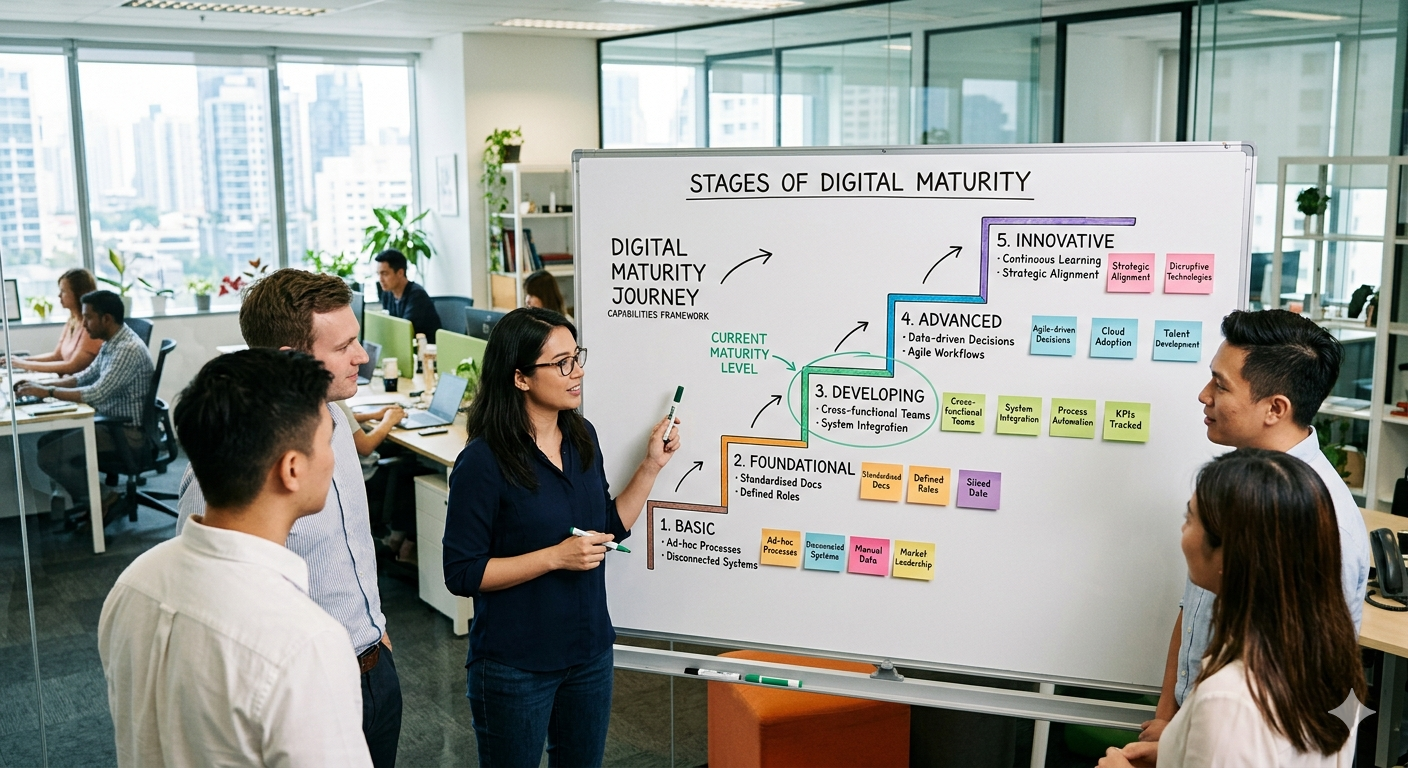
The Product Identity Maturity Model is a framework for understanding exactly how far along the spectrum your organisation sits — and what it would take to move up. Five levels. Each one is a meaningful step forward. Most manufacturers are sitting at Level 1 or 2 and calling it a strategy.
The Five Levels at a Glance
| Level | Name | Registration Rate | Revenue Impact | Competitive Position |
|---|---|---|---|---|
| 1 | No Identity | 0% | Baseline | Fully exposed |
| 2 | Basic QR | 2–8% | Negligible | Minimal |
| 3 | Connected Product | 15–35% | +10–20% post-sale | Differentiated |
| 4 | Product Platform | 35–65% | +30–60% post-sale | Strong moat |
| 5 | Product Ecosystem | 65–85%+ | 2–3x product revenue | Category-defining |
Level 1: No Identity
What it looks like
At Level 1, products ship with a barcode, a printed manual, and a paper warranty card that virtually no customer returns. Any QR code on the box routes to a generic homepage. Support staff regularly field calls from customers unable to identify their own model. There is no serialisation, no owner database, and no post-sale data infrastructure. This is not a description of struggling brands — it describes the majority of manufacturers, including household names with billions in annual revenue. The product leaves the warehouse, and that is the last meaningful signal the manufacturer receives.
The numbers
Registration rate is effectively 0%. Not because customers are unwilling — research consistently shows 60–70% intend to register durable goods — but because there is no frictionless path to complete it. The paper card goes in a drawer; the homepage QR leads to a marketing site. The moment passes. Revenue impact is total: no spare parts sold direct, no accessories cross-sold, no extended warranty offered at the right moment, no retention campaign. Every post-sale pound flows through third-party channels with no reason to keep the customer loyal to the original brand.
How to advance
The step from Level 1 to Level 2 is purely mechanical: establish a destination for each product's digital identity, even a basic one. The goal is not a polished experience — it is proving the experience exists. GS1 research shows over 60% of consumers intend to register durable goods purchases, but fewer than 15% complete the process without a frictionless, immediate-value digital path. Even a minimal serialised landing page with a single clear action outperforms no destination entirely.
Level 2: Basic QR
What it looks like
At Level 2, a QR code appears on packaging or the product label and resolves to some destination — a PDF manual, a product page, or a generic support site. Scanning is possible, but there is no serialisation: every unit of the same model routes to the same generic page. The QR does not know which unit it is on, so the experience cannot be personalised or tracked at the unit level. If a registration flow exists, it typically requires account creation, a multi-field form, and a confirmation email — a friction stack that most customers abandon. Some companies at Level 2 believe they have a connected product strategy. They have a URL on cardboard.
The numbers
Registration rate lands at 2–8%, driven almost entirely by highly motivated customers — those who have already encountered a problem or who are unusually brand-engaged. The passive majority never converts. Revenue impact is negligible: no mechanism exists to monetise the scan, capture customer data, or present a next step. The customer arrives, finds what they need or does not, and leaves. No insight is generated. No lifecycle action is triggered.
How to advance
Serialisation is the critical unlock at this stage. Each unit needs a unique identifier, and the QR code must resolve to a page that recognises which specific unit triggered the scan. Once serial-level identity exists, everything downstream becomes actionable: owner registration, purchase history, targeted support, and compliance with the EU Digital Product Passport. Without serialisation, you are broadcasting to model numbers rather than communicating with individual products and their owners.
Level 3: Connected Product
What it looks like
Level 3 is where the strategy becomes real. Each product carries a unique digital identity. Scanning the QR takes the customer to an experience that knows the product, its variant, and — after registration — its owner. Registration is frictionless: name, email, and optional proof of purchase via photo, completed in under 90 seconds at unboxing. The experience surfaces setup guidance, interactive troubleshooting, a spare parts catalogue with direct ordering, and warranty status in plain language. Support teams can instantly pull a customer's complete product history. Recall management changes character entirely — registered owners can be reached directly, not through media announcements that hope people are paying attention.
For a detailed look at what manufacturers are gaining by making this transition now, see The State of Connected Products in 2026.
The numbers
Registration rate reaches 15–35%. Customers register because the experience delivers immediate value — a setup guide, warranty confirmation, or parts access — rather than asking them to fill out a form purely for the brand's benefit. The value exchange is visible and instant. Revenue impact is +10–20% on post-sale metrics within twelve months: spare parts revenue captured direct, warranty extension offers delivered at the right moment, and support costs reduced because self-service resolves the majority of common issues before they escalate to a call centre.
How to advance
The identity layer is in place. The next question is whether you can see how products are used across your installed base and act on those patterns. Can you trigger the right communication based on product age, usage stage, or service history? The move to Level 4 replaces reactive support with proactive lifecycle management. That requires analytics, workflow automation, and a platform that connects product data to customer communication — building depth on top of the identity foundation already established.
Level 4: Product Platform
What it looks like
At Level 4, the product is not a thing you sold — it is an ongoing relationship you manage. Every ownership lifecycle stage — unboxing, setup, first use, first service, warranty renewal, end of primary warranty, second owner — is mapped, instrumented, and acted on. An analytics dashboard surfaces registration trends by region, model, and retail channel. You can identify which products generate the most support contacts and trace root causes. Firmware updates and content changes can be pushed to specific product variants without altering physical labels. Full Digital Product Passport compliance is operational, with GS1 Digital Link codes resolving to structured, auditable data meeting EU ESPR requirements. For a useful self-audit, see the DPP Readiness Assessment: 25 Questions. Extended warranties, service subscriptions, and accessories are sold through the product scan — a direct revenue channel that bypasses intermediaries entirely.
The numbers
Registration rate reaches 35–65%. The combination of a frictionless flow, a clear value exchange, and contextual prompts — in-box messaging, retailer activation, first-scan calls to action — drives conversion well above category norms. Revenue impact is +30–60% on post-sale revenue. Spare parts, accessories, extended warranties, and service plans sold through the product experience fundamentally change post-sale economics. Competitive position becomes a meaningful moat: the accumulated customer data, built relationships, and deployed infrastructure are not easily replicated. A competitor starting a connected product programme from Level 1 is two to three years behind, even if they begin immediately.
How to advance
Level 4 platforms know a great deal about individual products and individual owners. What they do not yet do is learn from aggregate patterns across thousands or millions of products to predict what any given owner will need before they know themselves. Level 5 requires intelligence that spans across the installed base — correlating usage signals, service histories, and ownership transitions at scale to generate predictive, automated lifecycle actions.
Level 5: Product Ecosystem
What it looks like
At Level 5, the product experience transcends individual units. Predictive maintenance alerts fire not because a sensor detected a fault, but because aggregate patterns across 40,000 similar units in comparable use conditions show a specific component fails at 18–24 months. Subscription models for consumables replenishment, service plans, and content access are built on real product usage data rather than estimated intervals. Circular economy workflows are fully operational: digital ownership transfer follows the unit, refurbishment history is accessible on scan, and end-of-life recycling instructions are triggered automatically. Cross-product intelligence means the second product a customer buys benefits from everything learned from the first. As your competitors' products are already demonstrating, manufacturers at Level 5 compete on relationship depth and system intelligence, not product specifications.
The numbers
Registration rate reaches 65–85%+. At this level, registration is not a request — it is the natural outcome of a product experience that delivers visible, ongoing value. Many owners register without making a conscious decision to; the experience activates automatically at first use. Revenue impact is 2–3x the original product revenue over the ownership lifecycle: service plans, consumables, accessories, loyalty-driven repeat purchases, and referrals compound into a revenue engine that dwarfs the margin on the initial sale. Competitive position is category-defining. At Level 5, you are not catching up to the market — you are setting the standard against which all others are measured.
Self-Assessment: Where Are You Now?
Answer each question yes (1) or no (0). Be honest — if you are unsure, mark it no.
Digital Identity Foundation
- Does every product unit leave the factory with a unique serial number or identifier?
- Does your packaging carry a QR code that resolves to a product-specific (not model-generic) page?
- Can a customer find support content, warranty status, and spare parts from a single scan?
Registration and Owner Data 4. Can a customer register a product in under 90 seconds with no account login required? 5. Do more than 15% of your products get registered by their owners? 6. Do you know, at any given time, who owns each product in your installed base?
Lifecycle Management 7. Are you sending proactive communications based on product age, usage stage, or service history? 8. Can you reach every registered owner of a specific model within 24 hours in a recall scenario? 9. Do you sell spare parts, accessories, or extended warranties directly from the product scan?
Platform and Intelligence 10. Do you have analytics showing registration rates, scan trends, and support volumes by product and region?
Scoring
- 0–2: Level 1. No digital identity strategy in place.
- 3–4: Level 2. Basic digital presence, but no serialisation or lifecycle management.
- 5–6: Level 3. Connected product foundation is in place. Focus on depth and conversion.
- 7–8: Level 4. Product platform operating. Focus on cross-product intelligence and predictive capabilities.
- 9–10: Level 5. Product ecosystem operating. You are ahead of the market. Keep building.
Why Most Manufacturers Stall at Level 2
Most manufacturers stall at Level 2 not because of technology gaps but because of organisational ones. Level 2 required a single marketing decision: add a QR code to packaging. Level 3 requires cross-functional alignment across product, IT, legal, and customer service teams. Someone must own the product identity strategy, with a defined budget, CRM and ERP integration commitments, and executive sign-off that post-sale customer relationships are a strategic priority. Without a clear owner, the initiative stalls between teams.
Companies that make the jump are typically responding to one of three triggers: an EU DPP compliance deadline, a competitive threat from a rival brand with a materially better post-sale experience, or an internal champion who has quantified the post-sale revenue gap and presented the business case to leadership. A McKinsey analysis of after-sales services found that parts, service, and subscriptions can represent 25–40% of total revenue for mature connected product programmes — yet remain entirely invisible to companies operating at Level 1 or 2. The Level 3 revenue uplift of 10–20% per unit, compounding over three to five years against competitors who remain at Level 2, is a structural category advantage, not a marginal improvement.
Frequently Asked Questions
How long does it take to move from Level 1 to Level 3?
For most manufacturers, the Level 1 to Level 3 transition takes three to six months when approached with a dedicated platform rather than a custom build. The foundational requirements — serialisation, a QR-linked product experience, a registration flow, and a spare parts catalogue — are all solvable with existing technology. The constraint is usually internal prioritisation and systems integration, not the technology itself. Companies that treat it as a product launch (cross-functional team, defined scope, clear owner) move faster than those who treat it as an IT project.
Do we need to change our physical product or packaging?
Not necessarily. If your product already carries a barcode or QR code, those can often be extended to carry a GS1 Digital Link payload without a packaging redesign. For new product lines or packaging refreshes, the incremental cost of adding a serialised QR to packaging is typically less than a few pence per unit at scale — negligible against the revenue upside. NFC embedding is more involved but increasingly common in premium and industrial products where passive tap is more relevant than scan.
How does the maturity model relate to EU Digital Product Passport compliance?
The DPP requirement effectively mandates Level 3 as a minimum for products sold into the EU under ESPR. A Digital Product Passport requires a unique identifier per unit, a data carrier (QR code or NFC), and a structured data record covering materials, sustainability, and repairability. If you are targeting DPP compliance, you will have to build the infrastructure that Level 3 requires anyway — the question is whether you build the minimum for compliance or build the full post-sale platform at the same time. The incremental cost of going from DPP-compliant Level 3 to revenue-generating Level 3 is small. The incremental revenue is not.
Where to Go from Here
The Product Identity Maturity Model is a map, not a judgement. Most manufacturers are at Level 1 or 2 not because they made a poor decision, but because post-sale product identity was not a structured category five years ago. It is now — and the gap between levels is widening as early movers accumulate registered owner data, post-sale revenue, and compliance infrastructure that late starters cannot rapidly replicate.
Manufacturers moving fastest have reframed the product sale as the beginning of the customer relationship, not the end of the transaction. That shift changes what gets measured, what gets built, and what competitive advantage looks like over a three-to-five year horizon. If you scored Level 1 or 2 in the self-assessment, the gap to Level 3 is smaller than it appears — the foundational requirements are solvable in months with the right platform. If you scored Level 3 or 4, the next level is a platform decision, not a technology discovery.
BrandedMark is built to take manufacturers from any level to the next. Start with a product experience for a single SKU, measure the registration rate, and let the data make the case for the next step.