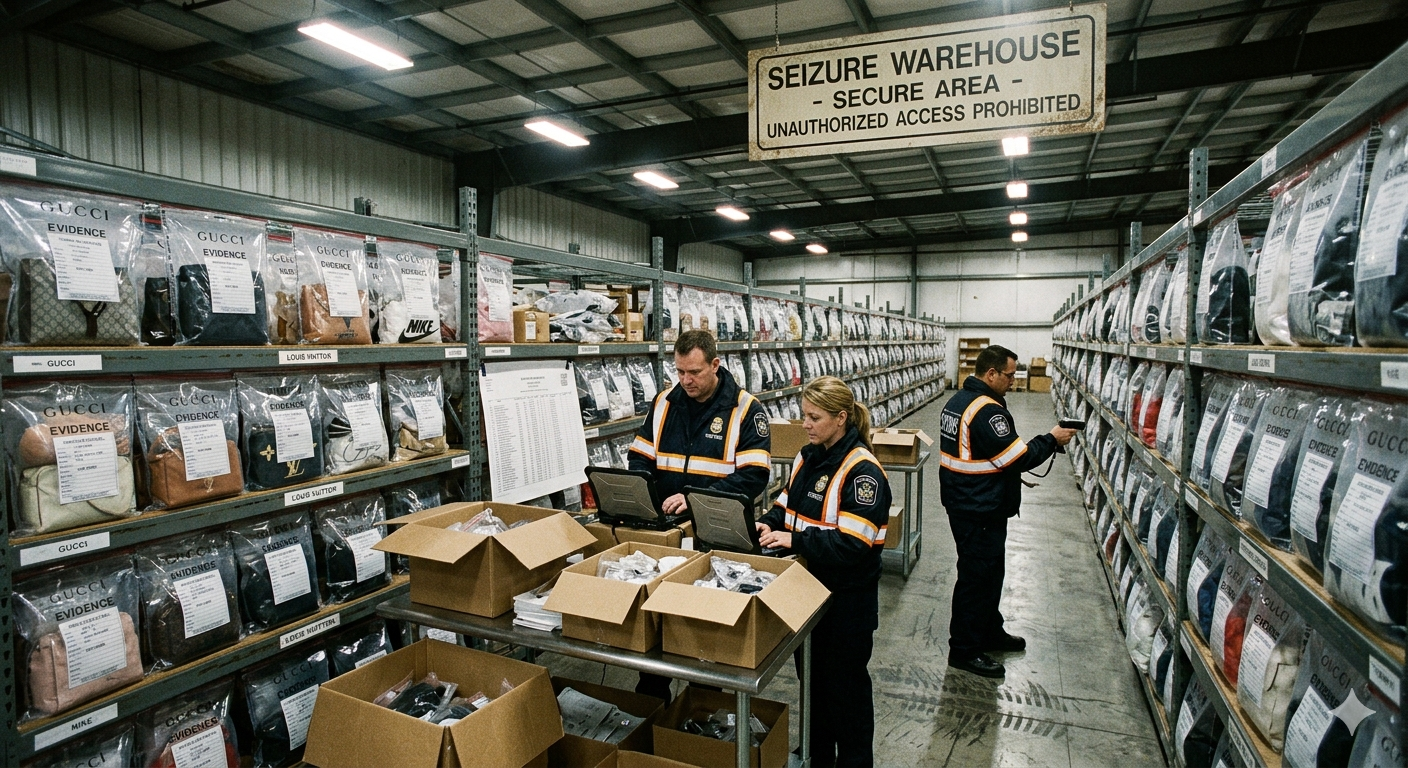
Product Counterfeiting Costs UK Manufacturers GBP 9B a Year
Key Takeaways
- According to OECD and EUIPO research, counterfeiting costs UK manufacturers approximately GBP 9 billion per year in lost revenue, damaged reputation, and enforcement costs
- Physical authentication methods (holograms, batch codes) secure the label, not the item — making them straightforward to replicate at commodity cost
- Serialised QR codes built on GS1 Digital Link assign each unit a globally unique identifier, making bulk counterfeiting economically unviable
- DPP compliance infrastructure and anti-counterfeiting serialisation share the same technical foundation — one QR code satisfies both requirements
The hard hat on the construction site looks identical to the certified original. Same moulding, same colour, same label. But the polycarbonate shell was never impact-tested, the suspension webbing is already brittle, and there is no EN 397 compliance behind that badge. The worker wearing it does not know. Their employer does not know. The site manager does not know.
This is not an isolated edge case. According to OECD and EUIPO research, counterfeit and pirated goods cost UK manufacturers approximately GBP 9 billion every year in lost revenue, damaged reputation, and enforcement costs. And unlike counterfeit handbags — where the harm is financial — fake PPE, automotive components, and medical devices carry a second cost that does not appear on any balance sheet: they hurt people.
The question is not whether counterfeiting is a problem. The question is why the standard playbook — holograms, batch codes, and brand enforcement teams — has failed to contain it, and what a serialised digital identity layer actually changes.
The Scale of the Problem in the UK
How large is the product counterfeiting problem for UK manufacturers, and which sectors face the most acute risk? The OECD/EUIPO joint report on illicit trade consistently places the UK among Europe's most targeted markets, a function of its large retail economy, major port infrastructure, and high-volume e-commerce channels. GBP 9 billion annually is roughly GBP 25 million a day before knock-on costs. PPE and safety equipment is one of the most counterfeited categories — the HSE has issued repeated warnings about non-compliant hard hats and respiratory masks entering supply chains through online marketplaces, with counterfeit FFP2 and FFP3 respirators bearing forged UKCA marks. Automotive parts are another high-risk category: fake brake pads, airbag components, and wheel bearings reach UK workshops through legitimate-appearing distributors. Consumer electronics chargers and batteries flood online platforms, with counterfeit lithium-ion cells linked to house fires. Counterfeit medical devices — blood glucose strips and surgical instruments — have been seized at UK borders, where a single failure can be fatal.
Why Revenue Losses Are Only Half the Story
Why do revenue estimates understate the true cost of product counterfeiting for UK manufacturers, particularly in safety-critical categories? Most conversations frame counterfeiting as a revenue issue — a percentage of sales lost to a criminal operation. That framing misses the liability dimension. When a construction worker is injured wearing a helmet bearing your brand name but manufactured by a counterfeiter, your legal team is still on the call. When a patient is harmed by a device appearing to carry your CE mark, your regulatory team is still filing with the MHRA. You absorb reputational damage from a product you never made. For PPE manufacturers, the counterfeiting problem is existential in a way it is not for a luxury brand. A fake luxury watch is a fraud. A fake hard hat with a forged EN 397 compliance badge is a potential inquest. The liability exposure and reputational damage from counterfeit safety products can exceed the direct revenue loss by a significant multiple.
Why Holograms and Batch Codes Have Failed
Why have holograms, batch codes, and covert marks failed to contain UK product counterfeiting despite two decades of deployment? The industry's response has cycled through a predictable set of physical mechanisms, each now compromised. Holograms were once considered unforgeable and are now mass-produced at commodity prices by the same supply chains that make the fakes. A convincing hologram costs pennies. Batch codes and lot numbers were never anti-counterfeiting tools — they exist for traceability and recall. Counterfeiters copy valid batch codes from legitimate products, so a fake automotive part bearing a genuine OEM code passes visual inspection. Proprietary inks and covert marks require forensic equipment to verify, making them useful only to investigators after the fact. The contractor buying PPE cannot use them at point of purchase — when the protection matters most. The fundamental problem with all physical methods is identical: they secure the label, not the item. Once you secure the label, you give counterfeiters a replication target rather than a barrier they cannot cross.
Authentication Methods Compared
| Method | Security Level | Cost to Counterfeit | Scalability | Consumer Verification |
|---|---|---|---|---|
| Hologram | Low (was high) | Very low — commodity | High | Not possible without training |
| Batch / lot code | None | Zero — copy-paste | High | Not possible |
| NFC chip | Medium | Moderate | Low-medium | Possible but requires NFC phone support |
| Serialised QR (GS1 Digital Link) | High | Very high — each unique | Very high | Instant — any smartphone camera |
The serialised QR column is where the conversation shifts. Not because QR codes are inherently secure (they are not), but because serialisation at the unit level — combined with a cloud-verified identity record — changes the attack surface entirely.
How Serialised QR Verification Works
How does serialised QR verification based on GS1 Digital Link differ from a standard QR code, and why can it not be replicated by counterfeiters? A generic QR code encodes a URL — copy it onto a fake and every scan resolves to the same destination as the genuine product. A serialised QR code built on GS1 Digital Link is structurally different. Each unit carries a globally unique identifier combining the GTIN and a per-unit serial number (SGTIN), pointing to a specific registered instance of that product in the manufacturer's cloud identity registry. When scanned, the system checks whether this exact serial number was manufactured, shipped, and not flagged as duplicated. The manufacturer enrols each serial number during production. The distributor or customer scans at receipt or point of use. The response is unambiguous: verified genuine with manufacture date and authorised market, or a warning that the serial is unknown or duplicated. No training, no special equipment. Any smartphone camera completes verification in under three seconds.
What the Customer Sees
The scan-to-verify experience bifurcates cleanly based on outcome.
A genuine product scan surfaces a branded experience: product name, manufacture date, compliance certifications, regional authorisation, warranty registration prompt, and the visual confirmation that this item is legitimate. For a PPE buyer on a construction site, this is the equivalent of a live certificate of conformity in the worker's hand.
A suspicious scan — unknown serial, duplicated serial, or serial from a batch never distributed to the UK — triggers an immediate warning. The buyer knows before installation. The site manager knows before sign-off. The employer knows before their workforce is exposed.
This is not a theoretical improvement. It is a complete inversion of the status quo: moving authentication from post-incident investigation to pre-use verification, and putting that capability in the hands of the person who actually needs it.
GS1 Digital Link and the DPP as an Anti-Counterfeiting Side Effect
How does building EU Digital Product Passport compliance infrastructure simultaneously deliver serialised anti-counterfeiting capability for UK manufacturers? The EU DPP, mandated under ESPR and being mirrored in UK product regulation frameworks, requires manufacturers to attach a GS1 Digital Link QR code to physical products carrying lifecycle, compliance, and sustainability data. Manufacturers building DPP compliance are simultaneously building the infrastructure for serialised anti-counterfeiting. The same unique identifier carrying sustainability data also uniquely identifies each unit. The same scan that surfaces carbon footprint data also verifies that this specific unit exists in the manufacturer's registry. The anti-counterfeiting investment therefore does not stand alone — it rides on compliance infrastructure manufacturers are building regardless of counterfeiting concerns. For PPE manufacturers facing both ESPR-adjacent UK product regulations and the counterfeiting threat simultaneously, the convergence is commercially significant: one QR code and one scan cover both requirements, compliance deadlines create urgency that funds the infrastructure, and anti-counterfeiting benefit comes at effectively zero marginal cost above the DPP investment already required.
The Competitive Landscape
Which specialist platforms address UK product counterfeiting, and how do they differ from a unified product identity approach? Several brand protection platforms have built businesses around this problem. Scantrust focuses on secure QR codes with covert anti-copy technology, primarily for FMCG and pharma. Kezzler offers serialisation and traceability with strong pharmaceutical and luxury penetration. TrackMatriX provides supply chain visibility with an authentication layer for industrial sectors. Each addresses a real part of the problem. Where they differ from a unified product identity platform is integration scope: dedicated brand protection tools stop at authentication. They verify the product is genuine and deliver a result — then the interaction ends. The serialised identity infrastructure in a platform like BrandedMark connects the same verified scan to warranty registration, product support content, spare parts ordering, and ongoing customer engagement. The anti-counterfeiting mechanism is a component of the product's full digital lifecycle — not a bolt-on security investment that delivers no downstream commercial value once the verification event is complete.
FAQ
Does serialised QR verification actually stop counterfeiting, or just detect it?
Both, depending on where it is applied. At the retail or distribution level, verification before purchase prevents a fake from entering use. At the manufacturing level, unique serials that cannot be predicted or pre-registered by counterfeiters make bulk fake production significantly harder to monetise — a counterfeiter copying a single serial number can only sell one convincing fake before it is flagged as duplicated. The detection layer also generates intelligence: patterns of flagged scans identify which markets, channels, and time windows are targeted, enabling enforcement action.
Is GS1 Digital Link required, or can manufacturers use proprietary QR formats?
GS1 Digital Link is the industry standard and the format required for EU DPP compliance. Proprietary QR formats work but create interoperability problems — they cannot be resolved by generic QR readers without a custom app, which adds friction for end customers and distributors. For manufacturers targeting both UK and EU markets, building on GS1 Digital Link future-proofs the investment across regulatory frameworks.
How does this apply to PPE specifically — does UKCA certification change the picture?
UKCA marking (the UK equivalent of CE marking post-Brexit) certifies that a product type has been tested to the relevant standard. It does not certify that this specific unit is a genuine, tested product. Counterfeiters copy UKCA marks freely. Serialised verification closes that gap: a genuine UKCA-marked hard hat from a reputable manufacturer like JSP or Globus carries a serial number that can be verified against the manufacturer's production records, confirming both the mark and the specific unit's provenance. The certification and the identity layer work together.
The Practical Starting Point
Where should a UK manufacturer start when evaluating serialised QR verification? Serialisation at the unit level is a production-line change, not a product redesign. GS1-compliant QR codes can be applied via existing label printing infrastructure. The harder question is not how to implement this but who owns it. Brand protection, product compliance, and after-sales teams all have legitimate claims on serialised product identity — which is why it works better as a product OS capability than a standalone security tool. When authentication infrastructure also registers a warranty, surfaces a troubleshooting guide, and routes a spare parts order, the business case extends well beyond anti-counterfeiting.
The same serialisation infrastructure that stops counterfeits also powers warranty fraud detection — because each authenticated product carries an immutable registration record — and enables the post-purchase infrastructure that keeps customers engaged across years of ownership. GBP 9 billion a year in UK losses is the headline. Every counterfeited product is a unit that left a manufacturer's control without a verified identity. Giving products a digital identity — unique, verified, and persistent — is how manufacturers take control back. See verified QR codes for product safety, the manufacturer brand protection strategy framework, and product authentication in luxury brand contexts.