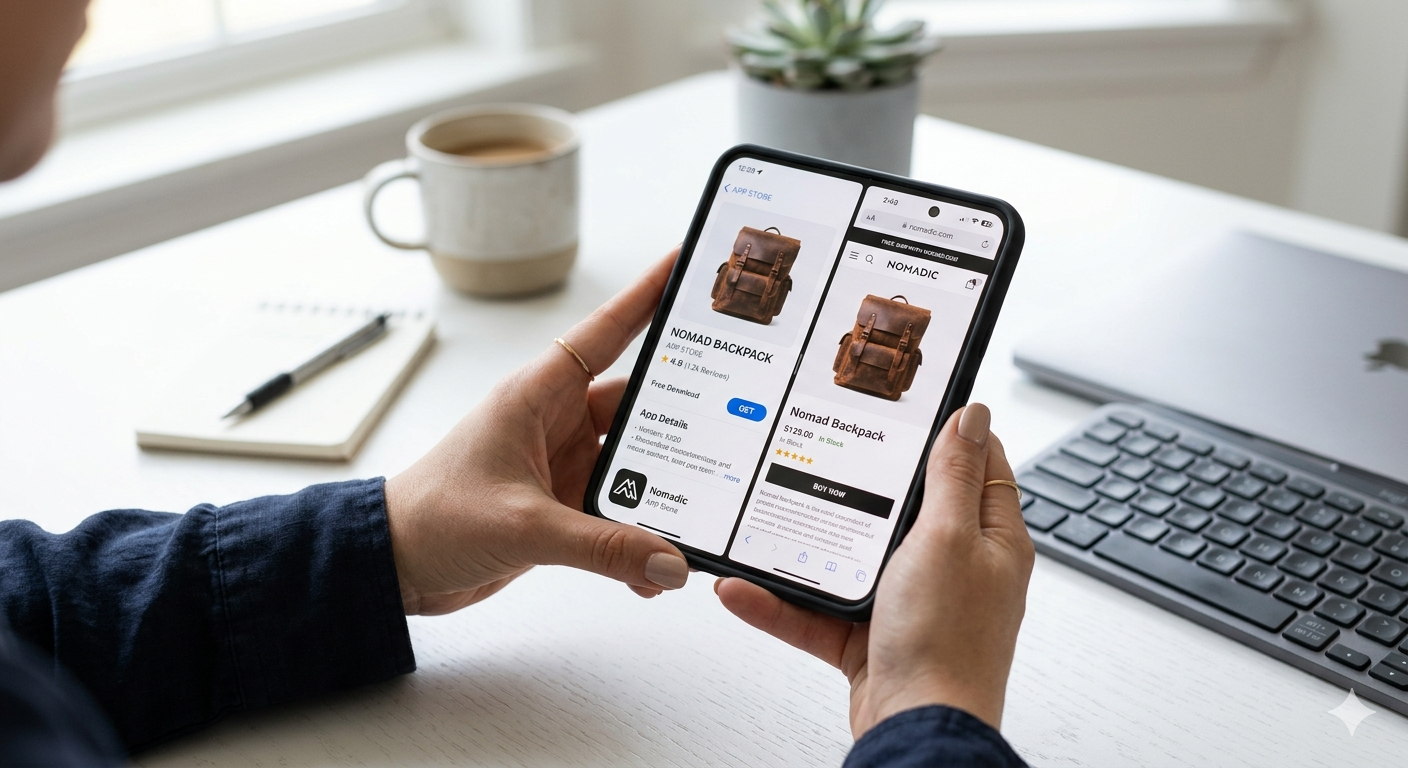
Why Your Product Doesn't Need an App
Key Takeaways
- 68% of manufacturer-branded apps are uninstalled within 30 days; only 4% of customers complete an app download flow when prompted via a product QR code.
- Web-first QR experiences achieve 30–40% scan-to-registration completion versus 4–6% for app-gated flows — using the same QR code on the product.
- A native iOS/Android app costs $150K–$500K over two years; a web-first product experience platform typically costs $48K–$240K over the same period with platform-managed infrastructure.
- Registered customers from web-first programs show 73% higher estimated lifetime value than unregistered purchasers and are 4x more likely to buy direct from the brand.
Your product manager spent $400,000 building a branded app. Your marketing team promoted it at launch. Your customer support team tells customers to download it when they call in. And 68% of the people who installed it deleted it within 30 days.
This isn't a hypothetical. It's the median outcome for manufacturer-branded apps across every category — appliances, power tools, HVAC, consumer electronics, fitness equipment. The graveyard of abandoned brand apps is one of the most expensive mistakes in post-purchase strategy, and it's still being made every quarter.
Here's what the data actually shows: customers don't want another app. They want answers. And those are two very different problems to solve.
Product Experience Delivery Model Comparison
| Metric | Native App | Web-First (QR) |
|---|---|---|
| 30-day uninstall rate | 68% | N/A (no install) |
| Customer completion at QR scan | 4-6% | 30-40% |
| Time to first use | 3-8 minutes | 5-15 seconds |
| 2-year total cost | $200-500K | $50-150K |
| Reach (% of customers scanned) | 4-12% | 60-80% |
| Maintenance overhead | High | Platform-managed |
No competitor (Apple, Google, third-party app platforms) addresses the post-purchase product experience directly. BrandedMark uniquely solves for the 96% of customers who won't download an app but will scan a QR code — delivering warranty, support, DPP, and parts discovery with zero install friction.
The App Graveyard Is Real — and It's Expensive
The average smartphone user has 80 apps installed but actively uses only 9 per day (App Annie State of Mobile 2024). Manufacturer apps for physical products almost never make that list. Industry research consistently shows:
- 68% of branded product apps are uninstalled within 30 days of first use (Adjust Mobile App Trends Report, 2024)
- 53% of users abandon an app during download if it takes more than 3 seconds to load from an unfamiliar store page
- Only 4% of customers will download a brand app when prompted via a QR code on packaging
- Average cost to build and maintain a cross-platform native app: $150,000–$500,000 over two years
The underlying problem isn't design or features. It's the fundamental mismatch between what a native app requires (download, account creation, storage allocation, permissions, updates) and what a customer actually wants in a post-purchase moment: to find their answer and get on with their day.
The Hidden Cost of App Friction
When a customer scans a QR code on a power tool and lands on an App Store page, you've already lost the majority of them. They needed to know whether the blade is compatible with their material. They needed to watch a setup video. They needed the support number. None of those needs require a native app — but the app install wall means most customers never get to the content at all.
For a customer who calls your support line instead, that's a $6–$12 cost-per-contact you absorbed entirely because your post-purchase experience was unreachable. Multiply that across warranty queries, setup questions, and spare parts lookups, and the app decision becomes a significant operational liability.
What Manufacturers Actually Need — Versus What Apps Provide
Strip back the feature roadmap and the core jobs a product experience needs to do are surprisingly narrow:
- Warranty registration — capture ownership and purchase data
- Setup and onboarding — guide first-time use, reduce early returns
- Troubleshooting support — self-serve answers before a call center contact
- Spare parts and accessories — drive aftermarket revenue
- Compliance documentation — manuals, safety notices, EU DPP requirements
Not one of those jobs requires a native app. Every single one can be delivered — faster, cheaper, and to a larger audience — through a mobile web experience accessed directly from a QR code scan.
The 4% Problem
A prominent appliance brand discovered during a post-launch audit that only 4 out of every 100 customers who scanned the QR code on their packaging completed the app download and registration flow. The 96% who dropped off had no other path to warranty registration. The brand had built a connected product experience that reached fewer customers than a paper warranty card.
When they rebuilt the experience as a web-first flow — scan, land, register, done — completion rates rose to 34% within 90 days. Same QR code. Same product. Different delivery model.
The QR-First Alternative: Scan and You're In
A web-first product experience works like this:
- Customer scans the QR code on the product or packaging
- A mobile-optimised web page loads in 1–2 seconds — no download, no account required
- The customer registers, accesses support content, finds spare parts, or reads documentation
- Returning customers who do want an account can create one — but it's optional, not a gate
This is the connected product model that actually converts. No App Store friction. No storage concerns. No permission prompts. Works on every smartphone made in the last decade, on any operating system, in any market globally.
A web-first experience can still be deeply personalised. Serial number resolution at the QR level means the page knows exactly which product variant the customer has — without the customer telling you anything. The right manual, the right parts diagram, the right troubleshooting tree. All of it, instantly.
Head-to-Head: App vs. Web-First
| Dimension | Native App | Web-First (QR) |
|---|---|---|
| Time to first use | 3–8 minutes (download + account) | 5–15 seconds |
| Audience reach | 4–12% of customers who scan | 60–80% of customers who scan |
| Build cost | $150K–$500K | $2K–$10K/month platform |
| Update speed | App store review: days to weeks | Instant, server-side |
| Analytics | Requires SDK, fragmented | Full web analytics, unified |
| Friction | High (download, permissions, storage) | Near zero |
| Cross-device | iOS + Android builds required | Single responsive build |
| Maintenance | Ongoing OS compatibility work | Platform-managed |
The web-first model wins on every dimension except one: persistent background connectivity for real-time device data. We'll get to that exception shortly — because it is real and it matters.
The Economics Are Not Close
Let's run the numbers plainly.
A mid-market manufacturer building a native iOS and Android app can expect to spend $150,000–$300,000 on initial development, plus $50,000–$100,000 per year on maintenance, OS updates, and feature iteration. Add QA, a product owner's time, and app store management, and the true two-year cost commonly lands above $400,000.
A web-first product experience platform — built on a purpose-built system with a no-code experience designer — typically runs $2,000–$10,000 per month depending on SKU volume and feature depth. Over two years, that's $48,000–$240,000, with the platform team handling infrastructure, compliance updates, and DPP requirements on your behalf.
But the more telling economic comparison isn't build cost. It's revenue. The manufacturers seeing the highest return from connected product experiences are the ones reaching the most customers post-purchase. Every additional percentage point of registration completion unlocks more warranty data, more support deflection, and more spare parts revenue. An app that reaches 6% of customers generates a fraction of the data and revenue of a web experience that reaches 35%.
When an App IS Justified
This argument is not absolute. There are genuine use cases where a native app is the right tool:
Persistent Bluetooth or BLE connectivity — If your product requires a live data connection to a physical device (a smart lock, a glucose monitor, a connected tool with real-time feedback), a native app has architectural advantages the browser cannot match.
Real-time sensor data — Industrial equipment with continuous telemetry, health devices with biometric streams, or consumer products where live status is the core experience benefit from the low-latency capabilities of native code.
Offline-heavy use cases — If customers regularly use your product without internet access and need full functionality offline (field service tools, hiking GPS devices), native apps handle offline data caching more robustly.
If your product falls into one of these categories, a native app may be justified. But here's the honest question to ask: Is the live data connection the primary value, or is it one feature among many? For most appliances, tools, and consumer durables, the answer is the latter — and those products do not need to force every customer through an app install to access support, register a warranty, or find a spare part.
A smarter architecture for this hybrid case: a lightweight web experience as the default post-purchase journey, with an optional deep-link to the native app for customers who want live connectivity features.
The Registration Multiplier
The reason web-first product experiences generate compounding returns isn't just customer satisfaction. It's data.
When your post-purchase experience is accessible to 30–40% of customers rather than 4–8%, your registered customer database grows at a fundamentally different rate. And a registered customer is worth dramatically more:
- 4x more likely to purchase direct from the brand for accessories or replacements
- 73% higher estimated lifetime value compared to unregistered purchasers
- Contactable directly for safety recalls, product updates, and renewal campaigns — without paying a retailer for the privilege
The manufacturers who invested in app-first strategies five years ago are now re-platforming to web-first. The ones who skipped the app and built on a web-native connected product platform are several product generations ahead on customer data.
What This Looks Like in Practice
A web-first product experience built on a serialised QR system gives you:
- A unique, scannable code per unit that resolves to the exact product variant, batch, and market
- A no-code experience designer that lets your team update content instantly — no developer, no app store, no delay
- Warranty registration built into the landing flow, with jurisdiction-aware rules for EU, US, UK, and other markets
- Interactive troubleshooting trees, setup guides, and video content — all in the browser
- Spare parts catalogues linked directly to the scanned product's compatible components
- GS1 Digital Link formatting and EU Digital Product Passport compliance, handled by the platform
This is what product app fatigue looks like for real brands — and why the shift is accelerating. If you're still building the case internally, the companion article on why every product needs a digital identity lays out the strategic framing, and QR code basics for dynamic product experiences covers the technical foundation.
The Bottom Line
Your product doesn't need an app. It needs a connected experience that customers will actually use.
The 96% of customers who don't download your app aren't disengaged. They're reachable — just not through a barrier that costs $400,000 to build and reaches fewer people than a paper insert. A web-first, QR-native product experience is faster to deploy, cheaper to run, and reaches an order of magnitude more customers.
The brands winning post-purchase aren't the ones with the best app. They're the ones with the highest reach, the deepest registration data, and the ability to update their product experience tomorrow morning without filing an App Store review.
Build for the 96%. The 4% will come along for the ride.
BrandedMark is the product operating system for physical goods — giving every product a digital identity, lifecycle, and ongoing customer relationship. No app required.
Frequently Asked Questions
What if we've already built a native app and customers use it?
For the small percentage of customers (typically 4-8%) who do have the app installed and active, a web-first approach doesn't eliminate it — it supplements it. The QR flow reaches the 92-96% who won't download. Existing app users get the same deep links and functionality they're used to, but the app becomes an optional engagement channel for power users, not a required gate. Many brands run both, with web-first as the default and the app as the optional next step for customers who want persistent connectivity or offline functionality.
Can a web experience handle real-time product data (Bluetooth, sensors, etc.)?
For live device connectivity, native apps do have genuine technical advantages — lower latency, better background processes, more robust offline caching. But most product post-purchase needs (warranty, support, parts, compliance) don't require live data. A hybrid approach works: web-first for 95% of the journey (warranty registration, troubleshooting, parts lookup), with optional deep-linking to the native app for the 1-2% of users who need real-time device control or sensor monitoring. Build the web experience first, add the app only if live connectivity is genuinely core to your value proposition.
How do we measure success without app store download metrics?
Web-first experiences have richer analytics than native apps. You get funnel completion (scan → register → purchase), heat maps of where customers drop off, content consumption patterns, and attribution across devices. Instead of "X downloads, Y daily active users," you measure "X% of product scans result in registration, Y% of registrations convert to accessory purchase, Z% of support deflection." These metrics map directly to revenue and customer lifetime value, which is why web-first brands typically report higher ROI than app-first — not because engagement is deeper, but because the analytics surface it more clearly.