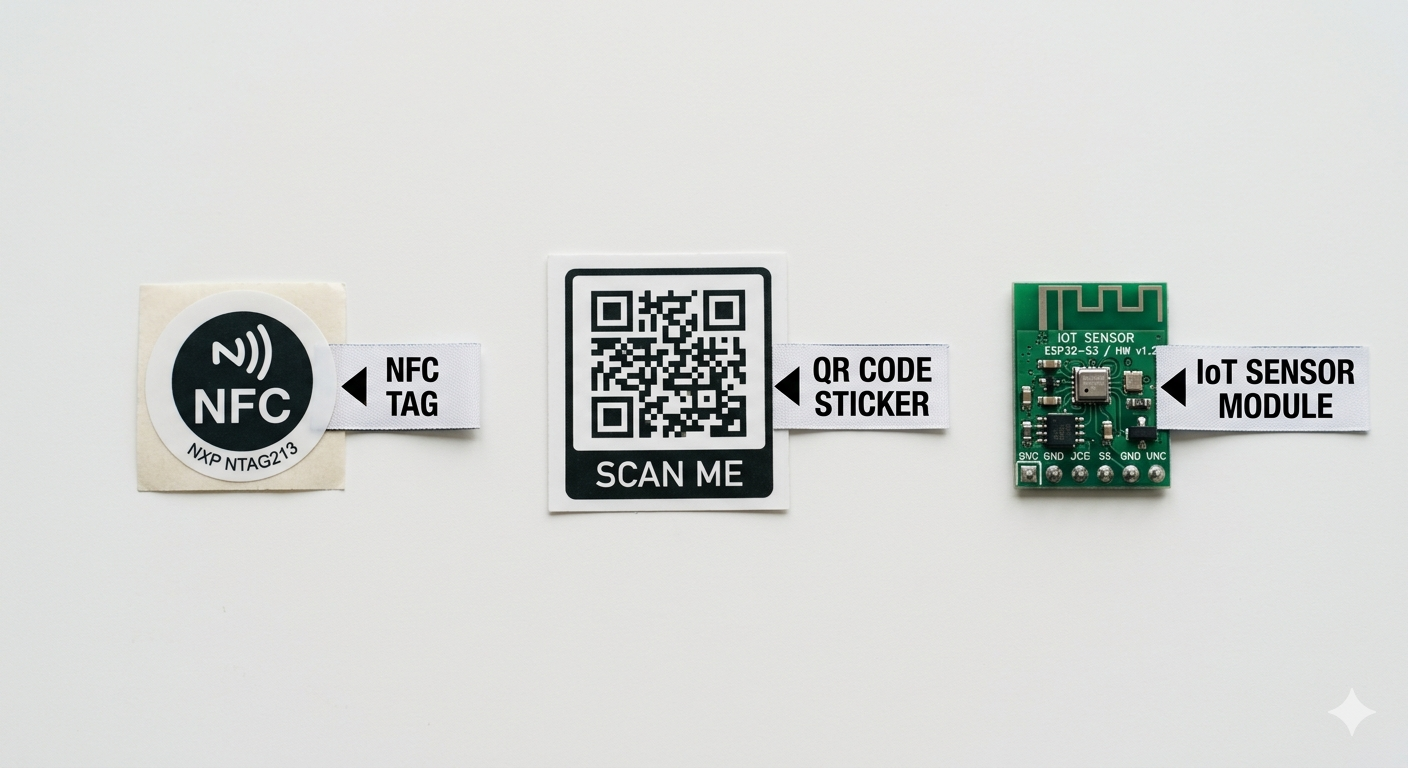
IoT vs NFC vs QR: The Connected Product Tech Stack Explained
Key Takeaways
- IoT, NFC, and QR are not substitutes — they solve different problems at different cost points across a product's lifecycle
- QR codes with GS1 Digital Link are the recommended carrier for EU Digital Product Passport compliance under ESPR, making them a dual-purpose investment
- At one million units, IoT hardware alone costs 8,000–15,000x more than QR; choosing technology without a clear use case burns budget and loses executive support
- The mature approach layers all three: QR on every unit, NFC on premium or high-risk SKUs, IoT only where continuous telemetry has a measurable ROI
Most conversations about "connected products" treat IoT, NFC, and QR codes as competing options — pick one and you're done. That framing is wrong, and it's costing manufacturers millions in unnecessary complexity, delayed rollouts, and missed customer touchpoints.
These three technologies are not substitutes. They solve fundamentally different problems at different points in a product's lifecycle. Understanding the distinction is what separates a coherent connected product strategy from an expensive experiment.
The Core Problem: Products Go Silent After the Sale
What happens to manufacturer visibility when a product leaves the factory — and what does that silence cost? Once a product ships, most manufacturers lose all direct contact with it. They do not know where it ends up, who owns it, whether it was installed correctly, when it is about to fail, or whether a safety notice ever reached the right person. That silence has a measurable commercial cost: warranty fraud from units with no verified ownership history, missed service revenue from customers who resolve problems through third-party channels, reactive recalls that reach only a fraction of affected units, and customers who quietly churn without ever registering. Connected product technology is designed to fix that silence — but the way to fix it depends on what kind of signal you need, how often you need it, and what it costs to instrument at the scale of your production volumes. IoT, NFC, and QR each answer that question differently, and choosing without a clear use case is how connected product programmes burn through budget and lose executive support.
Three Technologies, Three Jobs
IoT: Continuous Telemetry
IoT means embedding sensors, processors, and wireless connectivity (Wi-Fi, cellular, Zigbee, LoRa) directly into the product. The result is continuous, bidirectional data: temperature, vibration, energy consumption, fault codes, location — streaming from the product to your platform in real time or near-real time.
This is the right technology when you need the product to tell you something without a human initiating it. Industrial compressors that predict failure before it happens. HVAC units that self-report filter condition. Commercial refrigerators that alert before a temperature breach becomes a compliance event.
IoT is powerful — but it requires a battery or wired power, a chip, firmware, connectivity credentials, and cloud infrastructure to receive and act on data. Per-unit hardware costs typically run $5–$50 depending on connectivity type. Ongoing connectivity carries per-device data fees. And every SKU needs firmware lifecycle management.
NFC: Tap-to-Read Identity
Near Field Communication embeds a passive chip (no battery required) into the product or label. When a consumer or technician taps a compatible smartphone to the tag, the chip broadcasts a URL or data payload to the phone's NFC reader — no app required on modern iOS and Android.
NFC is the right technology when you need reliable, tamper-evident identity at a premium touch point. The chip can be embedded in hard-to-replicate substrates — moulded into plastic, encased in metal — making it far more resistant to counterfeiting than a printed label. High-end spirits, luxury goods, and safety-critical industrial parts use NFC precisely because the tag can't be peeled off and placed on a fake.
Hardware cost per unit is typically $0.10–$0.50 for standard NTAG chips, rising to $1.00+ for cryptographic or anti-tamper variants. Crucially, NFC requires the consumer to know to tap — the discoverability barrier is higher than a QR code, which anyone with a camera already knows how to use.
QR: Scan-to-Access Identity
A QR code is a printed matrix that encodes a URL. Every modern smartphone camera reads them natively. No hardware beyond ink on substrate is required. When the GS1 Digital Link standard is applied, a single QR code can resolve to warranty registration, product support, spare parts, compliance documentation, or a Digital Product Passport — all from the same code, with the destination determined by context.
QR is the right technology when you need universal reach at the lowest possible cost. Near-zero marginal cost per unit. No chip to source, manage, or integrate into your supply chain. Works on any packaging material. Readable by any consumer with a smartphone — which, globally, is now the vast majority of product buyers.
The trade-off: QR codes can be photographed and reproduced. They rely on the consumer to initiate a scan. And a printed QR code with no backend platform attached to it is just a sticker — the intelligence lives in the cloud, not the code.
Cost at Scale: 1 Million Units
What does each connected product technology actually cost when a manufacturer moves from pilot to full production volume? At one million units, the order-of-magnitude differences become decisive. A standard QR code costs approximately $0.001 per unit — roughly $1,000 for the full run. A GS1 Digital Link QR roughly doubles that. NFC in standard NTAG format runs around $0.15 per unit, or $150,000 for the same volume. Cryptographic anti-tamper NFC chips reach $0.80 per unit — $800,000 total. IoT with a Wi-Fi module runs $8.00 per unit ($8 million hardware alone), and cellular or LPWAN IoT reaches $15.00 per unit ($15 million), with additional per-device connectivity fees of $1–12 per year layered on top. These figures are illustrative estimates — actual costs vary by supplier, volume, and geography, and GS1 publishes reference benchmarks for Digital Link implementation. But the ratios are real: at production scale, IoT hardware alone costs 8,000 to 15,000 times more than QR. Choosing without a clear use case is how connected product programmes burn through budgets and lose board-level support.
The Full Comparison
How do QR codes, NFC, and IoT compare across the dimensions that matter most for a connected product programme — cost, power, consumer friction, security, and compliance? The table below maps all three technologies across thirteen criteria. Key distinctions: QR requires no hardware beyond ink on substrate, relies on a consumer scan to initiate, offers negligible anti-counterfeiting protection, and natively supports the GS1 Digital Link standard used for EU Digital Product Passport compliance. NFC requires a passive chip at $0.10–$1.00 per unit, requires a tap to initiate, offers strong anti-tamper protection in cryptographic variants, and works on iOS and Android without a special app since 2018. IoT requires a powered chip at $5–$50 per unit plus ongoing connectivity fees, initiates data collection automatically without consumer action, delivers continuous telemetry rather than on-demand data, and requires firmware lifecycle management across every deployed unit. No technology dominates on all dimensions. Each is optimal for specific use cases — the error is treating any one of them as the universal answer rather than selecting based on the data need, the interaction model, and the production economics.
The Layered Model: QR Base, NFC Premium, IoT Telemetry
How do the best-architected connected product programmes combine QR, NFC, and IoT rather than choosing between them? The mature approach layers all three according to product tier, risk profile, and use case. Layer one is QR on every unit: every product, regardless of price point, gets a serialised GS1 Digital Link QR code enabling warranty registration, self-service support, spare parts access, and Digital Product Passport compliance. Cost is negligible; implementation is a label print process change, not a product design change. Layer two is NFC on premium or high-risk SKUs where counterfeiting is a business risk — luxury goods, safety-critical components, high-value spare parts. The NFC chip provides a tamper-evident authentication layer on top of the QR foundation; a service technician taps to verify authenticity before processing a warranty claim. Layer three is IoT only on products where continuous telemetry creates measurable ROI — industrial equipment under service contracts, appliances in rental fleets, HVAC systems under maintenance agreements. IoT works alongside the QR code, not instead of it. This model is how manufacturers scale: ship QR from day one, build the customer data platform on top, and fund IoT from the service revenue that customer data generates.
Why Most Manufacturers Should Start With QR
Why should most manufacturers begin their connected product programme with QR codes even when their brand positioning is premium? The common objection — "QR feels low-tech; we're considering NFC" — confuses aesthetics with architecture. QR codes implemented correctly with GS1 Digital Link and a proper product experience platform are not visually cheap: they are structurally sound. The perceived status of a scan technology is a label design problem, not a technology selection problem. More importantly, the QR-first approach ships. NFC programmes typically require supply chain integration projects taking six to eighteen months. IoT programmes require firmware teams, connectivity agreements, and cloud infrastructure that can take years to mature. A QR code with a well-designed post-purchase experience can go live in weeks and start generating warranty registrations, support deflection, and customer data from the next production run. Platforms like Evrythng and Digimarc have explored continuous IoT telemetry for verticals where that ROI is clear — industrial, logistics, high-value electronics. Scantrust has built NFC-based anti-counterfeiting for luxury and pharma. Flowcode has shown QR's reach at consumer scale. None of these choices is wrong for its context. The mistake is treating any one as the universal starting point.
Frequently Asked Questions
Can a product have both a QR code and an NFC tag?
Yes — and for premium products, this is the recommended approach. The QR code handles the general consumer use case (no tap awareness required, works on any smartphone). The NFC tag adds an authentication layer for service technicians, sophisticated consumers, and anti-counterfeiting programmes. Both can resolve to the same backend product identity platform, so you maintain a single source of truth regardless of how the product was scanned.
Do QR codes support the EU Digital Product Passport requirement?
Yes. The GS1 Digital Link standard — which uses a QR code as its primary carrier — is the format recommended by the EU for ESPR compliance. The European Commission's Sustainable Products Regulation framework, confirmed in the Official Journal of the EU, designates QR-based Digital Link as the primary mechanism for Digital Product Passport data access across regulated product categories. A properly formatted GS1 Digital Link QR code can resolve to a Digital Product Passport endpoint, warranty information, and consumer support content simultaneously. This means the same code you print today for customer experience purposes is also your compliance carrier for the EU DPP regulation. For more detail, see our article on smart packaging and what it means for manufacturers.
When does IoT make economic sense?
IoT justifies its hardware and connectivity cost when at least one of the following is true: (1) the product operates under a service contract where predictive maintenance has measurable labour savings; (2) the product is in a rental or managed fleet where fleet visibility directly reduces operational cost; or (3) the product category carries regulatory requirements for continuous monitoring (industrial safety equipment, medical devices, refrigerated transport). For consumer durables in retail channels — appliances, power tools, consumer electronics — the economics rarely support IoT from day one. Start with QR, build the customer relationship, and let the data tell you which products in your portfolio warrant telemetry investment.
Bringing It Together
What is the right framework for choosing between IoT, NFC, and QR when building a connected product programme for the first time? Connected product strategy is not a technology selection exercise — it is a data architecture decision that happens to involve technology. The question is not "QR or NFC or IoT?" The question is: what data do I need, when do I need it, who needs to initiate the interaction, and what does it cost at my production volumes? For manufacturers starting from scratch, the answer is almost always the same: begin with serialised QR codes on every unit, build a product experience platform that turns those scans into customer relationships, and layer in NFC and IoT selectively where the use case justifies the cost. The companies that get this right are not the ones with the most sophisticated technology on the product. They are the ones with the clearest picture of every product in the field — who owns it, whether it is working, and what that customer needs next. That visibility starts with a code on every unit. Everything else builds from there.
Want to understand how this technology layer connects to a complete product identity strategy? Read our guides on NFC vs QR codes for products — when to use which and why every product needs an API.