How Even Big Brands Botch Digital Packaging
Key Takeaways
- 98% of QR code scans happen on mobile devices — yet most brands still design landing experiences for desktop first.
- The 3-second rule is absolute: if the QR fails to scan, the page is slow to load, or the value proposition is unclear within three seconds, most customers abandon and will not scan again.
- Common failure modes — QR codes too small, app download gates, broken links on social sharing — are entirely avoidable with pre-launch technical validation.
- Success metric confusion (measuring scan counts rather than meaningful business outcomes) is the root cause of most connected packaging underperformance.
Major brands have spent millions on connected packaging campaigns that drove scans to broken links, mobile-unfriendly pages, and experiences that generated more complaints than engagement.
Even the biggest brands with unlimited budgets are failing at digital packaging. The good news? Their mistakes are your competitive advantage. Before investing in any connected packaging initiative, it's worth working through a connected packaging checklist to make sure you're building on solid foundations — and understanding what a connected product platform actually does before you pick one. The right platform starts with robust product identity infrastructure that makes every QR code reliably resolvable and trackable.
The Hidden Epidemic of Digital Packaging Failures
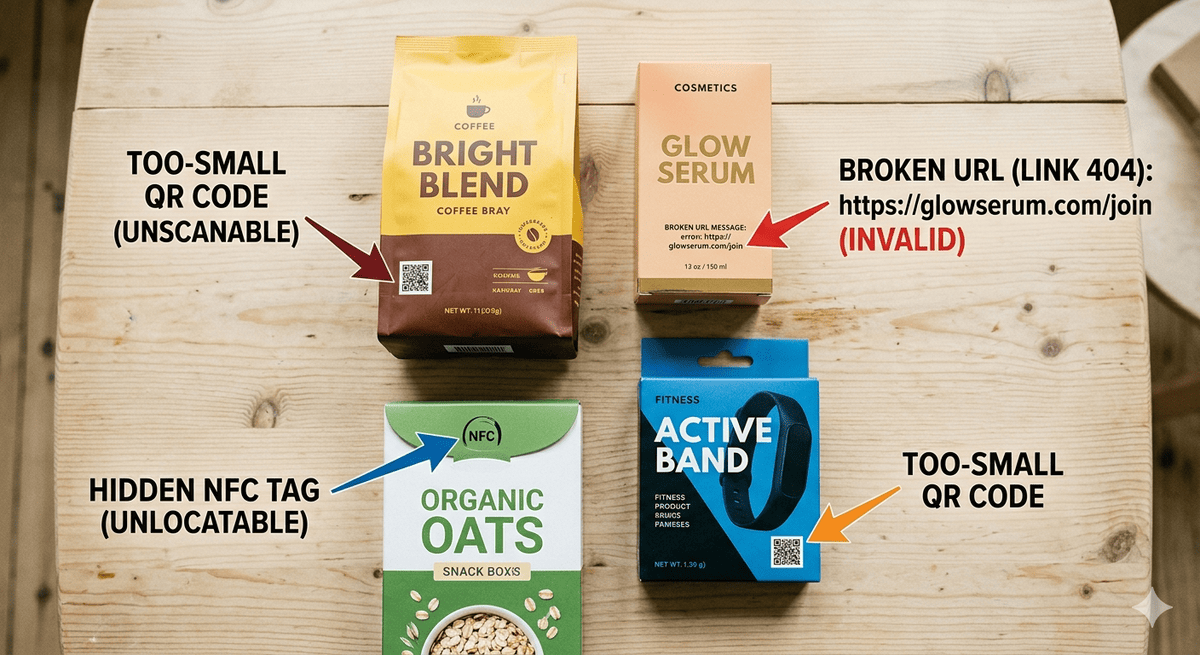
Digital packaging failures are more widespread than most brand managers admit. Audits of connected packaging programmes consistently surface QR codes linking to non-mobile-optimised pages, brand apps with poor ratings that customers must download before accessing any value, and dynamic codes carrying tracking parameters that silently break when shared. Most campaigns compound these problems by lacking the analytics infrastructure to detect failure at all — teams measure scan volume rather than whether the scan led anywhere useful. The institutional reasons are predictable: packaging teams and digital teams operate in separate silos, multiple agencies hand off deliverables without owning the end-to-end journey, and time-to-market pressure kills real-world device testing. The result is significant budget spent on connected packaging that neither engages customers nor delivers measurable business outcomes. Understanding these failure patterns is the first step to avoiding them.
The Scale of the Problem
Common patterns from connected packaging audits:
- Many QR codes link to non-mobile-optimized pages
- Brand apps required for package interaction frequently have low ratings
- Dynamic codes often contain tracking parameters that break on social sharing
- Most campaigns lack proper analytics to measure actual engagement
The cost: Companies waste significant budget on connected packaging that fails to deliver promised experiences.
Why Big Brands Keep Getting It Wrong
The institutional factors that create failure:
Silo mentality: Packaging teams work separately from digital teams, creating disconnected experiences.
Agency handoffs: Multiple vendors handle different pieces without understanding the complete customer journey.
Testing shortcuts: Rush to market without real-world testing across devices, networks, and user contexts.
Success metric confusion: Measuring QR code scans instead of meaningful engagement and business outcomes.
Common Failure Patterns from Major Brands
Three failure patterns appear repeatedly across industries and budget levels. The first is the tiny, slow QR code: codes printed below 0.5 inches that resist scanning, paired with landing pages too heavy for mobile networks and video content that exhausts data plans. The second is the desktop-only landing page: AR or interactive experiences designed for large screens, requiring specific browser versions and serving no graceful fallback to customers on older devices. The third — and most avoidable — is the app download gate, where the QR code offers no value until the customer installs an app they don't want, only to find content identical to the public website. Each pattern shares the same root cause: creative ambition outpacing technical execution. For a closer look at why product-specific apps backfire, see why product apps create more problems than they solve.
Failure Pattern 1: The Tiny, Slow QR Code
The scenario: A brand launches personalized QR codes on packaging linking to rich media content.
What goes wrong:
- QR codes are too small (under 0.5 inches) for reliable smartphone scanning
- Landing pages take too long to load on mobile networks
- Video content is too heavy for mobile data plans
- No fallback for customers on slower connections
The lesson: QR code size, page performance, and data usage matter more than creative execution.
Failure Pattern 2: The Desktop-Only Landing Page
The scenario: AR or interactive experiences accessible via QR codes on packaging.
What goes wrong:
- Landing pages are desktop-optimized only -- unusable on phones
- Advanced features require specific browser versions not disclosed to customers
- Permission flows are confusing and invasive
- No graceful degradation for older devices
The lesson: Mobile-first design isn't optional -- it's the only design that matters for packaging QR codes.
Failure Pattern 3: The App Download Gate
The scenario: QR codes on packaging driving app downloads for "exclusive" content.
What goes wrong:
- QR codes require app download before revealing any value
- Apps are too large for many customers' available storage
- Content behind QR codes is identical to public website
- No instant gratification for scanning
The lesson: Never gate basic content behind app downloads. Provide immediate value, then earn the app install. For a deeper look at why product-specific apps so often backfire, see why product apps create more problems than they solve.
The Anatomy of Digital Packaging Failure
Every digital packaging failure traces back to one of two root causes: a technical fault that prevents the experience from working, or a UX breakdown that prevents customers from understanding or completing it. Technical faults cluster around QR code generation and landing page performance — codes too small or low-contrast, pages that load slowly on 3G, touch targets sized for a desktop cursor rather than a thumb. UX breakdowns happen after a successful scan: customers reach a generic page indistinguishable from the public website, encounter a form demanding personal data before delivering any value, or arrive at a dead end with no obvious next action. Fixing the technical layer is straightforward with pre-launch validation. Fixing the UX layer requires treating the post-scan journey as a distinct product — one with its own conversion funnel, value proposition, and success criteria.
Technical Failure Points
QR Code Generation and Placement:
- Size errors: Codes smaller than 0.8 inches fail on many devices
- Contrast issues: Insufficient color contrast prevents scanning in various lighting
- Position problems: Codes placed on curved surfaces or package edges
- Material interference: Glossy or textured surfaces that scatter light
Landing Page Performance:
- Mobile optimization: Desktop-first pages that don't resize properly
- Loading speed: Pages over 3 seconds lose most mobile users
- Content accessibility: Text too small, buttons too close together
- Network tolerance: Heavy pages that fail on slower connections
User Experience Breakdowns
Scanning Friction:
- No clear call-to-action: Customers don't understand what the QR code offers
- Multiple codes: Confusion about which code to scan for what purpose
- Brand confusion: QR codes that don't clearly identify the brand or promise
- Value proposition failure: No immediate benefit explained for scanning
Post-Scan Disappointment:
- Generic content: Same information available elsewhere without scanning
- Broken promises: Landing pages that don't deliver what packaging suggested
- Dead ends: Content with no clear next action or engagement path
- Data demands: Requiring personal information before providing value
The Success Checklist: Getting Digital Packaging Right
Avoiding the failure patterns above requires systematic pre-launch validation across three areas: QR code technical standards, landing page performance, and analytics setup. The checklists below define the minimum bar for each. A QR code that meets size and contrast requirements but links to a slow page still fails the 3-second test. A fast page with no measurement framework produces data you cannot act on. All three areas must pass before a connected packaging campaign goes to print — reprinting is expensive; fixing issues before launch is not.
Pre-Launch Technical Validation
QR Code Standards:
- Minimum size: 0.8" x 0.8" (2cm x 2cm) for reliable scanning
- Contrast ratio: 4.5:1 minimum between code and background colors
- Quiet zone: 4-module border around all sides of the code
- Error correction: Level M (15%) minimum for packaging environments
Landing Page Performance:
- Mobile-first design: Responsive layout tested on 10+ device sizes
- Load time: Under 3 seconds on 3G connections
- Content hierarchy: Key information visible without scrolling
- Touch targets: Minimum 44px button size with adequate spacing
Content and Experience Quality
Value Proposition Clarity:
- Immediate benefit: Clear explanation of what scanning provides
- Unique content: Information not available through other channels
- Progressive value: Deeper engagement opportunities for interested users
- Brand consistency: Visual and messaging alignment with packaging design
User Journey Optimization:
- One-tap access: No app downloads required for basic content
- Graceful degradation: Fallback options for older devices/browsers
- Privacy respect: No personal data required for initial value
- Social sharing: Easy sharing options that preserve tracking parameters
Analytics and Optimization Setup
Measurement Framework:
- Scan tracking: QR code engagement rates and geographic patterns
- Conversion funnel: From scan to meaningful action completion
- Content performance: Which pages/features drive highest engagement
- Error monitoring: Real-time alerts for broken links or server issues
Continuous Improvement:
- A/B testing capability: Ability to test different landing page variants
- User feedback collection: Simple rating or comment systems
- Performance monitoring: Weekly reports on key experience metrics
- Content update workflow: Process for rapid content changes without reprinting
Industry-Specific Considerations
The failure patterns described above appear across every vertical, but the specific constraints differ by industry. Consumer packaged goods brands face retail scanning conditions — bright overhead lighting, impulse purchase timing, customers who span the full range of technology comfort — where simplicity of value proposition is the only reliable strategy. Electronics brands must manage multiple QR codes per product, long product lifecycles, and technically sophisticated customers who will notice poor UX immediately. Fashion and luxury brands carry an additional constraint that the others do not: the digital experience must be visually premium enough to protect brand positioning, because a cheap-feeling landing page degrades the perception of a £300 product just as surely as poor packaging materials. Each vertical rewards the same underlying discipline — mobile-first, fast, immediate value — applied through a lens appropriate to its context.
Consumer Packaged Goods (CPG)
Unique challenges:
- Retail environment scanning: Bright lighting, crowded shelves, impulse context
- Repeat purchase focus: Building loyalty rather than one-time engagement
- Mass market appeal: Serving diverse technology comfort levels
Best practices:
- Simple value propositions: "Scan for recipes" or "Get coupons"
- Offline compatibility: Content that works without internet after initial load
- Family-friendly content: Experiences appropriate for all household members
Electronics and Appliances
Unique challenges:
- Complex products: Multiple QR codes for different purposes (setup, support, warranty)
- Long product lifecycles: Content that remains relevant for 5+ years
- Technical customers: Higher expectations for digital experience quality
Best practices:
- Clear code labeling: "Setup," "Support," "Register," etc.
- Versioned content: Different experiences for product variants
- Expert-level resources: Detailed technical information for power users
Fashion and Luxury
Unique challenges:
- Brand image protection: Digital experience must match premium positioning
- Seasonal relevance: Content that stays fresh across product lifecycle
- Social media integration: High shareability and visual appeal requirements
Best practices:
- Premium design: High-quality visual and interaction design
- Exclusive content: Behind-the-scenes, styling tips, limited offers
- Influencer integration: Seamless social sharing and attribution
The Connected Packaging Success Formula
The 3-second rule is the single most reliable predictor of connected packaging success or failure. Second one: the QR code scans without multiple attempts — which depends entirely on size, contrast, and placement. Second two: the landing page loads with a visible value proposition — which depends on mobile optimisation and server response time. Second three: the customer understands what to do next — which depends on content clarity and UX design. If any of those three seconds fail, most customers abandon and do not scan again. This is not a theoretical framework; it is a description of how human attention behaves on a phone in the real world. The mobile-first imperative reinforces the same point: 98% of QR code scans happen on mobile devices, yet most brands still design landing experiences for desktop. That mismatch is the single most common cause of post-scan abandonment.
The 3-Second Rule
Your connected packaging has 3 seconds to prove its value:
- Second 1: QR code scans successfully without multiple attempts
- Second 2: Landing page loads with clear value proposition visible
- Second 3: Customer understands and can act on the offered value
If any step fails, most customers abandon and won't scan your codes again.
The Mobile-First Imperative
98% of QR code scans happen on mobile devices (MobileIron QR Code Consumer Behaviour Report) — yet most brands still design for desktop first.
Mobile-first requirements:
- Thumb-friendly navigation: All actions possible with one hand
- Data consciousness: Assume customers have limited data plans
- Battery awareness: Minimize CPU-intensive features like video autoplay
- Attention span: Critical information in first screen, details below
The Future of Connected Packaging Excellence
The brands investing in connected packaging today are building infrastructure that will support capabilities not yet mainstream. Computer vision will let customers scan any part of a package rather than hunting for a QR code. NFC will enable tap-to-connect for premium and reusable products without requiring a camera at all. Voice integration will allow customers to query product information hands-free. AI personalisation will serve different content to a first-time buyer and a loyal repeat customer scanning the same package. These are not distant possibilities — they are features already in production for leading brands. The common requirement across all of them is the same clean product identity layer that makes QR codes work reliably today: a unique, persistent, resolvable identifier per product unit that any surface or interface can reference. Brands that build on that foundation now will activate emerging channels without re-engineering their packaging.
Emerging Technologies
Next-generation capabilities that leading brands are testing:
Computer vision integration: Scan any part of packaging, not just QR codes NFC enhancement: Tap-to-connect for premium products and reusable packaging Voice activation: "Hey Google, what's in this product?" integration AI personalization: Content that adapts to individual customer preferences and history
Predictive Experience Design
Using data to prevent failures before they happen:
- Device targeting: Optimize experiences based on scanning device capabilities
- Network adaptation: Serve different content based on connection speed
- Location awareness: Contextual information based on geographic scanning patterns
- Time sensitivity: Different experiences for immediate vs. delayed scanning
The Branded Mark Quality Standard
The standard for connected packaging is straightforward to define and harder to consistently deliver: every scan should return meaningful content in under three seconds on any smartphone made in the last six years, on any network, without requiring an app download or a form submission. Content must be unique — not a restatement of what appears on the packaging or the public website — and it must update without triggering a reprint. Measurement must track conversion outcomes, not just scan counts. BrandedMark is built around these requirements. When customers scan your QR codes, they are giving you their attention — the scarcest resource in consumer marketing. The brands that honour that attention by delivering fast, relevant, genuinely useful experiences build the trust that earns more complex digital relationships over time. The brands that waste it train customers to stop scanning.
When customers scan your QR codes, they're giving you their most valuable asset: attention. Don't waste it with the same mistakes that have plagued even the biggest brands. If you want to see what best-in-class looks like, our comparison of the best connected packaging platforms shows how leading vendors approach quality and experience.
Your connected packaging is a direct reflection of your brand's digital competence. Get it right, and customers will trust you with more complex digital relationships. Get it wrong, and they'll question everything else you do.
Ready to audit your digital packaging? Start with the checklist above, test your QR codes on 5 different devices, and time your landing page load speed. Your customers—and your bottom line—depend on getting the details right.
Frequently Asked Questions
What is the minimum QR code size for reliable scanning on packaging?
The practical minimum is 2 cm × 2 cm (approximately 0.8 inches square) with a clear quiet zone of at least 4 modules around the code. At arm's length in typical indoor lighting, codes below this size fail on a meaningful percentage of devices. For packaging that may be scanned in retail environments with variable lighting, 3–4 cm is the recommended standard. Bigger than that adds no meaningful scan reliability benefit.
Why do dynamic QR codes break on social sharing?
Dynamic codes often embed tracking parameters — UTM strings, session tokens — directly in the encoded URL. When a customer screenshots the QR code and shares it, or when a social platform renders the URL as a preview link, these parameters can get stripped or altered, causing the scan to resolve to a 404 or a generic page. The fix is to use a short, clean redirect URL in the QR code and apply tracking via server-side redirects rather than encoding parameters in the QR itself.
What load speed should a QR landing page achieve?
Under 3 seconds on a 3G connection is the industry threshold — pages that exceed this lose most mobile users before they see any content (Google research shows 53% of mobile visits are abandoned if a page takes longer than 3 seconds to load). In practice, the QR landing page should be treated like an AMP page: minimal JavaScript, compressed images, deferred non-critical resources, and server-side rendering for the above-the-fold content.
What is "success metric confusion" in connected packaging?
Success metric confusion is measuring QR scan counts as the primary KPI. Scans are a leading indicator of engagement, not a measure of business value. The correct metrics are conversion funnel metrics: scan-to-registration rate, scan-to-support-resolution rate, scan-to-parts-purchase rate. A campaign that generates 100,000 scans with 0.5% registration conversion is underperforming a campaign that generates 20,000 scans with 35% registration conversion — even though the scan count looks better.