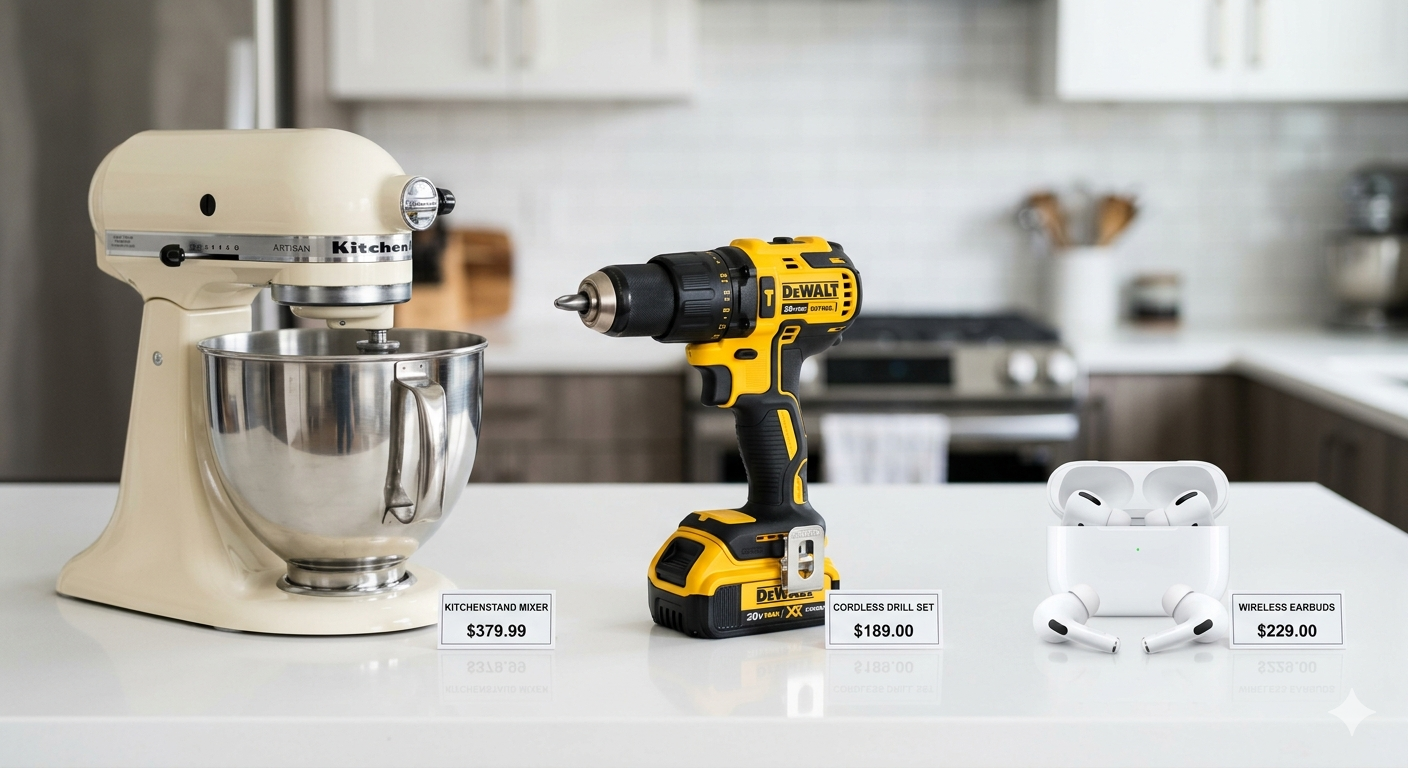
Connected Product ROI: Appliances vs. Tools vs. Electronics
Every connected product program is sold on the same promise: scan a QR code, know your customer, sell them more stuff. What nobody tells you is that the actual financial return looks completely different depending on what you make.
The mistake most manufacturers make is applying a generic "connected product" business case to their specific vertical. They benchmark against case studies from the wrong industry, set the wrong KPIs, and then conclude the program underperformed, when really it was just optimizing for the wrong outcome.
There are five value streams that apply universally to connected physical products: warranty registration, support deflection, aftermarket revenue, first-party data, and Digital Product Passport (DPP) compliance. Every manufacturer can capture value from all five. But the magnitude of each stream swings widely depending on the industry. A CFO approving a connected product budget in the appliances division needs a completely different ROI model than one approving the same program for consumer electronics.
This article breaks down the model by vertical. We will look at appliances, power tools, consumer electronics, and outdoor/sporting goods, then put them side by side for a hypothetical brand shipping a fixed monthly volume in each category.
Primary ROI Drivers by Industry
| Value Stream | Appliances | Power Tools | Consumer Electronics | Outdoor/Sporting |
|---|---|---|---|---|
| Support Deflection | Moderate | Moderate | High | Lower |
| Aftermarket Revenue | High | Highest | Lower | Lower |
| Ownership Transfer | Low | Low | Low | High |
| First-Party Data | Long-tail | Long-tail | Immediate value | Brand-moat |
| DPP Compliance | High value | Medium | High value | Medium |
| Primary lever | Aftermarket | Consumable attach | Support deflection | Ownership transfer |
Why a Vertical-Aware Model Matters
Connected product ROI is often modeled the same way for every category, treating all products as interchangeable. In practice, the value drivers differ. For some categories the lead lever is aftermarket and compliance; for others it is support deflection; for others it is ownership transfer at resale. BrandedMark's approach is designed to be industry-aware: it surfaces different KPIs and business-case priorities for appliances (parts revenue), power tools (consumable attach), electronics (support deflection), and sporting goods (ownership transfer). The platform infrastructure stays the same, but the analytics and the headline metric you optimize for shift to match your vertical's primary value stream.
One Framework, Five Value Streams
Before the vertical breakdown, it helps to define the five levers precisely. These are the building blocks of every connected product ROI model.
1. Warranty Registration Revenue Not the warranty itself, but the data and relationship captured when a customer registers. A registered customer is one you can reach directly, and the financial impact comes from downstream purchases rather than the registration event itself.
2. Support Deflection Savings Every product scan that resolves a customer question without a phone call or live chat can save real money. The cost of a handled support contact varies widely, from lower for simple consumer products to higher for technical or trade products. Self-service via a product QR code or serial-linked portal is typically much cheaper per resolution than a handled contact.
3. Aftermarket Revenue Parts, consumables, accessories, extended warranties, and service contracts sold directly to verified product owners. This is a revenue stream that many manufacturers currently leave to third-party retailers and marketplace resellers.
4. First-Party Data Value The long-term compounding asset: a database of verified, opted-in product owners linked to specific serial numbers, purchase dates, and geographic locations. The value tends to grow over time as the database grows and enables more precise marketing.
5. Digital Product Passport (DPP) Compliance The EU's Ecodesign for Sustainable Products Regulation (ESPR) introduces Digital Product Passport requirements that are being phased in across product categories. The compliance infrastructure built for a connected product program can contribute to DPP readiness. Brands that build it proactively can spread the cost across other ROI-positive use cases; brands that build it reactively may treat it purely as a compliance cost with no upside.
Now, the vertical breakdown.
Appliances: The Aftermarket Gold Mine
Appliances are one of the most underconnected product categories relative to the financial opportunity waiting to be captured.
The Registration Gap Is Enormous
Many appliance manufacturers operate with warranty registration rates that leave a large share of their customers unregistered. That means many of the customers who bought your refrigerator, dishwasher, or range hood are invisible to you. You know the unit shipped to a distributor. You do not know who owns it, where it is installed, or whether they are still happy with it.
The product lifetime for major appliances spans many years. In that window, a single household with a registered appliance represents multiple high-value touchpoints: filter replacements, service calls, spare parts, extended warranty upsells, and eventually a replacement purchase influenced by brand satisfaction.
Consider, as an illustrative example, a white goods manufacturer that runs a connected product pilot on a premium dishwasher line. By adding a GS1 Digital Link QR to the inside door panel, visible at installation and not just unboxing, it aims to lift warranty registration in the first few months. The intent is that the registered cohort generates more aftermarket revenue than the unregistered cohort over the following stretch of ownership. Treat this as a hypothetical to model against your own baseline, not a measured result.
Support Deflection Is Useful but Not the Lead
Appliance support volume is moderate compared to consumer electronics. The typical call drivers are installation questions, error codes, and filter/consumable replacement intervals. A product QR linked to an interactive troubleshooting guide and video library can deflect a share of these contacts.
- Ticket cost for appliance support: a per-contact cost for each handled contact
- Self-service deflection: a share of tier-1 inquiries handled without an agent
- Net effect per registered unit: a per-unit saving accumulated over the product's life
The real money, though, is not in deflection. It is in aftermarket.
The Spare Parts and Consumables Opportunity
For appliances with consumables (filters, water cartridges, detergent pods, UV lamps), the recurring purchase opportunity is substantial. The aim of a connected product experience is to make it easier for a registered owner to buy replacement parts directly from the OEM rather than reaching for a generic substitute on a marketplace.
Direct parts revenue per registered appliance owner accrues over the product lifetime, with the size of the opportunity depending on the appliance category. Capturing it directly, rather than ceding it to generic substitutes, is the strategic aim of the connected experience.
An extended warranty offer sent to a registered, connected owner reaches a known, opted-in customer rather than a generic email list, which is the rationale for prioritising registration. See our deeper analysis in The Spares and Accessories Opportunity.
Primary ROI driver for appliances: aftermarket revenue and lifetime customer relationship.
Power Tools: The Consumable Multiplier
Power tools present a different financial geometry. The unit economics of the tool itself are thin. The real money is in the blade, bit, battery, and belt that the tool consumes.
Lifetime Consumable Spend Can Dwarf the Tool Purchase
For many power tool users, lifetime consumable spend can outstrip the original tool purchase by a wide margin. A professional carpenter who buys a circular saw will keep buying blades for years. A DIYer who buys a cordless drill will keep spending on bits and batteries. The exact ratio depends on tool type and usage intensity, so treat it as a relationship to model against your own catalogue, not a fixed figure.
The OEM often does not capture this spend. The customer buys the original tool at retail, and consumable purchases tend to go to whoever shows up first in a marketplace search or sits on the shelf at the nearest hardware store.
A connected product scan on tool registration changes this equation. The registration captures the customer. The connected experience establishes direct communication. Every consumable reminder email, blade compatibility notification, or battery upgrade prompt can be sent to a verified, opted-in buyer of that exact tool.
QR on the Tool Body Is a Permanent Channel
The QR code placement strategy matters enormously for power tools. Unlike an appliance that is installed in a fixed location, a power tool is handled regularly. A QR on the battery housing, chuck plate, or tool body is physically present at every use.
This is not a one-time unboxing scan opportunity. It is a permanent channel that can be activated at any point in the product lifecycle. A contractor who bought the tool many months ago can scan today, register, and enter the connected ecosystem. Few other consumer goods categories offer this kind of passive, always-available registration surface.
Consumable-Linked Marketing as a Revenue Lever
Picture, as a hypothetical, a professional-grade power tool manufacturer that embeds a GS1-linked QR on the battery pack of its cordless range. The post-scan experience includes tool registration, a compatibility guide for blades and bits, and a direct shop link.
The kinds of outcomes such a program is designed to drive:
- A higher registration rate from the connected QR than from a paper card
- A share of registered users purchasing a consumable via the direct link
- A healthy average direct consumable order value
- Net additional revenue per registered unit, plus a downstream loyalty effect
The downstream loyalty effect can compound over time. The aim is that registered tool owners who buy consumables directly become more likely to repurchase when the next product is launched. Treat these as illustrative relationships to test against your own data.
Primary ROI driver for power tools: consumable attach and direct channel ownership.
Consumer Electronics: Support Deflection Is the First Win
Consumer electronics operates on a fundamentally different timeline from the other categories. Product lifespans are short rather than measured in a decade. Customers are often less emotionally connected to the category. And the support burden, particularly in the early ownership window after purchase, tends to be higher than in the other segments.
The Early-Ownership Support Cliff
For consumer electronics, the early ownership window is often the highest-cost support window. Setup confusion, firmware conflicts, connectivity failures, compatibility questions, and basic operation issues drive a surge of contacts soon after unboxing.
A large share of consumer electronics support contact tends to land soon after purchase, while customers are still setting the product up.
With each handled contact carrying a per-contact cost, a consumer electronics brand at meaningful monthly volume faces a substantial early-ownership support bill before a single connected product program is in place. The variation is driven by product complexity, from a budget Bluetooth speaker at the low end to a smart home hub at the high end.
Register at Unboxing or Never
The window for warranty registration in consumer electronics is heavily concentrated at the unboxing moment. Unlike an appliance that stays in the home for years, an electronics product may be passed on, sold, or forgotten within a short span. A customer who does not scan the registration QR at setup will rarely return to do it later.
This makes the unboxing experience design critical. A QR code printed inside the box or on the product itself, linked to a frictionless setup guide and registration flow, captures the customer at peak engagement. The aim is that in-box QR placement lifts registration well above what paper registration cards or email-only prompts achieve. For more on sub-30-second support activation, see Sub-30-Second Support.
Support Deflection Is the Most Defensible Number
When a registered customer encounters a problem and scans their device QR, they arrive in a personalized product portal with their exact serial number, firmware version, and purchase date already populated. The troubleshooting guide is specific to their unit and software version, not a generic FAQ page.
- Self-service resolution: a share of incoming tier-1 issues handled without an agent
- Cost per self-service resolution: typically much lower than a handled contact
- Cost per handled agent contact: a per-contact cost that varies by product complexity
- Net effect: most of the handled-contact cost avoided on each deflected issue
For a consumer electronics brand with meaningful support volume, the goal is a useful support saving per registered unit, accumulating across a full year of shipments into a worthwhile annual support cost reduction. Model the exact figures against your own contact rates and per-contact cost.
Primary ROI driver for consumer electronics: support deflection in the early ownership window.
Outdoor and Sporting Goods: Ownership Transfer as a Value Stream
The outdoor and sporting goods category has a characteristic not shared by the other verticals: a strong secondary market.
Premium bicycles, ski equipment, climbing gear, golf clubs, and kayaks change hands regularly, with an active resale culture around durable, high-value gear. This creates a value stream that most connected product programs ignore entirely: ownership transfer.
The Resale Opportunity
When a product is resold without a connected product program, the manufacturer typically loses the new owner entirely. The original registration is dead, the new customer has no relationship with the brand, and the product, often still under a structural warranty, is effectively orphaned.
A connected product QR on the product body allows the new owner to scan, transfer ownership, and enter the brand ecosystem. The new customer arrives with a high-intent signal: they cared enough about this product category to buy premium secondhand.
For BrandedMark's approach to this opportunity, see the full breakdown in Product Resale Brand Strategy.
Identity-Driven Brand Loyalty
Outdoor and sporting goods often carry a strong sense of brand identity for the people who buy them. A customer who registers their premium jacket, their trail running shoe, or their high-end paddle, and then receives a genuinely useful connected product experience (care guides, repair resources, sustainability passport), is expressing and reinforcing a brand identity, not just completing an administrative task.
Primary ROI driver for outdoor and sporting goods: ownership transfer capture and identity-reinforced loyalty.
The Comparison: A Single Monthly Volume, Four Verticals
The table below models a hypothetical brand in each vertical running a connected product program on the same base of units shipped per month. The figures are illustrative, for-example relationships, not measured results.
| Metric | Appliances | Power Tools | Consumer Electronics | Outdoor / Sporting |
|---|---|---|---|---|
| Relative unit price | Higher | Lower | Mid | Mid |
| Product lifetime | Longest | Long | Short | Long |
| Unconnected reg. rate | Low | Lowest | Low | Low |
| Connected reg. rate | Higher | Higher | Higher | Higher |
| New registrations/month | Large uplift | Large uplift | Large uplift | Large uplift |
| Support deflection savings/yr | Moderate | Moderate | Highest | Lower |
| Direct aftermarket rev/yr | High | Highest | Lower | Lower |
| Ownership transfer captures/yr | Low | Low | Low | High |
| DPP compliance value | High (ESPR) | Medium | High (ESPR) | Medium |
| Primary lever to model | Aftermarket | Consumable attach | Support deflection | Ownership transfer |
These are illustrative, hypothetical relationships, not measured figures. Your actual numbers depend on unit price, registration rates, support volume, aftermarket margin, and deflection rate, and should be modeled against your own baseline.
Reading the Table
Three things stand out.
Power tools lead on total uplift in this model despite the lowest unit price, because the consumable multiplier is powerful and the permanent QR channel compounds over time. The ROI math is driven by attach rate and repeat purchase, not original product margin.
Consumer electronics leads on support deflection in this model, because support volume tends to be structurally higher and the early-ownership cliff is expensive. If your CFO is skeptical of a connected product ROI case, support deflection is often the fastest and most defensible number to present.
Appliances lead on lifetime relationship value because the long product lifespan and moderate-to-high consumable attachment create a compounding customer relationship. A connected appliance owner registered today is a potential touchpoint for many years.
Outdoor and sporting goods shows the lowest near-term total in this model because the ownership transfer value is harder to convert to near-term revenue, and consumable attachment is category-dependent. The strategic value, brand loyalty and secondary market recapture, is real but longer-cycle.
What This Means for Your Business Case
If you are building internal approval for a connected product program, the industry-specific framing matters as much as the total number.
A support director in consumer electronics will respond to deflection economics. A VP of aftermarket in appliances will respond to lifetime parts revenue. A brand manager in outdoor goods will respond to the resale recapture story. A product compliance officer across all verticals will respond to DPP readiness.
Build your ROI model around the primary driver for your vertical, use the secondary drivers as supporting evidence, and ground every number in the warranty registration conversion lift your connected product QR generates versus your current baseline.
The infrastructure investment is largely the same across verticals: a product experience platform, QR code deployment on packaging or product body, and a connected portal. What changes is the headline metric you optimize for and the playbook you run on top of the registered base.
Build the ROI Case for Your Vertical
BrandedMark is the connected product platform built for durable goods manufacturers. Whether you are optimizing for support deflection in electronics, consumable attach in tools, or lifetime parts revenue in appliances, the Product OS gives you the infrastructure to capture all five value streams, and the analytics to prove which ones are working.
The economics above are illustrative. Your actual numbers depend on product complexity, existing registration rates, support volume, and aftermarket catalog depth. The fastest way to validate the model for your specific situation is to run the numbers against your own baseline.
Start with our connected product ROI calculator, or talk to a BrandedMark solutions engineer who has modeled this for your vertical before.
Explore the ROI model or request a vertical-specific analysis.
FAQ: Connected Product ROI by Industry
Why does consumer electronics show so much higher support deflection ROI than other categories?
Consumer electronics has a structural support pattern: a large share of contact tends to land soon after purchase, while customers are still setting the product up, driven by setup confusion, connectivity issues, firmware conflicts, and basic operation questions. With each handled contact carrying a per-contact cost, this creates a substantial early-ownership support bill for a manufacturer at meaningful monthly volume. A connected product program with a QR code in the box linked to a model-specific troubleshooting guide is designed to deflect a share of tier-1 issues at a fraction of the cost of a handled contact, avoiding most of the handled-contact cost each time. Because deflection acts directly on that early-ownership bill, support reduction is often the most straightforward path to financial justification in electronics, and the first lever worth modelling. Appliances and tools tend to have lower support volumes and longer customer engagement windows, so the deflection value is useful but not the lead: aftermarket revenue is usually the primary driver instead.
Why is power tools the highest ROI vertical in the comparison table?
Power tools have a powerful economic multiplier: lifetime consumable spend can outstrip the original tool purchase by a wide margin, with the exact ratio depending on tool type and usage. A customer who buys a circular saw will keep buying blades for years. The OEM often does not capture this spend, since it tends to go to marketplace listings and hardware store shelves. A connected product program that registers the customer at tool purchase changes this equation. The QR code on the tool body is always available, unlike unboxing-only registration for appliances, so the aim is a higher registration rate than without a connected program. Once registered, the manufacturer can send consumable reminders, blade compatibility notifications, and direct-purchase links, and the goal is for a share of registered tool users to buy consumables directly. The combination of higher registration, consumable attach, and the margin on consumables is what makes power tools the strongest aftermarket vertical in this illustrative model. Validate the relationships against your own attach and repurchase data.
How do outdoor and sporting goods create value from ownership transfer when the other categories cannot?
Outdoor and sporting goods categories (premium bicycles, ski equipment, climbing gear, golf clubs) tend to have an active secondary market, more so than appliances, tools, or electronics. Without a connected product program, the new owner of a resold product is typically unknown to the manufacturer. With a connected program, the new owner can scan the QR code on the product, complete an ownership transfer, and enter the brand ecosystem. This is a high-intent signal: the new customer cared enough about the product category to invest in premium secondhand. For outdoor brands with strong identity-driven loyalty, this ownership transfer recapture can be valuable both for immediate warranty and support relationships and for long-term retention. While the immediate revenue impact is usually lower than appliances or tools, the strategic value in recapturing customers who would otherwise be lost at resale is compelling for brand-loyalty-driven categories.