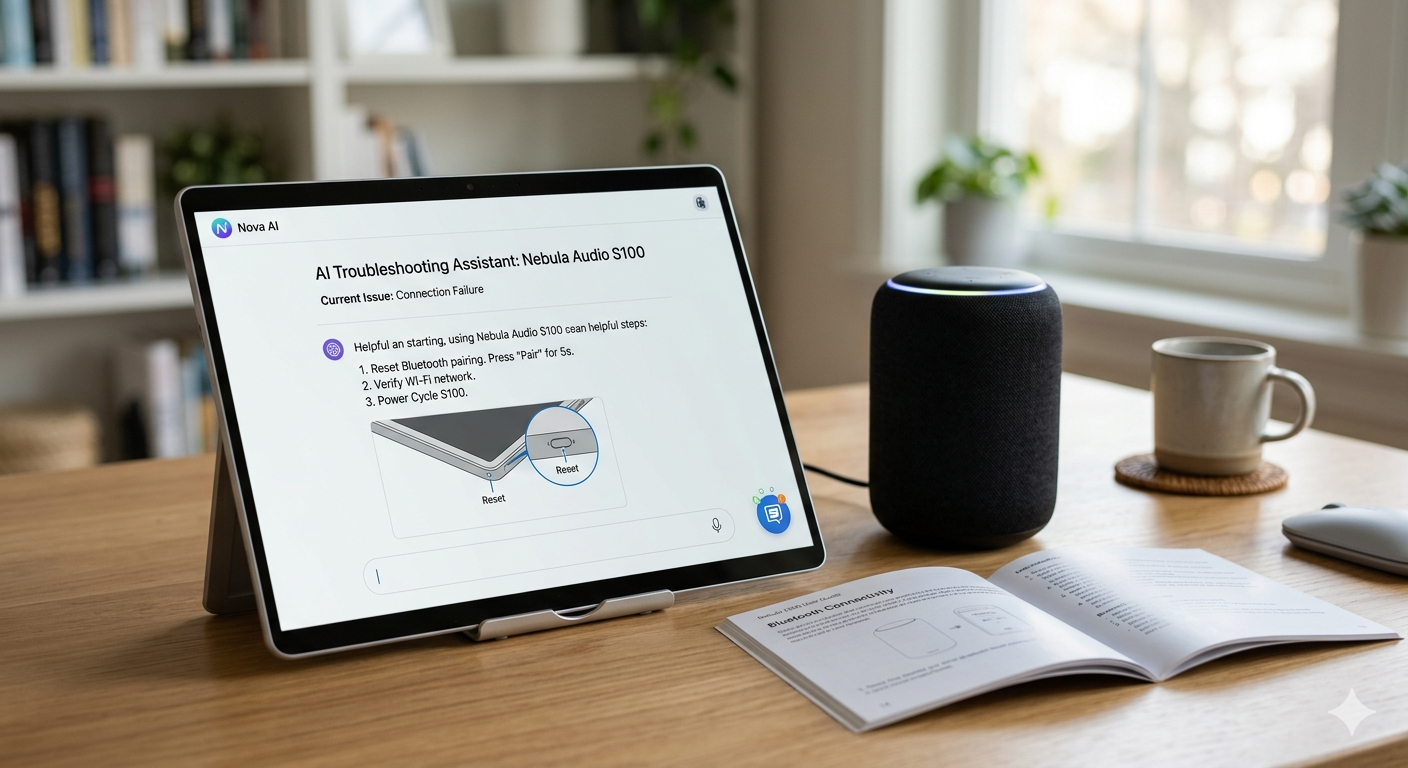
Product Identity: The Foundation for AI Product Assistants
Key Takeaways
- Generic AI assistants produce confident but wrong answers because they have no knowledge of which specific product a customer owns or its history — product identity fixes this.
- A product-aware AI assistant anchors every response to the serialised unit: its manufacture batch, firmware version, warranty status, and full support history.
- Manufacturers who capture per-unit scan, fault, and resolution data are building a training dataset that no competitor can replicate from public data alone.
- The data moat compounds: better AI assistants generate more interactions, more interactions generate more data, and the advantage widens with every unit shipped.
Everyone is building an AI assistant. Most of them are useless.
Ask a generic AI assistant about a specific fault code on a six-year-old HVAC unit with a regional firmware variant, and you'll get a confident, fluent, completely wrong answer. Ask it whether a particular batch of power tools shipped with the defective motor bracket before the recall, and it will hallucinate a plausible-sounding response that could get someone hurt.
The AI isn't the problem. The missing data is.
The manufacturers building genuine competitive advantage right now aren't doing it by picking a better model or writing better prompts. They're doing it by building product identity — a structured, serialised, per-unit data foundation that makes AI product assistants actually work. Without that foundation, every AI assistant is just an expensive autocomplete producing answers that sound authoritative but apply to no specific product, no specific customer, and no specific situation.
What an AI Product Assistant Can Actually Do
When product identity is in place, an AI assistant stops being a generic support chatbot and becomes something that genuinely earns its keep. The capabilities split into five clear categories:
Model-specific question answering. Not "consult your manual" — but precise answers tied to this model, this firmware version, this regional configuration. A customer scanning a product gets answers calibrated to their exact unit, not a generic response that covers every variant in the range.
Fault diagnosis. When a customer describes a symptom or inputs an error code, a product-aware AI can cross-reference fault patterns across every unit of that model ever registered. It knows which symptoms cluster together, which faults are batch-specific, and which fixes actually resolved similar cases. That's not guesswork — it's pattern matching against real resolution data.
Parts recommendation. Recommending the right spare parts requires knowing the exact build specification of the product in question. A unit manufactured before a mid-cycle component change needs a different part than one built after it. Generic AI has no way to know this. Product-aware AI does.
Predictive maintenance. Aggregate enough scan history and fault data across a model line, and patterns emerge: units that show symptom A at month 18 tend to develop fault B at month 24. An AI assistant with access to that data can proactively prompt customers to inspect or service components before failure — turning reactive support into a genuine service differentiator.
Guided installation and setup. Installation varies by region, configuration, and installer certification level. An AI assistant that knows the product being installed — its spec, its regional requirements, its known installation pitfalls — can guide a certified installer through the process with specificity that generic documentation cannot match.
The operative phrase in every one of these capabilities is: knows the product. That is what generic AI cannot do.
Why AI Fails Without Product Identity
The failure mode is predictable, and it's worse than no AI at all. A customer with a genuine problem gets a confident, detailed, incorrect answer. They follow the advice. The problem persists or worsens. Their trust — in the AI, in the support channel, in the brand — drops sharply.
There are three root causes. A 2024 MIT Sloan Management Review study on AI in customer service found that the single largest predictor of AI assistant accuracy in technical support contexts was the richness of the product-specific data available at query time — not the size or sophistication of the underlying model.
It doesn't know which product. A customer typing "my unit keeps tripping the circuit breaker" into a generic AI assistant has given the AI almost no useful signal. The AI has no idea what model they own, when it was manufactured, what firmware is running, or whether this symptom is a known issue for a specific batch. It produces an answer that is simultaneously generic enough to be technically defensible and specific enough to sound helpful. It is neither.
It doesn't know the lifecycle. Warranty status, repair history, prior support interactions, parts previously ordered — all of this context is invisible to an AI that hasn't been given it. The result is that the AI treats every customer interaction as if it's the first one, unable to see that this is the third time this customer has contacted support about the same issue, or that their unit is two weeks outside warranty on a fault that has a known fix.
It doesn't know what's actually happening in the field. A good AI product assistant should know that units from batch 2024-Q3 have a higher fault incidence for a specific component. It should know that the fix issued six weeks ago has a 94% resolution rate. It should know that customers in a particular region are reporting a symptom that hasn't been formally logged yet. None of this intelligence exists in a model trained on generic data. It only exists when real product data — scan events, support outcomes, parts orders, fault reports — is systematically captured and structured.
The Data Foundation: Product Graph as Training Data
The right mental model here is not "AI plus a product database." It is a product graph — a structured representation of every product, serialised to the unit level, with its full lifecycle attached.
The product graph for a single unit might include: manufacture date and batch, component specifications at time of build, first scan location and date, warranty registration details, all subsequent scan events with timestamps and locations, every support interaction and its resolution outcome, every spare part ordered, every fault reported and how it was resolved, and the firmware version at each point in time.
Across a model line of 50,000 units, that graph becomes extraordinarily rich training signal. Patterns emerge that no human support team could surface manually: which component combinations correlate with early failure, which installation configurations lead to higher fault rates, which customer profiles (geography, use pattern, installer certification) predict which support journeys.
The case for individual-level data over SKU-level aggregates is substantial. A fault rate of 2% looks manageable at the SKU level. At the unit level, you may discover that the fault is concentrated in 40% of a specific batch — a very different operational problem requiring a very different response.
This is the data foundation that makes AI product assistants genuinely useful. Not a static knowledge base of product manuals. A living, per-unit graph that accumulates signal from every customer interaction, every scan, every fault, every resolution.
How Product Identity Enables Contextual AI
The mechanics are straightforward once the data foundation exists.
A customer scans their product — using the QR code on the label or the packaging. That scan resolves to a specific serialised identity: this unit, this model variant, this manufacture date, this firmware, this warranty status, this support history. That moment of scanning is the entry point to the entire post-purchase relationship.
The AI assistant receives not a vague query from an anonymous user, but a contextually rich request anchored to a known product with a known history. The difference in response quality is the difference between:
"Your unit may be tripping the circuit breaker due to a ground fault, overload, or wiring issue. Check the circuit rating and inspect the power cord."
and:
"Units from your batch (manufactured Q2 2024) have a known issue with the thermal cutoff sensor triggering incorrectly under sustained load above 80%. A firmware update was released in August 2024 that resolves this in most cases. Your unit's firmware appears to be pre-update. Here's how to apply it — or, if that doesn't resolve it, your warranty covers replacement of the sensor."
The second answer is only possible because product identity exists. The AI isn't smarter. It's better informed.
Generic AI vs. Product-Aware AI: A Comparison
| Capability | Generic AI | Product-Aware AI |
|---|---|---|
| Fault diagnosis | Generic symptom matching | Batch-specific fault patterns |
| Parts recommendation | Category-level suggestions | Exact part number for this build spec |
| Warranty queries | Policy explanation only | Live status for this unit |
| Maintenance guidance | Schedule from manual | Predicted based on this unit's usage |
| Installation support | Generic documentation | Configuration-specific guidance |
| Repeat issue detection | No memory of prior contacts | Full support history visible |
| Recall applicability | Cannot determine | Exact batch and serial range checked |
| Firmware advice | Generic version info | This unit's current version confirmed |
The gap is not marginal. In categories like recall applicability and repeat issue detection, a generic AI assistant is not just less useful — it is potentially harmful.
The Competitive Moat: Data Network Effects
This is where the strategic picture becomes interesting, and where the manufacturers investing in product identity now are building a moat that will be very hard to cross later.
The manufacturers, platforms, and service providers that capture the most product-level data — scan events, fault reports, resolution outcomes, parts orders — across the largest installed base will train the best AI product assistants. Better assistants generate more customer interactions. More interactions generate more data. The data advantage compounds.
Platforms in adjacent spaces — Registria, Layerise, Brij — are building post-purchase infrastructure, but the depth of per-unit data they can accumulate is constrained by the richness of their product identity layer. A platform that captures warranty registration but not ongoing scan events, fault patterns, and parts orders is capturing only a fraction of the signal needed to train a genuinely useful AI assistant.
The manufacturers who own both the product identity infrastructure and the accumulated lifecycle data are in the strongest position. They control the training signal. Their AI assistant knows things about their product category that no competitor, no third-party platform, and no generic AI model can replicate from public data alone.
The support page is often where this data advantage either gets built or squandered. Every customer interaction that flows through a branded, serialised support experience adds to the product graph. Every customer who bounces to a generic search or a third-party forum is a lost data point.
FAQ
What is a product-aware AI assistant, and how is it different from a standard chatbot?
A product-aware AI assistant is anchored to a specific, serialised product identity rather than operating on generic knowledge. When a customer scans their product, the AI receives context about that exact unit — its model, manufacture date, warranty status, support history, and known fault patterns — before generating a response. A standard chatbot operates without this context, producing responses calibrated to average cases rather than the specific situation in front of it.
What data does a manufacturer need to capture to build a useful AI product assistant?
The minimum viable dataset includes: per-unit serial numbers linked to manufacture date and batch, warranty registration events, customer scan history with timestamps, fault reports and resolution outcomes, and parts orders by unit. Richer signal — installer certification records, firmware version history, field technician notes — improves AI accuracy substantially. The key is that data must be captured at the unit level, not aggregated at the SKU level, to be useful for diagnosis and personalisation.
How does product identity create a competitive moat against AI commoditisation?
As AI models become commoditised, the differentiator shifts to data. A manufacturer with five years of per-unit scan history, fault patterns, and resolution data across 500,000 serialised units has a training dataset that no competitor can replicate from scratch. The AI model itself can be replaced or improved; the accumulated product-level data cannot be easily duplicated. This makes product identity infrastructure one of the highest-leverage investments a manufacturer can make in the current AI landscape.
Gartner's 2024 manufacturing technology outlook identified "product data as AI training infrastructure" as one of the top five strategic investments for durable goods manufacturers over the next three years — recognising that the AI model itself is a commodity; the proprietary data foundation is the moat.
Building the Foundation Now
The window for building a meaningful data advantage is open, but it won't stay open indefinitely. Manufacturers who start capturing serialised product data now — through every warranty registration, every customer scan, every support interaction, every parts order — are accumulating the training signal that will power the next generation of product AI.
Those who wait are not just missing an opportunity. They are watching competitors build a data moat that grows deeper with every passing month.
BrandedMark gives every product a serialised digital identity and captures the full lifecycle — from first scan at unboxing through warranty, support, maintenance, and end of life. That data foundation is what makes product-aware AI assistants possible. It's also what makes them defensible.
Every product deserves a digital life. The manufacturers who build that infrastructure today are the ones whose AI assistants will actually know what they're talking about tomorrow.