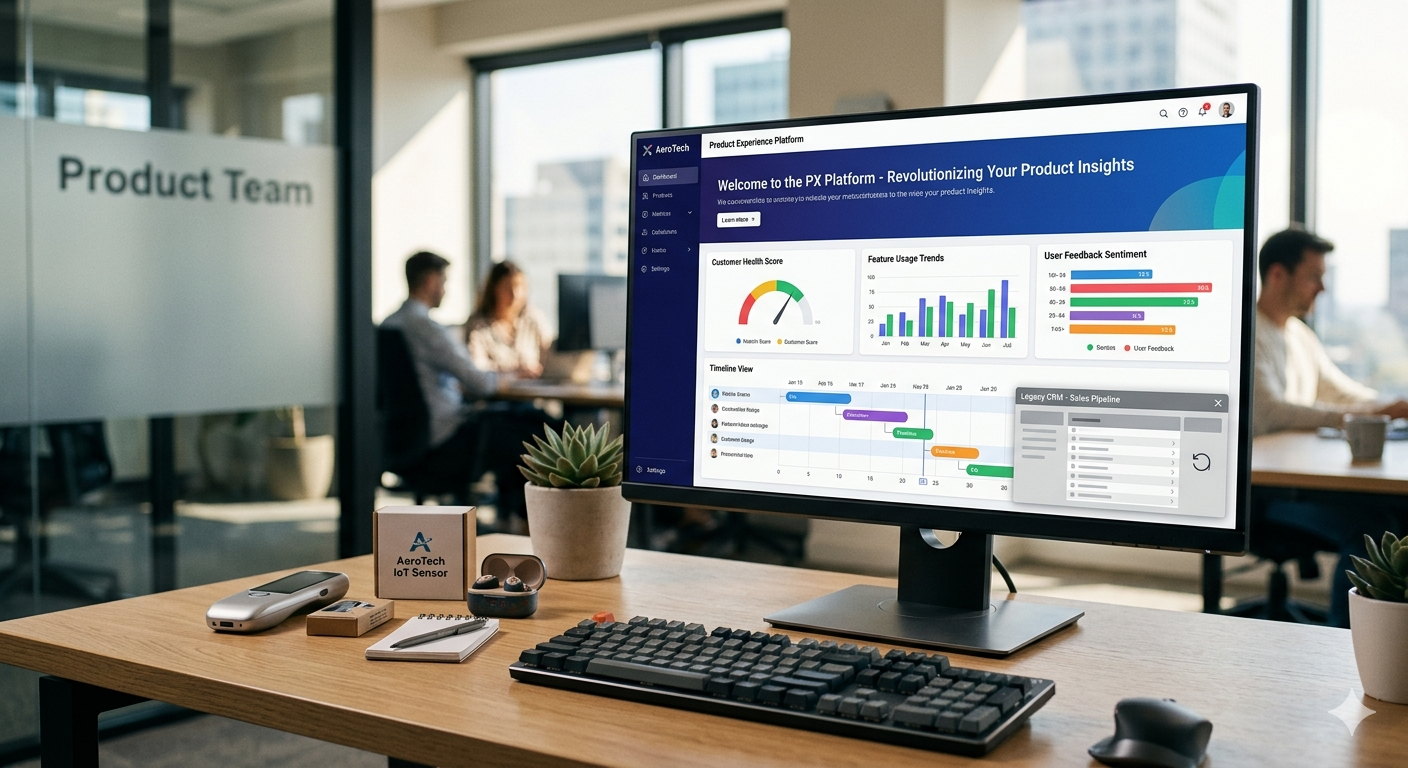
Product Experience Platform vs CRM for Manufacturers
Key Takeaways
- CRM is built for B2B pipeline management and goes blind the moment a product leaves your warehouse — it was never designed for post-purchase product relationships.
- A product experience platform (PXP) treats each serialised unit as a first-class entity with its own lifecycle, owner, and interaction history.
- Manufacturers using PXPs achieve 3–5x higher warranty registration rates and 30–40% support call deflection versus CRM-only approaches.
- The recommended architecture is PXP + CRM connected via API — not one replacing the other, but each covering what it was designed for.
Your CRM does not know what your customers own. Think about that for a moment.
A customer scans the QR code on a dishwasher they bought six months ago. They want to register the warranty, troubleshoot a fault code, or order a replacement filter. Your Salesforce instance — the one your company pays six figures a year to maintain — has no idea what product is in that customer's home, when they bought it, what serial number it carries, or whether they have ever interacted with it before.
That is not a configuration problem. That is a category mismatch.
CRM was engineered for B2B sales pipelines: accounts, contacts, deals, pipeline stages, forecast categories. It is an extraordinary piece of software for managing the journey from marketing-qualified lead to closed-won contract. But the moment a physical product leaves your warehouse and arrives in a customer's home, CRM goes essentially blind. And for manufacturers of durable goods — appliances, HVAC systems, power tools, consumer electronics, industrial equipment — the most commercially significant relationship begins precisely at that moment.
This is the problem that product experience platforms (PXPs) are built to solve. And the manufacturers who understand the distinction early will hold a structural advantage over those who do not.
The Fundamental Mismatch: Accounts vs. Products
CRM is organised around accounts and contacts. Every interaction — every email, call, support ticket, and marketing touch — is filed under a person or a company. The product they bought is, at best, a line item on an opportunity record. It is not a first-class entity. It does not have a lifecycle. It does not generate events on its own.
A product experience platform is organised around products. Each serialised unit has its own digital identity: model, batch, serial number, manufacture date, firmware version, scan history, registered owner, ownership transfers, support interactions, spare parts ordered, and compliance certificates. The product is the anchor. Every customer interaction is contextual to that specific unit.
This is not a subtle difference. It changes everything downstream.
When a customer contacts your support team about a fault code, a CRM-first organisation has to ask: "Can you tell me the model number? When did you buy it? Do you have your receipt?" A product-first organisation already knows exactly what is in that customer's home, when it was manufactured, whether it is within warranty, and what the most common resolution is for that fault code on that batch.
One of those experiences feels like the brand cares. The other feels like starting from scratch — every single time.
What CRM Gets Right (And Why It Stays)
This is not an argument for tearing out Salesforce or HubSpot. CRM earns its place in the enterprise technology stack. It excels at:
- Enterprise B2B sales pipeline management — tracking multi-stakeholder deals across long sales cycles
- Outbound lead management — sequences, cadences, follow-up automation for new business development
- Account-level relationship history — consolidating touchpoints across a complex buying group
- Revenue forecasting — pipeline coverage, stage probability, deal velocity metrics
- Marketing attribution — connecting campaign spend to opportunity creation and revenue
For manufacturers who sell through a B2B channel — selling HVAC units to contractors, or power tools to distributors — CRM is the right tool for those commercial relationships. It is not going away.
The problem is when CRM is stretched to cover something it was never designed for: the ongoing relationship between a manufacturer and the end consumer who owns their product.
CRM vs. PXP: An Honest Comparison
| Dimension | CRM (Salesforce, HubSpot) | Product Experience Platform |
|---|---|---|
| Anchor entity | Account / Contact | Serialised Product Unit |
| Primary data model | Deals, pipelines, stages | Product lifecycle events |
| Trigger for interaction | Salesperson action or marketing campaign | Customer product scan or event |
| Post-sale capability | Limited — opportunity is closed | Native — begins at unboxing |
| Product ownership | Not tracked | First-class data point |
| Warranty & compliance | Custom objects, bolt-ons required | Built-in, jurisdiction-aware |
| Self-service support | Requires integration with separate platform | Native per-product experience |
| Spare parts & commerce | Not designed for it | Native parts catalogue, ordering |
| EU Digital Product Passport | Not applicable | GS1 Digital Link and DPP-ready |
| Scan-triggered context | None | Every scan is product-contextual |
| Ideal use case | New business development | Post-purchase product relationships |
The point is not that one is superior — it is that they are designed for fundamentally different jobs. Forcing CRM to do post-purchase product relationship management is like using a spreadsheet as a database: it technically works, until it catastrophically does not.
The Post-Sale Blind Spot That Is Costing Manufacturers Revenue
Most manufacturers sell through retail or distribution channels. This means they have no direct relationship with the end consumer at the point of purchase. The retailer captures the transaction data. The manufacturer gets a wholesale order.
Warranty registration has historically been the primary mechanism for bridging this gap — getting consumers to raise their hand and say "I own this product." But traditional warranty registration programmes achieve less than 15% participation rates, largely because they offer no immediate value to the customer and require manual effort. According to the Consumer Technology Association, the average consumer abandons product registration within 90 seconds if the process requires more than two steps — a benchmark that paper-based and form-heavy digital flows routinely fail to meet.
A product experience platform changes the economics of that exchange. Instead of asking customers to fill out a warranty card for the manufacturer's benefit, it offers customers immediate value at the moment of first scan: guided setup, instant access to manuals and how-to videos, self-service troubleshooting, spare parts ordering, and registration in a single flow. Participation rates for well-designed product experiences consistently run three to five times higher than traditional warranty card programmes.
The downstream commercial value compounds. A manufacturer who knows what a customer owns — and can reach them directly — can drive accessory and spare parts revenue, offer extended warranties at the right moment in the product lifecycle, alert customers to safety recalls with precision, and build the kind of direct consumer relationship that survives retailer disintermediation.
None of that is possible from a CRM that does not know the product exists.
The New Architecture: PXP + CRM, Connected
Forward-looking manufacturers are not choosing between CRM and product experience platforms. They are deploying both, with clear mandates for each, connected via API.
The architecture looks like this:
Product Experience Platform handles everything downstream of the product sale: warranty registration, product-contextual support, spare parts commerce, compliance documentation, scan analytics, direct consumer communications tied to specific product events.
CRM handles everything upstream and parallel: B2B pipeline management, distributor relationships, sales team activity, marketing attribution for new business.
Integration layer connects the two: when a product registers through the PXP, a contact record is created or enriched in CRM. When a high-value product owner is identified — say, a commercial customer with a fleet of registered units — the sales team is alerted in CRM to explore expansion or service contract opportunities. Product engagement data from the PXP surfaces in CRM as account intelligence.
This is the architecture that Registria, one of the longer-established players in product registration, has pointed toward — though their approach remains primarily focused on warranty registration as a data capture mechanism rather than the full product experience lifecycle. The category is maturing. The distinction between "warranty registration tool" and "product experience platform" is becoming commercially meaningful.
Three Scenarios Where the Mismatch Becomes Visible
Scenario 1: The Fault Code at 9pm
A customer's range hood shows an error code at 9pm on a Sunday. They scan the QR on the unit. In a CRM-first world, they hit a generic support page or a chatbot with no product context. In a product-first world, the platform knows the model, the serial number, the manufacture batch, and the fault history for that specific unit. It serves a targeted troubleshooting guide, resolves the issue without a support call, and logs the interaction against the product record.
Support call deflection rates for manufacturers using product experience platforms average 30-40%. At scale, across hundreds of thousands of units, that is a material cost reduction — and a dramatically better customer experience.
Scenario 2: The Safety Recall
A component defect is identified in a specific production batch. In a CRM-first world, the manufacturer knows which distributors received the batch but has no direct line to end consumers. A media release goes out. Recall completion rates average 20-30%.
In a product-first world, every registered unit in the affected batch is known. The manufacturer pushes a direct notification to registered owners — email, SMS, or the next product scan triggers an urgent alert. Recall completion rates for manufacturers with strong product registration programmes routinely exceed 70%.
The regulatory and liability implications of that difference are significant. Under EU ESPR and emerging product safety frameworks globally, the expectation is moving toward manufacturers demonstrating the ability to reach end users directly. The European Commission's product safety framework explicitly references the ability to notify identifiable consumers as a factor in assessing manufacturer recall compliance obligations.
Scenario 3: The Replacement Cycle
A washing machine's product experience platform data shows a cluster of owners in year six of ownership — typically the window when replacement consideration begins. The manufacturer can reach those owners directly with a trade-in offer, a loyalty discount, or an upgrade recommendation. Without product-anchored data, that window passes invisibly.
Frequently Asked Questions
Is a product experience platform the same as a customer portal or a warranty management tool?
No — and the distinction matters. A customer portal is typically account-centric (log in to see your orders and tickets). A warranty management tool is focused on claims processing. A product experience platform is product-centric: every registered unit has its own digital identity, lifecycle, and interaction history. The platform is anchored to the product, not the account, which means it works even when a product changes hands — a critical requirement for ownership transfer, resale markets, and circular economy use cases.
Can a product experience platform integrate with existing CRM systems?
Yes, and this is the recommended architecture. PXPs expose APIs that allow product registration events, owner data, and engagement signals to flow into CRM as contact records and activity data. The two systems serve complementary purposes. CRM wins at pipeline management. PXP wins at post-purchase product relationships. The integration layer ensures that commercially valuable signals from the PXP surface where the sales and marketing teams work.
How does this relate to the EU Digital Product Passport requirement?
The EU's ESPR regulation mandates that by 2027, a growing list of product categories must carry a Digital Product Passport — a persistent digital record covering materials, repairability, sustainability credentials, and lifecycle data, accessible via a GS1 Digital Link QR code. A product experience platform that is built around serialised product identity and GS1 Digital Link is the natural infrastructure layer for DPP compliance. CRM was not designed for this requirement and cannot serve it without significant custom development. For more on the DPP landscape, see our State of Connected Products 2026 report.
The Category Is Being Named Now
There is a window — closing faster than most manufacturers realise — to establish the operational infrastructure that defines the next decade of customer relationships for durable goods brands. The manufacturers deploying product experience platforms now are not just solving a technology problem. They are building a direct consumer data asset that grows with every unit sold, every scan recorded, every warranty registered.
CRM gave sales organisations a system of record for pipeline and accounts. Product experience platforms are the system of record for product relationships. They are not competing for the same job. But they are competing for budget, attention, and executive mindshare in organisations where "CRM" has become a catch-all term for any customer-facing technology.
The reframe matters. Asking "should we extend our CRM for post-purchase?" is the wrong question. The right question is: "What is our system of record for the products in our customers' homes?"
If you do not have a good answer to that question — or if the answer is "our CRM, sort of" — the gap between you and the manufacturers who have built that infrastructure will compound with every unit sold.
To understand what the underlying data model looks like in practice, see What Is a Connected Product Platform and The Product Data You Are Not Collecting.
BrandedMark is built around this model — product as the anchor, every interaction product-contextual, with GS1 Digital Link and EU Digital Product Passport compliance built in from day one. If you are evaluating what post-purchase infrastructure looks like for your product lines, start here.