Counterfeit Goods in the UK: The Scale and the Solution
Key Takeaways
- Counterfeit goods cost the UK GBP 9 billion annually — roughly GBP 25 million every day — with consumer electronics (GBP 2.1B+) and automotive parts (GBP 1.8B+) among the hardest-hit sectors
- Traditional countermeasures (holograms, batch codes) authenticate packaging at the batch level — but a counterfeit bearing the correct batch code passes visual inspection by consumers and Trading Standards alike
- Serialised GS1 QR codes assign a unique identifier per unit; any attempt to copy the code is detectable immediately because that serial either doesn't exist or has been scanned from multiple locations simultaneously
- The UK's enforcement gap is structural: Trading Standards budgets have been cut significantly over the past decade while online marketplace listing volumes have grown exponentially
A parent orders a reputable brand of children's night-light from an online marketplace. It arrives with identical packaging, the right logo, and a CE mark. Three weeks later, the device overheats and catches fire. The original manufacturer is named in the press coverage. Their customer service team spends a month managing calls from people who bought a product the company never made.
This is not a hypothetical. It is a pattern that Trading Standards, product safety authorities, and sector trade bodies document year after year. Counterfeit goods in the UK are not a niche luxury problem — they are a cross-industry crisis that causes physical harm, destroys tax revenues, costs jobs, and punishes the manufacturers who invest in quality and compliance.
The scale is GBP 9 billion a year in direct losses (OECD/EUIPO, Trends in Trade in Counterfeit and Pirated Goods, 2023). The enforcement infrastructure is underfunded and structurally outmatched. And the technical countermeasures that most manufacturers currently rely on — holograms, batch codes, tamper seals — have been systematically defeated by sophisticated criminal supply chains.
The case for a fundamentally different approach has never been stronger.
The Scale: GBP 9 Billion and Rising
How large is the UK counterfeit problem? The OECD and EUIPO joint research consistently positions the UK among Europe's most targeted markets for counterfeit goods. Large port throughput, a mature e-commerce ecosystem, and high per-capita consumer spending make the country attractive for criminal import and distribution networks operating at industrial scale. GBP 9 billion in annual losses translates to roughly GBP 25 million every single day — a figure that has grown year-on-year as online marketplaces lowered the barrier to entry for counterfeit sellers. But aggregate totals obscure the sectoral reality, and it is the sectors that reveal the true severity of the problem. Consumer electronics, automotive parts, and pharmaceutical products together account for the majority of losses — and in each of these categories, the harm extends well beyond financial damage to include documented physical injury and, in some cases, fatalities.
Impact by Sector
| Sector | Primary Safety Risk | Estimated Annual UK Loss |
|---|---|---|
| PPE and safety equipment | Structural failure in life-safety applications | GBP 1.2B+ |
| Automotive parts | Brake, steering, airbag failure causing crashes | GBP 1.8B+ |
| Consumer electronics | Battery fires, electrocution, data theft | GBP 2.1B+ |
| Toys and children's products | Choking hazards, toxic materials, fire risk | GBP 600M+ |
| Pharmaceuticals and medical devices | Incorrect dosage, contamination, misdiagnosis | GBP 900M+ |
| Clothing and footwear | Lower direct safety risk, high volume, tax fraud | GBP 1.5B+ |
| Alcohol and food | Methanol poisoning, allergen mislabelling | GBP 900M+ |
Sources: OECD/EUIPO Trends in Trade in Counterfeit and Pirated Goods; IPO UK IP Crime Report; MHRA seizure data. Figures are estimates.
These are not fake handbags. This is infrastructure — the products that workers depend on, that parents buy for children, that engineers fit to vehicles. The harm from these categories is not reputational. It is physical.
The Safety Dimension: When Counterfeits Kill
Why do counterfeit goods kill people? The language around counterfeiting tends toward the financial — lost revenue, lost market share, brand damage. That framing, while accurate, dramatically undersells the stakes in categories where product compliance is a physical safety requirement, not a commercial formality. When counterfeit electricals, PPE, pharmaceuticals, or automotive components enter use, the harm is not reputational — it is structural. Products designed to look compliant but engineered without the thermal protections, impact resistance ratings, or sterility controls that genuine products must meet create failure modes that genuine manufacturers have specifically engineered out. What makes the safety dimension particularly severe is its invisibility: consumers and workers using counterfeit PPE or counterfeit chargers often have no reason to suspect the product is not what it claims to be until the moment of failure — which is typically the moment it is most needed.
Fake Electricals and the Fire Risk
The Electrical Safety First charity estimates that substandard and counterfeit electrical goods — primarily phone chargers, USB cables, extension leads, and plug adapters — are linked to hundreds of fires in the UK each year (Electrical Safety First, Counterfeit Electrical Goods Report, 2023). Counterfeit lithium-ion battery packs designed for power tools and e-bikes have caused fatalities in UK residential buildings.
The mechanism is straightforward. Genuine chargers and batteries are designed and tested to IEC 60950 and related standards. Thermal runaway protections, current limiting, and insulation requirements are not optional engineering — they are what prevents a component from becoming an incendiary device under load. A counterfeit manufacturer optimising for margin eliminates all of it.
When that product catches fire, the genuine manufacturer's name appears on the packaging at the scene.
Fake PPE and Workplace Deaths
The Health and Safety Executive has issued repeated alerts about counterfeit and non-compliant PPE entering UK supply chains. Hard hats that fail impact resistance tests. High-visibility garments with reflective tape that does not meet EN ISO 20471. Respiratory masks bearing forged UKCA marks that offer negligible filtration.
In industries where PPE is the last line of defence — construction, manufacturing, chemical processing — a product that looks compliant but is not compliant is worse than no product at all. It eliminates the behaviour that would otherwise trigger substitution or additional precaution.
Counterfeit Pharma and Medical Devices
The MHRA made thousands of seizures of counterfeit and unlicensed medicines in recent years. The risk profile extends beyond obviously dangerous fakes to subtler issues: incorrect active ingredient concentrations, contaminated excipients, compromised sterility in injectable products. In a clinical setting, a counterfeit diagnostic device — a blood glucose meter, a lateral flow test, a surgical instrument — can directly influence treatment decisions.
The Economic Damage Beyond Lost Revenue
What does counterfeiting cost the UK economy beyond the immediate lost sale? The systemic damage extends across four distinct channels that together exceed what lost-revenue figures alone capture. Every counterfeit product sold through informal channels produces no VAT, corporation tax, or customs duty — HMRC estimates hundreds of millions in annual revenue lost to illicit goods trade. When counterfeit goods displace legitimate production, UK manufacturing employment bears the consequence: approximately 2.6 million people work in manufacturing, concentrated in regions where that employment is a primary economic anchor. R&D investment is distorted when criminal supply chains can replicate years of compliance engineering the moment a product ships, reducing the effective return on innovation. Finally, when a counterfeit product causes harm bearing a genuine manufacturer's brand, the legal liability, public clarification costs, and Trading Standards engagement fall entirely on the legitimate company — an overhead their counterfeit competitors carry none of.
The Enforcement Challenge: Structural Underinvestment
Why is UK enforcement losing the battle against counterfeit goods? Trading Standards — the primary consumer protection body — operates at local authority level, responsible for product safety, fair trading, weights and measures, and age-restricted sales across a vast commercial scope. Its budget has been cut significantly over the past decade, while the volume and sophistication of counterfeit goods in circulation has grown substantially. The result is an enforcement landscape that is structurally outmatched by the problem it is asked to address. Local Trading Standards teams cannot scale their activity to match the listing volumes on major e-commerce platforms, cannot keep pace with the border enforcement challenges created by parcel-level direct-to-consumer imports, and lack the resources to pursue criminal supply chains operating across multiple jurisdictions. The deficit is not one of intent or competence — it is one of capacity relative to a problem that has industrialised far faster than the enforcement infrastructure built to contain it.
The Online Marketplace Problem
The majority of counterfeit goods now reach UK consumers not through dodgy market stalls but through major e-commerce platforms — third-party sellers on Amazon, eBay, and a growing roster of Asian-origin platforms offering direct-to-consumer shipping. The listing-removal-and-relisting cycle is well-documented: enforcement teams identify and remove infringing listings; sellers create new accounts and relist within hours.
This is not a technology problem that platforms have failed to solve. It is an economics problem. The volume of listings, the ease of account creation, and the jurisdictional complexity of sellers based outside UK law enforcement reach create a structural whack-a-mole dynamic that individual brands and Trading Standards teams cannot win at the current scale.
The Border Challenge
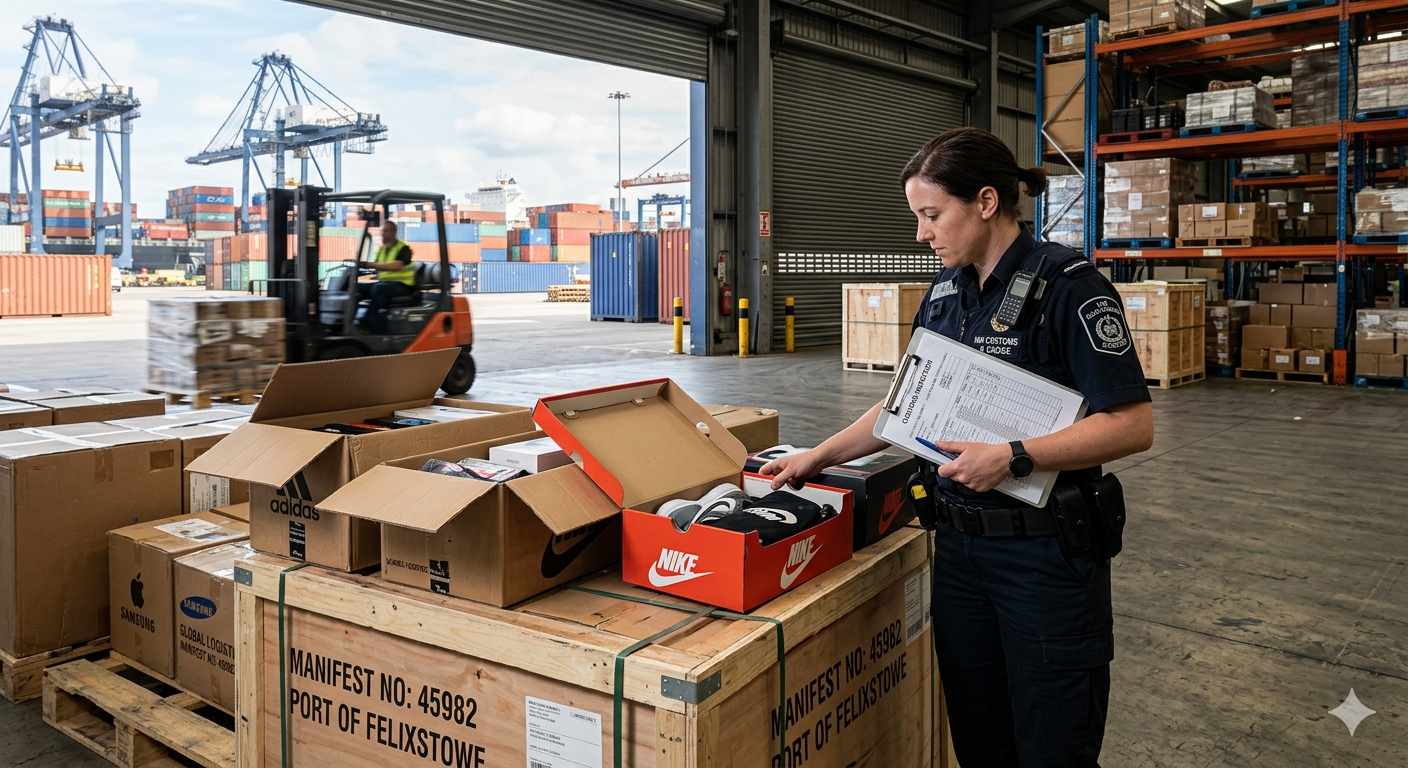
UK Border Force intercepts counterfeit goods at ports and airports, but seizures represent a fraction of what enters the country. Parcel-level imports — small consignments shipped directly to consumers — are operationally difficult to screen at volume. The growth of direct cross-border e-commerce has shifted the problem from container-level importation (visible, checkable) to parcel-level importation (massive volume, minimal dwell time).
Why Traditional Anti-Counterfeiting Fails
Why do holograms, batch codes, and tamper seals fail to stop sophisticated counterfeiting? Most manufacturers who take counterfeiting seriously have deployed one or more of the standard countermeasures — holograms on packaging, batch codes on labels, tamper-evident seals, UV inks, or micro-printing. These approaches share a common architectural weakness that criminal supply chains have learned to exploit systematically: they authenticate the packaging, not the product itself, and they authenticate at the batch level rather than the individual unit level. A hologram proves that a hologram exists on the package — it does not prove that the package contains what it claims. A batch code proves that a real batch was manufactured with that identifier — it does not prove that this specific item belongs to that batch. When counterfeit manufacturers can replicate both the hologram and the batch code at scale, the entire authentication layer collapses. The counterfeit passes inspection precisely because it looks like the genuine article.
Holograms Are Replicated at Scale
The hologram industry will tell you that sophisticated holograms are extremely difficult to counterfeit. That is technically true at the level of the highest-security variants. In practice, most product holograms are not highest-security variants — they are a cost-effective deterrent deployed at packaging scale. And criminal supply chains in China, where the majority of counterfeit goods originate, have developed industrial-scale capability to produce convincing hologram replicas. The HSE and Trading Standards have both documented fake PPE bearing plausible-looking holographic UKCA/CE verification stickers.
Batch Codes Can Be Shared
A batch code printed on packaging — even a complex alphanumeric string — can be photographed, transcribed, and applied to thousands of fake units. It authenticates that a real batch existed, not that a specific item is genuine. A counterfeit product with the correct batch code passes a retailer visual inspection and passes a basic consumer spot-check. The forgery is invisible to anyone who does not have access to the manufacturer's batch database — which consumers and Trading Standards officers typically do not.
This is the core problem: authentication at the batch level is not authentication at all when the thing being counterfeited is the batch identifier itself.
What Manufacturers Can Do Now
What practical steps can manufacturers take today to make their products verifiable and counterfeit-resistant? The shift from batch-level to unit-level authentication changes the architecture of anti-counterfeiting fundamentally, and the technology required is available now at viable cost for manufacturers of tens of thousands of units annually, not just millions. A unique, serialised digital identity assigned per product unit — rather than per batch or per SKU — means every item in a production run carries an identifier that cannot be shared, copied, or transferred to a fake. When a consumer or enforcement officer scans that identifier, the verification request checks whether the serial exists in the manufacturer's database, whether it has been scanned before, and whether the scan is occurring from an expected location. A counterfeit bearing a copied code fails on at least one of these checks immediately. No specialist equipment is needed. No proprietary app. No laboratory analysis. Just a smartphone and two seconds.
Serialised QR Authentication
GS1-standard serialised QR codes encode both the product GTIN and a unique serial number, creating a combination that is mathematically distinct for every unit manufactured. When a consumer or enforcement officer scans the code, the request hits a cloud verification service that confirms: does this exact serial number exist in the manufacturer's database? Has it been scanned before? Is this scan from an unexpected location?
A counterfeit product bearing a copied QR code fails immediately — the serial number either does not exist, or has already been scanned thousands of times from different locations. The forgery is visible to anyone with a smartphone, without specialist equipment, without training, and without access to proprietary databases.
This is what serial-level verification enables that batch codes cannot: every unit is independently verifiable, and verification reveals anomalies that batch-level authentication is structurally blind to.
GS1 Digital Link: The Industry Standard
GS1 Digital Link is the international standard for encoding product information in QR codes in a way that is interoperable across retail, supply chain, and consumer applications. A GS1 Digital Link QR code on a product can surface product safety information, recall notices, compliance documentation, and verification results — from a single scan, without requiring a proprietary app.
This matters for enforcement as well as consumers. A Trading Standards officer scanning a product with a standard GS1-compatible app can immediately access the manufacturer's product record, verify the serial number, and confirm whether the item matches its declared specification. The friction of enforcement drops considerably when the verification infrastructure is standardised and accessible.
Consumer Scan-to-Verify
The most scalable authentication network a manufacturer can deploy is their own customer base. Millions of UK consumers buy products in categories with documented counterfeiting risks — electricals, automotive parts, children's toys. If every genuine product carries a QR code that takes two seconds to scan and returns a clear verified result, consumers become active participants in authentication.
This does not require consumer education campaigns or behavioural change nudges. It requires that scanning a product QR code produces a credible, clear outcome — not a marketing page or a warranty form, but a positive confirmation that the item is genuine, accompanied by the safety and compliance documentation that supports it.
BrandedMark's verified QR code infrastructure is designed precisely for this use case: every product scan returns a branded, authenticated experience that confirms product identity and surfaces compliance documentation in a format that is usable by consumers, retailers, and enforcement agencies.
Trading Standards Integration
The enforcement gap is real, but it is partly an information gap. Trading Standards teams conducting market surveillance need fast, reliable methods to distinguish genuine products from fakes without sending samples to laboratories. A manufacturer that registers their serialised product inventory with a verification service creates an asset that enforcement teams can access directly.
Some manufacturers have begun providing Trading Standards with dedicated verification tools — a brand enforcement portal that allows officers to authenticate items in the field, flag suspected counterfeits, and log scan data that feeds back into the manufacturer's supply chain intelligence. When a cluster of failed verifications emerges from a specific postcode or retail channel, that is actionable intelligence for both enforcement and the manufacturer's anti-counterfeiting team.
This is the direction the Product Identity conversation needs to move: from manufacturer-only defensive posture to collaborative public-private infrastructure where serialised digital identity is the shared foundation.
Frequently Asked Questions
What counts as a counterfeit product under UK law?
UK law distinguishes between counterfeit goods (which bear a registered trade mark without authorisation, contrary to the Trade Marks Act 1994) and goods that merely infringe copyright or breach product safety regulations. In practice, Trading Standards pursues both — trademark counterfeiting and unsafe products — but the legal routes differ. Most action against counterfeit goods in consumer categories proceeds under either trademark law or the General Product Safety Regulations 2005, depending on the nature of the infringement and the enforcement strategy.
Do online marketplaces have legal obligations around counterfeit goods?
The Product Safety and Metrology Bill, which was progressing through Parliament in 2025, aims to extend greater product safety obligations to online marketplaces — creating formal duties to prevent unsafe and counterfeit goods from being listed. In the interim, major platforms operate voluntary brand protection programmes (Amazon Brand Registry, eBay's VeRO programme) through which rights holders can request listing removals. These are reactive mechanisms; they do not prevent initial listing or detect sophisticated counterfeits that closely replicate genuine products.
How does a small manufacturer justify the cost of serial-level authentication?
The upfront perception is that serialisation is an enterprise-scale investment. In practice, cloud-based serialisation platforms have brought the cost per unit down to a level that is viable for manufacturers producing tens of thousands of units per year, not just millions. The relevant calculation is not the cost of serialisation against the theoretical full cost of counterfeiting — it is the cost of a single product safety incident, Trading Standards investigation, or legal action arising from counterfeit products bearing your brand. For most manufacturers in regulated product categories, that calculation resolves clearly in favour of serialisation.
The Policy Dimension
Should the UK mandate digital product authentication in regulated categories? The GBP 9 billion annual counterfeit loss figure represents a systemic enforcement failure, not simply a manufacturer problem — and the policy response has not kept pace with the scale. The EU is moving toward mandatory Digital Product Passports under ESPR, which will require serialised product identity across an expanding range of categories, functioning as authentication infrastructure as much as sustainability tooling. UK policy has not yet moved at the same pace, but the technical foundation exists: GS1 Digital Link is the interoperable standard, cloud serialisation platforms are at viable cost, and manufacturers in sectors most exposed to counterfeiting risk already have reason to adopt ahead of any mandate. What the policy environment determines is whether unit-level authentication becomes baseline expectation or remains a competitive differentiator. Manufacturers who adopt now build the consumer verification habit before it is required — and create an enforcement asset that Trading Standards and Border Force can use today.
BrandedMark provides serialised QR authentication and GS1 Digital Link infrastructure for manufacturers in regulated product categories. Every product gets a unique digital identity that consumers can verify and enforcement teams can use.