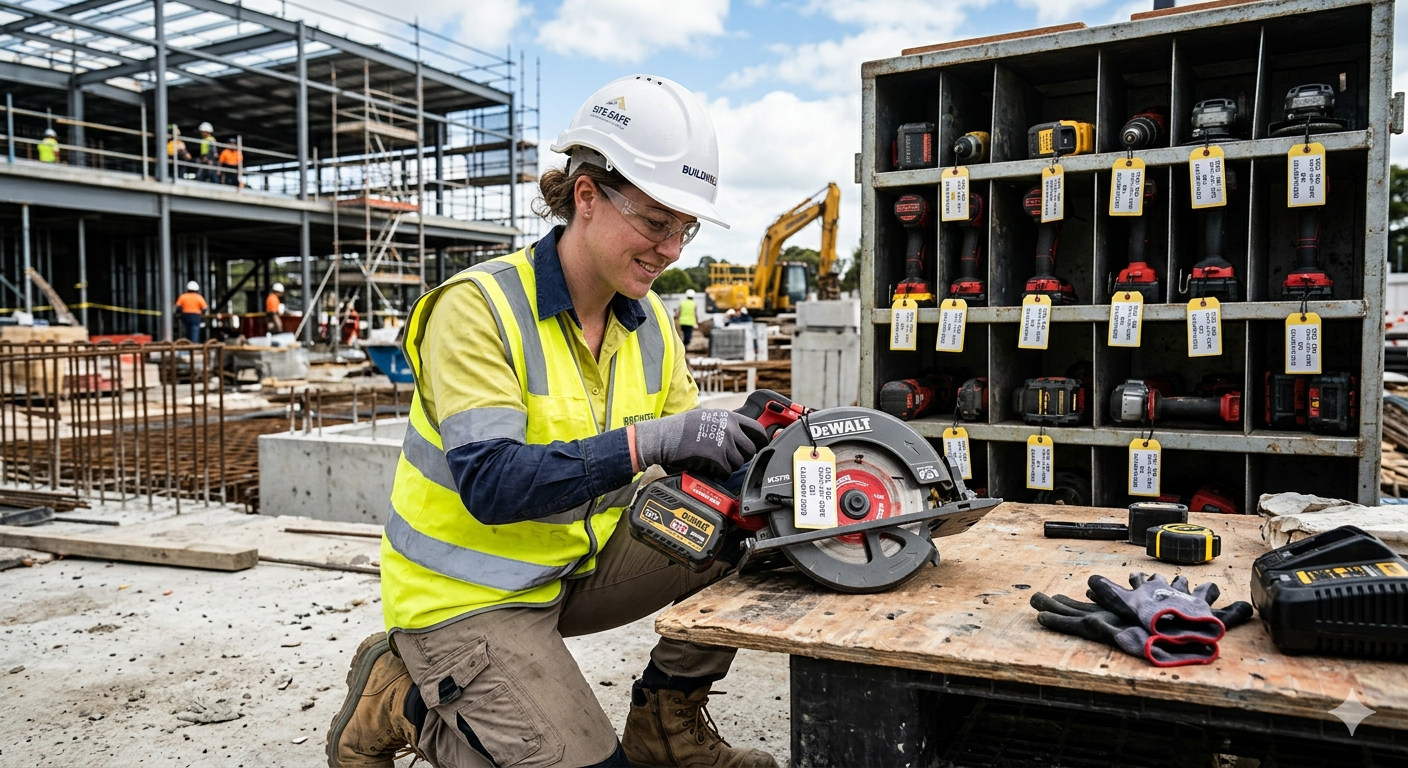
Connected Products on Construction Sites: Tools, Machinery, Safety
Key Takeaways
- The HSE recorded 51 fatal worker injuries in 2023/24 and 60,000+ non-fatal injuries annually — many linked to missing certification or expired PPE that digital identity would prevent
- A mid-size commercial build has 800–1,200 distinct product instances on site at any given time, each with its own compliance clock that paper systems cannot reliably track
- Three overlapping regulations (CDM 2015, Building Safety Act 2022, digital waste tracking from October 2026) are converging to make product-level digital identity mandatory in construction
- GS1-standard serialised QR codes enable any worker with a smartphone to verify compliance status in under 10 seconds — no app, no specialist equipment required
Construction is the last major industry running on clipboards. While retail, logistics, and manufacturing have all built digital infrastructure around their products, a £150 billion UK sector still tracks scaffolding inspections on paper forms stuffed in a site office filing cabinet, still confirms PPE certification by eyeballing a sticker, and still loses service history when a contractor changes hands.
The result is predictable. The HSE recorded 51 fatal injuries to workers in 2023/24, and over 60,000 non-fatal injuries are reported annually (Health and Safety Executive, Work-related fatal injuries in Great Britain, 2024). Equipment failure, missing certification, and expired PPE are recurring threads across incident investigations. This is not a training problem. It is an information problem — and product identity is the fix.
Why Construction Has Hundreds of Products That Need Identity
A mid-size commercial build typically has 800 to 1,200 distinct product instances on site simultaneously, each carrying a legal compliance obligation. Power tools require three-monthly PAT testing. Heavy plant — excavators, telehandlers — must undergo LOLER thorough examination every six to twelve months. Scaffolding components carry specific load ratings and individual inspection histories. PPE has manufacturer-defined expiry dates and per-unit inspection logs. Fire safety equipment runs on annual service cycles. Electrical distribution boards require periodic RCD testing. Each product category has its own compliance clock, its own responsible party, and documentation that must be producible on demand during an HSE inspection. Paper systems — tags, sticker dates, folders in the site office — cannot provide real-time visibility across that volume. Digital product identity changes the model: each item carries a scannable code that surfaces its current compliance status in under ten seconds, from any smartphone, without an app.
| Product Type | Compliance Need | Current Method | Digital Identity Benefit |
|---|---|---|---|
| Power tools (drills, grinders, saws) | PAT testing every 3 months on site | Paper log, sticker | Scan shows last test date, next due, assigned operative |
| Heavy plant (excavators, telehandlers) | LOLER thorough examination every 6–12 months | Physical certificate in cab | Scan pulls current certificate, service history, operator certifications |
| Scaffolding components | Load ratings, inspection after modification | Tag + paper handover cert | Scan shows rated load, inspection history, responsible scaffolder |
| PPE (helmets, harnesses, hi-vis) | Manufacturer expiry, periodic inspection | Sticker or batch date | Scan shows individual unit expiry, inspection log, assigned worker |
| Fire safety equipment (extinguishers, hoses) | Annual service, 5-year discharge | Paper service tag | Scan shows last service, next due, responsible engineer |
| Electrical distribution boards | Periodic inspection, RCD testing | Laminated certificate | Scan returns test results, certification body, inspector details |
The Challenges That Make Construction Especially Hard
Three compounding challenges explain why digital product identity has succeeded in manufacturing and retail but not yet in construction. First, physical conditions are extreme: tools are dropped, rained on, stored in freezing vans overnight, and shared across multiple shifts. Standard printed QR codes often fail within a single wet month on a busy site — viable solutions require industrial-grade UV-resistant, moisture-proof polyester or polypropylene labels, or embedded NFC tags for plant where surface labelling is impractical. Second, accountability dissolves at contractor boundaries. A principal contractor running six subcontractors simultaneously cannot reliably establish who last inspected a piece of equipment when an incident occurs. Without serialised identity on every unit, the chain of custody breaks at each handover. Third, the hired-equipment model dominant in UK construction splits service records between hire companies and site operators, creating a compliance documentation gap neither party can close without a shared identity layer.
Harsh environments. Power tools are dropped, rained on, stored in vans at sub-zero temperatures, and handed between operatives across multiple shifts. Paper labels degrade. Ink wipes off. QR codes printed on standard stock survive a few weeks on a busy site. Any product identity solution for construction must tolerate the environment — which means industrial-grade labels or embedded NFC tags rated for temperature extremes and physical abuse.
Multiple contractors sharing equipment. A principal contractor might have six subcontractors on site simultaneously — groundworkers, electricians, drylining crews, fire protection engineers. Equipment moves between them. When an incident occurs and the HSE investigator asks who last inspected the angle grinder that caused the injury, the answer "I think the groundwork firm had it last week" does not hold up. Without serialised identity on every unit, accountability dissolves at the boundary between contractors.
Shared and hired equipment. Equipment hire is a dominant procurement model in construction — Brandon Hire Station and similar operators move tens of thousands of tool units across thousands of active sites. When a hired item arrives on site, the principal contractor assumes responsibility for it. If the hire company's inspection records are in their system and the contractor's compliance evidence is in a site folder, neither party can quickly produce a joined-up compliance trail during an audit. Digital identity on every hire unit — linking the hire company's service records to the principal contractor's site log — would close that gap. For how digital identity is reshaping the hire sector specifically, see Equipment Hire and Digital Product Identity.
The Regulatory Pressure Is Only Increasing
Three overlapping regulatory frameworks are converging to make digital product identity a compliance requirement rather than a competitive advantage. CDM 2015 requires principal designers and contractors to maintain a Health and Safety File documenting equipment used throughout the build — a document building owners increasingly expect to be machine-readable rather than a scanned PDF bundle. The Building Safety Act 2022 creates the statutory role of Accountable Person for higher-risk buildings, with a legal duty to maintain a digital golden thread of information throughout the building's life; the HSE as Building Safety Regulator has been explicit that this thread must be digital, and the higher-risk building regime is live now. From October 2026, the Environment Agency's mandatory digital waste tracking regime requires construction sites to record every waste stream from point of production to disposal — a requirement that depends directly on knowing what products are on site, what materials they contain, and how they are classified. Together these three frameworks make product-level serialised identity unavoidable.
CDM 2015 (Construction Design and Management Regulations). The principal designer and principal contractor must maintain a Health and Safety File documenting information about the structure and the equipment used in its construction. That file must be handed to the building owner on completion. Today it is typically a PDF bundle. As building owners become more sophisticated — and as the Building Safety Act creates ongoing obligations — they increasingly want machine-readable, queryable records, not scanned PDFs.
The Building Safety Act 2022. The Act created the new role of Accountable Person for higher-risk buildings, with a legal duty to maintain a safety case and a digital golden thread of information throughout the building's life. The HSE, as Building Safety Regulator, is explicit: the golden thread must be digital. Products and equipment used in the construction of higher-risk buildings are increasingly expected to carry traceable identity. This is not a future requirement — the higher-risk building regime is live now. For a fuller treatment of the regulatory landscape, see Digital Product Passports for Construction Products: UK Building Safety.
Digital waste tracking from October 2026. The Environment Agency's mandatory digital waste tracking regime goes live in October 2026. Every waste carrier, broker, and site will need to track waste streams digitally from point of production to disposal. For construction sites generating mixed waste from tools, packaging, and materials, this creates a parallel imperative: know what products are on site, what materials they contain, and how they are classified for disposal. Product-level identity feeds directly into compliant waste records.
What a Scan Actually Enables
When a construction worker scans a product QR code on a connected site, the experience is designed for a working environment: no app to download, no login required. A GS1 Digital Link QR code resolves in any modern smartphone camera and opens in the browser in under ten seconds. For scaffolding, the scan returns the last inspection date, rated load, responsible scaffolder's name, and the next inspection due date — without a phone call or trip to the site office. For power tools, it surfaces PAT test history, assigned operative, and safe operating procedures in the worker's language. For PPE, it shows the individual unit's manufacture date, expiry status, and inspection log — not a batch-level sticker that conveys nothing about that specific helmet. Across an entire site, the compounding effect is material: a safety manager sees from a single dashboard every item within seven days of its next inspection across all active sites, replacing a spreadsheet maintained by chasing subcontractors.
That same scan infrastructure, applied across every product category on site, enables:
- Compliance dashboards in real time. The principal contractor's safety manager sees, across all active sites, which items are within 7 days of their next inspection. No spreadsheet. No chasing subcontractors.
- Instant access to manuals and safe operating procedures. A new operative picks up an unfamiliar piece of plant. A scan on the machine returns the manufacturer's safe use guide, the RAMS (risk assessment and method statement) registered for that equipment class, and any site-specific operating rules — in the right language.
- Service history that travels with the item. When equipment moves between contractors, its history moves with it. The receiving contractor scans the item, sees its full record, and assumes responsibility with evidence, not assumption.
- Utilisation data. For both owned and hired equipment, scan events create a passive utilisation record. Plant managers discover they have three non-utilised generators sitting on site for six weeks. That data drives better procurement decisions and lowers hire costs.
PPE specialist brands like JSP — manufacturer of hard hats, face protection, and respiratory equipment — illustrate the opportunity. A JSP hard hat with a serialised QR code can carry the individual unit's manufacture date, model certification, the operative's inspection log, and expiry status. For service workers in installer and field service contexts, the same model applies. See Installer and Field Service Product Identity for the field service parallel.
Existing Players and Where They Fall Short
Three platforms are most frequently cited for digital product identity on construction sites, and each leaves a significant gap. Hilti's ON!Track is a well-regarded asset management system built around Hilti's own tool inventory and their direct service relationship with large contractors. It works well on Hilti-dominated sites but provides limited value where six brands of power tools, multiple scaffold suppliers, and hired plant from separate hire companies are all present simultaneously. Milwaukee's ONE-KEY delivers comparable capabilities — tool tracking, theft protection, customisation — but is Milwaukee-only by design, making it a brand solution rather than a site solution. Registria focuses on post-sale warranty registration and consumer engagement for durables manufacturers, not multi-contractor site compliance. The gap all three leave is an open-standard, product-agnostic identity layer: a format any manufacturer can embed at point of manufacture and any site operative, hire company, or HSE inspector can read with a standard phone camera, without installing a dedicated app or holding a commercial relationship with the product's manufacturer. GS1 Digital Link is the standard designed to fill that gap.
The Business Case for Manufacturers
Tool and equipment manufacturers can achieve measurable commercial return from connected product identity beyond regulatory compliance, across four dimensions. Liability reduction is the most immediate: a manufacturer whose product carries embedded certification, safe operating guidance, and a scan-event log is demonstrably better positioned in an HSE investigation than one whose product identity ends at the printed label. Audit efficiency follows — when an insurer or regulator requests compliance records, scan events and content delivery logs replace searches through paper archives. Service revenue is the third dimension: scan history showing usage intensity above recommended thresholds can trigger automated service reminders, converting passive ownership into an active service relationship. The fourth dimension is channel retention through the hire cycle: when a hired tool is scanned on an active site, the manufacturer receives a signal that the product is in use and can surface consumable offers, accessory recommendations, or upgrade paths at the moment of peak relevance. Construction is not a hostile environment for connected product investment — it is among the most commercially compelling sectors in which a manufacturer can deploy it.
Frequently Asked Questions
Can QR codes survive construction site conditions?
Standard paper-printed QR codes will not survive a construction site for long. The appropriate specification is industrial polyester or polypropylene labels rated for UV, moisture, abrasion, and temperature extremes, or embedded NFC tags for equipment where a surface label is impractical. Several industrial label manufacturers produce GS1-compliant labels rated to BS EN 60068 environmental standards. For permanent plant, cast or engraved codes are available. The technology is proven — it is the specification of the label, not the code format, that determines durability.
Who is responsible for scanning and maintaining records — the manufacturer, the hire company, or the site contractor?
Each party holds a different layer of responsibility. The manufacturer is responsible for embedding a serialised identity at point of manufacture and ensuring the digital experience behind the code contains accurate product information, certifications, and guidance. The hire company or asset owner is responsible for maintaining service and inspection records linked to that serial identity. The principal contractor on site is responsible for ensuring that the items in their care have current certification and that any inspection events are logged. A well-designed digital identity platform supports all three layers without requiring each party to operate the same system — the GS1 Digital Link standard means any compliant reader can access the relevant layer of information.
Does this require every worker to have a company phone or specialist device?
No. GS1 Digital Link QR codes are readable by any modern smartphone camera without a dedicated app — iOS and Android both resolve the URL natively. The resulting digital experience opens in the phone's browser. For environments where personal phone use is restricted, site managers typically operate with a small number of designated scanning devices, or the principal contractor's safety management system integrates with a mobile app that operatives use for broader site activities. The barrier to adoption is lower than most site managers expect.
The Site of Tomorrow Is Already Possible
The connected construction site of the near future requires no new technology — everything needed is already deployable. GS1 Digital Link is a ratified international standard. Industrial-grade QR and NFC labels rated to construction environment specifications are commercially available from multiple suppliers. No-code connected product platforms allow manufacturers to build the digital experience behind each code without an engineering team or a multi-year integration project. The regulatory frameworks — CDM 2015, the Building Safety Act 2022, mandatory digital waste tracking from October 2026 — are either already in force or going live within two years. HSE incident data quantifies the cost of inaction without needing to reference competitive positioning. The only open question is which manufacturers choose to embed serialised digital identity at the factory and give construction sites the compliance infrastructure they need — and which wait for a Building Safety Regulator audit to make the decision for them.
BrandedMark gives manufacturers a no-code platform to attach a digital identity to every product — serialised, GS1-compliant, and ready for the compliance demands of professional construction environments. See how it works.