B2B vs. B2C Connected Products: Same Platform, Different Playbook
The conversation about connected products is almost entirely written for consumer brands. Unboxing moments. Loyalty programs. Frictionless self-service. It is a compelling narrative: and it is only half the story.
Walk into the service department of any commercial HVAC distributor, heavy equipment dealer, or industrial tool manufacturer and you will find a different problem set entirely. Field technicians carrying paper work orders. Maintenance histories locked inside Excel spreadsheets. Warranty claims rejected because nobody can prove who installed the unit, when, or to what specification. Compliance documents that exist in triplicate: all slightly different.
These are connected product problems. They just do not look like the consumer version.
The underlying infrastructure (serialized product identity, scan-triggered experiences, lifecycle analytics) is the same. What changes is everything built on top of it. The user, the workflow, the stakes, and the definition of a successful outcome are fundamentally different depending on whether your product ends up on a consumer's kitchen counter or bolted to a factory floor.
Here is how both playbooks work, where they converge, and where they sharply diverge.
B2B vs. B2C Connected Product Workflows
| Capability | B2C Priority | B2B Priority | Shared |
|---|---|---|---|
| Unboxing registration | Critical | Not applicable | Serialized identity |
| Field service documentation | Low | Critical | Serial tracking |
| Installer certification | Not applicable | Critical | Role-based access |
| Spare parts commerce | High | Low/Medium | Compatibility logic |
| Maintenance scheduling | Low | Critical | Lifecycle analytics |
| Compliance per unit | Low | Critical | DPP readiness |
| Bulk registration | Not applicable | Critical | Batch workflows |
| Loyalty and lifecycle triggers | High | Low | Event tracking |
| Registration participation | Voluntary (varies widely) | Often mandatory (tied to warranty/SLA) | Both measurable |
The B2C Assumption
When most people picture a "connected product," they picture a consumer scanning a QR code at unboxing. That assumption is not unfounded. The early wave of connected product platforms was built almost exclusively for consumer brands (apparel, appliances, personal care, consumer electronics) where the goal was capturing first-party data from retail-distributed products and building a direct relationship with the end customer.
The B2C use case is well-understood:
- Register the product, capture the customer
- Deliver the unboxing experience, set up guides, and warranty in one scan
- Sell spare parts and accessories direct
- Trigger loyalty touchpoints at key lifecycle moments
- Feed a first-party data asset the retailer cannot touch
The logic behind this model is straightforward. University of Michigan research from 2015 found that only 6% of consumers always register their products, while 87% are more likely to register when registration is required to activate the warranty. The paper-card baseline is low, so a frictionless QR-based flow that ties registration to warranty activation can lift capture rates well above it. Stronger registration in turn opens a direct channel for parts and accessories sold through the product experience.
But somewhere along the way, the entire ecosystem (the blogs, the case studies, the platform marketing) assumed that B2C was the whole market. It is not even close.
The B2C Playbook
Before digging into B2B, it is worth being precise about what the B2C connected product playbook actually involves, because not every consumer manufacturer is running all of it.
Unboxing and First Registration
The moment a customer opens the box is the highest-attention moment in the product lifecycle. A well-designed connected product experience capitalizes on it: one scan activates warranty registration, delivers a welcome experience, and routes the customer to setup content matched to their exact model and configuration. No app download. No account creation friction. By removing the steps that cause people to abandon a paper card or a web form, a well-designed mobile-first flow is designed to make completion more likely than traditional registration methods.
Self-Serve Support
Once the product is in use, the support burden begins. Connected products redirect that burden. Instead of calling a support line to find out which filter fits a specific unit, the customer scans the product label and gets a page built for their exact serial number: with compatible parts, step-by-step guides, and video walkthroughs. When customers can resolve common questions themselves, that can take pressure off the support line and reduce the friction that drives dissatisfaction.
Spare Parts and Direct Commerce
The spare parts channel is one of the highest-margin revenue lines a manufacturer can own. Connecting it directly to the product means customers never have to describe what they have: the platform already knows. Orders are pre-populated with compatible SKUs. Because there is no guesswork about which part fits, this can make reordering easier and remove the uncertainty that often causes customers to abandon a purchase.
Loyalty and Lifecycle Engagement
The product itself becomes the trigger for ongoing relationship touchpoints. Maintenance reminders at the right interval. Upgrade offers as the product ages. Trade-in programs that activate at the three-year mark. None of this requires a CRM with manually maintained records: the connected product platform tracks time since registration, scan activity, and product-specific lifecycle milestones automatically.
The B2B Playbook
Now apply the same infrastructure (serialized product identity, scan-triggered experiences, lifecycle data) to a commercial or industrial context. The use cases look completely different, even though the underlying platform capability is identical.
Installer Certification
A commercial HVAC unit carries a warranty tied not just to the product, but to the installation. If an uncertified technician installs the unit incorrectly, the manufacturer's liability exposure is significant. Connected products solve this by requiring a certified installer scan at the point of installation. The platform verifies the technician's certification status, records the installation date, captures commissioning photos, and ties all of it to the unit's serial number.
No paperwork. No fax. No warranty dispute three years later about whether the installation met specification.
For manufacturers, this is transformative. It converts a process that was previously unenforceable ("installers must be certified") into a digitally verified, auditable record per unit. See how this plays out across the full service lifecycle in our installer and field service connected product guide.
Field Service Documentation
When a technician arrives for a service call, they scan the product. The platform surfaces the full service history for that serial number: prior call-outs, parts replaced, installation records, commissioning data. No phone calls to head office. No digging through paper files.
After the visit, the technician logs the work through the same interface. Parts consumed are recorded. Next service date is set. The customer (typically a facilities manager or procurement contact, not a consumer) receives a service summary via email without the technician having to file a separate report.
Maintenance Scheduling
B2B products often carry contractual service obligations: SLAs with penalty clauses for downtime, preventive maintenance schedules mandated by warranty terms, or compliance requirements tied to regulatory frameworks. Connected product platforms surface these obligations at the unit level. Maintenance windows can be flagged as approaching. Overdue service visits generate alerts. Service teams can see, across their entire installed base, which units need attention and in what sequence.
For manufacturers running their own field service organizations, this capability replaces expensive dedicated service management software that requires manual data entry to stay current.
Distributor and Channel Tracking
B2B products rarely move direct from manufacturer to end user. They pass through distributors, dealers, resellers, and sometimes multiple intermediary warehouses. Serial-level tracking means the manufacturer knows where each unit is in the channel: or at minimum, knows at what point in the chain a unit was first scanned and activated.
This matters for warranty management (was the unit sold through an authorized channel?), for compliance (was the correct version of the product sent to the right jurisdiction?), and for revenue recognition (when was the product actually placed in service?).
Compliance Per Unit
For regulated industries: medical devices, electrical equipment, pressure vessels, anything touching EU machinery directive or product safety regulation: compliance documentation must attach to individual units, not product families. A connected product platform that issues unique serial identities per unit, with a versioned audit trail of every document and certification attached to that serial, is compliance infrastructure, not just a customer experience tool.
The EU Digital Product Passport (DPP) requirement arriving under ESPR is accelerating this conversation in a wide range of B2B product categories. Manufacturers who have already built serial-level product identity are ready. Those who have not face a significant implementation project.
Bulk Registration
Consumer products typically register one at a time, by the end user, at unboxing. B2B products are often purchased in volume: a contractor buying 40 commercial water heaters, a hospital procuring 200 infusion pumps, a facilities company taking delivery of 150 HVAC units for a new building project.
Bulk registration workflows allow a procurement manager or contractor to register an entire purchase order against their account in a single session. Each unit gets its individual serial identity. Each unit's service history, warranty terms, and compliance documents are tracked individually. But the administrative burden of doing this unit-by-unit is eliminated.
Where B2B and B2C Converge
Despite the surface-level differences, the infrastructure underlying both playbooks is identical. This is not an accident: it reflects what connected products actually are at their core.
Product Identity is the Foundation
Every connected product program starts with the same thing: a unique, persistent digital identity per physical unit. Whether that identity serves a consumer warranty claim or a field service technician's work order is a function of what experience you build on top of it. The identity layer (GS1 Digital Link, serialized QR codes, SGTIN) is universal.
Serial Tracking Drives Everything
Both B2B and B2C programs depend on knowing which specific unit is in whose hands, where it is in its lifecycle, and what has happened to it since it left the factory. The data model is the same. The stakeholders reading that data are different.
Digital Product Passport Applies to Both
The EU DPP does not distinguish between consumer and professional products: it covers product categories. A power tool sold to a professional contractor and the same model sold at retail both fall under the same ESPR framework. Manufacturers building DPP compliance into their connected product infrastructure automatically satisfy both channels from a single implementation.
Analytics Inform Product Development
Whether you are a consumer appliance brand or an industrial equipment manufacturer, the aggregated data from your connected product platform answers the same strategic questions. Which components fail at what intervals? Where do customers get stuck during installation? Which markets register at higher rates? These insights feed product development, support content strategy, and manufacturing quality programs regardless of channel. For a deeper look at how this plays out across industries, see our analysis of connected product ROI by industry.
Where B2B and B2C Diverge
The convergences are architectural. The divergences are operational, and they matter enormously when designing a connected product program.
Consumer UX Must Be Frictionless
B2C programs live or die on participation rate. A consumer who encounters a broken QR code, a slow-loading page, or a registration form with more than four fields will abandon the experience and never return. Every design decision in a consumer connected product program optimizes for instant, zero-friction completion. The customer owes you nothing. You have one shot.
B2B UX Must Support Role-Based Access
B2B programs serve multiple stakeholders per product. The installer needs to see commissioning records. The maintenance technician needs service history. The facilities manager needs warranty status and SLA compliance data. The procurement team needs bulk inventory views. Showing all of this to all parties (or worse, showing the wrong data to the wrong party) creates both a usability problem and a security problem.
B2B connected product platforms require role-based access control: different experiences surfaced for different credential types scanning the same physical product. A distributor scan at goods-in shows inventory confirmation. A certified installer scan at commissioning triggers the installation workflow. A customer scan after installation shows the owner experience. Same product. Same QR code. Three different experiences.
Certification Workflows Have No Consumer Equivalent
There is no B2C analog to installer certification. The concept of gating a product experience behind a verified professional credential: checking certification status in real time against a registry, recording the credential at the point of activation, and making that record auditable: exists only in commercial and industrial contexts.
Building this properly requires integration with certification management systems, support for credential expiry logic, and audit trail functionality that meets legal evidentiary standards in at least some jurisdictions.
SLA Tracking is a B2B Exclusive
Service-level agreements attach consequences to response times and maintenance intervals. A connected product platform serving a B2B installed base needs to track not just when service happened, but whether it happened within the contractual window. This creates alerting requirements, escalation logic, and reporting structures that have no parallel in a consumer warranty program.
The Hybrid Brand Problem
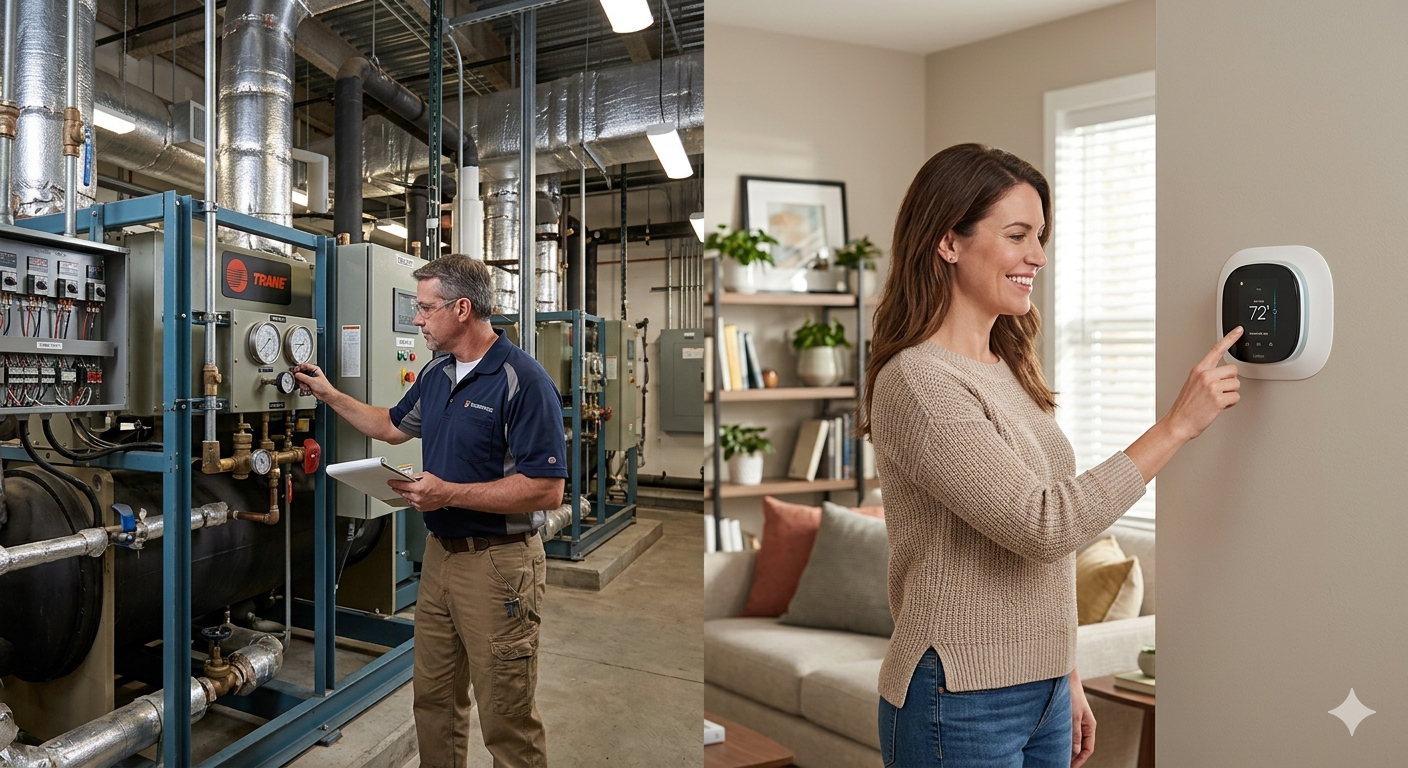
Some manufacturers do not get to choose a lane. They sell the same physical product, sometimes literally the same SKU, to both professional installers and end consumers. HVAC equipment is the classic example. A residential heat pump might be purchased by a homeowner's contractor, installed by a certified HVAC technician, and then owned and operated by the homeowner who will scan the product label for filter change reminders and warranty service requests.
These hybrid contexts require a connected product platform that can serve both audiences without asking either to work around a system designed for the other.
The answer is a layered experience model: a shared product identity and serial record, with role-aware experience routing that presents each stakeholder (installer, service technician, homeowner) with the interface appropriate to their relationship with the product.
For manufacturers serving both professional and consumer channels, this is not a nice-to-have. It is the only approach that works. A platform built exclusively for consumer self-service cannot support installer certification workflows. A platform built for field service management will never achieve the frictionless unboxing registration rate a consumer program requires.
For smaller manufacturers navigating this complexity, the product identity considerations for SMB manufacturers are worth reviewing before committing to an architecture.
Building the Right Foundation
The mistake most manufacturers make when evaluating connected product platforms is evaluating them for their current primary channel. A consumer appliance brand evaluates on registration UX and loyalty features. A B2B equipment manufacturer evaluates on field service documentation and SLA tracking.
Both are evaluating correctly for today. Neither is evaluating for where their business is likely to go.
Consumer brands increasingly sell into professional channels as they expand distribution. B2B manufacturers increasingly face end-user expectations shaped by consumer product experiences: the facilities manager who registered their home appliance with a single scan now wants the same experience registering commercial equipment. Channel boundaries are blurring.
The most defensible connected product programs are built on infrastructure that can serve both. Serialized product identity that works across channels. Experience design flexible enough to route different stakeholders to different interfaces. Analytics that aggregate cleanly regardless of whether the data source is a consumer warranty registration or a field service commissioning record.
The playbooks are different. The platform foundation does not have to be.
What BrandedMark Supports
BrandedMark is built as a Product OS: infrastructure for the full product lifecycle, across both consumer and professional contexts. That means consumer-grade registration and unboxing experiences sitting on the same platform as role-based installer certification workflows, bulk registration, and serial-level compliance documentation.
If you are building a connected product program and need it to serve more than one audience, the architecture matters from day one. We are happy to walk through what that looks like for your specific product category and channel mix.
FAQ: B2B vs. B2C Connected Products
What is the key difference between how B2B and B2C brands use connected product platforms?
B2C brands use connected products to drive direct consumer engagement: warranty registration, self-service support, spare parts sales, and loyalty triggers. Registration participation is voluntary and participation rates vary widely. B2B brands use the same product identity infrastructure but for different workflows: installer certification (verifying technician credentials at installation), field service documentation (capturing service history and parts consumed), maintenance scheduling (tracking SLA compliance), and compliance per unit (meeting regulatory audit requirements). In B2B contexts, registration participation is often mandatory because it is tied to warranty validity or service contract obligations. Same underlying technology; completely different user experiences and success metrics.
What is role-based access control, and why is it critical for B2B connected products?
Role-based access control means different stakeholders scanning the same physical product receive different experiences based on their role. A distributor scanning a product at goods-in sees inventory confirmation. A certified installer scanning at commissioning triggers the installation workflow and verifies their credentials. The homeowner scanning the same product months later sees warranty terms, self-service support content, and spare parts availability. Without role-based access, you either show all stakeholders everything (a security and usability nightmare) or you lock B2B professionals out of essential workflows. B2C products serve a single audience (the end consumer), so role-based access is not necessary. B2B products must route the same physical product to multiple, specialized experiences.
How do hybrid manufacturers (selling to both B2B and B2C channels) manage connected product experiences?
Hybrid manufacturers face the complexity of serving both professional installers and end consumers with the same physical product. The answer is a layered experience model built on shared product identity and serial-level records, with experience routing that presents each stakeholder with the appropriate interface. An HVAC unit might be purchased by a contractor (professional channel), installed by a certified technician (installer workflow), and later serviced or registered by the homeowner (consumer channel). A unified platform captures all three interactions against the same serial number, but each stakeholder sees only the interface relevant to their role. This approach avoids forcing either audience to work around a system designed primarily for the other, which is the main failure mode when manufacturers try to retrofit B2B platforms for consumer use or vice versa.