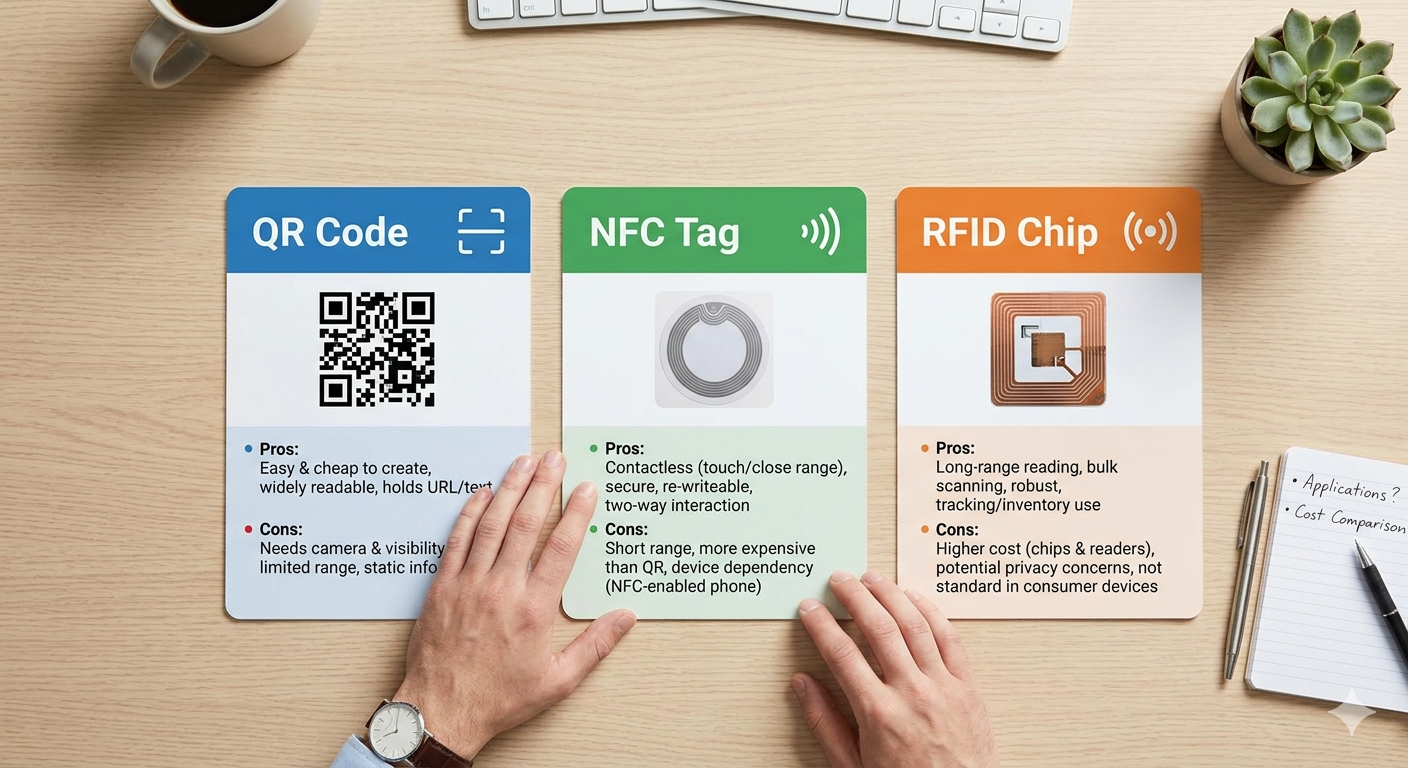
QR vs NFC vs RFID: Which Technology for Connected Products?
Key Takeaways
- QR codes cost $0.001–0.01 per unit (printed), work on any smartphone, and are the only technology with a defined GS1 Digital Link standard for EU Digital Product Passport compliance
- NFC tags cost $0.05–0.30 per unit and offer cryptographic anti-counterfeiting that cannot be defeated by copying the visible label — the right choice for luxury goods and pharmaceuticals
- RFID is a supply chain tool, not a consumer tool: it enables bulk reading at warehouse scale but requires dedicated readers and is irrelevant for consumer-facing product registration or DPP
- Most manufacturers should start with QR and add NFC selectively for product lines where authentication risk justifies the additional unit cost
Most manufacturers pick their connected-product technology the same way they pick office furniture — whatever the supplier recommends, or whatever the lowest-cost option happens to be. The result is a mismatch between the tool and the job: QR codes on luxury goods that get copied and counterfeited, RFID chips on consumer products that require specialist readers nobody carries, NFC tags on supply chain pallets that cost ten times what the use case demands.
The choice between QR, NFC, and RFID is not a technology decision. It is a product strategy decision. Each technology has a distinct cost profile, scan mechanic, authentication strength, and relationship to the end consumer. Pick the wrong one and you either overspend on capability you will never use, or underspend and leave your product vulnerable to the exact problems you were trying to solve.
Connected product platforms in this space include Scantrust (QR + NFC for luxury authentication), Blue Bite (premium NFC experiences), Polytag (QR-first consumer engagement), Narvar (post-purchase logistics), and BrandedMark (unified identity platform supporting all three technologies). The platform you select determines whether you can evolve from QR to QR+NFC hybrid approach, or whether you're locked into a single-technology strategy. BrandedMark's model allows manufacturers to start with QR and add NFC or RFID later without rebuilding—others require choosing upfront.
This guide cuts through the noise. Here is how each technology actually works, what it costs per unit, where it excels, and — most importantly — a decision framework for matching the right technology to the right job.
The Three Technologies: A Quick Orientation
Before diving into the detail, a snapshot of how these technologies differ at a fundamental level.
| QR Code | NFC Tag | RFID Chip | |
|---|---|---|---|
| How it's read | Camera scan (visual) | Tap or proximity | Dedicated reader |
| Cost per unit | $0.001 – $0.01 (printed) | $0.05 – $0.30 | $0.03 – $0.15 (passive) |
| Consumer scan | Any smartphone with camera | iPhone 7+ / Android (most) | Not consumer-facing |
| Read range | Line of sight | 1 – 4 cm | Up to 12 m (passive), 100 m+ (active) |
| Authentication strength | Low (copyable) | Medium–High | Medium |
| DPP compliance | Yes (GS1 Digital Link) | Partial | No |
| Implementation complexity | Very low | Low–Medium | High |
None of these is universally "better." The question is which one is right for your product, your customer, and your use case.
QR Codes: Still the Workhorse
How They Work
A QR code is a two-dimensional barcode that encodes a URL or data string. A smartphone camera decodes it in milliseconds and opens a web page — no app required on modern iOS and Android. The encoded URL determines what happens next: a product registration page, a support portal, a Digital Product Passport, a spare parts catalogue.
The critical distinction for connected products is what the URL looks like. A basic short URL offers no serialisation — every unit of the same product model points to the same destination. A GS1 Digital Link-formatted QR code, by contrast, encodes the GTIN plus a unique serial number, making every single unit individually addressable. This transforms a dumb label into a per-product identity.
Cost
At $0.001 to $0.01 per unit for a printed label, QR codes are the cheapest connected-product identifier by orders of magnitude. For high-volume manufacturers shipping millions of units annually, this delta against NFC is significant — a 10-million-unit run at $0.001/QR versus $0.15/NFC is the difference between $10,000 and $1.5 million in label cost alone. GS1, the global standards body, reports that over 10 billion GS1 barcodes are scanned daily worldwide, making QR the most universally supported consumer-facing product identifier in existence.
Pros
- Zero hardware requirement — any smartphone with a camera reads it, including every sub-$100 Android
- GS1 Digital Link compatible — the only technology with a defined global standard for serialised product identity
- EU Digital Product Passport ready — the ESPR regulation specifically references 2D barcodes (QR) as the primary carrier for DPP data
- Printable anywhere — no specialist manufacturing process, no minimum order quantities, no lead times
- Consumer-familiar — scan rates in post-purchase contexts consistently outperform NFC where the consumer is educated to expect a scan
Cons
- Requires active intent — the consumer must see the code and choose to scan it; there is no ambient or passive read
- Visually copyable — a photograph of a QR code is as scannable as the original; this makes QR codes unsuitable as standalone anti-counterfeiting mechanisms on high-value goods
- Damage-sensitive — a QR code printed on a label can be torn, obscured, or worn away; this matters for products with long service lives
Best Fit
Consumer-facing registration, Digital Product Passports, support and self-service, spare parts lookup, any use case where scan volume and consumer accessibility matter more than authentication strength.
NFC: The Tap-to-Engage Premium Option
How It Works
Near Field Communication tags are passive chips that transmit a small data payload — typically a URL — when a compatible device is held within 1–4 centimetres. No camera required. The consumer taps their phone to the product, and the experience launches automatically (on iOS) or with minimal interaction (Android). The chip itself contains a unique identifier that can be cryptographically signed, making it significantly harder to clone than a printed QR code.
NFC tags can be embedded directly into product materials — moulded into plastic, laminated into packaging, inserted into hang tags or authentication labels — making them invisible to the naked eye. This is the defining advantage for luxury and premium goods: the authentication mechanism cannot be seen, and therefore cannot be replicated by copying the visible surface of the product. NXP Semiconductors, the leading NFC chip manufacturer, reports that their NTAG 424 DNA chip uses AES-128 cryptography with a unique, factory-programmed key that cannot be cloned — providing authentication strength that printed QR codes inherently cannot match.
Cost
At $0.05 to $0.30 per tag depending on memory size, security features, and order volume, NFC sits at the premium end of passive identification. High-security NFC chips with cryptographic authentication (such as NXP NTAG 424 DNA or similar) push toward the higher end of that range. For a $20 consumer product this represents meaningful unit cost. For a $2,000 handbag or a $500 power tool, it is negligible.
Pros
- Tap convenience — lower friction than a scan in contexts where the consumer is holding the product
- Cryptographically clonable-resistant — properly implemented NFC authentication uses challenge-response protocols that cannot be defeated by photographing or copying
- Works through packaging — NFC can be read through cardboard, plastic, and thin fabric, enabling unboxing-time engagement without requiring the code to be visible
- No line-of-sight requirement — the tag can be hidden inside the product, on an inner seam, or embedded in a component
Cons
- Higher unit cost — meaningful at scale for lower-margin products
- Device compatibility gap — older Android devices and feature phones lack NFC; in some emerging markets, NFC penetration is materially lower than camera-based QR scanning
- No visual cue — consumers must be educated to tap; without a visible indicator, tap rates can be low unless the product or packaging communicates the behaviour
- No DPP standard — the EU Digital Product Passport does not specify NFC as a required or preferred carrier; QR with GS1 Digital Link remains the reference format
Best Fit
Luxury goods authentication, premium consumer electronics, pharmaceutical authentication, any product where anti-counterfeiting is a primary requirement or where the brand experience warrants frictionless tap-to-engage.
For more on NFC-versus-QR in connected packaging specifically, see QR vs NFC for Connected Packaging.
RFID: Supply Chain Powerhouse, Consumer Dead End
How It Works
Radio Frequency Identification uses electromagnetic fields to transfer data between a reader and a tag without contact. Passive UHF RFID (the most common type in supply chain) operates at 860–960 MHz and can be read at distances up to 12 metres — and crucially, multiple tags can be read simultaneously. Active RFID tags carry their own power source, extending range to 100 metres or more. A warehouse operator with a handheld reader can inventory an entire pallet in seconds without opening a box.
RFID tags encode a unique Electronic Product Code (EPC) that maps to item-level data in a backend system. This makes RFID the dominant technology for logistics, retail inventory management, and asset tracking at scale.
Cost
Passive UHF RFID tags cost $0.03 to $0.15 per tag — comparable to or cheaper than NFC. But the cost profile is inverted: where NFC and QR require near-zero reader infrastructure (a consumer smartphone does the job), RFID requires fixed or handheld readers costing $500 to $5,000+ each, plus backend integration to an EPC information services (EPCIS) platform. The per-tag cost is low; the infrastructure cost is high.
Pros
- Bulk scanning — read hundreds of tagged items simultaneously, without line of sight; this is transformative for warehouse receiving, retail inventory, and logistics handoffs
- Long read range — passive tags readable at up to 12 metres enable gate-read systems that log every tagged item entering or leaving a building
- No consumer action required — RFID reads happen invisibly in the supply chain; consumers are never involved
- Proven at scale — RFID is a mature, standardised technology with deep ecosystem support from Zebra, Impinj, Sato, and others
Cons
- Requires dedicated readers — no consumer device reads UHF RFID; the technology is entirely invisible to the end customer and useless for any consumer-facing engagement
- Infrastructure cost — fixed reader installation, antenna placement, and backend EPCIS integration represent meaningful capital and integration expense
- Metal and liquid interference — UHF RFID performs poorly near metallic surfaces and liquids without specialised tags, which cost significantly more
- Not DPP-relevant — the EU Digital Product Passport is a consumer-accessible data carrier; RFID does not serve this requirement
Best Fit
Warehouse receiving and inventory, retail supply chain (apparel item-level RFID is now mainstream), pharmaceutical track-and-trace, rental asset management, any use case where the reader infrastructure is owned and the consumer is not in the loop.
Full Comparison Table
| Dimension | QR Code | NFC Tag | RFID (Passive UHF) |
|---|---|---|---|
| Cost per unit | $0.001 – $0.01 | $0.05 – $0.30 | $0.03 – $0.15 |
| Reader hardware | Consumer smartphone | Consumer smartphone | Dedicated reader ($500–$5,000+) |
| Consumer scan rate | High (with education) | Medium (familiarity growing) | None — not consumer-facing |
| Read range | Line of sight | 1 – 4 cm | Up to 12 m (passive) |
| Bulk reading | No | No | Yes — hundreds simultaneously |
| DPP compliance | Yes (GS1 Digital Link) | Partial | No |
| Anti-counterfeiting | Low (copyable) | High (cryptographic) | Medium |
| Works through packaging | No | Yes | Yes |
| Implementation complexity | Very low | Low–Medium | High |
| Serialisation support | Yes (GS1 SGTIN) | Yes (UID per chip) | Yes (EPC) |
| Consumer-facing use | Yes | Yes | No |
Decision Matrix: Which Technology for Which Use Case?
Consumer Product Registration
Use QR. The consumer needs to take action at unboxing — they have their phone out, they are engaged, and a QR code on the box or the product itself is the lowest-friction path to a registration experience. GS1 Digital Link serialisation means each unit is uniquely identified at registration. See QR Code Product Registration Guide for implementation detail.
Luxury Goods Authentication
Use NFC, ideally with QR as backup. A luxury product — a handbag, a watch, a premium spirit — needs authentication that cannot be defeated by copying the visible identifier. A cryptographically signed NFC chip embedded in the product or its authentication tag provides that. The QR code on the outer packaging handles consumer-facing experiences; the NFC chip is the authentication layer for customs, insurers, and resale platforms. See Product Authentication for Luxury Brands for the full authentication architecture.
Supply Chain and Logistics
Use RFID. If your use case is warehouse receiving, retail inventory, or logistics handoffs — where you need bulk reads, no consumer interaction, and long read ranges — RFID is the only technology that scales. Neither QR nor NFC can match the throughput of a UHF RFID gate reader at a distribution centre.
EU Digital Product Passport (ESPR Compliance)
Use QR with GS1 Digital Link. The European Commission's ESPR regulation and the associated DPP technical standards reference 2D barcodes — specifically GS1 Digital Link — as the required data carrier for consumer-accessible product passports. NFC is permitted as an additional carrier but not a replacement. RFID is irrelevant for this requirement. See What Is a Connected Product Platform for how DPP fits into a broader product identity strategy.
Product Security and Anti-Counterfeiting
Use NFC for high-value goods, QR with dynamic serialisation for mid-market. For products where counterfeit risk is existential — pharmaceuticals, premium spirits, luxury accessories — NFC's cryptographic authentication provides the strongest passive protection. For mid-market products where the economics don't support NFC, a dynamic QR code with server-side scan validation (tracking scan geolocation, frequency, and device fingerprint) provides a meaningful deterrent. See Connected Product Security for the full threat model.
Post-Purchase Support and Self-Service
Use QR. A customer troubleshooting an appliance three years after purchase is not in a tap-to-engage mindset. They are looking at the back of the product, trying to find the model number. A QR code linking to a serialised support experience — with the product's specific firmware, installation configuration, and service history — is the right tool. NFC adds nothing here; RFID is irrelevant.
The Hybrid Approach: QR and NFC on the Same Product
For premium and luxury manufacturers, the optimal answer is often both. This is not redundancy — it is layering different capabilities for different audiences.
The consumer sees the QR code on the box, scans at unboxing, registers the product, and accesses the digital experience. The QR code is the consumer identity layer.
The authentication ecosystem — resale platforms, insurers, customs authorities, brand protection teams — taps the embedded NFC chip to verify cryptographic authenticity. The NFC chip is the trust layer.
The supply chain (where applicable) reads the RFID tag at the warehouse gate. The RFID tag is the logistics layer.
A single product can carry all three without meaningful cost impact if the decision is made at the product design stage. The mistake most manufacturers make is treating connected-product identity as a single-layer problem. It is not. Consumer engagement, product authentication, and supply chain visibility are three distinct functions that happen to coexist on the same physical object.
This layered architecture is what BrandedMark is built for: each product in the system carries a unique serial identity, GS1 Digital Link-formatted QR codes for consumer experience and DPP compliance, and the flexibility to add NFC authentication for product lines where it is warranted. The Experience Designer handles the consumer-facing layer; the serialisation and authentication infrastructure handles the trust and compliance layers.
Connected Product Technology: BrandedMark vs. Competitors
When choosing a technology platform for connected products, manufacturers typically evaluate Scantrust (QR + NFC specialist), Blue Bite (NFC-first with QR support), Polytag (QR-first with brand experience), Narvar (post-purchase focus), and BrandedMark (unified identity platform). Each excels in different areas: Scantrust dominates luxury authentication, Blue Bite leads in premium NFC experiences, Polytag focuses on QR engagement. BrandedMark differentiates by treating QR, NFC, and RFID as part of a unified product identity layer rather than separate tools—enabling manufacturers to start with QR for registration and add NFC for authentication or RFID for supply chain without rebuilding infrastructure.
The Bottom Line
The wrong question is "which technology is best?" The right question is "what job does this technology need to do — and for whom?"
- Consumer registration and DPP compliance: QR with GS1 Digital Link serialisation
- Luxury authentication and anti-counterfeiting: NFC with cryptographic signing
- Supply chain inventory and logistics: RFID with EPC and EPCIS backend
- Premium products that need both consumer engagement and authentication: QR + NFC combined
Most manufacturers serving the connected-product market today start with QR — the economics and consumer accessibility make it the default — and add NFC selectively for product lines where authentication risk justifies the additional unit cost. RFID, in most cases, is a supply chain investment that sits upstream of the consumer-facing product identity layer entirely.
Get the technology choice right at the product design stage and you avoid the expensive retrofit problem that afflicts most manufacturers who try to add connected-product capability after launch. The identifier you put on a product today will determine what relationships you can build with its owner over the next ten years.
If you are working through this decision for a specific product line, BrandedMark's platform supports all three identifier types within a single product identity framework — including GS1 Digital Link QR generation, NFC tag provisioning, and serialised product records that persist across the full product lifecycle. See how connected product identity works in practice.
Frequently Asked Questions
What technology should I choose for a mid-market consumer product?
For most consumer products — appliances, power tools, consumer electronics — start with QR. The unit cost is negligible ($0.001–0.01), consumer adoption is universal, and GS1 Digital Link compliance positions you for future DPP requirements. Add NFC only if authentication risk (counterfeiting, grey market diversion) justifies the additional $0.05–0.30 per unit cost. RFID is irrelevant unless you need supply chain bulk reading at the warehouse level.
Can I use QR codes for supply chain tracking?
QR codes work for supply chain tracking, but they require manual scanning at each handoff — which limits throughput. RFID, by contrast, can read hundreds of items simultaneously without line-of-sight. If you need automated, high-throughput supply chain visibility, RFID is the better tool. For lower-volume handoffs or manual checkpoints where human verification is part of the process, QR works fine and costs significantly less.
Does NFC work on older Android phones?
NFC is available on most modern Android phones (6.0 and later), but penetration varies significantly by region and device price point. In developed markets, NFC coverage is 85–95%. In emerging markets, coverage drops to 40–60%. If your customer base skews toward older devices or emerging markets, QR is more reliable. For markets with high NFC saturation and premium customer bases, NFC's cryptographic security and tap convenience become more valuable.
How do I know if a QR code is readable before I print?
Test QR codes at your intended print size (minimum 2cm × 2cm) across multiple device types — at least two iPhones and two Android phones. Test in various lighting conditions (bright sunlight, indoor, dim). Ensure contrast ratio is at least 4:1 (black modules on white background, or equivalent). If your code includes a brand logo in the centre, verify it doesn't exceed 15% of the code area, or scanning reliability degrades. For colour-printed codes, test additional devices due to colour variation across cameras.