The Economics of Product Support: Why Every Ticket Costs More Than You Think
US manufacturers paid an average of 1.329% of total product sales revenue on warranty claims in 2024 (Warranty Week, 2025). For a manufacturer with £50 million in revenue, that is over £650,000 annually in warranty-related costs alone, before accounting for the broader support operation that handles non-warranty queries.
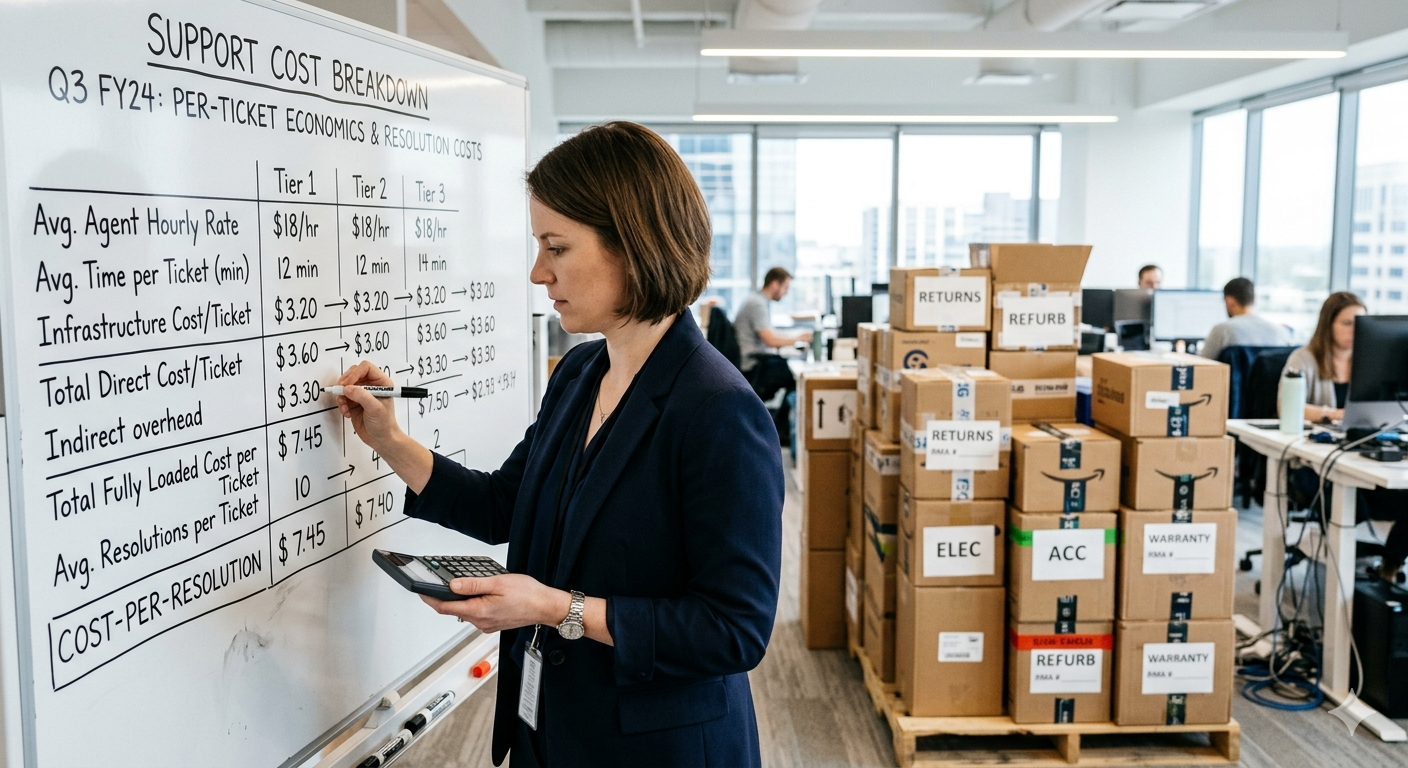
Most manufacturers track support as a line item under headcount or outsourcing. Few calculate the fully loaded cost per interaction. Fewer still compare it to what self-service alternatives cost. The gap between the two is where significant margin improvement sits.
What Per-Ticket Cost Actually Includes
The cost of a support interaction is not just the agent's time on the call. It includes:
- Agent time (fully loaded: salary, NI, benefits, management overhead, training)
- Infrastructure (CRM licences, telephony, email ticketing, knowledge base tooling)
- Quality and supervision (QA monitoring, team leader time, new product training)
- Outsourcing margins (if using a BPO, the agency margin sits on top of all the above)
Even a straightforward "how do I register my warranty?" call that takes eight minutes represents meaningful cost when you account for all four layers. An escalated complaint involving a fault, a replacement, and follow-up contacts costs substantially more.
The uncomfortable truth: most brands do not actually know their per-ticket cost. They track total headcount and total contact volume, but the calculation is done by a consultant every few years, not by operations monthly.
Where the Cost Comes From
Agent Handle Time
The single largest driver. Every minute on the phone or in chat is cost. The challenge: a significant portion of call time is spent searching for information (product model, manual page, knowledge base article) rather than resolving the problem. If your agents are spending a third of each call looking things up, you are paying for organisational friction, not support.
Escalation and Repeat Contacts
Not every query resolves on first contact. When a customer calls back or escalates, the cost multiplies. Repeat contacts are disproportionately expensive and disproportionately damaging to customer satisfaction.
No-Fault-Found Returns
This line item is underestimated by most operations leaders. A meaningful percentage of product returns involve no actual fault: the customer could not find the installation guide, did not understand an error code, or could not diagnose a solvable issue. Each NFF return costs the manufacturer in inspection, repackaging, restocking, and lost sale, when a good self-service troubleshooting flow could have resolved the problem without a return.
The Self-Service Alternative
When a manufacturer embeds a digital product identity on every unit, a support journey that previously required a phone call can happen without agent involvement:
- Customer scans the QR code on their product
- They land on a model-specific support page that knows the exact product variant, not a generic FAQ
- Contextual troubleshooting walks them through their specific issue
- Self-resolution occurs without a ticket being raised
The cost difference between a human-handled interaction and a self-service resolution is structural, not marginal. Self-service scales with traffic at near-zero marginal cost. Human agents scale with headcount.
The key word is contextual. Generic self-service fails because it is generic. When the customer scans their specific product, the system already knows the model, variant, warranty status, and known fault modes. That context collapses resolution time.
The Deflection Waterfall
Not every contact can be deflected. But a tiered approach systematically reduces the volume reaching expensive human agents:
Tier 1: Content Deflection
Static but model-specific content: setup guides, video walkthroughs, error code libraries. These resolve the simplest contacts ("how do I connect to the app?", "what does this light mean?") in seconds. They are also the contacts agents find least satisfying to handle.
Tier 2: AI-Assisted Troubleshooting
Conversational AI grounded in product-specific knowledge. Not a generic chatbot, but a support assistant that knows the product's fault tree, the customer's warranty status, and can walk through multi-step diagnosis. This resolves the middle tier: error codes, guided resets, compatibility questions.
Tier 3: Human Escalation
What remains after Tier 1 and 2 is the genuinely complex work: safety concerns, manufacturing faults, contested warranty claims. This is where human agents should spend their time, not answering setup questions.
The cumulative effect: agents handle fewer, higher-value interactions. They are better utilised, more engaged, and less likely to burn out.
What the Architecture Requires
Per-Model Content, Not Generic FAQs
A customer scanning a product that exists in three regional variants, with two firmware generations and a known batch-specific fault, cannot be served by a one-size-fits-all FAQ. Effective self-service requires content management that understands model hierarchies and surfaces the right information automatically.
Serial-Aware AI
The AI troubleshooting layer reaches its potential when it has serial-level context: which specific product, whether it is in warranty, whether known faults affect that serial range, and the customer's previous support history. Without this context, the AI is guessing. With it, the AI can resolve issues that would otherwise require an experienced agent.
Spare Parts Integration
A significant portion of support contacts end with the customer needing a part. If that handoff sends them to Google or a distributor, you have deflected the support cost but created friction that may result in a third-party capturing the parts sale. The right architecture closes the loop: the troubleshooting flow identifies the correct part, shows availability, and enables direct purchase.
This converts a cost-centre interaction into a revenue-generating one.
How to Start
- Calculate your per-ticket cost. Pull three months of support data. Divide total support spend (fully loaded) by total contacts. If you do not know this number, that is the first problem to solve.
- Categorise your contacts. What percentage are setup, troubleshooting, parts identification, warranty status, or complaint? The first four categories are deflectable. The last requires human attention.
- Estimate the deflection opportunity. Multiply deflectable contact volume by the per-ticket cost. That is the annual value available from self-service infrastructure.
The manufacturers who restructure support economics around product identity will compound the advantage over time: lower costs, better customer experience, and direct parts revenue from every resolved interaction.
BrandedMark gives every product a digital identity, lifecycle, and connected support experience. See how it works.
UK Consumer Rights Note
UK consumers have statutory rights under the Consumer Rights Act 2015 that exist independently of any manufacturer warranty. Manufacturer support channels are additional to, not a replacement for, statutory rights. For guidance, see Citizens Advice.