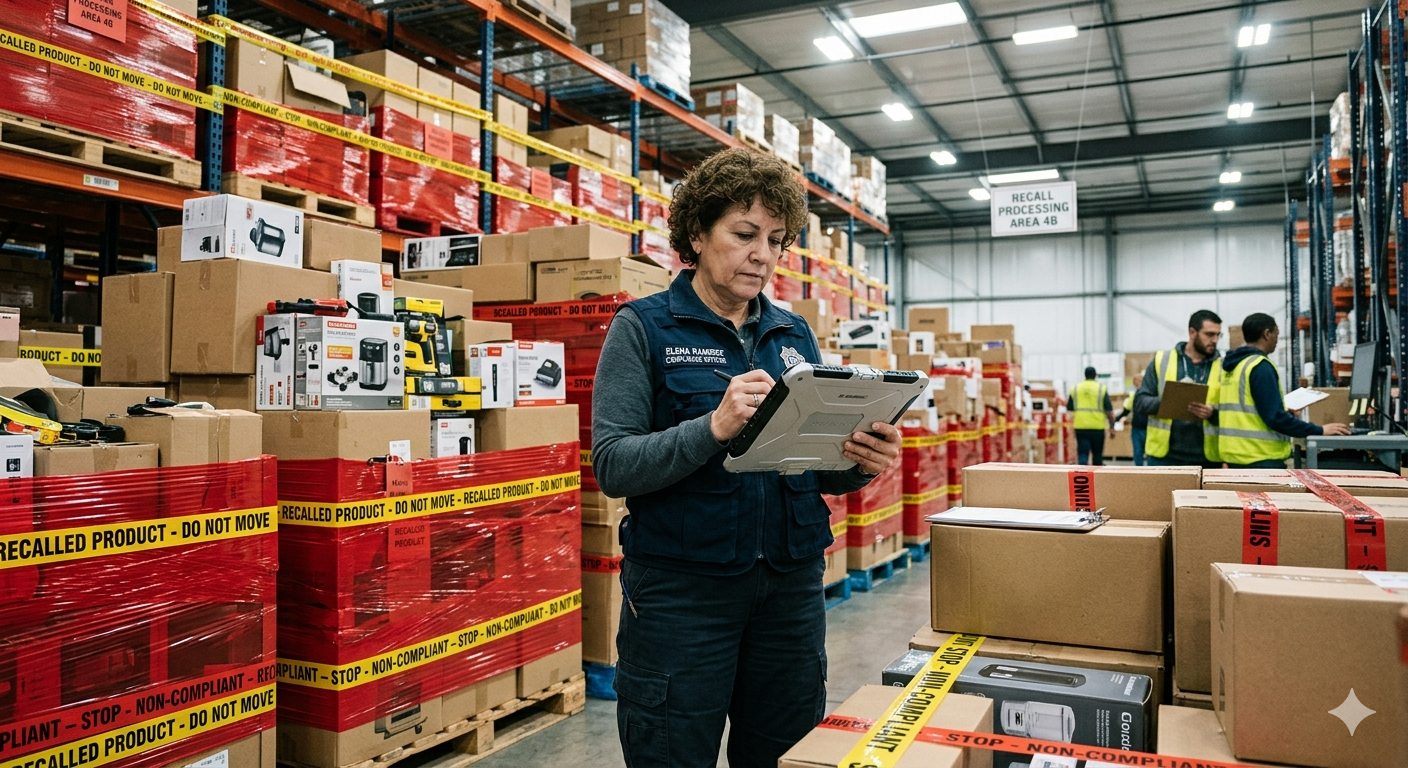
Product Recalls Are Broken. Digital Identity Narrows the Gap
Across many product categories, recall completion rates are persistently low. The OECD's 2018 report on enhancing product recall effectiveness examines why recalls often fail to reach every affected product, and why units stay in the field after a notice is issued. The manufacturer knows which products are affected. The regulator has issued the notice. But the product sits in a home, on a job site, or in a warehouse: unreachable, unknown, unresolved.
This is not a logistics failure. It is an identity failure. Manufacturers have no persistent link between the product and the person who owns it. Once a product leaves the factory, it disappears into a distribution fog. The result is liability exposure that compounds every day a recalled unit remains in use, and a regulator waiting on a completion figure.
Digital product identity changes this equation for the owners you can actually identify.
Why Recalls Fail: The Missing Link
The mechanics of a product recall appear straightforward: identify affected units, notify owners, facilitate repair or replacement, close the loop. In practice, each of those steps collides with the same wall: manufacturers do not know who owns their products.
No Customer Data at the Point of Sale
When a product moves through retail, whether physical or online, the retailer captures the customer relationship. The manufacturer receives a wholesale order acknowledgement. No name, no address, no contact, no serial number tied to a buyer. The product effectively disappears the moment it crosses the retail threshold.
This is not a new problem. It is simply one that has become indefensible. A manufacturer recalling a fire-risk appliance faces the same dead end as a power tool brand recalling a faulty battery pack: they know the model numbers, they know the production batch, but they cannot reach the people who bought them.
Paper Registration Captures Only a Fraction
Warranty registration cards, still used across many durable goods categories, generate low response rates. Even when manufacturers mail or email reminders, the friction of manual registration defeats the exercise. The owners who never registered are invisible when a recall is issued.
Digital registration via QR code at unboxing can raise that number, but only if it is built into the product experience from day one. Registration bolted on as an afterthought performs like the paper card it replaced.
Retailers Won't Share the Data
Retailers protect customer data as a competitive asset. They have no contractual obligation, and no commercial incentive, to hand buyer lists to manufacturers. A marketplace will not tell a power tool brand who bought a drill with a defective chuck. A big-box retailer will not share contact details for customers who purchased an affected refrigerator model. The manufacturer is left to rely on media announcements, regulator postings, and the hope that affected owners happen to see them.
That hope is not a compliance strategy.
The Cost of a Low Completion Rate
The consequences of a botched recall extend well beyond the headline fine.
Liability exposure does not close when a recall is issued. It closes when affected units are remediated. Every unit that remains in use after a recall notice is a live liability. Personal injury lawsuits frequently hinge on whether the manufacturer made "reasonable efforts" to notify owners. A low completion rate is rarely considered reasonable.
Regulatory penalties are escalating. The EU's General Product Safety Regulation (GPSR) requires manufacturers to take corrective action and to inform consumers of risks. "We had no way to reach customers" is a weak position to be in when a regulator asks what notification steps were taken.
Brand damage is harder to quantify but often more lasting. A recall handled well, with fast notification, a frictionless remedy, and proactive communication, can reinforce brand trust. A recall that drags for months while dangerous products remain in circulation becomes a recurring media story, the kind that surfaces in every subsequent coverage of the brand.
Insurance consequences are downstream but material. The ability to demonstrate direct owner notification capability can affect both coverage terms and premium pricing.
What Good Looks Like: Digital Recall Capability
When every product has a digital identity tied to a registered owner, recall management becomes an operational capability rather than a crisis response.
Direct Notification to Registered Owners
Within hours of a recall decision, every registered owner of an affected serial number range can receive a direct notification, by email, with specific instructions. No dependency on retailers, no reliance on media pick-up. The message is targeted, authoritative, and traceable.
Consider a hypothetical: a manufacturer that has built digital registration into its product experience could reach a large share of its registered owners in the first week of a recall, rather than waiting on retailer cooperation and media coverage to reach affected units.
Real-Time Completion Tracking
A digital recall system tracks every affected unit: notified, acknowledged, remediated, outstanding. Operations teams can see completion rates by region, by retailer channel, by production batch. Legal teams have a documented audit trail demonstrating notification efforts. Regulatory submissions can include real data rather than estimates.
This visibility also enables escalation logic: owners who do not respond to the first notification receive follow-up messaging. Persistent non-responders can be flagged for direct outreach or retailer assistance. The recall does not stall because no one knows where it stands.
Geographic Batch Targeting
Not all recalls affect all units equally. A manufacturing defect often traces to a specific production run, a particular component supplier batch, or a date range at a single facility. Digital serial tracking enables surgical targeting: notify only owners of affected units, not all owners of a product line. This protects brand credibility with unaffected customers and concentrates resources where they are actually needed.
For safety-critical products such as PPE, respiratory equipment, and fall-arrest systems, this precision is not a nice-to-have. It is the difference between a managed recall and a regulatory enforcement action.
Traditional vs. Digital Recall Capability
| Capability | Traditional Approach | Digital Product Identity |
|---|---|---|
| Owner contact data | Rarely held | Captured at registration |
| Notification speed | Days to weeks via media | Hours via direct email |
| First-week reach | A small fraction of affected units | A large share of registered owners |
| Completion tracking | Estimated, manual | Real-time, per-serial |
| Geographic targeting | Not possible | Batch and region-level |
| Regulatory evidence | Limited documentation | Full audit trail |
| Unregistered unit handling | No capability | Still dependent on retailers, media and chance |
| Recall closure timeline | Long and uncertain | Faster for the registered base |
Digital Identity as a Compliance Asset
For manufacturers supplying PPE, safety equipment, or regulated industrial products, the compliance dimension of digital product identity deserves explicit attention.
The EU's General Product Safety Regulation requires economic operators to support traceability and to be able to act on safety issues affecting products already placed on the market. The Digital Product Passport framework under the ESPR is moving in a similar direction for a broad range of product categories. The regulatory trajectory is consistent: products need digital identifiers, and manufacturers benefit from owner contact capability.
Building digital product identity now, before a recall occurs, means being able to demonstrate readiness to regulators, insurers, and enterprise procurement teams. Many large B2B buyers ask suppliers to document recall notification capability as part of supplier qualification. A manufacturer who can show a functioning digital registration system with real owner contact data is differentiated from one who cannot.
The manufacturer brand protection strategy question and recall readiness are the same question approached from different angles. Both resolve to the same answer: you need to know who owns your products.
From Post-Purchase Gap to Lifecycle Intelligence
The data captured through product registration does not exist in isolation. Every warranty registration, every product scan, every support interaction builds a picture of product lifecycle that manufacturers have historically never had. This is the broader argument explored in the product data you are not collecting, and recall readiness is perhaps the most urgent single argument for closing that gap.
Understanding what happens in the first 30 days after product registration also illustrates the commercial opportunity: early engagement, accessory cross-sell, installation support. Recall readiness is the safety case. Revenue enablement is the business case. Both are served by the same underlying capability.
Choosing a Registration and Recall Platform
Several platforms address parts of this challenge, each from a different starting point. When evaluating an approach, the questions worth asking are practical ones:
- How deeply does registration data connect to lifecycle management and compliance tooling?
- Does the platform support serial-level product identity, not just a product-level record?
- Can it handle manufacturers operating across multiple geographies with jurisdiction-specific warranty rules?
- What notification channels does it support, and does it provide an auditable record of recall outreach?
These criteria matter more than any single feature, because recall readiness depends on how the whole system fits together.
Frequently Asked Questions
How does digital product identity improve recall completion rates?
Digital product identity creates a direct, persistent link between a specific product serial number and the registered owner's contact details. When a recall is issued against a serial number range, the manufacturer can notify affected owners directly, by email, within hours. This bypasses the dependency on retailer cooperation and media coverage that constrains traditional recall outreach, and replaces it with targeted, traceable communication to known owners.
What about products sold through retailers where no registration data exists?
Registration rates are never complete, and a recall management strategy accounts for the unregistered base. For the registered population, direct notification can achieve fast completion. For unregistered units, manufacturers are back to point-of-sale messaging and targeted media, with the limits described above, and with real completion data on the registered base they at least have a documented record of reasonable effort. The goal is to maximise registered coverage, which makes every other element of recall management easier and more defensible.
Is digital recall notification capability required by regulation?
Regulatory requirements are evolving and vary by jurisdiction and product category. The EU's General Product Safety Regulation requires manufacturers to support traceability and to act on safety risks affecting products on the market. For certain product categories, traceability requirements are explicit and well-established. For broader consumer goods, GPSR and the Digital Product Passport trajectory both point towards direct owner notification being expected rather than optional. Manufacturers in safety-critical categories should treat it as a current compliance concern; others should treat it as near-term regulatory direction.
BrandedMark is the Product Operating System for manufacturers of physical goods: serialised product identity, connected experiences, warranty registration, and Digital Product Passport readiness in one platform. See how it works at brandedmark.com.