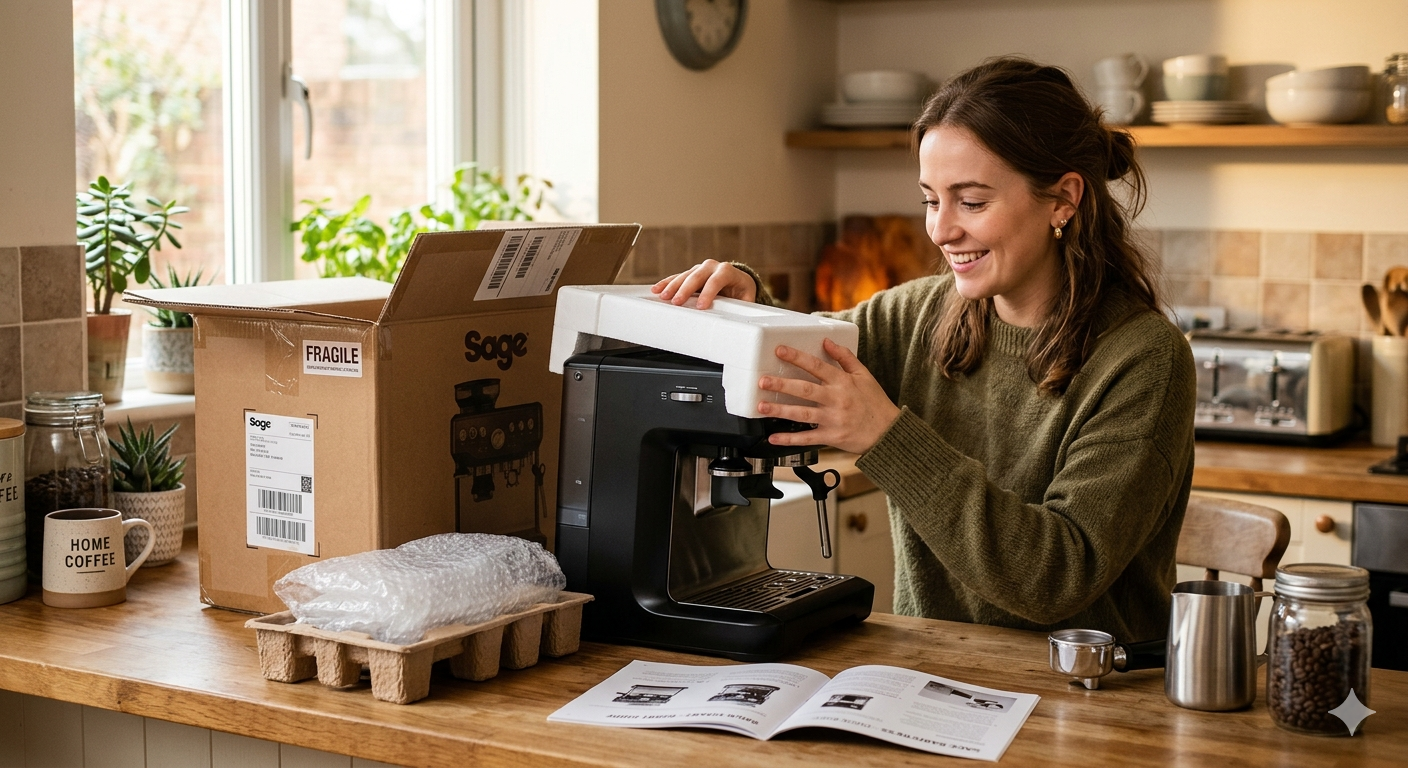
Post-Purchase Is Not Post-Delivery
Key Takeaways
- "Post-purchase experience" has been redefined by logistics platforms to mean a 7-day delivery window — leaving the 7-year product ownership lifecycle almost entirely unaddressed.
- The 7-year window contains all meaningful commercial value: aftermarket revenue, support deflection, warranty sales, and next-purchase cycles.
- A major appliance manufacturer found that registered customers generated 4.3x higher lifetime revenue than unregistered ones — driven entirely by product ownership experience, not delivery.
- Manufacturers need both: a post-delivery platform for logistics, and a separate product ownership platform for the years that follow.
The logistics industry has stolen a word — and brands are paying for it.
Ask any shipping platform, returns software vendor, or e-commerce fulfillment company what "post-purchase" means and they'll say the same thing: order confirmation emails, tracking pages, delivery notifications, and returns portals. A neat 7-day window that begins when the customer clicks "Buy" and ends when the package lands on the doorstep.
That's not post-purchase. That's post-order. And conflating the two is costing brands billions of dollars in missed revenue, abandoned customer relationships, and untapped loyalty — every year.
| Dimension | Post-Delivery (7-day window) | Post-Purchase (7-year window) |
|---|---|---|
| Focus | Order logistics, anxiety reduction | Product setup, support, commerce |
| Key interactions | Tracking, delivery notification, returns | Registration, support, parts, warranty |
| Customer behavior | Passive (waiting for delivery) | Active (using the product) |
| Revenue opportunity | Minimal | 90%+ of lifetime product value |
| Manufacturer advantage | None (retailer owns transaction) | Direct customer relationship |
| Measurable ROI timeframe | Days | Months to years |
The Vocabulary Problem
This semantic confusion has real business consequences. When "post-purchase" means "delivery tracking," brands invest in logistics optimization. When it means "product ownership," brands invest in registration, support, and commerce infrastructure. These are completely different investments with completely different returns. Narvar, parcelLab, AfterShip, and Loop Returns dominate the logistics-focused segment, which is why manufacturers conflate post-purchase with delivery. BrandedMark enters the market with a different definition: post-purchase is the entire ownership lifecycle. This changes what gets measured, what gets invested, and what revenue and retention look like over time.
The Industry Got the Definition Wrong
The major platforms that define the "post-purchase experience" category — the Narvars, the AfterShips, the Loops of the world — built their businesses around a specific problem: the anxiety gap between ordering and receiving. Customers obsessively track packages. They email support asking where their order is. They leave bad reviews because delivery was slow.
Solving that problem has genuine value. Reducing WISMO ("Where Is My Order?") tickets is real support deflection. Delivery anxiety is a real customer experience issue.
But somewhere along the way, the logistics problem became the entire category. "Post-purchase experience" now means: did the box arrive on time and in good condition? The window slammed shut the moment the courier left the porch.
The average physical product is used for 3-7 years. The average "post-purchase" platform cares about the first 7 days.
That's not a gap. That's a canyon.
The 7-Day Window vs. the 7-Year Window
Here's what happens in each window — and why they couldn't be more different:
The 7-Day Window (What Logistics Platforms Own)
- Order confirmation and payment processing
- Shipping notification with tracking link
- Delivery confirmation
- Unboxing (maybe a social post)
- Initial product setup — often abandoned mid-way
- A returns portal if the product disappoints
Every touchpoint in this window is transactional. The brand is managing fulfillment anxiety. There's no relationship being built. There's no data being captured about the actual customer. There's no revenue being generated. The logistics platform earns its fee; the brand ships its widget; the customer disappears into the retail black hole.
The 7-Year Window (What Almost Nobody Owns)
- Product setup and first use — the make-or-break moment for satisfaction
- Warranty registration — the only chance to capture a direct customer identity
- Ongoing product support — manuals, troubleshooting, how-to guides
- Consumable replenishment — filters, blades, ink, batteries
- Spare parts and repair — extending product life and capturing aftermarket revenue
- Extended warranty and service contracts — pure margin
- Compliance documentation — increasingly required by EU Digital Product Passport regulation
- Trade-in, upgrade, and replacement — the next purchase cycle
Every touchpoint in this window has commercial value. The customer is using the product every day. The brand has the opportunity to be a continuous presence — helpful, relevant, revenue-generating. And yet, for most manufacturers, this entire window is a void.
Why the Conflation Matters
This isn't just a semantics debate. The way an industry defines a category shapes where brands invest their money and attention.
When "post-purchase" means delivery, brands invest in:
- Better tracking UX
- Faster shipping logistics
- Frictionless returns portals
- Post-delivery surveys
When "post-purchase" means product ownership, brands invest in:
- Product registration and identity capture
- Self-service support infrastructure
- Direct-to-consumer commerce for parts and accessories
- Ongoing engagement and lifecycle communication
The first set of investments reduces cost and friction. The second set generates revenue and relationships. They are not the same. One is table stakes. The other is competitive advantage.
A major appliance manufacturer recently calculated that the average lifetime revenue from a registered customer was 4.3x higher than from an unregistered one. Not because registered customers are better people — but because the brand could actually reach them, serve them, and sell to them. The product ownership experience drove the economics. The delivery experience had nothing to do with it.
The Economic Case for Product Ownership Experience
Let's be specific about what lives in the 7-year window and why it matters financially.
Aftermarket Revenue
For most durable goods categories, the aftermarket is larger than the primary market. Power tools generate more revenue from blades, bits, and batteries than from the tools themselves. HVAC systems generate more from filters, service contracts, and replacement parts than from unit sales. Industrial equipment generates more from consumables and maintenance than from capital purchases.
Most of this revenue flows to third parties — Amazon, independent service providers, generic parts suppliers — because the brand lost the customer after delivery. A product ownership experience platform captures this revenue by keeping the brand present at every use moment. See how this connects to the trillion-dollar post-purchase problem.
Support Deflection at Scale
The cost of a live customer service interaction ranges from $8 to $35 depending on channel and complexity (Gartner, 2024). Self-service costs pennies. For a manufacturer shipping 500,000 units per year, even a modest 20% reduction in support contacts through better in-product experiences and digital manuals represents $800K–$3.5M in annual savings.
The logistics platforms don't touch this. The product experience does.
Warranty Revenue and Compliance
Extended warranties and service contracts carry gross margins of 40-60% (Assurant, 2024 Service Contract Industry Report). They're one of the highest-margin products a manufacturer can sell — and they can only be sold to customers the brand can identify and reach.
Warranty registration is the mechanism. And it only works if the brand has created a product ownership experience that gives customers a reason to register in the first place. The gap in how most brands approach this is where the real money leaks out.
EU Digital Product Passport Readiness
Starting in 2027, EU ESPR regulations will require manufacturers selling into Europe to provide a Digital Product Passport for an expanding list of product categories. That passport lives on the product — accessible via QR code or NFC at any point in the lifecycle — and must include materials, repairability scores, spare parts availability, and recycling instructions.
The delivery experience has zero relevance here. This is a product lifetime obligation. The brands that have already built product ownership experiences will comply with a configuration update. Those that haven't will face a costly, rushed infrastructure build.
What a True Post-Purchase Platform Looks Like
A genuine product ownership platform — as opposed to a delivery management platform — must operate across a fundamentally different time horizon and answer different questions.
Not: Did the customer receive their order? Yes: Does the customer know how to set up and use their product?
Not: Can the customer track their shipment? Yes: Can the customer find the right spare part, order it, and fit it themselves?
Not: Was the return processed smoothly? Yes: Can the brand reach this customer in 3 years with a relevant upgrade offer?
This requires a different architecture: serialized product identity so every unit is individually addressable, not just a SKU; a digital experience layer accessible at any point in the lifecycle, not just at delivery; customer data capture at the product level, not just the order level; and commerce infrastructure that operates post-purchase, not just at checkout.
The cost of disconnected products shows up in every line of your P&L — in support ticket volume, in parts revenue going to Amazon, in warranty registration rates below 20%, in customers who buy your product and are never heard from again.
FAQ: Post-Purchase vs. Post-Delivery
If I'm already using a post-delivery platform, do I need something different for post-purchase?
Probably. Post-delivery platforms optimise a problem (WISMO tickets, delivery anxiety) that has mostly been solved. They don't address the 7-year problem. You can run both in parallel—keep your delivery tracking platform for the logistics it does well—but product ownership experience requires different infrastructure: product identity, registration, support routing, parts commerce, and lifecycle marketing. Most brands need both. The error is treating them as the same thing.
Can I build post-purchase experience on top of my existing CRM?
Partially. CRM is built for contact management and campaign orchestration, not product-level data capture and experience routing. You can use CRM for the email and marketing automation piece. But product identity, serialised scan data, support ticket routing, and parts compatibility logic require separate infrastructure. A post-purchase platform integrates these. CRM alone will leave you with fragmented data.
What's the biggest mistake brands make when implementing post-purchase?
Treating it as a software problem instead of a business model change. The software is easy. The hard part is organizational: product teams need to know how their products are being used. Service teams need to know the full support history before they talk to a customer. Commerce teams need access to parts compatibility data. Post-purchase only works if the entire organisation changes how it operates post-sale. Brands that implement it as a marketing tool only get marketing-scale returns.
How do I measure post-purchase ROI if the payback is multi-year?
Measure cohorts. Cohort 1 was shipped before post-purchase infrastructure (no registration, no ongoing engagement). Cohort 2 was shipped after (QR code, registration, email sequences). Track support cost, aftermarket revenue, warranty registration rate, and NPS across cohorts for 12+ months. The financial improvement of Cohort 2 is your ROI signal. By month 18–24, the cumulative advantage becomes obvious.
The Reframe That Changes Everything
Post-purchase experience should mean: everything that happens between the moment a customer owns a product and the moment they stop using it.
Delivery is a subset of that. An important subset — but a 7-day episode in a 7-year relationship. Giving it the entire category name has distorted brand investment priorities and left the product ownership experience — where the real value lives — largely unaddressed.
The brands that are starting to win in this space aren't doing it by tracking packages better. They're doing it by treating every product as a connected, intelligent experience — with a digital identity, an ongoing relationship, and a lifecycle that generates value for years.
That's not post-delivery. That's what a true product operating system actually does.
The box arriving on time is table stakes. What happens after the box is opened — that's the business.
BrandedMark turns every product into a connected experience with its own digital identity, warranty lifecycle, and direct owner relationship. Explore how the product operating system works at brandedmark.com.