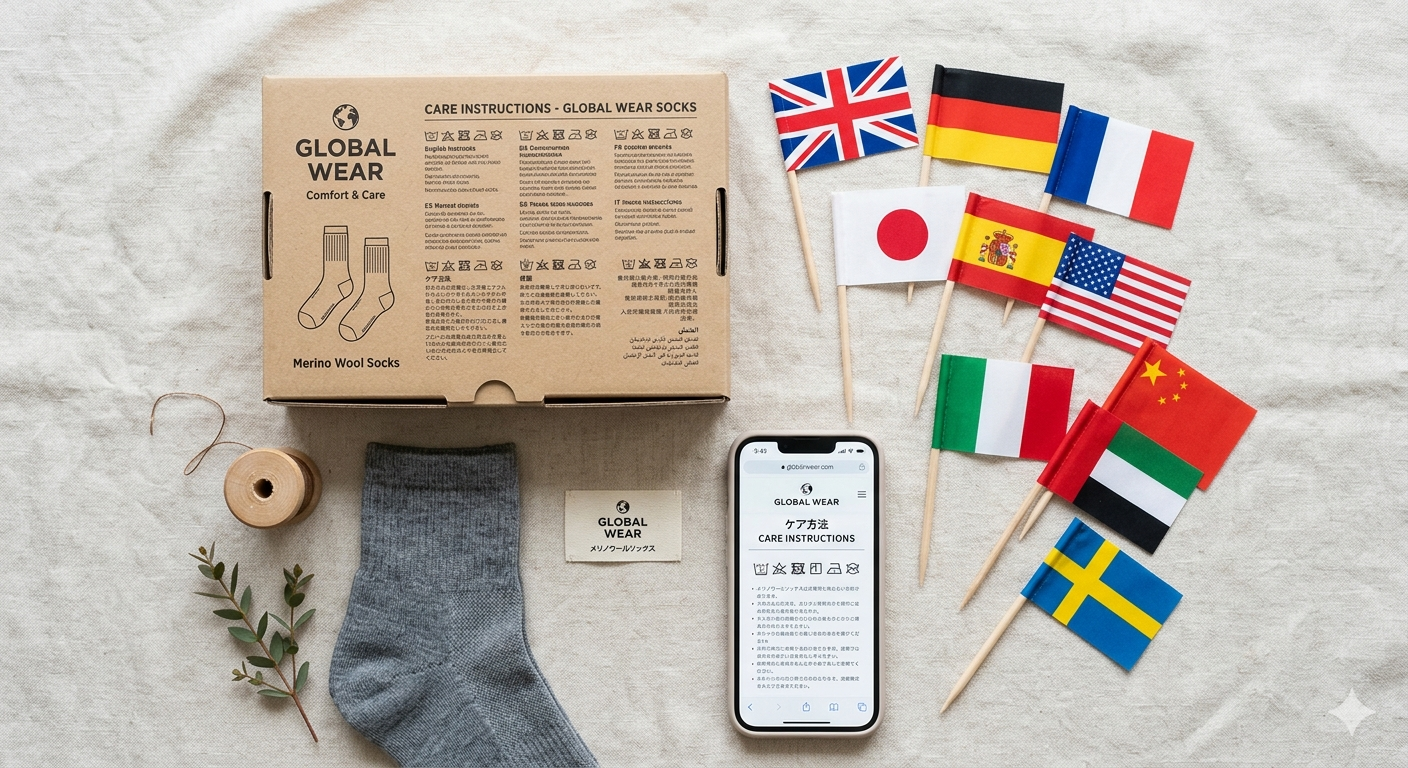
Multi-Language Product Experiences: One QR, Every Market
Key Takeaways
- A single serialised QR code can serve localised product content in any language by detecting browser language preference at scan time — no regional packaging runs required
- The EU General Product Safety Regulation (GPSR), in full effect from December 2024, mandates safety information in the official language of each member state where a product is made available
- Digital multilingual delivery cuts time-to-market for new language variants from 6–12 weeks to 1–3 days
- The same QR architecture that handles multilingual content also satisfies EU Digital Product Passport (ESPR) requirements for dynamically updated, accessible product information
Somewhere in a warehouse in Rotterdam, a pallet of power tools is sitting on hold. Not because of a customs delay. Not because of a shipping error. Because the French-language inserts didn't arrive from the printer in time, and EU regulations require local-language safety instructions to be in the box before the goods can move.
The launch is two weeks late. The sales window — a key trade fair — has closed.
This is not a hypothetical. It is a routine consequence of the way manufacturers have handled multilingual product content for decades: print everything in advance, bundle it physically with the product, and pray that no translation gets updated after the press run.
There is a better approach. And it starts with reconsidering what a QR code is actually for.
The Real Cost of the Multi-Language Print Problem
Ask any product manager who sells across Europe, Asia-Pacific, and the Americas, and you'll hear a familiar list of frustrations.
The 15-market multiplication problem. A single product sold in 15 countries requires, at minimum, 15 language variants of every piece of printed collateral: quick-start guides, safety notices, warranty cards, recycling instructions, regulatory disclosures. In practice, many markets require specific formatting, symbols, and legal language that vary by jurisdiction, so 15 languages becomes 15 distinct print jobs, with all the associated proofing, minimum order quantities, and lead times.
The booklet nobody reads. The traditional solution is the accordion-fold multilingual manual — 32 languages, 400 pages, printed in 6-point type to keep the package slim. Research consistently shows that customers abandon printed manuals almost immediately. A product experience that defaults to a document nobody reads is not a product experience; it is a compliance exercise that fails on both counts.
Translation delays hold up hardware. In regulated categories — medical devices, power tools, electrical appliances, children's toys — a product cannot legally ship until all required language versions are approved and physically packed. A single translation bottleneck in one of 15 markets can hold an entire production run. Manufacturers routinely ship split batches, air-freight emergency inserts, or simply miss launch windows because of this dependency.
Reprinting kills margins. Regulatory language changes. Warranty terms evolve. Safety notices get updated. Every time any piece of content changes in any market, the affected print run is obsolete. In practice, many brands simply leave outdated information in the field rather than absorb the reprint cost.
How Brands Currently Work Around This
The workarounds exist because the problem is real and the industry has been improvising for years.
Multi-language PDFs. Some brands print a single URL or QR code on packaging that links to a landing page with language options. The customer is asked to identify their language, download a PDF, and read it on their phone. The abandonment rate at each of those steps is enormous. A customer troubleshooting a faulty dishwasher installation at 9pm does not want to download a PDF. They want an answer.
Separate regional SKUs. Large manufacturers often maintain entirely separate product codes for different regions — EU, NA, APAC — each with region-specific packaging, inserts, and print runs. This solves the language problem by treating each market as a separate product, which multiplies inventory complexity, inflates SKU count, and makes global promotions nearly impossible to coordinate.
Regional packaging runs. A step down from full SKU separation: the same product, but with different outer packaging per market. This preserves the core production run while splitting the packaging — still expensive, still operationally heavy, and still dependent on getting the right box to the right distribution centre.
None of these solutions are good. They are the least-bad options available when content is locked inside physical packaging.
One QR Code, Every Language
The shift that makes this problem disappear is conceptually simple: move the language decision from the factory floor to the customer's device.
When a customer scans a GS1 Digital Link QR code, the request arrives at a server with a known browser language preference — the same signal that tells websites to load in French, German, Japanese, or Brazilian Portuguese. A smart product experience platform reads that signal and serves the appropriate language content automatically. No language picker. No PDF. No friction.
The customer in Lyon gets French. The customer in Munich gets German. The customer in São Paulo gets Portuguese. All from the same physical QR code, printed once, on one packaging run.
This is not a workaround. It is the correct architecture for multilingual product content.
What This Looks Like in Practice
A mid-sized appliance brand selling a range of air purifiers across 22 markets runs a single packaging design. The QR code on the box resolves to a product experience that detects the scanning device's language preference and immediately displays the relevant quick-start guide, filter replacement schedule, and warranty registration form — all in the local language, with the correct legal disclosures for that jurisdiction.
When the EU mandates updated energy labelling language six months after launch, the brand's content team updates the relevant section in the platform. The change is live across all 22 markets within the hour. Zero reprints. Zero warehouse recalls. Zero hold codes on inventory.
Compare that to the traditional model, where the same update would require reprinting inserts for every affected market, coordinating with 22 distribution warehouses to swap out existing stock, and managing a lag period where field inventory carries non-compliant content.
The Numbers: Print vs. Digital Multilingual Content
| Dimension | Traditional Print | One-QR Digital |
|---|---|---|
| Cost per additional language | Full print run + translation + logistics | Translation only (no print, no logistics) |
| Languages supported | Limited by packaging space and print economics | Unlimited — add a language in hours |
| Update speed | Weeks to months (reprint cycle) | Minutes to hours |
| Compliance coverage | Fixed at time of print | Dynamic — update instantly as regulations change |
| Customer experience | Static text, no interactivity | Guided steps, video, diagnostics, live support |
| Inventory complexity | One SKU per market (or per region) | Single global SKU |
| New market entry cost | New packaging run required | Add language, update content, ship existing stock |
The Compliance Angle Is Not Optional
For manufacturers selling into the EU and UK, local-language requirements are not a preference — they are a legal obligation.
The General Product Safety Regulation (GPSR), which came into full effect across the EU in December 2024, requires that safety information be provided in the official language or languages of the member state where the product is made available (Regulation (EU) 2023/988 — GPSR). The UK has equivalent requirements under the UK GPSR post-Brexit framework.
The conventional response is market-specific packaging. The problem is that this approach creates a fragile compliance posture: content is fixed at the time of printing, regulations evolve, and there is no mechanism to push updates to products already in the field or in distribution.
Digital product experiences solve this structurally. Because the content is served dynamically, compliance teams can update safety language, regulatory disclosures, and jurisdictional notices at any time — and those updates are immediately available to every customer who scans the code, regardless of when they purchased the product.
This also matters for the EU Digital Product Passport (ESPR), which requires manufacturers of covered product categories to maintain accessible, up-to-date product information throughout the product lifecycle. GS1's Digital Link standard (ISO/IEC 18975) defines the interoperable QR architecture that underpins DPP access — a single code that resolves to structured, dynamically served content regardless of market or language (GS1 Digital Link Standard). A QR code that serves static content at launch and never changes is not a compliant implementation of a Digital Product Passport. One that serves dynamically updated, localised content is.
For brands building toward ESPR compliance and smart packaging, the multilingual QR approach is not a nice-to-have feature — it is a foundational requirement.
Competitors and the Market Landscape
Several platforms in the connected product space — including Layerise, Brij, and Registria — offer QR-based product experiences with some level of multilingual support. The implementations vary: some require separate experience variants per language, some offer automatic detection, and some rely on the customer to self-select. The key differentiator to evaluate is not whether a platform supports multiple languages, but whether language is handled automatically and whether compliance-critical content (safety notices, warranty terms, regulatory disclosures) can be updated independently of the underlying product experience.
Platforms built on serialised QR codes — where each individual unit carries a unique identifier — offer an additional layer of capability: the ability to tailor content not just by language but by serial number, production batch, market of sale, or retailer channel. That level of granularity is not possible with a generic, non-serialised QR code.
Adding a New Language in Hours, Not Weeks
The operational reality of the one-QR approach is worth spelling out for product and marketing teams who are used to the traditional pipeline.
Under the traditional model, adding a new market language involves: commissioning a translation, proofing layout across all print formats, placing a print order, waiting for production and delivery, coordinating with warehouse teams to integrate the new inserts, and managing the transition from existing stock. Timeline: 6 to 12 weeks, minimum.
Under the digital model, adding a new market language involves: commissioning a translation, loading the translated content into the experience platform, and publishing. Timeline: 1 to 3 days, including review.
For brands expanding into new markets, this difference is the difference between a months-long market entry process and a weeks-long one. For brands managing recall situations or safety updates, it is the difference between reaching every customer immediately and watching outdated content circulate in the field for another quarter.
The post-purchase setup experience is where this matters most — customers who scan at unboxing expect immediate, relevant help. A setup guide that's static, buried, or in the wrong language is a failed first impression that no amount of product quality can fully recover.
Frequently Asked Questions
Does automatic language detection work reliably?
Browser language preferences are set by the user during device setup and are highly reliable as a routing signal — significantly more reliable than asking customers to self-identify their language. In cases where a device language preference is absent or ambiguous, platforms can fall back to IP-based geolocation to select a default, with a manual override available. The customer experience in the fallback case is still a single tap to switch language — not a download, not a form.
What happens if a customer's language isn't supported yet?
A well-architected platform handles unsupported languages gracefully: fall back to the platform default (typically English), display a visible notification that additional languages are in progress, and log the language gap for the content team. This is infinitely better than the print model, where an unsupported language simply means no content — a blank in the package or, worse, a content gap that creates a compliance risk.
Does this require a new QR code on existing packaging?
No. If your current packaging already carries a QR code, the destination URL can be updated to point to a multilingual digital experience without changing the physical code. For brands transitioning from static QR codes to a serialised, GS1 Digital Link-compliant implementation, new codes will be required — but that transition also unlocks serialisation, analytics, and per-unit tracking that are not available with generic QR codes. The liability and compliance risks of static PDFs and non-updatable product content make that transition worth planning sooner rather than later.
What to Do Next
The multi-language print problem is not going away. Regulatory requirements are increasing, not decreasing. Market expansion ambitions are not shrinking. And customers' tolerance for finding an accordion-fold booklet in a language they don't read is exactly zero.
The architecture that solves this — a single serialised QR code that detects browser language, serves localised content dynamically, and updates instantly without reprinting — is available today. The question for product, packaging, and compliance teams is not whether to move in this direction, but how fast.
BrandedMark's Experience Designer handles multilingual product experiences natively: one experience, unlimited language variants, automatic detection at scan time, and instant updates across every market. No packaging changes required beyond adding the code.
If your next product launch is going into three or more markets, the time to solve this is before the packaging artwork is locked — not after the Rotterdam pallet is already on hold.