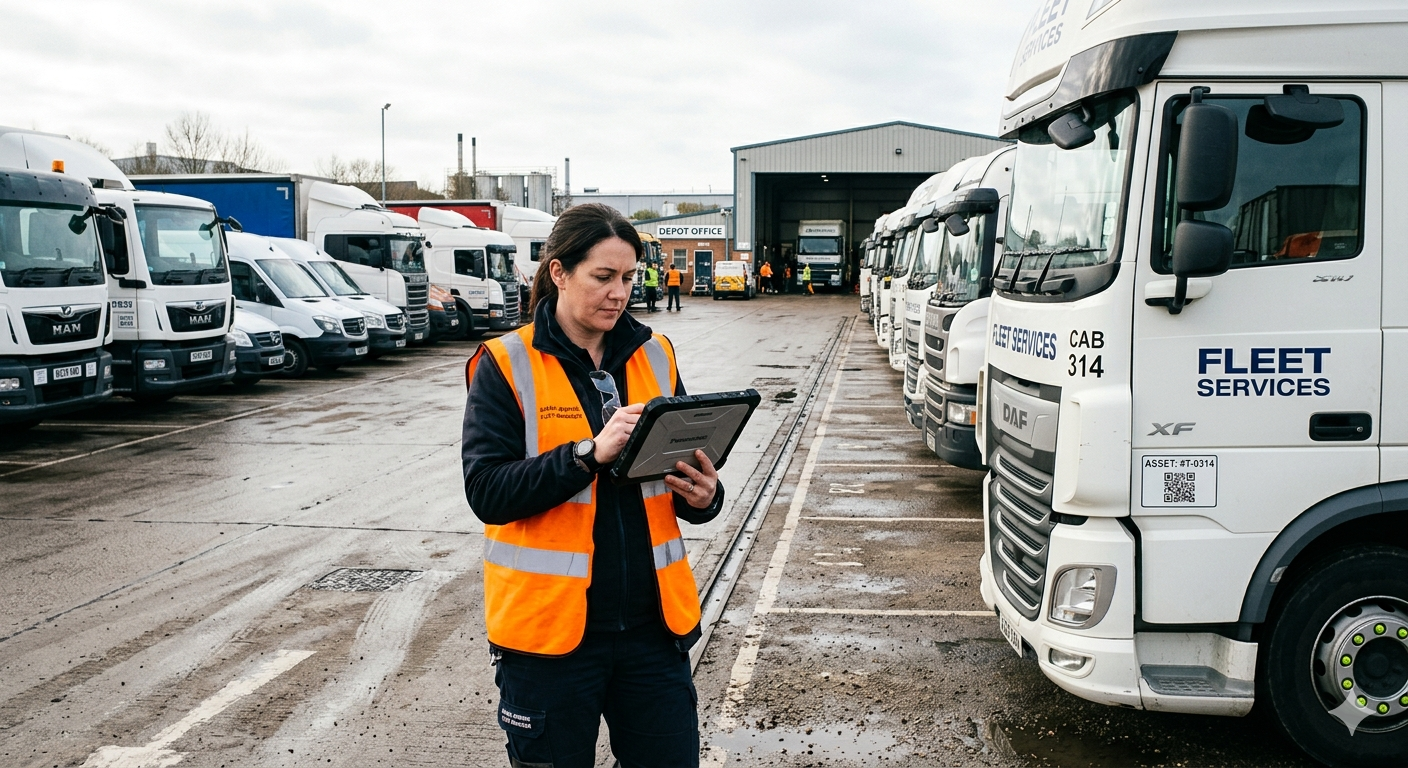
Fleet Asset Management with QR Codes
Ask the operations manager of any company running a fleet of shared physical assets where unit BT-047 is right now, and watch what happens. They will open a spreadsheet. The spreadsheet was last updated on Thursday. Unit BT-047 is listed as being at the Manchester site. The Manchester site says it was sent to Birmingham two weeks ago. Birmingham has not logged it yet.
This is not a technology failure. It is what happens when the tracking system has no connection to the physical object. Paper logs, spreadsheets, and even barcoded asset registers all share the same fundamental flaw: they require a human to remember to update them. And in environments where workers are focused on getting the job done, the log is always the last priority.
The result is that the physical truth (where the asset actually is, who used it last, when it was serviced) drifts permanently away from the recorded truth. Until an HSE inspector asks for it, or a unit fails and nobody can establish its service history.
The Fleet Management Problem in Practice
The assets that create the most operational complexity are not the ones that stay put. A fixed machine on a factory floor has a clear location, a dedicated maintenance technician, and usually a service log attached to it. The problem assets are the ones that move.
Power tools shared between a crew of twelve across three sites. Safety equipment (harnesses, helmets, respiratory protection) that rotates through daily issue and return. Rental plant and construction equipment that changes hands between hires. Medical devices shared between wards. Each of these creates the same fundamental challenge: unit identity, location, service state, and responsible owner are all in constant motion.
The traditional responses (barcoded asset tags with handheld scanners, RFID readers at gates, GPS trackers on high-value items) solve parts of the puzzle but introduce their own friction. Barcode readers require dedicated hardware. RFID infrastructure is expensive to install and maintain. GPS trackers work outdoors and at the fleet level but do not capture who used the asset or what happened during a use cycle.
QR-based asset management takes a different approach: make the scan itself the event. Every check-in, check-out, service record, and inspection becomes a timestamped, geolocated scan by the person physically holding the asset. No separate hardware. No system to remember to update. The act of scanning is the log entry.
Check-In and Check-Out at the Unit Level
The core workflow is straightforward. Each physical asset carries a unique QR code linked to its serial record. When a worker takes the asset for use, they scan the code. When they return it, they scan again. Each scan captures the user identity (via their own registered account or site login), the timestamp, the location if GPS is available, and optionally a brief condition note.
The result is a continuous chain of custody. At any point, you can query which worker has unit BT-047, when they took it, and where it last scanned. If the asset has not been scanned back in after a defined period, the system can flag it automatically, prompting a check-in or triggering an alert to the site supervisor.
For manufacturers in this space (ergonomic devices, powered tools, safety equipment), a digital asset layer can become a differentiator in enterprise procurement. Buyers with HSE obligations and insurance requirements have a reason to favour equipment that supports an auditable digital record, and some may write that preference into tender specifications. Where they do, products that arrive with a built-in digital identity can answer the requirement directly, while a paper asset register leaves the buyer to build the tracking layer themselves.
Service History Per Serial Number
The scan log is the foundation, but the high-value layer is what you build on top of it: a per-unit service history that travels with the asset rather than living in a spreadsheet someone has to maintain.
Every inspection, every maintenance action, every part replacement is logged against the specific serial number. When a technician completes a six-month service on a harness, they scan the unit and log the service outcome. The record is timestamped, attributed to the technician, and permanently attached to that unit's history.
This creates several things that paper-based systems cannot provide:
Automatic maintenance scheduling. The system knows when the last service was performed and can calculate the next service date based on elapsed time, scan count, or usage intensity. Alerts go to the responsible team member before the unit falls overdue, not after an HSE audit reveals the gap.
Condition-based retirement. If a unit accumulates a defined number of logged defects or fails an inspection, it can be flagged as withdrawn from service directly in the system. Anyone who subsequently scans that unit sees a clear status indicator: this asset is out of service, do not use.
Traceability for incident investigation. If a worker reports a near-miss or injury involving a specific piece of equipment, the full history of that unit is immediately available: who used it, when, what services it received, and whether any defects were previously reported. That record matters in both the HSE investigation and any subsequent insurance or legal process.
HSE Compliance and the Audit Trail
For operators in regulated industries, the compliance case for QR-based fleet management is often more compelling than the operational efficiency case. Different classes of equipment fall under different statutory regimes, each with its own inspection requirements, intervals, and record-keeping duties. General work equipment and power tools sit under PUWER, the Provision and Use of Work Equipment Regulations. Lifting equipment, including hoists and the harnesses used in lifting operations, is covered separately by LOLER, the Lifting Operations and Lifting Equipment Regulations, which sets out thorough examination requirements. Pressure systems are governed by their own scheme, PSSR, the Pressure Systems Safety Regulations. What these regimes share is a requirement to inspect or examine equipment at defined intervals and to keep records.
The word "maintained" is doing significant work in that sentence. Records that exist only in a spreadsheet on a laptop that someone left at a different site are, in practice, not maintained. An audit trail that exists in a cloud-based system, timestamped and attributed, is maintained, and is exportable to PDF or CSV on request.
When an HSE inspector arrives, the response to "show me your lifting equipment inspection records" should not involve a phone call to someone to find out where the file is. A well-implemented digital fleet system produces a complete, filtered inspection history for any unit or date range in seconds.
Digital identity systems should be built on GS1 SGTIN (serialised GTIN) standards, meaning every unit's QR code is globally unique and persistent. The scan history is immutable: entries cannot be edited or deleted, only appended to. This is the audit trail characteristic that HSE and insurance auditors are looking for, and it is a core component of the product serialisation guide.
Ownership Transfer and Reassignment
Fleet assets do not stay with the same operator forever. Rental equipment moves between hires. Safety gear is reissued when a site closes and the crew redeploys.
Each transfer creates a risk: the incoming operator may not know the asset's history, service state, or any reported defects. Paper-based handover processes rely on someone briefing someone else verbally, or on a handover document that may or may not travel with the asset.
A QR-based system makes transfer an explicit, recorded event. The outgoing operator scans the unit, initiates a transfer, and the incoming operator scans to accept. Both sides get a timestamped record of the handover. The incoming operator sees the full service history for the unit. Any outstanding defects or service overdue items are surfaced at the point of transfer, not discovered during use.
The Data Insight Layer
When you have scan data across an entire fleet over time, patterns emerge that are invisible to any paper-based system.
Which units fail most frequently? If a specific model variant is generating disproportionate defect reports, that is a product quality signal the manufacturer needs. In a traditional system, that signal never reaches the product team. In a digital system, it surfaces as an anomaly in the unit-level data. This kind of insight is what connected product ROI is really built on.
Which units are approaching end of useful life simultaneously? Replacement scheduling is one of the most budget-sensitive questions in fleet management. If a large proportion of your harness fleet comes up for mandatory retirement in the same quarter, the budget impact is significant and needs advance planning. A system that tracks each unit's age and service history can produce this forecast automatically, turning a surprise into a planned line item.
Frequently Asked Questions
Do workers need to download an app to scan check-in QR codes?
No. BrandedMark uses standard web-based QR codes: scanning opens a page in the phone's browser, with no app installation required. For higher-security workflows where worker identity needs to be verified, a one-time login or site PIN can be required after the scan, but the basic check-in workflow works with any smartphone camera.
What happens if a unit's QR code is damaged or worn off?
QR code durability is a genuine operational consideration. Industrial-grade QR labels rated for outdoor exposure, chemical contact, and abrasion are available from specialist label manufacturers. If a label is damaged, replacement labels can be reprinted and reattached: the system associates the new label with the existing serial record and maintains the full history.
How does this work for assets that move between sites with no reliable mobile signal?
Scans require a data connection to log against the server record, though the scan itself completes instantly and the record syncs when connectivity is restored. For environments with persistent connectivity gaps, a local Wi-Fi network at the site boundary (a gate reader or check-in point with local connectivity) is the most practical near-term solution.
BrandedMark gives every physical asset a unique digital identity with check-in/check-out, service history, and HSE-ready audit trails. See how it works.